• Home
  • About
  • FAQ
  • Feeds
  • Glossary
  • Contact
Tours In Space
  • Home
  • Start Here
    • Intro to Commercial Spaceflight
    • How to Book a Space Tour
    • Is Space Tourism Safe?
    • Space Travel FAQs
    • View Earth from the Edge
    • What to Pack
  • Preparing for Your Trip
    • Insurance and Legal Waivers
    • Physical and Medical Requirements
    • Training Programs
    • What to Expect
  • Space Tourism Companies
    • Axiom Space
    • Blue Origin
    • SpaceX
    • Virgin Galactic
    • World View (stratospheric balloon flights)
    • Blue Origin vs Virgin Galactic
    • Comparison Chart: Features, Pricing, Booking
  • Space Tours
    • Custom & Luxury Packages
    • Duration, Training, Costs
    • Experiences
    • Future Moon/Mars Options
    • Orbital Flights
    • Parabolic Flight Experiences
    • Private Missions
    • Stratospheric Balloon Flights
    • Suborbital Flights
    • Zero-Gravity Flights
  • Spaceflight Technologies
    • Space Tourism Balloon
No Result
View All Result
  • Home
  • Start Here
    • Intro to Commercial Spaceflight
    • How to Book a Space Tour
    • Is Space Tourism Safe?
    • Space Travel FAQs
    • View Earth from the Edge
    • What to Pack
  • Preparing for Your Trip
    • Insurance and Legal Waivers
    • Physical and Medical Requirements
    • Training Programs
    • What to Expect
  • Space Tourism Companies
    • Axiom Space
    • Blue Origin
    • SpaceX
    • Virgin Galactic
    • World View (stratospheric balloon flights)
    • Blue Origin vs Virgin Galactic
    • Comparison Chart: Features, Pricing, Booking
  • Space Tours
    • Custom & Luxury Packages
    • Duration, Training, Costs
    • Experiences
    • Future Moon/Mars Options
    • Orbital Flights
    • Parabolic Flight Experiences
    • Private Missions
    • Stratospheric Balloon Flights
    • Suborbital Flights
    • Zero-Gravity Flights
  • Spaceflight Technologies
    • Space Tourism Balloon
No Result
View All Result
Tours In Space
No Result
View All Result
Home Space News

Interstellar comet 3I/ATLAS’s tail is still growing, new image shows

Ensign by Ensign
November 13, 2025
in Space News
0
Interstellar comet 3I/ATLAS’s tail is still growing, new image shows
189
SHARES
1.5k
VIEWS
Share on FacebookShare on Twitter
image

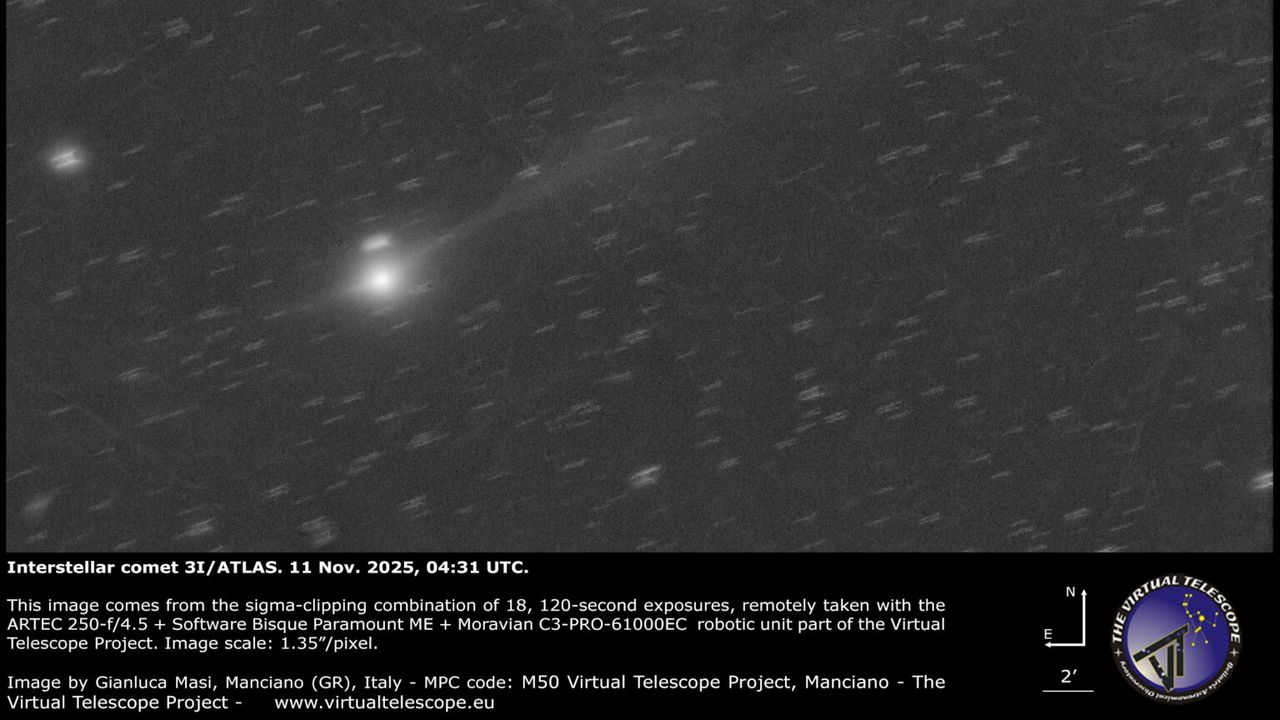
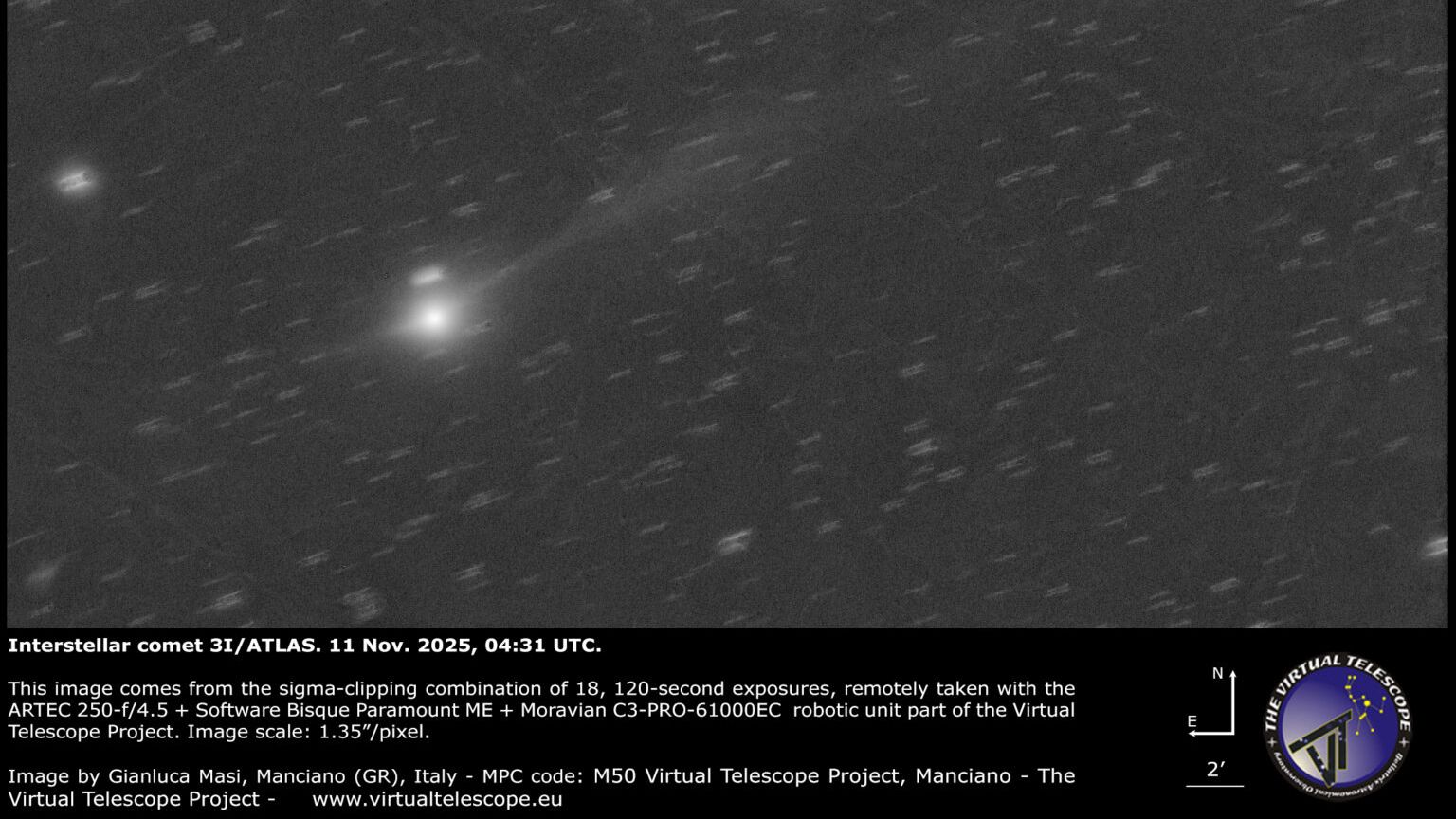
A stunning new image of interstellar comet 3I/ATLAS (C/2025 N1 ATLAS) reveals the cosmic visitor’s ion tail has grown dramatically longer and more structured — a sign of intensifying activity as it continues its journey through the inner solar system.

The image, captured by the Virtual Telescope Project at 11:31 p.m. EDT on Nov. 10 (0431 GMT on Nov. 11), is composed of 18 separate 120-second exposures, remotely taken by robotic telescopes located in Manciano, Italy. Despite the comet being just 14 degrees above the eastern horizon and a bright 61% moon shining about 70 degrees away, a sharply defined, luminous ion tail is seen.

“Exploiting the unusual good weather of this season, we imaged the interstellar comet 3I/ATLAS (C/2025 N1 ATLAS) again, recording a much more developed ion tail,” Gianluca Masi, Virtual Telescope Project founder and astronomer, said in a post sharing the new image. “Looking at the picture, we see how the ion tail of 3I/ATLAS is clearly showing better and better.”


You may like

An ion tail forms when the sun’s ultraviolet radiation strips electrons from gas molecules released by the comet, turning them into charged ions. These ions are then swept away by the solar wind — a constant stream of charged particles flowing outward from the sun — creating a long, often bluish tail that always points directly away from the sun regardless of the comet’s direction of travel. This tail differs from the dust tail, which tends to appear yellowish-white and curves gently along the comet’s orbital path.

In the new image, the comet’s bright core is surrounded by a compact coma and a sharply defined ion tail stretching roughly 0.7 degrees across the sky. A faint anti-tail — a feature caused by the observer’s perspective as dust trails along the comet’s orbit — can also be seen extending in the opposite direction. The image shows a clear increase in activity compared to earlier observations, suggesting that 3I/ATLAS is venting gas and dust more vigorously as it reacts to solar heating.

3I/ATLAS is only the third confirmed interstellar object ever detected, following 1I/’Oumuamua in 2017 and 2I/Borisov in 2019. Unlike its predecessors, this visitor from another star system is bright enough to be studied in detail by ground-based telescopes, offering astronomers a rare opportunity to observe how an interstellar comet behaves under the influence of our sun.

The growing length and brightness of the tail suggest increasing sublimation of volatile materials — likely including carbon dioxide and dust — that are then swept into space by the solar wind. Early data suggest that 3I/ATLAS may contain a high fraction of carbon dioxide ice, offering potential clues to the conditions in the distant planetary system where it formed, as well as valuable insight on how comets evolve beyond our solar neighborhood.

Breaking space news, the latest updates on rocket launches, skywatching events and more!

The Virtual Telescope Project will continue to monitor 3I/ATLAS as it travels through the inner solar system. You can check out past images of the comet taken since it was first detected in July of this year.

Tags: rocket launch
No Result
View All Result

Recent Posts

  • Germany outlines military space priorities in new strategy
  • Saturn’s rings will seem to disappear on Nov. 23: Here’s how to catch the illusion
  • Does the universe have extra dimensions hiding in plain sight?
  • Canon 8×20 IS binocular review
  • European Parliament member sees support for EU Space Act there

Categories

  • Excursions
  • Kepler Mission
  • NASA
  • NASA Breaking News
  • Physical Preparation
  • Preparation
  • Space News
  • Space Station News
  • Spacewalks
  • Tours
  • Uncategorized
  • Weightlessness Training
  • What Not to Pack
  • What to Pack

Meta

  • Log in
  • Entries feed
  • Comments feed
  • WordPress.org
  • Home
  • Start Here
  • Preparing for Your Trip
  • Space Tourism Companies
  • Space Tours
  • Contact

© 2025 JNews - Premium WordPress news & magazine theme by Jegtheme.

No Result
View All Result
  • About
  • Contact
  • Feeds
  • Frequently Asked Questions
  • Preparing for Your Trip
    • Insurance and Legal Waivers
    • Physical and Medical Requirements
    • Training Programs
    • What to Expect
  • Privacy Policy
  • Space Tourism Companies
    • Axiom Space
    • Blue Origin
    • Blue Origin vs Virgin Galactic
    • Comparison Chart: Features, Pricing, Booking
    • SpaceX
    • Virgin Galactic
    • World View (stratospheric balloon flights)
  • Space Tours
    • Custom & Luxury Packages
    • Duration, Training, Costs
    • Experiences
    • Future Moon/Mars Options
    • Orbital Flights
    • Parabolic Flight Experiences
    • Private Missions
    • Stratospheric Balloon Flights
    • Suborbital Flights
    • Zero-Gravity Flights
  • Spaceflight Technologies
    • Space Tourism Balloon
  • Start Here
    • How to Book a Space Tour
    • Intro to Commercial Spaceflight
    • Is Space Tourism Safe?
    • Space Travel FAQs
    • View Earth from the Edge
    • What to Pack
  • Tours in Space is your launchpad to the world of space tourism

© 2025 JNews - Premium WordPress news & magazine theme by Jegtheme.