• Home
  • About
  • FAQ
  • Feeds
  • Glossary
  • Contact
Tours In Space
  • Home
  • Start Here
    • Intro to Commercial Spaceflight
    • How to Book a Space Tour
    • Is Space Tourism Safe?
    • Space Travel FAQs
    • View Earth from the Edge
    • What to Pack
  • Preparing for Your Trip
    • Insurance and Legal Waivers
    • Physical and Medical Requirements
    • Training Programs
    • What to Expect
  • Space Tourism Companies
    • Axiom Space
    • Blue Origin
    • SpaceX
    • Virgin Galactic
    • World View (stratospheric balloon flights)
    • Blue Origin vs Virgin Galactic
    • Comparison Chart: Features, Pricing, Booking
  • Space Tours
    • Custom & Luxury Packages
    • Duration, Training, Costs
    • Experiences
    • Future Moon/Mars Options
    • Orbital Flights
    • Parabolic Flight Experiences
    • Private Missions
    • Stratospheric Balloon Flights
    • Suborbital Flights
    • Zero-Gravity Flights
  • Spaceflight Technologies
    • Space Tourism Balloon
No Result
View All Result
  • Home
  • Start Here
    • Intro to Commercial Spaceflight
    • How to Book a Space Tour
    • Is Space Tourism Safe?
    • Space Travel FAQs
    • View Earth from the Edge
    • What to Pack
  • Preparing for Your Trip
    • Insurance and Legal Waivers
    • Physical and Medical Requirements
    • Training Programs
    • What to Expect
  • Space Tourism Companies
    • Axiom Space
    • Blue Origin
    • SpaceX
    • Virgin Galactic
    • World View (stratospheric balloon flights)
    • Blue Origin vs Virgin Galactic
    • Comparison Chart: Features, Pricing, Booking
  • Space Tours
    • Custom & Luxury Packages
    • Duration, Training, Costs
    • Experiences
    • Future Moon/Mars Options
    • Orbital Flights
    • Parabolic Flight Experiences
    • Private Missions
    • Stratospheric Balloon Flights
    • Suborbital Flights
    • Zero-Gravity Flights
  • Spaceflight Technologies
    • Space Tourism Balloon
No Result
View All Result
Tours In Space
No Result
View All Result
Home Space News

The Euclid space telescope observed 1.2 million galaxies in just 1 year. Here’s what we’ve learned

Ensign by Ensign
November 19, 2025
in Space News
0
The Euclid space telescope observed 1.2 million galaxies in just 1 year. Here’s what we’ve learned
190
SHARES
1.5k
VIEWS
Share on FacebookShare on Twitter

After only one year of operations, the European Space Agency’s Euclid mission has begun to unravel the mystery of why galaxies take on different shapes and how these different shapes relate to each other. Answering this question involves tracking how galaxies and their central supermassive black holes grow together over time.

Having only launched in July of 2023, the Euclid space telescope has used its extraordinary field of view to observe a staggering 1.2 million galaxies. These galactic subjects are cataloged in the spacecraft’s first data release, which dropped in March of 2025. It is estimated that, by the end of its 6-year primary mission, Euclid will have studied tens of millions of galaxies. It is therefore little wonder that astronomers are expecting it to make major waves in our understanding of how galaxies evolve.

“Euclid offers an unprecedented combination of sharpness and sky coverage — it will map the entire extragalactic sky,” Maximilian Fabricius, scientist at the Max Planck Institute for Extraterrestrial Physics (MPE), said in a statement. “For the first time, we can systematically study how the shapes and central structures of galaxies relate to their formation history on truly cosmic scales.”


You may like

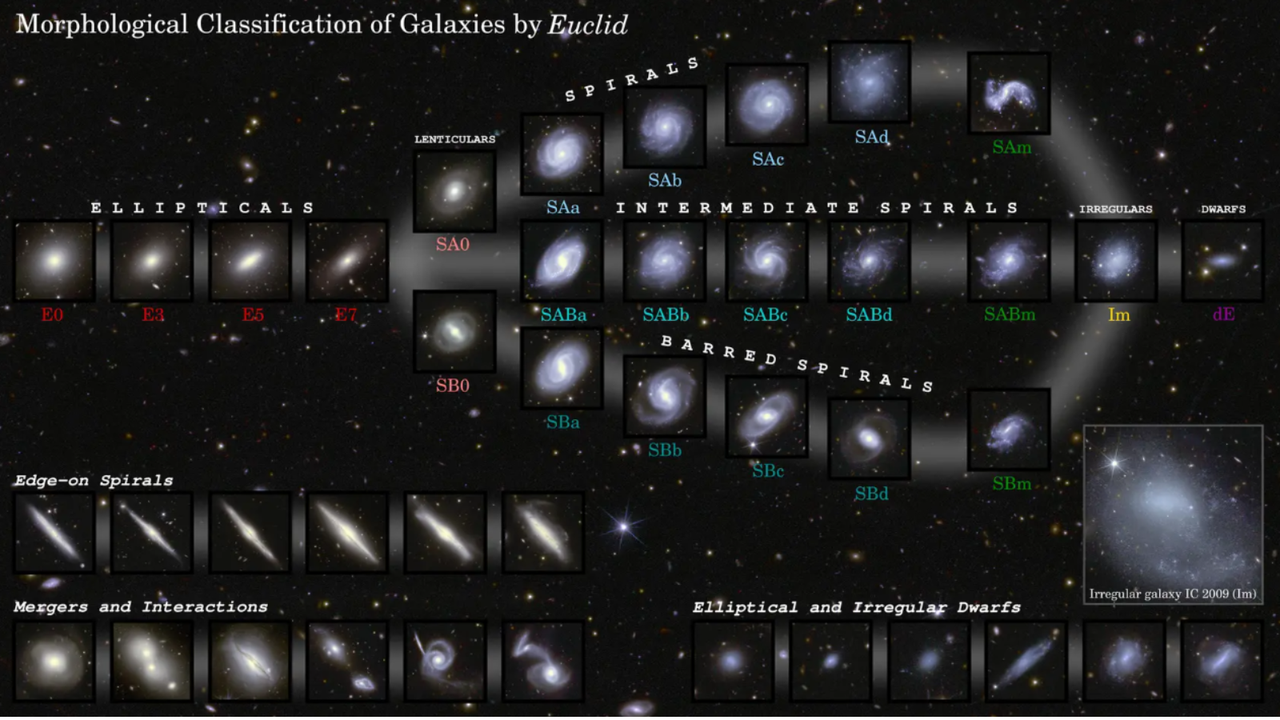
Scientists are aware that the distinct morphology of galaxies, ranging from vast spirals like the Milky Way to featureless ellipticals like Messier 87, results from the course of their evolution. Euclid data has been used to create a “galactic tuning fork” diagram that shows blue star-forming galaxies on the right, moving to the left as they grow and exhaust their star-birthing gas and dust, merge with other galaxies, and eventually form vast elliptical galaxies.

Galaxies grow with their black holes

Fabricius and colleagues began their research by diving into Euclid data and identified galaxies that show potential “secondary nuclei.” These have the potential to join with the existing nuclei to create a supermassive black hole binary. This is a vital stage in the merging of galaxies and helps dictate how the central regions of these galaxies are reshaped during these events.

The identified nuclei both host a supermassive black hole with a mass millions or even billions of times the mass of the sun, which are brought together via the merger between their host galaxies. These black holes initially form a binary system, swirling around each other. But as they orbit each other, this system emits ripples in spacetime called “gravitational waves,” which carry angular momentum away from the system.

This causes the black holes to spiral together until they collide and merge, creating an even more massive supermassive black hole. That means black hole growth via merger is an inevitable outcome of the merger of galaxies that gives rise to huge elliptical galaxies. But before that comes a relatively short “double nuclei” period.

Breaking space news, the latest updates on rocket launches, skywatching events and more!

“The most massive black holes lie at the centres of giant elliptical galaxies and are thought to grow primarily through mergers with other supermassive black holes,” Fabricius said. “By detecting and analysing secondary nuclei, Euclid enables us to explore how these enormous black holes continue to grow — and how their growth influences the galaxies that host them.”
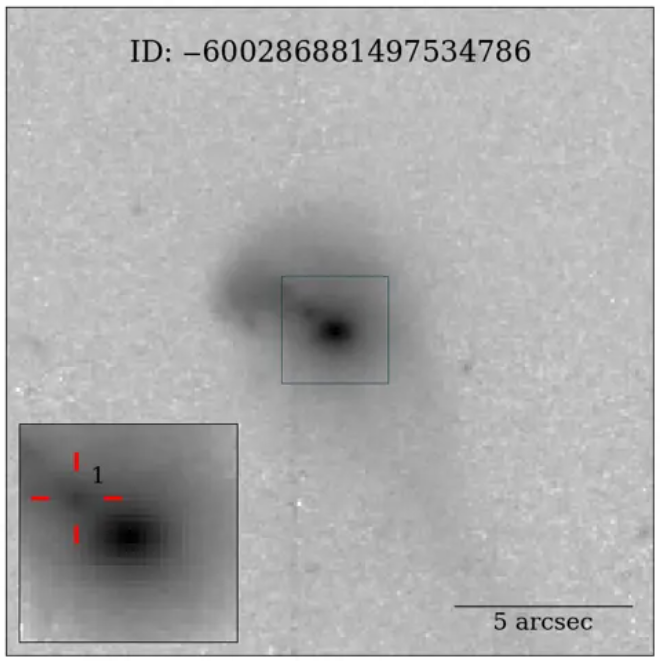
An example of galaxy with a second nuclei as the result of a merger

An example of galaxy with a second nuclei as the result of a merger (Image credit: ESA/Euclid/Euclid Consortium/MPE)

The first data release from Euclid only covers around 0.5% of the dataset that the mission will ultimately deliver — but the space telescope has already enabled other forms of research.

The sensitivity of Euclid has already revealed that the most common galaxies in the cosmos are not spiral galaxies like the Milky Way, but rather small and faint dwarf galaxies, which have been too dim to observe in detail previously.

Thus far, Euclid has identified 2,674 dwarf galaxies, some of which contain compact blue cores or globular clusters. This is significant to the evolution of galaxies because it is these dwarf galaxies that are thought to be the building blocks of larger galaxies like the Milky Way.

Thanks to Euclid, our view of the galactic tuning fork is changing and becoming far more detailed, leading to a better understanding of galactic structure and evolution.

Tags: rocket launch
No Result
View All Result

Recent Posts

  • Germany outlines military space priorities in new strategy
  • Saturn’s rings will seem to disappear on Nov. 23: Here’s how to catch the illusion
  • Does the universe have extra dimensions hiding in plain sight?
  • Canon 8×20 IS binocular review
  • European Parliament member sees support for EU Space Act there

Categories

  • Excursions
  • Kepler Mission
  • NASA
  • NASA Breaking News
  • Physical Preparation
  • Preparation
  • Space News
  • Space Station News
  • Spacewalks
  • Tours
  • Uncategorized
  • Weightlessness Training
  • What Not to Pack
  • What to Pack

Meta

  • Log in
  • Entries feed
  • Comments feed
  • WordPress.org
  • Home
  • Start Here
  • Preparing for Your Trip
  • Space Tourism Companies
  • Space Tours
  • Contact

© 2025 JNews - Premium WordPress news & magazine theme by Jegtheme.

No Result
View All Result
  • About
  • Contact
  • Feeds
  • Frequently Asked Questions
  • Preparing for Your Trip
    • Insurance and Legal Waivers
    • Physical and Medical Requirements
    • Training Programs
    • What to Expect
  • Privacy Policy
  • Space Tourism Companies
    • Axiom Space
    • Blue Origin
    • Blue Origin vs Virgin Galactic
    • Comparison Chart: Features, Pricing, Booking
    • SpaceX
    • Virgin Galactic
    • World View (stratospheric balloon flights)
  • Space Tours
    • Custom & Luxury Packages
    • Duration, Training, Costs
    • Experiences
    • Future Moon/Mars Options
    • Orbital Flights
    • Parabolic Flight Experiences
    • Private Missions
    • Stratospheric Balloon Flights
    • Suborbital Flights
    • Zero-Gravity Flights
  • Spaceflight Technologies
    • Space Tourism Balloon
  • Start Here
    • How to Book a Space Tour
    • Intro to Commercial Spaceflight
    • Is Space Tourism Safe?
    • Space Travel FAQs
    • View Earth from the Edge
    • What to Pack
  • Tours in Space is your launchpad to the world of space tourism

© 2025 JNews - Premium WordPress news & magazine theme by Jegtheme.