• Home
  • About
  • FAQ
  • Feeds
  • Glossary
  • Contact
Tours In Space
  • Home
  • Start Here
    • Intro to Commercial Spaceflight
    • How to Book a Space Tour
    • Is Space Tourism Safe?
    • Space Travel FAQs
    • View Earth from the Edge
    • What to Pack
  • Preparing for Your Trip
    • Insurance and Legal Waivers
    • Physical and Medical Requirements
    • Training Programs
    • What to Expect
  • Space Tourism Companies
    • Axiom Space
    • Blue Origin
    • SpaceX
    • Virgin Galactic
    • World View (stratospheric balloon flights)
    • Blue Origin vs Virgin Galactic
    • Comparison Chart: Features, Pricing, Booking
  • Space Tours
    • Custom & Luxury Packages
    • Duration, Training, Costs
    • Experiences
    • Future Moon/Mars Options
    • Orbital Flights
    • Parabolic Flight Experiences
    • Private Missions
    • Stratospheric Balloon Flights
    • Suborbital Flights
    • Zero-Gravity Flights
  • Spaceflight Technologies
    • Space Tourism Balloon
No Result
View All Result
  • Home
  • Start Here
    • Intro to Commercial Spaceflight
    • How to Book a Space Tour
    • Is Space Tourism Safe?
    • Space Travel FAQs
    • View Earth from the Edge
    • What to Pack
  • Preparing for Your Trip
    • Insurance and Legal Waivers
    • Physical and Medical Requirements
    • Training Programs
    • What to Expect
  • Space Tourism Companies
    • Axiom Space
    • Blue Origin
    • SpaceX
    • Virgin Galactic
    • World View (stratospheric balloon flights)
    • Blue Origin vs Virgin Galactic
    • Comparison Chart: Features, Pricing, Booking
  • Space Tours
    • Custom & Luxury Packages
    • Duration, Training, Costs
    • Experiences
    • Future Moon/Mars Options
    • Orbital Flights
    • Parabolic Flight Experiences
    • Private Missions
    • Stratospheric Balloon Flights
    • Suborbital Flights
    • Zero-Gravity Flights
  • Spaceflight Technologies
    • Space Tourism Balloon
No Result
View All Result
Tours In Space
No Result
View All Result
Home Space News

James Webb Space Telescope spots rapidly feeding supermassive black hole in the infant universe: ‘This discovery is truly remarkable.’

Ensign by Ensign
November 21, 2025
in Space News
0
James Webb Space Telescope spots rapidly feeding supermassive black hole in the infant universe: ‘This discovery is truly remarkable.’
189
SHARES
1.5k
VIEWS
Share on FacebookShare on Twitter
image

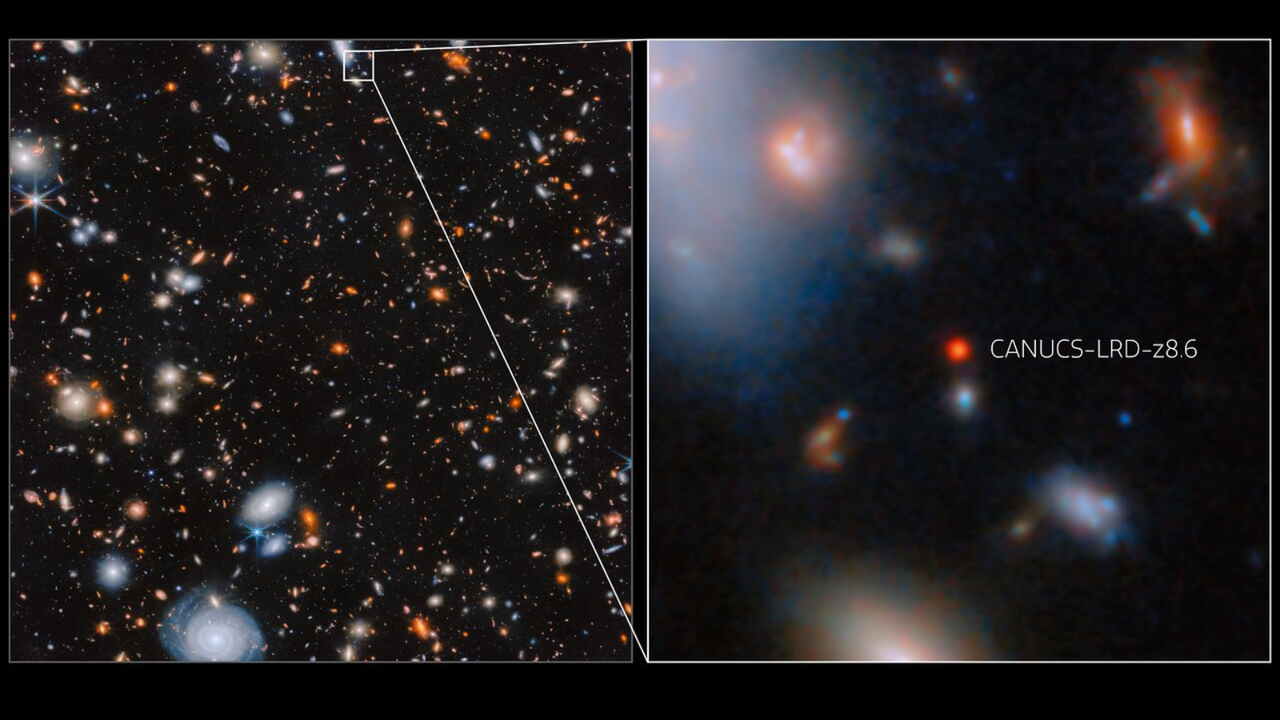
Using the James Webb Space Telescope (JWST), astronomers have uncovered a voraciously feeding and rapidly growing supermassive black hole in the infant universe. Existing just 570 million years after the Big Bang, this black hole sits at the heart of the galaxy CANUCS-LRD-z8.6.

CANUCS-LRD-z8.6 is an example of the class of galaxies in the early universe called “Little Red Dots.” These small, bright, and extremely distant objects have been routinely discovered by the JWST since it began observations in 2022. Little Red Dots have mystified astronomers because they don’t seem to conform to our understanding of how galaxies evolve in step with their central supermassive black holes, leading some scientists to dub them “universe-breaking” galaxies. That’s because Little Red Dots are either way too dense to account for the masses of their stars or host a supermassive black hole that is way too massive to sit in such a small galaxy.

The discovery of such a rapidly feeding and thus growing supermassive black hole in CANUCS-LRD-z8.6, thanks to the detection of faint light and spectral features made by JWST’s Near-Infrared Spectrograph (NIRSpec), could finally point scientists toward answers regarding these curious Little Red Dots.


Best picks for you

“This discovery is truly remarkable. We’ve observed a galaxy from less than 600 million years after the Big Bang, and not only is it hosting a supermassive black hole, but the black hole is growing rapidly – far faster than we would expect in such a galaxy at this early time,” team leader Roberta Tripodi of the University of Ljubljana FMF, in Slovenia, said in a statement. “This challenges our understanding of black hole and galaxy formation in the early universe and opens up new avenues of research into how these objects came to be.”

Searching for black hole fingerprints in Little Red Dots

As the CANUCS collaboration, Tripodi and colleagues analyzed the spectrum of light from CANUCS-LRD-z8.6, which has been traveling to Earth for around 13.2 billion years. This analysis revealed the presence of highly ionized gas rapidly swirling around a compact central region of this early galaxy  — the telltale fingerprint of a feeding, or accreting, black hole.

Deeper analysis revealed a supermassive black hole in the heart of CANUCS-LRD-z8.6 with an estimated mass of around 100 million times that of the sun. Though supermassive black holes can reach much larger masses equivalent to billions of suns in the large galaxies of the modern cosmos, the mass of the black hole in CANUCS-LRD-z8.6 is staggeringly massive for a compact galaxy at such an early stage in its evolution that has yet to be enriched with heavy elements by the explosive supernova deaths of massive stars.

By measuring the energy emitted from CANUCS-LRD-z8.6, the team was also able to estimate some of this galaxy’s characteristics, including the mass of its population of stars. This allowed them to compare the total mass of the stars in CANUCS-LRD-z8.6 with the mass of its central supermassive black hole. That’s an important ratio to measure, as astronomers have always considered the growth of central supermassive black holes to be linked to the growth of galaxies via their increasing stellar population. However, even though CANUCS-LRD-z8.6 is the most massive host galaxy seen during this early cosmic period, its central black hole is still much more massive than scientists would predict using the usual ratio of stellar mass to black hole mass. The team thinks that this suggests that black holes in the early universe may have grown much faster than the galaxies that host them.

Breaking space news, the latest updates on rocket launches, skywatching events and more!

“This discovery is an exciting step in understanding the formation of the first supermassive black holes in the universe,” team member Maruša Bradač, of the University of Ljubljana, FMF, said. “The unexpected rapid growth of the black hole in this galaxy raises questions about the processes that allowed such massive objects to emerge so early.”

The CANUCS team plans to continue to observe CANUCS-LRD-z8.6 with the JWST, as well as make further observations with the Atacama Large Millimetre/submillimetre Array (ALMA), an array of 66 radio antennas in the Atacama desert of Northern Chile, ALMA studies the universe in radio wavelengths. This should allow the team to study the cold gas in this galaxy in addition to better defining the characteristics of its supermassive black hole.

That means astronomers could be on the verge of understanding the JWST’s Little Red Dots.

“As we continue to analyse the data, we hope to find more galaxies like CANUCS-LRD-z8.6, which could provide us with even greater insights into the origins of black holes and galaxies,” Bradač added.

The team’s research was published on Wednesday (Nov. 19) in the journal Nature Communications.

No Result
View All Result

Recent Posts

  • Germany outlines military space priorities in new strategy
  • Saturn’s rings will seem to disappear on Nov. 23: Here’s how to catch the illusion
  • Does the universe have extra dimensions hiding in plain sight?
  • Canon 8×20 IS binocular review
  • European Parliament member sees support for EU Space Act there

Categories

  • Excursions
  • Kepler Mission
  • NASA
  • NASA Breaking News
  • Physical Preparation
  • Preparation
  • Space News
  • Space Station News
  • Spacewalks
  • Tours
  • Uncategorized
  • Weightlessness Training
  • What Not to Pack
  • What to Pack

Meta

  • Log in
  • Entries feed
  • Comments feed
  • WordPress.org
  • Home
  • Start Here
  • Preparing for Your Trip
  • Space Tourism Companies
  • Space Tours
  • Contact

© 2025 JNews - Premium WordPress news & magazine theme by Jegtheme.

No Result
View All Result
  • About
  • Contact
  • Feeds
  • Frequently Asked Questions
  • Preparing for Your Trip
    • Insurance and Legal Waivers
    • Physical and Medical Requirements
    • Training Programs
    • What to Expect
  • Privacy Policy
  • Space Tourism Companies
    • Axiom Space
    • Blue Origin
    • Blue Origin vs Virgin Galactic
    • Comparison Chart: Features, Pricing, Booking
    • SpaceX
    • Virgin Galactic
    • World View (stratospheric balloon flights)
  • Space Tours
    • Custom & Luxury Packages
    • Duration, Training, Costs
    • Experiences
    • Future Moon/Mars Options
    • Orbital Flights
    • Parabolic Flight Experiences
    • Private Missions
    • Stratospheric Balloon Flights
    • Suborbital Flights
    • Zero-Gravity Flights
  • Spaceflight Technologies
    • Space Tourism Balloon
  • Start Here
    • How to Book a Space Tour
    • Intro to Commercial Spaceflight
    • Is Space Tourism Safe?
    • Space Travel FAQs
    • View Earth from the Edge
    • What to Pack
  • Tours in Space is your launchpad to the world of space tourism

© 2025 JNews - Premium WordPress news & magazine theme by Jegtheme.