• Home
  • About
  • FAQ
  • Feeds
  • Glossary
  • Contact
Tours In Space
  • Home
  • Start Here
    • Intro to Commercial Spaceflight
    • How to Book a Space Tour
    • Is Space Tourism Safe?
    • Space Travel FAQs
    • View Earth from the Edge
    • What to Pack
  • Preparing for Your Trip
    • Insurance and Legal Waivers
    • Physical and Medical Requirements
    • Training Programs
    • What to Expect
  • Space Tourism Companies
    • Axiom Space
    • Blue Origin
    • SpaceX
    • Virgin Galactic
    • World View (stratospheric balloon flights)
    • Blue Origin vs Virgin Galactic
    • Comparison Chart: Features, Pricing, Booking
  • Space Tours
    • Custom & Luxury Packages
    • Duration, Training, Costs
    • Experiences
    • Future Moon/Mars Options
    • Orbital Flights
    • Parabolic Flight Experiences
    • Private Missions
    • Stratospheric Balloon Flights
    • Suborbital Flights
    • Zero-Gravity Flights
  • Spaceflight Technologies
    • Space Tourism Balloon
No Result
View All Result
  • Home
  • Start Here
    • Intro to Commercial Spaceflight
    • How to Book a Space Tour
    • Is Space Tourism Safe?
    • Space Travel FAQs
    • View Earth from the Edge
    • What to Pack
  • Preparing for Your Trip
    • Insurance and Legal Waivers
    • Physical and Medical Requirements
    • Training Programs
    • What to Expect
  • Space Tourism Companies
    • Axiom Space
    • Blue Origin
    • SpaceX
    • Virgin Galactic
    • World View (stratospheric balloon flights)
    • Blue Origin vs Virgin Galactic
    • Comparison Chart: Features, Pricing, Booking
  • Space Tours
    • Custom & Luxury Packages
    • Duration, Training, Costs
    • Experiences
    • Future Moon/Mars Options
    • Orbital Flights
    • Parabolic Flight Experiences
    • Private Missions
    • Stratospheric Balloon Flights
    • Suborbital Flights
    • Zero-Gravity Flights
  • Spaceflight Technologies
    • Space Tourism Balloon
No Result
View All Result
Tours In Space
No Result
View All Result
Home Space News

Astronomers finally explain the strange physics of ghostly ‘radio relics’ in space

Ensign by Ensign
November 22, 2025
in Space News
0
Astronomers finally explain the strange physics of ghostly ‘radio relics’ in space
189
SHARES
1.5k
VIEWS
Share on FacebookShare on Twitter
image

At the universe’s grandest scales, galaxy clusters collide in slow-motion cataclysms, leaving behind immense, ghostly arcs — vast ribbons of diffuse radio emissions that can stretch across millions of light-years. Forged by gigantic shock waves that accelerate electrons to near-light speed, these strange structures are known as “radio relics.”

Astronomers have cataloged dozens of them, yet their behavior has remained remarkably difficult to explain.

Observations from NASA’s Chandra X-ray Observatory, Europe’s XMM-Newton, and other telescopes have for instance revealed magnetic fields threading the relics that are far stronger than our models predicted. The shock waves of these relics also appear to have strengths that differ depending on whether they’re measured in radio or X-ray light. And, perhaps most bafflingly, X-ray measurements sometimes imply the shocks are too weak to accelerate electrons at all, seemingly contradicting the very existence of radio relics.


Best picks for you

Now, a new study led by researchers at the Leibniz Institute for Astrophysics Potsdam (AIP) in Germany may have finally resolved those mysteries.

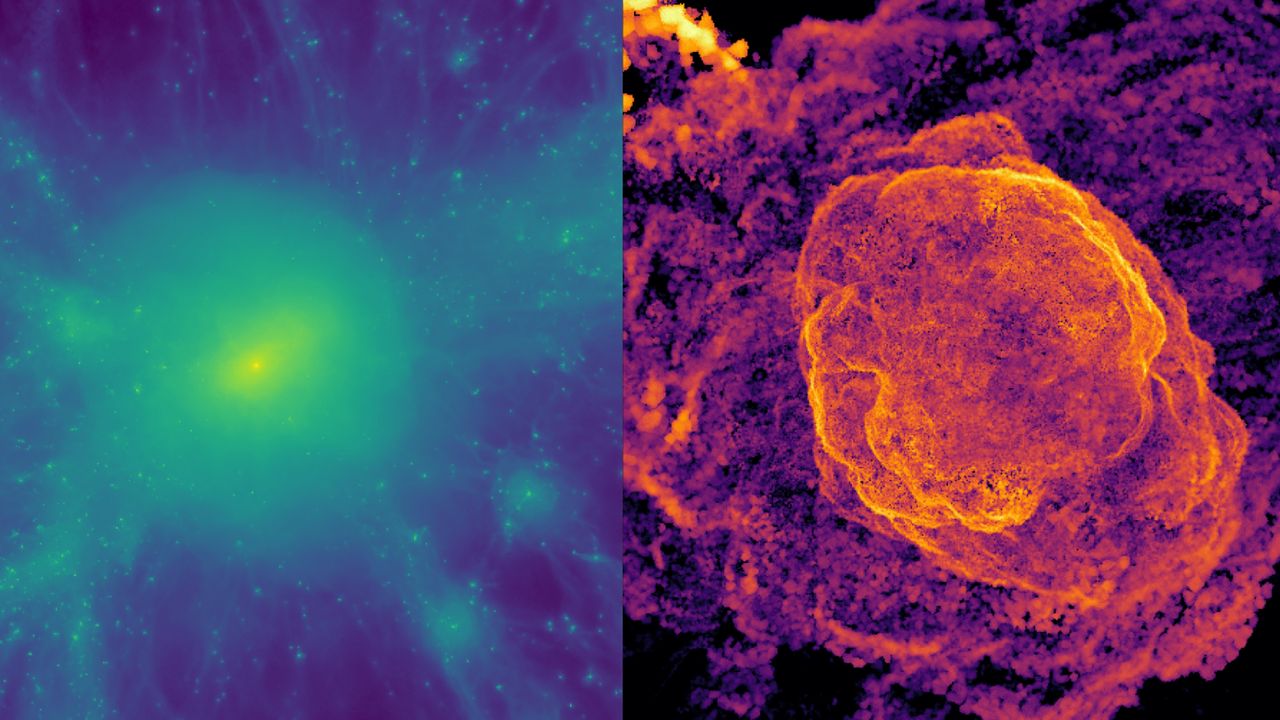
Using high-resolution simulations, the team traced the formation and evolution of radio relics and successfully reproduced the puzzling behaviors seen in real observations. Their findings offer the clearest picture yet of how these enigmatic structures form and why they look the way they do.

“Key to our success was tackling the issue using a range of scales,” study lead author Joseph Whittingham, a postdoctoral researcher at AIP, said in a statement.

To understand how radio relics form and evolve, Whittingham and his colleagues write in their paper that they used a large suite of cosmological simulations that model how galaxy clusters grow and collide over billions of years. From this suite, the team examined a particularly energetic, relic-forming merger between two galaxy clusters where one was roughly 2.5 times heavier than the other. As the two massive, simulated clusters merged, they launched enormous, arc-shaped shock waves spanning nearly 7 million light-years.

Breaking space news, the latest updates on rocket launches, skywatching events and more!

Then, using those results as a guide, the team constructed much higher-resolution “shock-tube” simulations that allowed researchers to isolate and track the fine-scale physics of a single shock wave interacting with the clumpy, turbulent outskirts of the galaxy clusters. From there, they modeled from first principles of how electrons are accelerated at the shock front and how the resulting radio emission would appear to telescopes.

This multi-scale approach, the team wrote in the new study, allowed them to resolve “physics that is, as yet, out of reach of current-generation cosmological simulations.”

The simulations revealed that, as a shock wave moves outward through a galaxy cluster, it eventually collides with other shocks created by cold gas falling in from the cosmic web. This interaction compresses the plasma into a dense sheet, which then slams into smaller gas clumps, resulting in a cosmic maelstrom that amplifies magnetic field strengths far beyond what a single shock could achieve — matching the unexpectedly strong values seen in observations.


Don’t miss these

“The whole mechanism generates turbulence, twisting and compressing the magnetic field up to the observed strengths, thereby solving the first puzzle,” study co-author Christoph Pfrommer of AIP said in the same statement.

The new work also clarifies that when a shock sweeps across dense gas clumps, certain regions of the shock front become sharply enhanced and accelerate electrons more efficiently, the study notes. These bright, compact patches dominate the radio signal, but X-ray telescopes measure the shock’s average strength, including its weaker regions, and that explains the discrepancies astronomers have long noted, the researchers say.

Finally, the simulations show only the strongest, localized parts of the shock front actually produce most of the radio emission, so the low average strengths inferred from X-rays are no threat to the underlying physics after all.

Taken together, the team’s multi-scale simulations reproduce the combination of magnetic, radio, and X-ray features astronomers see in real relics, resolving several longstanding puzzles, the researchers say.

“This success motivates us to build on our study to answer the remaining unresolved mysteries surrounding radio relics,” Whittingham said in the statement.

The team’s results are described in a paper accepted to the journal Astronomy & Astrophysics and posted to the pre-print paper repository arXiv on Nov. 18.

Tags: rocket launch
No Result
View All Result

Recent Posts

  • Germany outlines military space priorities in new strategy
  • Saturn’s rings will seem to disappear on Nov. 23: Here’s how to catch the illusion
  • Does the universe have extra dimensions hiding in plain sight?
  • Canon 8×20 IS binocular review
  • European Parliament member sees support for EU Space Act there

Categories

  • Excursions
  • Kepler Mission
  • NASA
  • NASA Breaking News
  • Physical Preparation
  • Preparation
  • Space News
  • Space Station News
  • Spacewalks
  • Tours
  • Uncategorized
  • Weightlessness Training
  • What Not to Pack
  • What to Pack

Meta

  • Log in
  • Entries feed
  • Comments feed
  • WordPress.org
  • Home
  • Start Here
  • Preparing for Your Trip
  • Space Tourism Companies
  • Space Tours
  • Contact

© 2025 JNews - Premium WordPress news & magazine theme by Jegtheme.

No Result
View All Result
  • About
  • Contact
  • Feeds
  • Frequently Asked Questions
  • Preparing for Your Trip
    • Insurance and Legal Waivers
    • Physical and Medical Requirements
    • Training Programs
    • What to Expect
  • Privacy Policy
  • Space Tourism Companies
    • Axiom Space
    • Blue Origin
    • Blue Origin vs Virgin Galactic
    • Comparison Chart: Features, Pricing, Booking
    • SpaceX
    • Virgin Galactic
    • World View (stratospheric balloon flights)
  • Space Tours
    • Custom & Luxury Packages
    • Duration, Training, Costs
    • Experiences
    • Future Moon/Mars Options
    • Orbital Flights
    • Parabolic Flight Experiences
    • Private Missions
    • Stratospheric Balloon Flights
    • Suborbital Flights
    • Zero-Gravity Flights
  • Spaceflight Technologies
    • Space Tourism Balloon
  • Start Here
    • How to Book a Space Tour
    • Intro to Commercial Spaceflight
    • Is Space Tourism Safe?
    • Space Travel FAQs
    • View Earth from the Edge
    • What to Pack
  • Tours in Space is your launchpad to the world of space tourism

© 2025 JNews - Premium WordPress news & magazine theme by Jegtheme.