

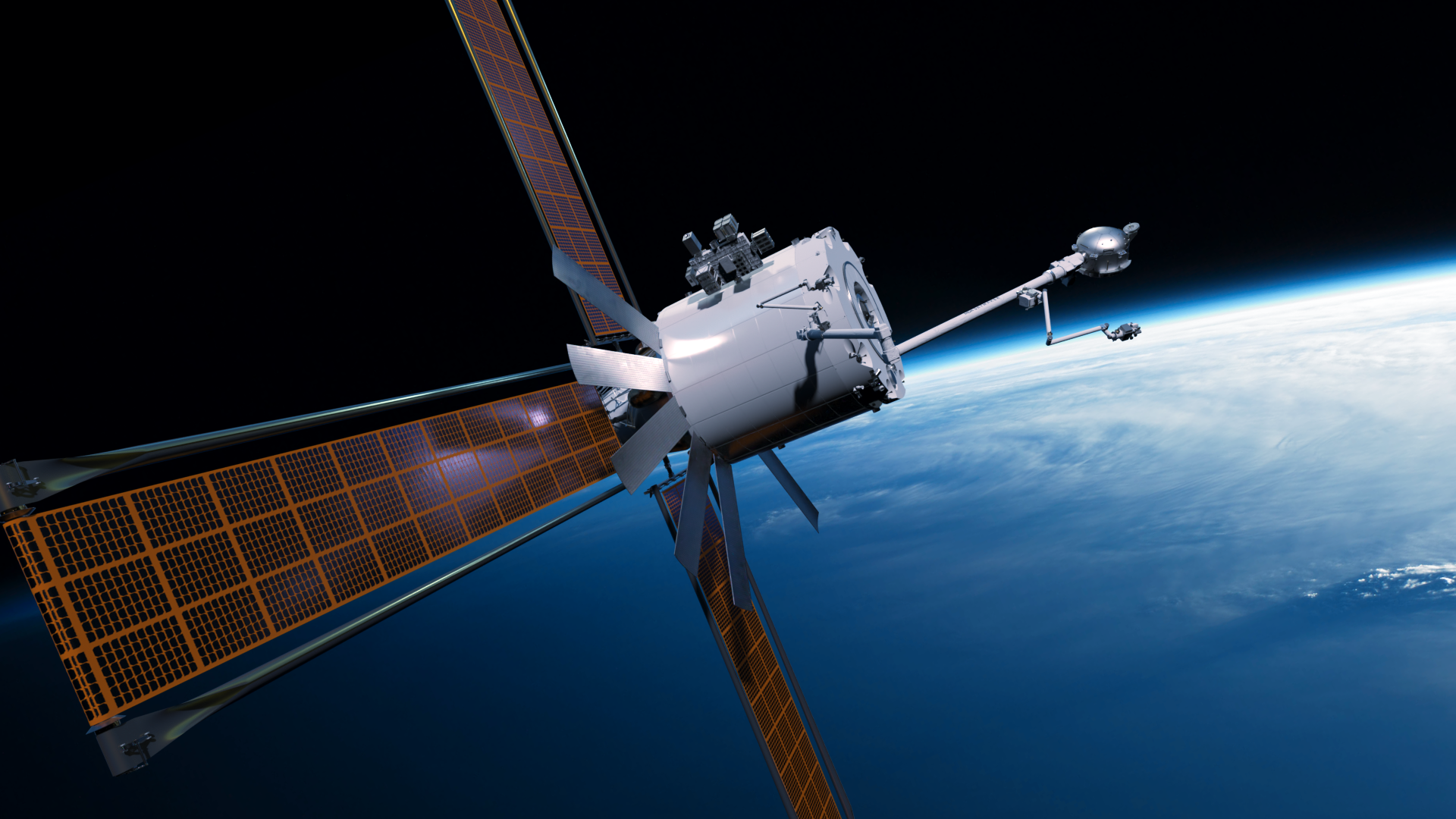
WASHINGTON — The Starlab commercial space station has fully booked its commercial payload space as the joint venture developing it awaits the next phase of a NASA program.
In a March 10 earnings call, Dylan Taylor, chief executive of Voyager Technologies, whose company is leading development of the station, said Starlab was seeing strong commercial demand.
“I am excited to share with you that Starlab’s commercial payload capacity is fully reserved, providing early visibility into the future utilization and revenue potential” of the station, he said. “I think it’s a fantastic outcome given the fact that we won’t be in orbit for another 36 months.”
He did not disclose details about how much payload space was reserved or by whom. However, the announcement coincided with a release by Starlab Space stating that Yuri, a German space biotech company, had reserved an unspecified amount of payload space on Starlab for the station’s first full year of commercial operations.
“Yuri has secured dedicated capacity for the entire first year of Starlab’s operations; not a single campaign or short-duration mission, but sustained, year-round access,” Brad Henderson, chief commercial officer of Starlab Space, said in the statement. “Starlab was designed to support exactly this kind of persistent commercial activity, moving the market beyond episodic access and toward reliable, scalable infrastructure in space.”
Starlab did not disclose financial terms of the Yuri agreement or other recent announcements of companies reserving space on the station. In the earnings call, Filipe de Sousa, chief financial officer of Voyager, said the company has booked $6 million in backlog related to Starlab, “which is quarters ahead of when I would have expected it.”
Voyager is the largest partner in the Starlab Space joint venture, which includes Airbus, Mitsubishi, MDA Space and other companies. Voyager had a 61.9% stake in the joint venture as of the end of 2025, according to Voyager’s Form 10-K filing with the Securities and Exchange Commission March 10.
Work on Starlab has been supported by a NASA Space Act Agreement through the first phase of the agency’s Commercial Low Earth Orbit Destinations, or CLD, program. Voyager said NASA has disbursed $183 million to date under the agreement, which has a total value of $218 million.
Starlab and other commercial stations are awaiting the next phase of the CLD program. NASA announced a revision to the program last summer, deciding to award multiple Space Act Agreements for Phase 2 that would lead to crewed demonstrations of commercial stations. However, the agency has yet to release a final call for proposals.
Those delays led the authors of a Senate NASA authorization bill to extend the life of the International Space Station by two years, to 2032. That bill, which also includes language directing NASA to expedite the next phase of the CLD program, cleared the Senate Commerce Committee March 4.
Taylor said in the earnings call that he expected NASA to release the CLD Phase 2 request for proposals in the next 60 days.
“We still anticipate a downselect this year. To be more precise, it is difficult to say,” he said, depending on the timing of the call for proposals and how long NASA will review them.
Any funding from NASA will be augmented by private investment. Starlab Space has announced investments from several firms since last fall but has not disclosed the amount raised. Those deals are part of an ongoing Series A round for Starlab Space, de Sousa said on the call.
Starlab’s design features a large module and other components designed to be deployed on a single launch. In the company’s 10-K filing, it said it has a launch contract priced at $90 million to send Starlab to orbit. The company did not name the launch provider in the filing, but Starlab Space announced in January 2024 that it had selected SpaceX’s Starship to launch the station.