

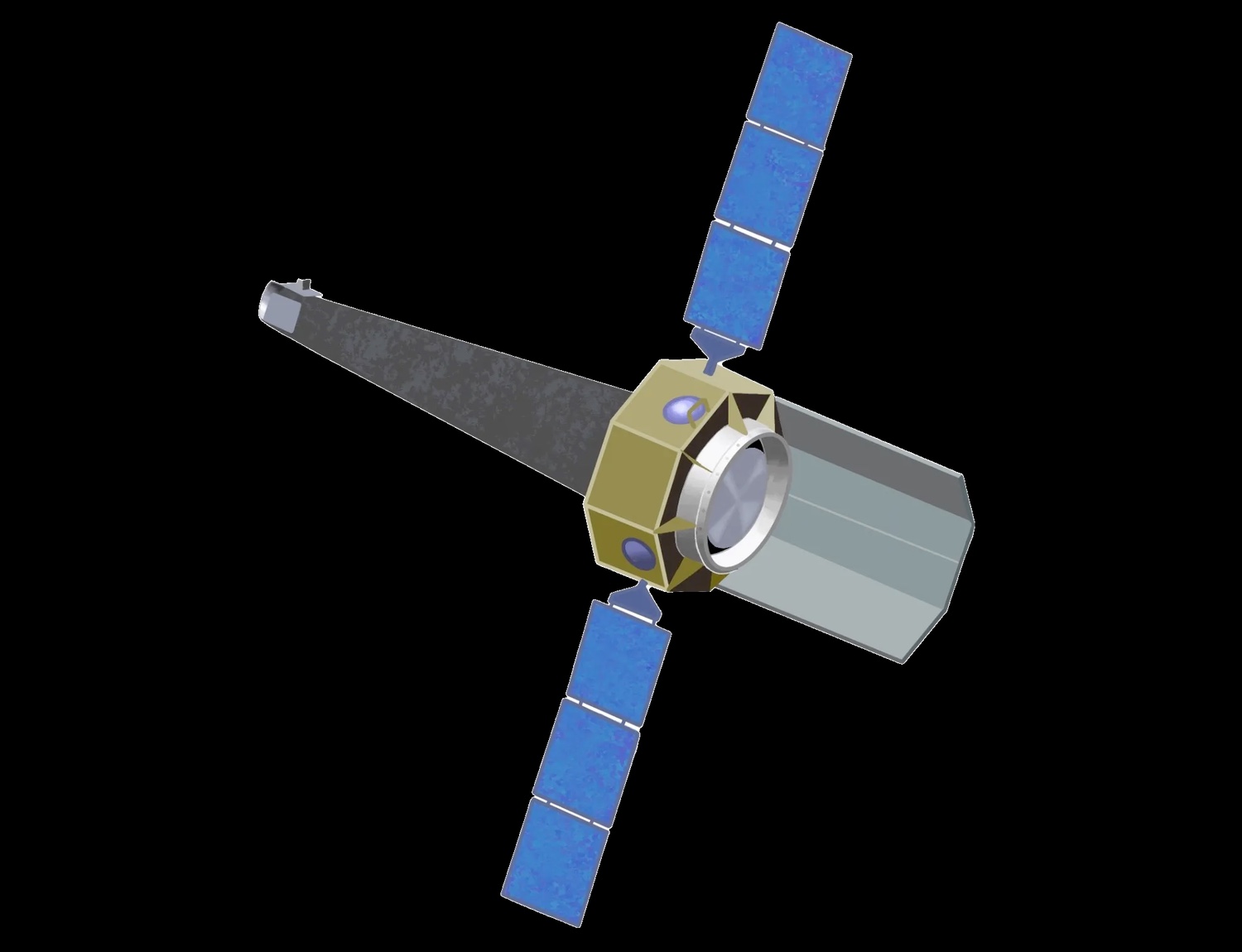
WASHINGTON — NASA has disqualified one of the two proposals for a large astrophysics mission, a decision the project’s leader blames on upheaval within the agency last year.
In a March 9 email, Christopher Reynolds, principal investigator for the proposed Advanced X-Ray Imaging Satellite, or AXIS, told members of the project team that NASA Headquarters had informed him the mission was “not eligible for selection.”
The decision came before NASA reviewed a concept study recently completed by the AXIS team and is instead based on the project’s own assessment that it missed its budget and schedule requirements, he said in the email, seen by SpaceNews.
“I am, quite frankly, livid that AXIS ultimately fell victim to the programmatic chaos of 2025. The astronomical community deserves better,” he wrote.
NASA, in a March 10 statement to SpaceNews, confirmed that it was no longer considering AXIS for its Astrophysics Probe Explorer program.
“Throughout NASA’s standard selection process for science missions, there are multiple points at which the agency evaluates mission concepts against established selection criteria and compliance requirements and makes decisions about how to proceed,” the agency said. “NASA has confirmed the AXIS (Advanced X-ray Imaging Satellite) Probe concept was not compliant with the 2023 Astrophysics Probe Explorer Announcement of Opportunity.”
In October 2024, NASA selected AXIS, an X-ray telescope with high spatial resolution, along with the Probe far-Infrared Mission for Astrophysics, or PRIMA, a far-infrared telescope, as the two finalists for the first Probe mission. This would be a new line of missions in the astrophysics division that, like other Explorer missions, would be competitively selected but have a higher cost cap of $1 billion.
AXIS and PRIMA each received $5 million contracts to perform one-year concept studies to refine their proposed missions. NASA then planned to select one of the missions for development, with a launch in 2032.
Reynolds said the work on the concept study was affected by disruptions at the Goddard Space Flight Center, which provided project management for AXIS.
“In short, with NASA-GSFC as the AXIS managing center, the mission formulation process was critically compromised by the seismic shifts occurring in NASA and the federal government,” he wrote.
One issue was NASA’s Deferred Resignation Program, a buyout program that resulted in about 20% of the agency’s civil servant workforce leaving in 2025. Reynolds said that included more than 20 key people at Goddard working on AXIS, such as its project manager and lead for the spacecraft’s X-ray mirrors, a key technology for the mission.
A second issue was Goddard’s response to the administration’s fiscal year 2026 budget proposal for NASA, which sought steep cuts to science programs, including termination of the Probe program. While that funding was largely restored in a final appropriations bill by Congress in January, he said there was reduced access to engineering and mission formulation personnel at Goddard during the summer and fall.
AXIS was also affected by the government shutdown that lasted a month and a half in October and November. While NASA extended the deadline for the concept studies by six weeks, from Dec. 18 to Jan. 29, that was “inadequate compensation,” he wrote.
Those three factors affected the AXIS team’s ability to fit the mission into NASA’s cost and schedule requirements. An initial “grassroots” cost estimate, completed only in September, put AXIS about 10% over budget. NASA’s deadlines, exacerbated by the government shutdown, kept the team from implementing cost and schedule savings it had identified.
Reynolds said that left the team with two options: submit a study that did not meet NASA’s cost and schedule requirements or not submit the study at all.
“We of course proceeded with the submission,” he wrote, planning to discuss how AXIS would meet those cost and schedule requirements during the review process. “NASA HQ has ruled this stance to be unacceptable.”
Reynolds, a professor of astronomy at the University of Maryland, said NASA’s decision not to consider AXIS was not a judgment of its technology and science. He said members of the AXIS team demonstrated advances in key technologies, such as X-ray mirrors and sensors, needed for the mission, and that the science case for the spacecraft “only became stronger during our Phase A study.”
NASA’s decision to disqualify AXIS leaves PRIMA as the only candidate for the next Probe mission. NASA has not disclosed how that might affect the selection process. Shawn Domagal-Goldman, director of NASA’s astrophysics division, said at an American Astronomical Society (AAS) conference in early January that the agency expected to make a Probe mission selection by the end of the fiscal year.
The dismissal of AXIS has concerned many in the X-ray astrophysics community, who worry about the field’s future. The Chandra X-ray Observatory, itself threatened with budget cuts and termination in recent budget proposals, is more than 25 years old. There are few options for large missions like it in the foreseeable future beyond NASA’s collaboration with the European Space Agency on its NewAthena X-ray observatory, slated for launch in the late 2030s.
Domagal-Goldman said at the AAS meeting that he expected NASA to focus technology development funding for future large astrophysics missions on the field not selected for the Probe mission, which in this case would be X-ray astronomy.
“I want the community to know that, no matter what happens with the probe, both the X-ray and the far-infrared communities have something to look forward to in the future,” he said.
“NASA will share details about future additional opportunities for the X-ray astrophysics community in the coming weeks,” the agency said in its statement to SpaceNews.
Reynolds wrote that he sees opportunities for X-ray astronomy to pursue “focused, high-impact” missions with smaller Explorer-class spacecraft, leveraging the science cases and technologies developed for AXIS.
He also expressed support for PRIMA. “There is still one excellent mission under consideration for the Probe program, PRIMA,” he wrote, “and we wish them a smooth and speedy path to selection and flight.”