• Home
  • About
  • FAQ
  • Feeds
  • Glossary
  • Contact
Tours In Space
  • Home
  • Start Here
    • Intro to Commercial Spaceflight
    • How to Book a Space Tour
    • Is Space Tourism Safe?
    • Space Travel FAQs
    • View Earth from the Edge
    • What to Pack
  • Preparing for Your Trip
    • Insurance and Legal Waivers
    • Physical and Medical Requirements
    • Training Programs
    • What to Expect
  • Space Tourism Companies
    • Axiom Space
    • Blue Origin
    • SpaceX
    • Virgin Galactic
    • World View (stratospheric balloon flights)
    • Blue Origin vs Virgin Galactic
    • Comparison Chart: Features, Pricing, Booking
  • Space Tours
    • Custom & Luxury Packages
    • Duration, Training, Costs
    • Experiences
    • Future Moon/Mars Options
    • Orbital Flights
    • Parabolic Flight Experiences
    • Private Missions
    • Stratospheric Balloon Flights
    • Suborbital Flights
    • Zero-Gravity Flights
  • Spaceflight Technologies
    • Space Tourism Balloon
No Result
View All Result
  • Home
  • Start Here
    • Intro to Commercial Spaceflight
    • How to Book a Space Tour
    • Is Space Tourism Safe?
    • Space Travel FAQs
    • View Earth from the Edge
    • What to Pack
  • Preparing for Your Trip
    • Insurance and Legal Waivers
    • Physical and Medical Requirements
    • Training Programs
    • What to Expect
  • Space Tourism Companies
    • Axiom Space
    • Blue Origin
    • SpaceX
    • Virgin Galactic
    • World View (stratospheric balloon flights)
    • Blue Origin vs Virgin Galactic
    • Comparison Chart: Features, Pricing, Booking
  • Space Tours
    • Custom & Luxury Packages
    • Duration, Training, Costs
    • Experiences
    • Future Moon/Mars Options
    • Orbital Flights
    • Parabolic Flight Experiences
    • Private Missions
    • Stratospheric Balloon Flights
    • Suborbital Flights
    • Zero-Gravity Flights
  • Spaceflight Technologies
    • Space Tourism Balloon
No Result
View All Result
Tours In Space
No Result
View All Result
Home Uncategorized

China ends month-long launch hiatus with separate Guowang and Shiyan-30 satellite missions

Ensign by Ensign
March 14, 2026
in Uncategorized
0
China ends month-long launch hiatus with separate Guowang and Shiyan-30 satellite missions
189
SHARES
1.5k
VIEWS
Share on FacebookShare on Twitter
image

HELSINKI — China resumed orbital launch activity Thursday with a pair of missions lifting off from Hainan and Xichang spaceports, launching satellite internet and technology test satellites.

The country had not conducted a launch since Feb. 12, when a Jielong-3 solid rocket sea launch carried the PRSC-EO2 remote sensing satellite and other passengers to orbit, ahead of a break for the Chinese New Year holiday. China’s annual political sessions in Beijing and a failure of a Long March 3B launch in January may also have contributed to the extended pause in launch activity.

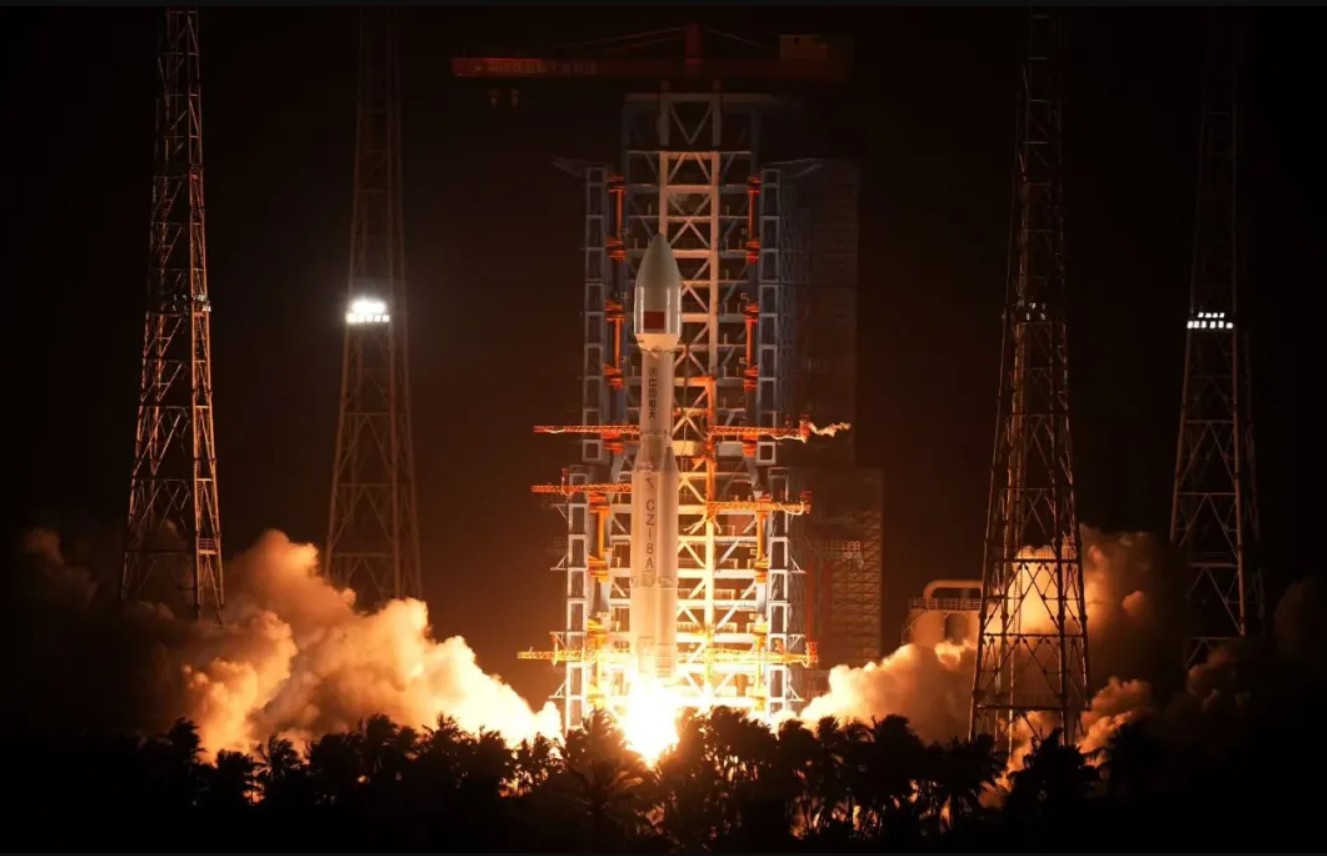
The resumption came on Thursday, with a Long March 8A lifting off from Hainan commercial launch center at 2:48 p.m. Eastern, March 12 (1948 UTC). The China Aerospace Science and Technology Corporation (CASC) announced launch success around two hours after liftoff, officially revealing the mission to be carrying the 20th group of satellites for the national Guowang low Earth orbit satellite internet megaconstellation.

Orbital data for the launch had not been published at time of reporting. Long March 8A launches typically carry nine Guowang satellites, while airspace closure notices indicate that this batch would join others in around 1,100-kilometer-altitude low Earth orbits inclined by 50 degrees. 

The satellites were manufactured by the Innovation Academy for Microsatellites of the Chinese Academy of Sciences (IAMCAS). Paperwork filed with the ITU shows Guowang is intended to be a 13,000-satellite constellation. There are now around 163 operational Guowang satellites in orbit, while the near-term target for Guowang is to have 400 satellites in orbit by 2027.

Guowang is part of China’s response to Starlink and other proliferated low Earth orbit constellations. The country has moved to greatly increase its launch capabilities, including reusable launch vehicles. A new Five-Year Plan also highlighted the advancement of satellite internet and reusable launch as priorities.

Shiyan-30 (03, 04)

Hours later, a second launch saw a classified technology demonstration mission liftoff from southwest China. A Long March 2D rocket lifted off at 5:33 p.m. Eastern (2233 UTC) from Xichang Satellite Launch Center. 

CASC declared the launch a success, revealing the payloads to be the Shiyan-30 (03 and 04) satellites. 

The Shiyan-30 (03 and 04) satellites are described as “primarily used for testing and verifying Earth observation technologies.” The spacecraft may be launched in pairs in order to allow interferometry tests. Combining data from the pair could enable more precise elevation measurements or improved optical or radar resolution. The pair may also be testing inter-satellite links, autonomous navigation and formation flying, and other applications.

The mission follows the first Shiyan-30 pair, launched in September 2025, which entered roughly circular 590-kilometer-altitude orbits inclined by 35 degrees.

Shiyan missions are typically opaque, but outside analysts believe Shiyan satellites are used to trial new systems such as sensors, communications subsystems and environmental instruments, forming part of China’s efforts to validate new space technologies in orbit. 

Satellites in the series appear to have been used for a range of purposes, including technology demonstrations, space environment monitoring, electronic intelligence, remote sensing, space situational awareness and space operations such as rendezvous and proximity maneuvers (RPO). Many Shiyan satellites operate in low Earth or near-polar orbits, though a number have headed to geosynchronous orbits, including the possible inspector satellites Shiyan-12 (01) and (02). Shiyan-10 satellites, meanwhile, entered Molniya orbits.

The launches were China’s 11th and 12th orbital launch attempts of 2026, of which two have been failures. The country is likely aiming to surpass the 100 launch mark in a single year for the first time in 2026, having recorded a national record 92 orbital launch attempts in 2025.

[embedded content]
Tags: Starlink
No Result
View All Result

Recent Posts

  • See the delicate crescent moon dance with the ‘Seven Sisters’ of the Pleiades tonight
  • What if the next great astronomer isn’t human? How AI is revolutionizing our study of the cosmos
  • ‘This is really intolerable’: Astronomers protest giant orbiting mirror project and SpaceX’s million AI satellites
  • Russian cargo spacecraft suffers glitch after launching toward International Space Station
  • We chat to legendary space shuttle commander Eileen Collins about her new documentary, ‘Spacewoman’ (interview)

Categories

  • Excursions
  • Kepler Mission
  • NASA
  • NASA Breaking News
  • Physical Preparation
  • Preparation
  • Space News
  • Space Station News
  • Spacewalks
  • Tours
  • Uncategorized
  • Weightlessness Training
  • What Not to Pack
  • What to Pack

Meta

  • Log in
  • Entries feed
  • Comments feed
  • WordPress.org
  • Home
  • Start Here
  • Preparing for Your Trip
  • Space Tourism Companies
  • Space Tours
  • Contact

© 2026 JNews - Premium WordPress news & magazine theme by Jegtheme.

No Result
View All Result
  • About
  • Contact
  • Feeds
  • Frequently Asked Questions
  • Preparing for Your Trip
    • Insurance and Legal Waivers
    • Physical and Medical Requirements
    • Training Programs
    • What to Expect
  • Privacy Policy
  • Space Tourism Companies
    • Axiom Space
    • Blue Origin
    • Blue Origin vs Virgin Galactic
    • Comparison Chart: Features, Pricing, Booking
    • SpaceX
    • Virgin Galactic
    • World View (stratospheric balloon flights)
  • Space Tours
    • Custom & Luxury Packages
    • Duration, Training, Costs
    • Experiences
    • Future Moon/Mars Options
    • Orbital Flights
    • Parabolic Flight Experiences
    • Private Missions
    • Stratospheric Balloon Flights
    • Suborbital Flights
    • Zero-Gravity Flights
  • Spaceflight Technologies
    • Space Tourism Balloon
  • Start Here
    • How to Book a Space Tour
    • Intro to Commercial Spaceflight
    • Is Space Tourism Safe?
    • Space Travel FAQs
    • View Earth from the Edge
    • What to Pack
  • Tours in Space is your launchpad to the world of space tourism

© 2026 JNews - Premium WordPress news & magazine theme by Jegtheme.