
• Home
  • About
  • FAQ
  • Feeds
  • Glossary
  • Contact
Tours In Space
  • Home
  • Start Here
    • Intro to Commercial Spaceflight
    • How to Book a Space Tour
    • Is Space Tourism Safe?
    • Space Travel FAQs
    • View Earth from the Edge
    • What to Pack
  • Preparing for Your Trip
    • Insurance and Legal Waivers
    • Physical and Medical Requirements
    • Training Programs
    • What to Expect
  • Space Tourism Companies
    • Axiom Space
    • Blue Origin
    • SpaceX
    • Virgin Galactic
    • World View (stratospheric balloon flights)
    • Blue Origin vs Virgin Galactic
    • Comparison Chart: Features, Pricing, Booking
  • Space Tours
    • Custom & Luxury Packages
    • Duration, Training, Costs
    • Experiences
    • Future Moon/Mars Options
    • Orbital Flights
    • Parabolic Flight Experiences
    • Private Missions
    • Stratospheric Balloon Flights
    • Suborbital Flights
    • Zero-Gravity Flights
  • Spaceflight Technologies
    • Space Tourism Balloon
No Result
View All Result
  • Home
  • Start Here
    • Intro to Commercial Spaceflight
    • How to Book a Space Tour
    • Is Space Tourism Safe?
    • Space Travel FAQs
    • View Earth from the Edge
    • What to Pack
  • Preparing for Your Trip
    • Insurance and Legal Waivers
    • Physical and Medical Requirements
    • Training Programs
    • What to Expect
  • Space Tourism Companies
    • Axiom Space
    • Blue Origin
    • SpaceX
    • Virgin Galactic
    • World View (stratospheric balloon flights)
    • Blue Origin vs Virgin Galactic
    • Comparison Chart: Features, Pricing, Booking
  • Space Tours
    • Custom & Luxury Packages
    • Duration, Training, Costs
    • Experiences
    • Future Moon/Mars Options
    • Orbital Flights
    • Parabolic Flight Experiences
    • Private Missions
    • Stratospheric Balloon Flights
    • Suborbital Flights
    • Zero-Gravity Flights
  • Spaceflight Technologies
    • Space Tourism Balloon
No Result
View All Result
Tours In Space
No Result
View All Result
Home Space News

A not-so-equal equinox: Why day beats night on the 1st day of spring

Ensign by Ensign
March 20, 2026
in Space News
0
A not-so-equal equinox: Why day beats night on the 1st day of spring
189
SHARES
1.5k
VIEWS
Share on FacebookShare on Twitter

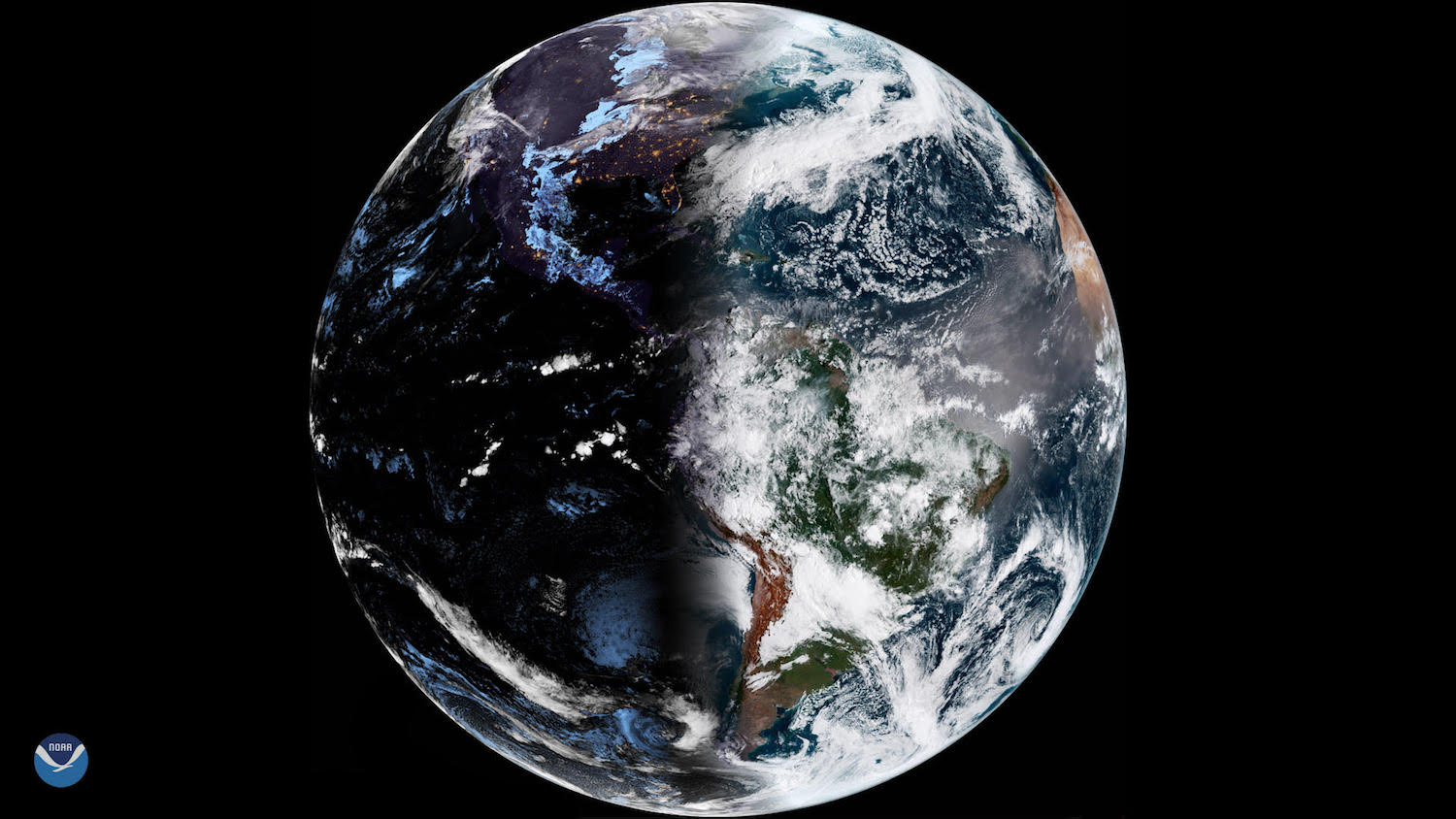
The forces of light and dark are basically equal at this moment on Earth.

The forces of light and dark are basically equal at this moment on Earth during the equinox. (Image credit: NOAA; NOAA Environmental Visualization Laboratory)

Today (March 20) at 10:46 a.m. Eastern Daylight Time (7:46 a.m. Pacific Daylight Time) the vernal or spring equinox occurs. At that moment, the sun comes to one of two places where its rays shine directly down on the equator. It will then shine equally on both halves of the Earth. More precisely, at that moment, the sun will be shining directly down on the equator at a point over the Atlantic Ocean, roughly 790 miles (1,280 kilometers) east of Macapá, Brazil.

When most of us were growing up, it always seemed that the first day of spring was on March 21, not March 20. But now, for North Americans, spring begins on March 20. In fact, during the 20th century, March 21 was the exception rather than the rule, with the equinox landing on that day only 36 times.

From the years 1980 through 2102, it comes no later than March 20. In 2028, in fact, for the Western Hemisphere, spring will officially begin on March 19. This shift in dates happens because the Earth’s elliptical orbit doesn’t match our calendar perfectly. The vagaries of our Gregorian calendar, such as the inclusion of a leap day in century years divisible by 400, also help contribute to the seasonal date shift. Had the year 2000 not been a leap year, the equinox would be occurring this year on Saturday (March 21), not Friday.

Article continues below


You may like

Not “equal” on the equinox!

Another complexity involving the vernal equinox concerns the axiom, “equal days and equal nights on the equinox.” Yet each year, I always get at least one or two inquiries asking why that isn’t so. Perhaps someone skimming through the weather page of their newspaper on the day of the equinox, looked at the almanac box which provides the local time of sunrise and sunset and noticed that the length of day and night is not equal at all. In fact, on the equinox dates in both March and September, the length of daylight is actually <em>longer than darkness by several minutes.

Check out the situation for Pittsburgh. As the table below shows, days and nights are equal not on the equinox, but on Saint Patrick’s Day:

Swipe to scroll horizontally

Date

Sunrise

Sunset

Length of day

March 17

7:28 a.m.

7:28 p.m.

12 hr. 00 min.

March 18

7:26 a.m.

7:30 p.m.

12 hr. 04 min.

March 19

7:24 a.m.

7:31 p.m.

12 hr. 07 min.

March 20

7:23 a.m.

7:32 p.m.

12 hr. 09 min.

One factor to consider is that when we refer to sunrise and sunset, it refers to when the very top edge of the sun appears on the horizon. Not its center, nor its bottom edge.

This fact alone would make the time of sunrise and sunset a little more than 12 hours apart on the equinox days. The sun’s apparent diameter is roughly equal to half a degree.
Breaking space news, the latest updates on rocket launches, skywatching events and more!

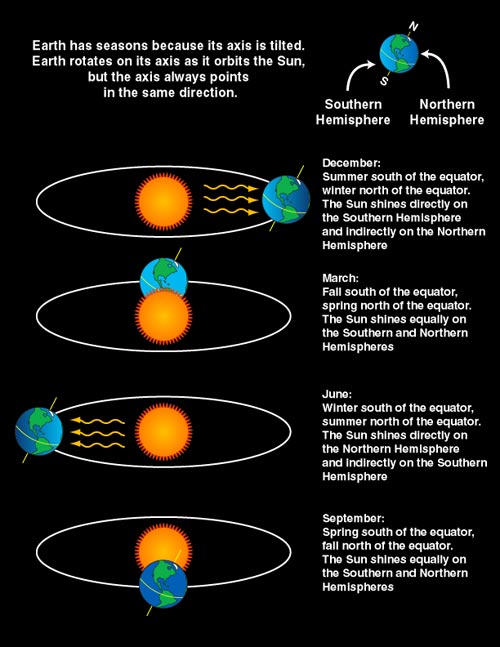
Equinox diagram showing the position of earth in relation to the sun throughout the seasons.

Earth’s seasons diagram. (Image credit: NASA/Space Place)

But the main reason that this happens is due to our atmosphere; it acts like a lens and refracts (bends) its light above the edge of the horizon. In their calculations of sunrise and sunset times, the U.S. Naval Observatory routinely uses 34 arc minutes for the angle of refraction and 16 arc minutes for the semi/half diameter of the sun’s disc. In other words, the geometric center of the sun is more than eight-tenths of a degree below a flat and unobstructed horizon at the moment of sunrise.

As a result, we end up seeing the sun for a few minutes before its disk actually rises and for a few minutes after it has actually set. So, you can thank our atmosphere for making our days a bit longer; the length of daylight on any given day is increased by approximately six or seven minutes.

So . . . when you watch the sun either coming up above the horizon at sunrise or going down below the horizon at sunset, you are looking at an illusion — the sun is not really there but is actually below the horizon!

Now you see it . . . when you don’t!

Joe Rao serves as an instructor and guest lecturer at New York’s Hayden Planetarium. He writes about astronomy for Natural History magazine, Sky and Telescope, The Old Farmer’s Almanac and other publications.

No Result
View All Result

Recent Posts

  • Officina Stellare wins $2 million contract for lasercom ground station in Spain
  • Rocket Lab launches eighth Synspective radar imaging satellite
  • Another GPS launch shifts from ULA to SpaceX as Vulcan investigation continues
  • OHB Sweden wins €248 million contract to build EPS-Sterna constellation
  • Rocket Lab scores $190 million launch deal to test hypersonic tech for US military

Categories

  • Excursions
  • Kepler Mission
  • NASA
  • NASA Breaking News
  • Physical Preparation
  • Preparation
  • Space News
  • Space Station News
  • Spacewalks
  • Tours
  • Uncategorized
  • Weightlessness Training
  • What Not to Pack
  • What to Pack

Meta

  • Log in
  • Entries feed
  • Comments feed
  • WordPress.org
  • Home
  • Start Here
  • Preparing for Your Trip
  • Space Tourism Companies
  • Space Tours
  • Contact

© 2026 JNews - Premium WordPress news & magazine theme by Jegtheme.

No Result
View All Result
  • About
  • Contact
  • Feeds
  • Frequently Asked Questions
  • Preparing for Your Trip
    • Insurance and Legal Waivers
    • Physical and Medical Requirements
    • Training Programs
    • What to Expect
  • Privacy Policy
  • Space Tourism Companies
    • Axiom Space
    • Blue Origin
    • Blue Origin vs Virgin Galactic
    • Comparison Chart: Features, Pricing, Booking
    • SpaceX
    • Virgin Galactic
    • World View (stratospheric balloon flights)
  • Space Tours
    • Custom & Luxury Packages
    • Duration, Training, Costs
    • Experiences
    • Future Moon/Mars Options
    • Orbital Flights
    • Parabolic Flight Experiences
    • Private Missions
    • Stratospheric Balloon Flights
    • Suborbital Flights
    • Zero-Gravity Flights
  • Spaceflight Technologies
    • Space Tourism Balloon
  • Start Here
    • How to Book a Space Tour
    • Intro to Commercial Spaceflight
    • Is Space Tourism Safe?
    • Space Travel FAQs
    • View Earth from the Edge
    • What to Pack
  • Tours in Space is your launchpad to the world of space tourism

© 2026 JNews - Premium WordPress news & magazine theme by Jegtheme.