
• Home
  • About
  • FAQ
  • Feeds
  • Glossary
  • Contact
Tours In Space
  • Home
  • Start Here
    • Intro to Commercial Spaceflight
    • How to Book a Space Tour
    • Is Space Tourism Safe?
    • Space Travel FAQs
    • View Earth from the Edge
    • What to Pack
  • Preparing for Your Trip
    • Insurance and Legal Waivers
    • Physical and Medical Requirements
    • Training Programs
    • What to Expect
  • Space Tourism Companies
    • Axiom Space
    • Blue Origin
    • SpaceX
    • Virgin Galactic
    • World View (stratospheric balloon flights)
    • Blue Origin vs Virgin Galactic
    • Comparison Chart: Features, Pricing, Booking
  • Space Tours
    • Custom & Luxury Packages
    • Duration, Training, Costs
    • Experiences
    • Future Moon/Mars Options
    • Orbital Flights
    • Parabolic Flight Experiences
    • Private Missions
    • Stratospheric Balloon Flights
    • Suborbital Flights
    • Zero-Gravity Flights
  • Spaceflight Technologies
    • Space Tourism Balloon
No Result
View All Result
  • Home
  • Start Here
    • Intro to Commercial Spaceflight
    • How to Book a Space Tour
    • Is Space Tourism Safe?
    • Space Travel FAQs
    • View Earth from the Edge
    • What to Pack
  • Preparing for Your Trip
    • Insurance and Legal Waivers
    • Physical and Medical Requirements
    • Training Programs
    • What to Expect
  • Space Tourism Companies
    • Axiom Space
    • Blue Origin
    • SpaceX
    • Virgin Galactic
    • World View (stratospheric balloon flights)
    • Blue Origin vs Virgin Galactic
    • Comparison Chart: Features, Pricing, Booking
  • Space Tours
    • Custom & Luxury Packages
    • Duration, Training, Costs
    • Experiences
    • Future Moon/Mars Options
    • Orbital Flights
    • Parabolic Flight Experiences
    • Private Missions
    • Stratospheric Balloon Flights
    • Suborbital Flights
    • Zero-Gravity Flights
  • Spaceflight Technologies
    • Space Tourism Balloon
No Result
View All Result
Tours In Space
No Result
View All Result
Home Space News

What if the next great astronomer isn’t human? How AI is revolutionizing our study of the cosmos

Ensign by Ensign
March 22, 2026
in Space News
0
What if the next great astronomer isn’t human? How AI is revolutionizing our study of the cosmos
189
SHARES
1.5k
VIEWS
Share on FacebookShare on Twitter

How do you unravel the universe’s deepest secrets when the data piles up faster than we can make sense of it? It’s a bit like being handed a zillion puzzle pieces from a cosmic explosion and being told to recreate the original star.

Modern cosmic data analysis faces some truly head-scratching algorithmic challenges, demanding not just cleverness, but brand-new ways to hunt for answers across vast conceptual spaces. Our tried-and-true cosmological algorithms — those computational procedures and models we use to analyze astronomical data, simulate the universe’s evolution, and reconstruct its physical properties — can only take us so far.

But what if the next great astronomer isn’t even human? What if it’s an AI that’s learned to write its own code? That’s where a rather ingenious framework called MadEvolve enters the cosmic stage.

Article continues below


You may like

Imagine a persistent, tireless apprentice designed to take our existing scientific algorithms, poke and prod them, and then make them fundamentally better. That’s MadEvolve for you: a system built to iteratively improve algorithms, starting with a basic human-written version and then relentlessly optimizing its performance by making smart, iterative code changes.

And it’s not just making minor tweaks. Across several crucial tasks in computational cosmology, MadEvolve has delivered substantial improvements over our best human-crafted baseline algorithms, even setting a new state-of-the-art for some simulation setups. So, how exactly does this digital prodigy manage such cosmic feats?

The real magic of MadEvolve lies in its clever collaboration between two powerful ideas: Large Language Models and evolutionary programming. A Large Language Model, or LLM, is a type of artificial intelligence program that’s been trained on colossal amounts of text data, allowing it to understand, generate, and process human language which, as it turns out, includes writing and understanding computer code. In the case of MadEvolve, these LLMs act as smart mutation operators. They suggest modifications to existing code, almost like a particularly insightful programmer.

Then there’s evolutionary programming, which is a class of optimization algorithms that take their cues from natural selection. Think of it as a digital version of survival of the fittest for computer code, where generations of candidate solutions evolve and improve by applying operations like mutation and selection.

Breaking space news, the latest updates on rocket launches, skywatching events and more!

MadEvolve samples a parent program from a diverse population of algorithms, prompts the LLM for modifications, evaluates the new programs against physics-based metrics, and then updates the population based on those scores. This iterative loop, nested with separate optimizations for structure and parameters, allows the system to continuously hone its creations. It’s a dazzling display of computational evolution.
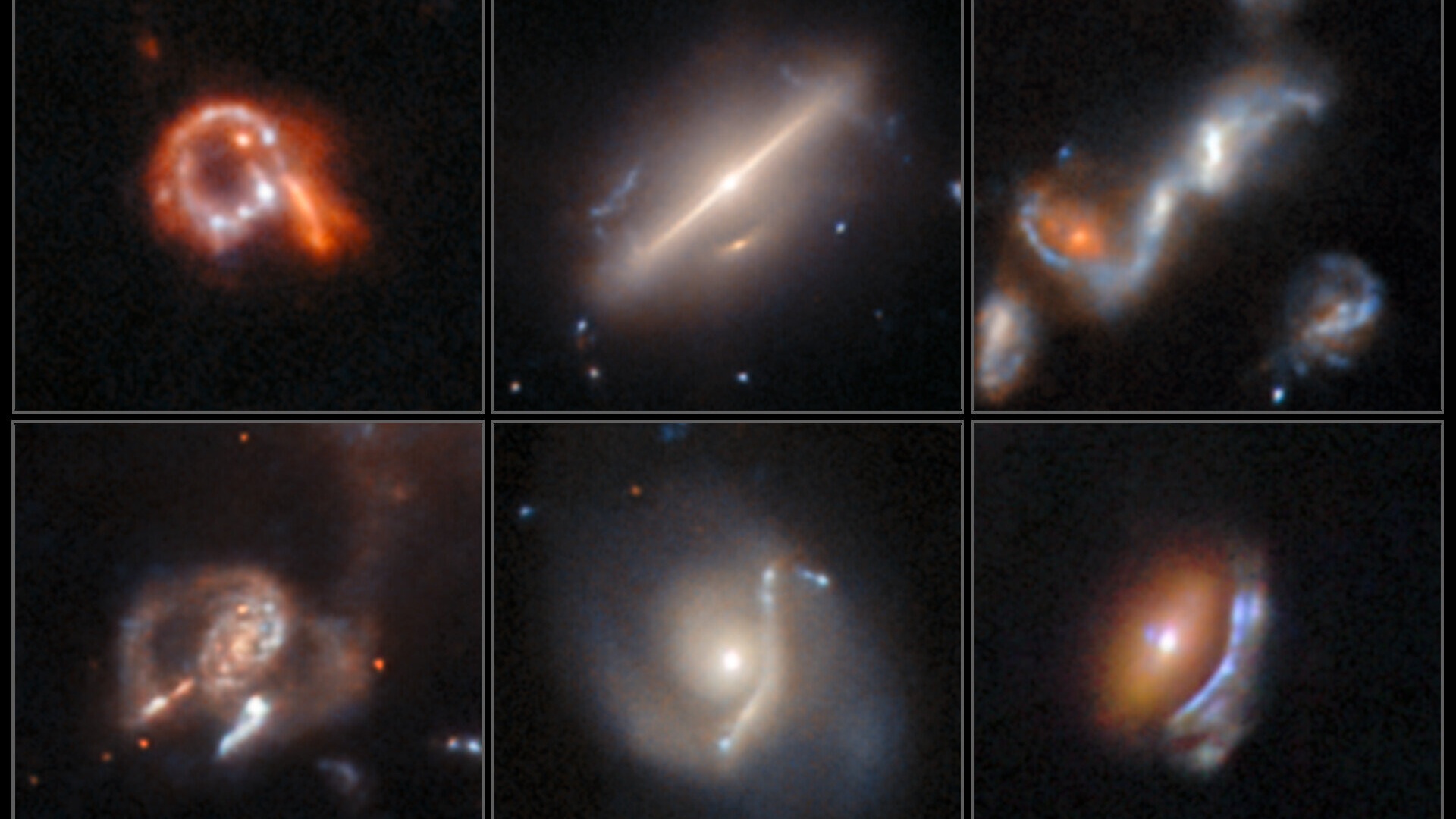
Six panels showing different objects in space. They all look like hazy blobs of light with different shapes.

An AI algorithm recently managed to discover 1,300 anomalies, or objects with odd appearances, in archival Hubble telescope data. Hundreds of these anomalies have never been documented before. (Image credit: ESA/Hubble & NASA, D. O’Ryan, P. Gómez (European Space Agency), M. Zamani (ESA/Hubble))

Now, you might be thinking, wait a minute, haven’t LLMs been a bit … flaky when it comes to hard physics? And you’d be right. Large Language Models often struggle with precise derivations and calculations in theoretical physics, sometimes exhibiting inconsistent reasoning. But this is where MadEvolve really shines with its cleverness. It doesn’t ask the LLM to invent new physics theories from scratch. Instead, it restricts the LLM to human-defined tasks that have clear, verifiable reward metrics. The physics evaluators keep the LLM honest, ensuring the suggested code changes actually improve performance.

MadEvolve has been put to the test in some of the most challenging corners of computational cosmology. It’s achieved substantial improvements in tasks like reconstructing the universe’s initial conditions, cleaning up foreground contamination from faint cosmic signals, and fine-tuning physics in N-body simulations. For the reconstruction of initial cosmic conditions, it actually surpassed the human state-of-the-art, setting a new benchmark for how we understand the early universe.

These gains represent a leap forward in our ability to extract meaningful insights from the torrent of cosmic data, pushing the boundaries of what we thought possible with current methods. It’s a sign that the very tools we use to explore the cosmos are about to get a serious upgrade.

But the story doesn’t end with cosmology. This incredible MadEvolve system is built as a general framework, meaning it could prove useful in countless other scientific fields. Think of it: from optimizing code generation and software engineering to refining neural networks and various other generative tasks, the integrated synergy between LLMs and evolutionary algorithms holds immense potential.

We’re just scratching the surface of what this innovative collaboration can unlock. The universe is vast, and our methods for exploring it need to be just as inventive.

Tags: NASArocket launch
No Result
View All Result

Recent Posts

  • See the delicate crescent moon dance with the ‘Seven Sisters’ of the Pleiades tonight
  • What if the next great astronomer isn’t human? How AI is revolutionizing our study of the cosmos
  • ‘This is really intolerable’: Astronomers protest giant orbiting mirror project and SpaceX’s million AI satellites
  • Russian cargo spacecraft suffers glitch after launching toward International Space Station
  • We chat to legendary space shuttle commander Eileen Collins about her new documentary, ‘Spacewoman’ (interview)

Categories

  • Excursions
  • Kepler Mission
  • NASA
  • NASA Breaking News
  • Physical Preparation
  • Preparation
  • Space News
  • Space Station News
  • Spacewalks
  • Tours
  • Uncategorized
  • Weightlessness Training
  • What Not to Pack
  • What to Pack

Meta

  • Log in
  • Entries feed
  • Comments feed
  • WordPress.org
  • Home
  • Start Here
  • Preparing for Your Trip
  • Space Tourism Companies
  • Space Tours
  • Contact

© 2026 JNews - Premium WordPress news & magazine theme by Jegtheme.

No Result
View All Result
  • About
  • Contact
  • Feeds
  • Frequently Asked Questions
  • Preparing for Your Trip
    • Insurance and Legal Waivers
    • Physical and Medical Requirements
    • Training Programs
    • What to Expect
  • Privacy Policy
  • Space Tourism Companies
    • Axiom Space
    • Blue Origin
    • Blue Origin vs Virgin Galactic
    • Comparison Chart: Features, Pricing, Booking
    • SpaceX
    • Virgin Galactic
    • World View (stratospheric balloon flights)
  • Space Tours
    • Custom & Luxury Packages
    • Duration, Training, Costs
    • Experiences
    • Future Moon/Mars Options
    • Orbital Flights
    • Parabolic Flight Experiences
    • Private Missions
    • Stratospheric Balloon Flights
    • Suborbital Flights
    • Zero-Gravity Flights
  • Spaceflight Technologies
    • Space Tourism Balloon
  • Start Here
    • How to Book a Space Tour
    • Intro to Commercial Spaceflight
    • Is Space Tourism Safe?
    • Space Travel FAQs
    • View Earth from the Edge
    • What to Pack
  • Tours in Space is your launchpad to the world of space tourism

© 2026 JNews - Premium WordPress news & magazine theme by Jegtheme.