• Home
  • About
  • FAQ
  • Feeds
  • Glossary
  • Contact
Tours In Space
  • Home
  • Start Here
    • Intro to Commercial Spaceflight
    • How to Book a Space Tour
    • Is Space Tourism Safe?
    • Space Travel FAQs
    • View Earth from the Edge
    • What to Pack
  • Preparing for Your Trip
    • Insurance and Legal Waivers
    • Physical and Medical Requirements
    • Training Programs
    • What to Expect
  • Space Tourism Companies
    • Axiom Space
    • Blue Origin
    • SpaceX
    • Virgin Galactic
    • World View (stratospheric balloon flights)
    • Blue Origin vs Virgin Galactic
    • Comparison Chart: Features, Pricing, Booking
  • Space Tours
    • Custom & Luxury Packages
    • Duration, Training, Costs
    • Experiences
    • Future Moon/Mars Options
    • Orbital Flights
    • Parabolic Flight Experiences
    • Private Missions
    • Stratospheric Balloon Flights
    • Suborbital Flights
    • Zero-Gravity Flights
  • Spaceflight Technologies
    • Space Tourism Balloon
No Result
View All Result
  • Home
  • Start Here
    • Intro to Commercial Spaceflight
    • How to Book a Space Tour
    • Is Space Tourism Safe?
    • Space Travel FAQs
    • View Earth from the Edge
    • What to Pack
  • Preparing for Your Trip
    • Insurance and Legal Waivers
    • Physical and Medical Requirements
    • Training Programs
    • What to Expect
  • Space Tourism Companies
    • Axiom Space
    • Blue Origin
    • SpaceX
    • Virgin Galactic
    • World View (stratospheric balloon flights)
    • Blue Origin vs Virgin Galactic
    • Comparison Chart: Features, Pricing, Booking
  • Space Tours
    • Custom & Luxury Packages
    • Duration, Training, Costs
    • Experiences
    • Future Moon/Mars Options
    • Orbital Flights
    • Parabolic Flight Experiences
    • Private Missions
    • Stratospheric Balloon Flights
    • Suborbital Flights
    • Zero-Gravity Flights
  • Spaceflight Technologies
    • Space Tourism Balloon
No Result
View All Result
Tours In Space
No Result
View All Result
Home Space News

Could our universe exist because black holes ate up all the antimatter?

Ensign by Ensign
March 23, 2026
in Space News
0
Could our universe exist because black holes ate up all the antimatter?
189
SHARES
1.5k
VIEWS
Share on FacebookShare on Twitter

One of the most fundamental and curious mysteries in the universe is the fact that anything exists at all. That is because during the Big Bang, equal amounts of matter and antimatter particles should have been created — antimatter being like the “opposite” of regular matter, meaning it’s made up of antiprotons and antielectrons. And when matter and antimatter particles meet, they are mutually annihilated.

That means in a universe split up into matter and antimatter, large structures such as galaxies, stars, planets, moons and even our bodies should struggle to exist. Thus, some early quirk of the universe must have eliminated antimatter and allowed a matter-dominated cosmos to prosper. For some time, scientists have been keenly searching for evidence of what this type of event might be.

Enter Polish theoretical physicist Nikodem Poplawski of the University of New Haven. Poplawski theorizes that the reason the matter and antimatter asymmetry exists is that tiny primordial black holes created during the Big Bang gobbled up vast amounts of antimatter.

Article continues below


You may like

“Primordial black holes are hypothetical black holes that formed soon after the Big Bang because of extreme, high-density fluctuations in the early universe. They are good candidates for being the seeds of supermassive black holes at the centers of massive galaxies, as well as of intermediate-mass black holes at the centers of globular clusters,” Poplawski told Space.com. “There are other models of elimination of antimatter, but they all assume some physics beyond the Standard Model of particle physics.

“The mass asymmetry between matter and antimatter was surprising, but it immediately suggested to me that it could be a simple and natural cause of the observed matter-antimatter imbalance in the universe.”

Was antimatter a drag in the earlier universe?

Poplawski explained how there are also unknown processes that violate the balance between a family of particles called baryons and their antimatter counterparts, the antibaryons.

“The mass asymmetry and the resulting black-hole capture asymmetry produced the matter–antimatter imbalance in the observable universe without violating the conservation of baryon number and invoking new physics beyond the Standard Model,” Poplawski explained.

Breaking space news, the latest updates on rocket launches, skywatching events and more!

The researcher says that because antimatter particles are more massive than matter particles, during pair production in the early universe, the antimatter particles were slower than the corresponding matter particles.

“Because the probability for gravitational capture of a massive particle by a black hole increases as its speed decreases, the antimatter particles were captured by black holes at larger rates than the corresponding matter particles,” Poplawski said. “The missing antimatter fell into primordial black holes and what did not fall was annihilated by matter.”
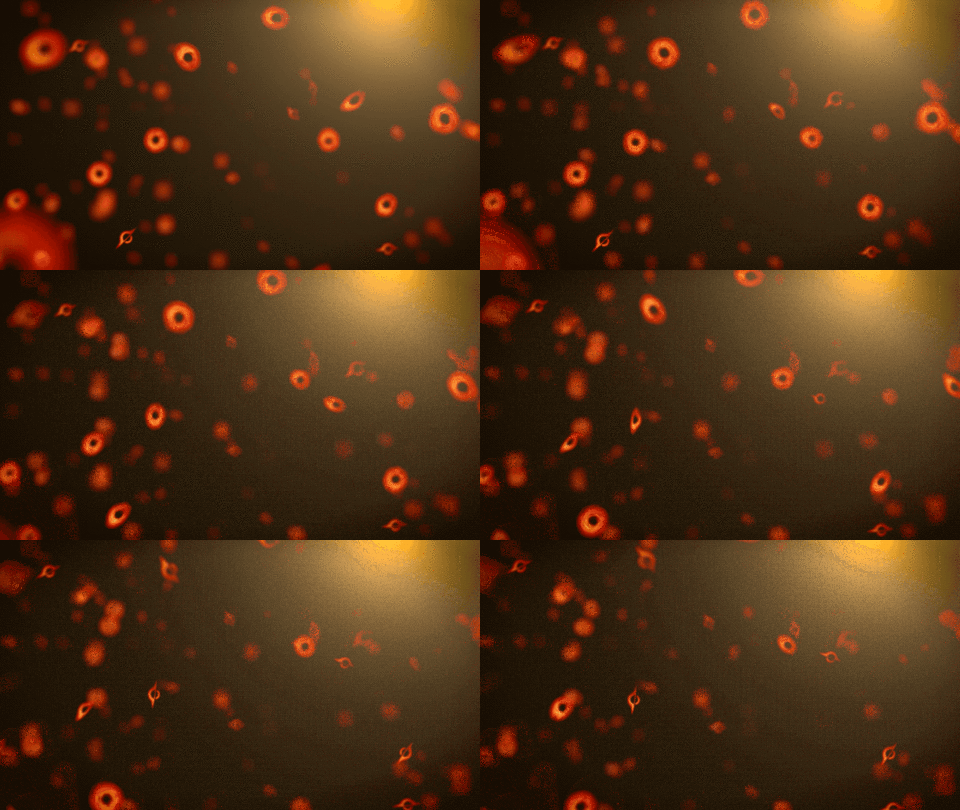
An GIF of primordial black holes in the early universe. They look like orange rings floating around.

A visualization of primordial black holes from the early universe. (Image credit: NASA’s Goddard Space Flight Center)

This could explain another problem in cosmology that has become pressing ever since the James Webb Space Telescope (JWST) began spotting supermassive black holes around 500 million years after the Big Bang. This is an issue because the merger and feeding process that allows supermassive black holes to grow to masses of millions, or even billions, of times that of the sun were previously thought to take at least 1 billion years to reach fruition. Seeing supermassive black holes before the universe was 1 billion years old therefore presents a considerable puzzle.


What to read next

Poplawski thinks that by gobbling up antimatter, primordial black holes could have gotten a head start on these growth processes.

“Primordial black holes consumed more antimatter than matter, and because antimatter was much heavier than matter, primordial black holes enormously increased their masses,” he said. “This could possibly explain how supermassive black holes recently observed in the early universe have grown so quickly.”

Of course, there is a long way to go before this theory is accepted by the scientific community at large. One thing that could aid in its acceptance is obtaining observational evidence of the existence of primordial black holes, which since they were first proposed by Stephen Hawking in the 1970s, have remained frustratingly hypothetical.

“Primordial black holes would have existed in the very early universe, which is currently very difficult to probe. I hope that gravitational waves and neutrinos could be possibly used in the future to test this hypothesis,” Poplawski said. “Also, there could be future experiments testing if matter and antimatter particles may have slightly different masses at higher densities or smaller distances compared to those currently probed. “In fact, some recent experiments showed that mesons and antimesons decay differently. This difference might be related to matter-antimatter mass asymmetry.”

Poplawski’s research is available on the preprint paper repository arXiv.

No Result
View All Result

Recent Posts

  • Astrophotographer spies Thor’s Helmet shining 15,000 light-years away in spectacular photo
  • Triangulum Galaxy dazzles in psychedelic color | Space photo of the day for March 23, 2026
  • Northern lights dazzle worldwide as strong G3 geomagnetic storm sparks stunning show (photos)
  • Are mysterious ‘Little Red Dots’ discovered by the James Webb Space Telescope actually baby galaxies under construction?
  • Could our universe exist because black holes ate up all the antimatter?

Categories

  • Excursions
  • Kepler Mission
  • NASA
  • NASA Breaking News
  • Physical Preparation
  • Preparation
  • Space News
  • Space Station News
  • Spacewalks
  • Tours
  • Uncategorized
  • Weightlessness Training
  • What Not to Pack
  • What to Pack

Meta

  • Log in
  • Entries feed
  • Comments feed
  • WordPress.org
  • Home
  • Start Here
  • Preparing for Your Trip
  • Space Tourism Companies
  • Space Tours
  • Contact

© 2026 JNews - Premium WordPress news & magazine theme by Jegtheme.

No Result
View All Result
  • About
  • Contact
  • Feeds
  • Frequently Asked Questions
  • Preparing for Your Trip
    • Insurance and Legal Waivers
    • Physical and Medical Requirements
    • Training Programs
    • What to Expect
  • Privacy Policy
  • Space Tourism Companies
    • Axiom Space
    • Blue Origin
    • Blue Origin vs Virgin Galactic
    • Comparison Chart: Features, Pricing, Booking
    • SpaceX
    • Virgin Galactic
    • World View (stratospheric balloon flights)
  • Space Tours
    • Custom & Luxury Packages
    • Duration, Training, Costs
    • Experiences
    • Future Moon/Mars Options
    • Orbital Flights
    • Parabolic Flight Experiences
    • Private Missions
    • Stratospheric Balloon Flights
    • Suborbital Flights
    • Zero-Gravity Flights
  • Spaceflight Technologies
    • Space Tourism Balloon
  • Start Here
    • How to Book a Space Tour
    • Intro to Commercial Spaceflight
    • Is Space Tourism Safe?
    • Space Travel FAQs
    • View Earth from the Edge
    • What to Pack
  • Tours in Space is your launchpad to the world of space tourism

© 2026 JNews - Premium WordPress news & magazine theme by Jegtheme.