• Home
  • About
  • FAQ
  • Feeds
  • Glossary
  • Contact
Tours In Space
  • Home
  • Start Here
    • Intro to Commercial Spaceflight
    • How to Book a Space Tour
    • Is Space Tourism Safe?
    • Space Travel FAQs
    • View Earth from the Edge
    • What to Pack
  • Preparing for Your Trip
    • Insurance and Legal Waivers
    • Physical and Medical Requirements
    • Training Programs
    • What to Expect
  • Space Tourism Companies
    • Axiom Space
    • Blue Origin
    • SpaceX
    • Virgin Galactic
    • World View (stratospheric balloon flights)
    • Blue Origin vs Virgin Galactic
    • Comparison Chart: Features, Pricing, Booking
  • Space Tours
    • Custom & Luxury Packages
    • Duration, Training, Costs
    • Experiences
    • Future Moon/Mars Options
    • Orbital Flights
    • Parabolic Flight Experiences
    • Private Missions
    • Stratospheric Balloon Flights
    • Suborbital Flights
    • Zero-Gravity Flights
  • Spaceflight Technologies
    • Space Tourism Balloon
No Result
View All Result
  • Home
  • Start Here
    • Intro to Commercial Spaceflight
    • How to Book a Space Tour
    • Is Space Tourism Safe?
    • Space Travel FAQs
    • View Earth from the Edge
    • What to Pack
  • Preparing for Your Trip
    • Insurance and Legal Waivers
    • Physical and Medical Requirements
    • Training Programs
    • What to Expect
  • Space Tourism Companies
    • Axiom Space
    • Blue Origin
    • SpaceX
    • Virgin Galactic
    • World View (stratospheric balloon flights)
    • Blue Origin vs Virgin Galactic
    • Comparison Chart: Features, Pricing, Booking
  • Space Tours
    • Custom & Luxury Packages
    • Duration, Training, Costs
    • Experiences
    • Future Moon/Mars Options
    • Orbital Flights
    • Parabolic Flight Experiences
    • Private Missions
    • Stratospheric Balloon Flights
    • Suborbital Flights
    • Zero-Gravity Flights
  • Spaceflight Technologies
    • Space Tourism Balloon
No Result
View All Result
Tours In Space
No Result
View All Result
Home Space News

Arriving safely on Venus and Titan: Different atmospheres affect heat shields differently, study shows

Ensign by Ensign
March 24, 2026
in Space News
0
NASA begins building nuclear-powered Dragonfly drone for 2028 launch to Saturn moon Titan
189
SHARES
1.5k
VIEWS
Share on FacebookShare on Twitter

Entering a planet’s atmosphere is a dangerous maneuver for any spacecraft, as it must withstand the intense frictional heat generated by high-speed contact with atoms and molecules.

That’s why landers and rovers have heat shields. And new research from the Grainger College of Engineering at the University of Illinois Urbana-Champaign suggests that an atmosphere’s composition has a big impact on how heat shields work.

A heat shield “breathes” when it hits the atmosphere. The surface of the shield begins to burn away, in a process called ablation. To mimic the hypersonic speed of a spacecraft’s entry, a team of researchers led by Francesco Panerai, a professor in the Department of Aerospace Engineering, experimented with heat shields in the Plasmatron X wind tunnel at the Center for Hypersonics and Entry System Studies, which is housed a few blocks from the university’s campus.

Article continues below


You may like

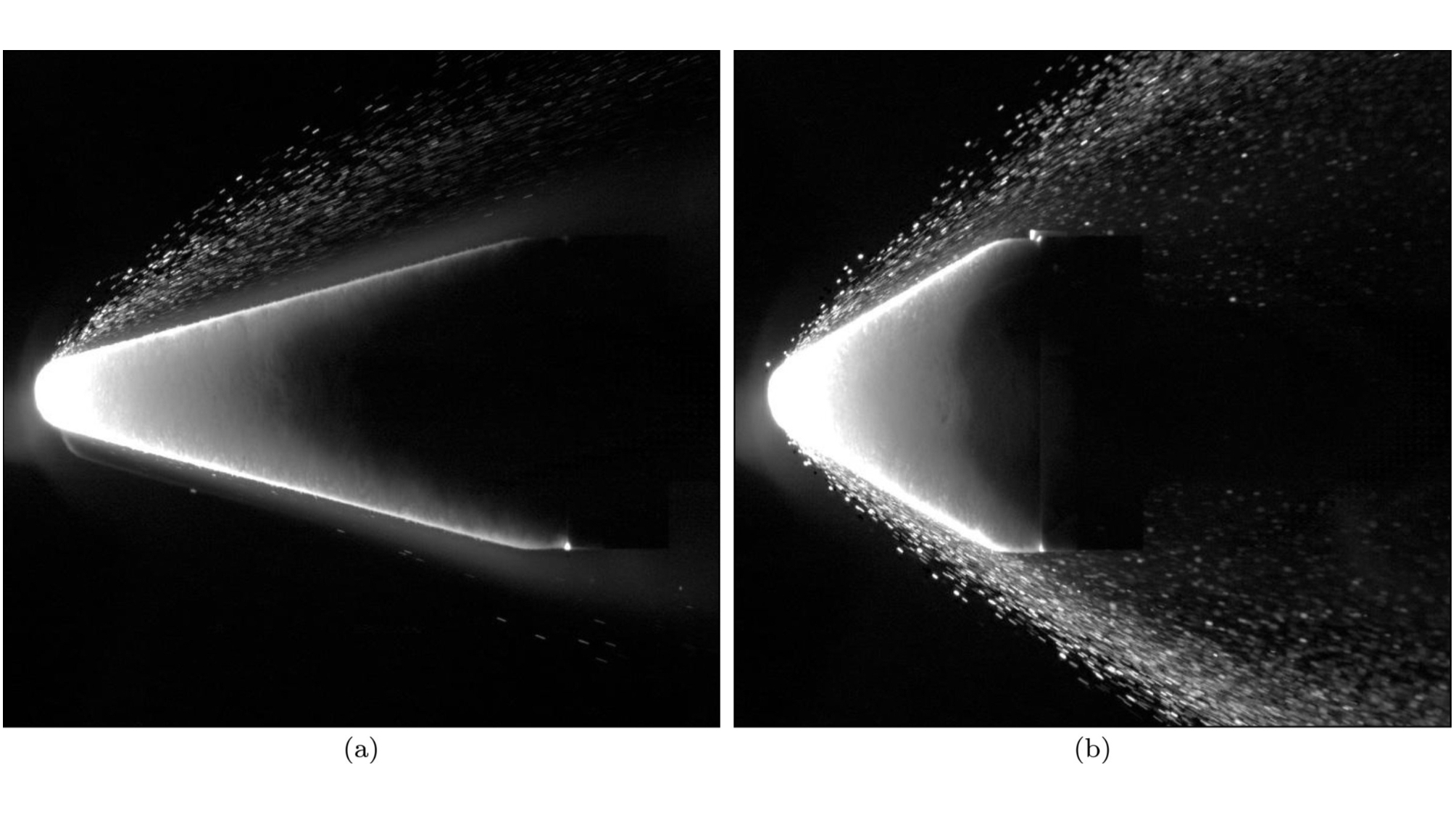
two side-by-side images showing conical bursts of nitrogen in a test chamber

High-speed image frames illustrate extreme particle burst events in supersonic nitrogen. In rare instances, particles are observed traveling upstream, indicating a pressure driven ejection mechanism. (Image credit: Francesco Panerai/University of Illinois)

“What was very surprising about the study is that, when we changed the gas, the ablation phenomenon behaved in different ways,” Panerai said in a March 12 statement. “In a classical air environment where you have oxygen present, the ablation happens in a steady way. The flow around the spacecraft erodes the surface, and particles get ejected as a constant stream.”

When material from the outer layer of the heat shield erodes, some of it can collect on the surface of the shield, potentially clogging up some areas and preventing the material below from “breathing.” This can impact how well the shield performs. In the new study, the researchers found that changing the gases that the shield comes into contact with also changes its performance.

“When the oxygen is removed, this phenomenon becomes unsteady. Intermittent bursts of particles are ejected and, at times, the process becomes violent,” Panerai said. “I’ve been around ablation research for over 15 years, and I’ve never seen this. We were all really surprised when we first observed this behavior in the tunnel.”

Understanding how an atmosphere’s composition affects heat shields is important, Panerai said, because NASA is getting Dragonfly, a robotic rotorcraft, ready for a 2028 launch toward the huge Saturn moon Titan. Titan has a thick atmosphere that’s quite different from that of Earth: It’s composed of about 95% nitrogen and 5% methane, whereas ours is 78% nitrogen and 21% oxygen.

Breaking space news, the latest updates on rocket launches, skywatching events and more!

Dragonfly will study Titan’s surface, which could give scientists clues on whether or not the moon’s hydrocarbon lakes and rivers hold molecules that are a precursor for life.

“Although this work doesn’t directly influence heat shield design, it does have very profound implications on the physics of the material — on the way the material behaves at extreme temperatures,” Panerai says. “Understanding at what conditions this phenomenon becomes prominent in flight can help us design better heat shields.”

The study was published Feb. 5 in the science journal Carbon.

Tags: rocket launch
No Result
View All Result

Recent Posts

  • Future Artemis missions could use fiber-optic cables to monitor moonquakes
  • Watch all your favorite sci-fi content like ‘For All Mankind’ and ‘Star City’ anywhere with this exclusive deal and get a free $50 Amazon Gift Card and 77% off NordVPN
  • Hubble revisits the Crab Nebula after 25 years | Space photo of the day for March 24, 2026
  • NASA Unveils Initiatives to Achieve America’s National Space Policy
  • Arriving safely on Venus and Titan: Different atmospheres affect heat shields differently, study shows

Categories

  • Excursions
  • Kepler Mission
  • NASA
  • NASA Breaking News
  • Physical Preparation
  • Preparation
  • Space News
  • Space Station News
  • Spacewalks
  • Tours
  • Uncategorized
  • Weightlessness Training
  • What Not to Pack
  • What to Pack

Meta

  • Log in
  • Entries feed
  • Comments feed
  • WordPress.org
  • Home
  • Start Here
  • Preparing for Your Trip
  • Space Tourism Companies
  • Space Tours
  • Contact

© 2026 JNews - Premium WordPress news & magazine theme by Jegtheme.

No Result
View All Result
  • About
  • Contact
  • Feeds
  • Frequently Asked Questions
  • Preparing for Your Trip
    • Insurance and Legal Waivers
    • Physical and Medical Requirements
    • Training Programs
    • What to Expect
  • Privacy Policy
  • Space Tourism Companies
    • Axiom Space
    • Blue Origin
    • Blue Origin vs Virgin Galactic
    • Comparison Chart: Features, Pricing, Booking
    • SpaceX
    • Virgin Galactic
    • World View (stratospheric balloon flights)
  • Space Tours
    • Custom & Luxury Packages
    • Duration, Training, Costs
    • Experiences
    • Future Moon/Mars Options
    • Orbital Flights
    • Parabolic Flight Experiences
    • Private Missions
    • Stratospheric Balloon Flights
    • Suborbital Flights
    • Zero-Gravity Flights
  • Spaceflight Technologies
    • Space Tourism Balloon
  • Start Here
    • How to Book a Space Tour
    • Intro to Commercial Spaceflight
    • Is Space Tourism Safe?
    • Space Travel FAQs
    • View Earth from the Edge
    • What to Pack
  • Tours in Space is your launchpad to the world of space tourism

© 2026 JNews - Premium WordPress news & magazine theme by Jegtheme.