• Home
  • About
  • FAQ
  • Feeds
  • Glossary
  • Contact
Tours In Space
  • Home
  • Start Here
    • Intro to Commercial Spaceflight
    • How to Book a Space Tour
    • Is Space Tourism Safe?
    • Space Travel FAQs
    • View Earth from the Edge
    • What to Pack
  • Preparing for Your Trip
    • Insurance and Legal Waivers
    • Physical and Medical Requirements
    • Training Programs
    • What to Expect
  • Space Tourism Companies
    • Axiom Space
    • Blue Origin
    • SpaceX
    • Virgin Galactic
    • World View (stratospheric balloon flights)
    • Blue Origin vs Virgin Galactic
    • Comparison Chart: Features, Pricing, Booking
  • Space Tours
    • Custom & Luxury Packages
    • Duration, Training, Costs
    • Experiences
    • Future Moon/Mars Options
    • Orbital Flights
    • Parabolic Flight Experiences
    • Private Missions
    • Stratospheric Balloon Flights
    • Suborbital Flights
    • Zero-Gravity Flights
  • Spaceflight Technologies
    • Space Tourism Balloon
No Result
View All Result
  • Home
  • Start Here
    • Intro to Commercial Spaceflight
    • How to Book a Space Tour
    • Is Space Tourism Safe?
    • Space Travel FAQs
    • View Earth from the Edge
    • What to Pack
  • Preparing for Your Trip
    • Insurance and Legal Waivers
    • Physical and Medical Requirements
    • Training Programs
    • What to Expect
  • Space Tourism Companies
    • Axiom Space
    • Blue Origin
    • SpaceX
    • Virgin Galactic
    • World View (stratospheric balloon flights)
    • Blue Origin vs Virgin Galactic
    • Comparison Chart: Features, Pricing, Booking
  • Space Tours
    • Custom & Luxury Packages
    • Duration, Training, Costs
    • Experiences
    • Future Moon/Mars Options
    • Orbital Flights
    • Parabolic Flight Experiences
    • Private Missions
    • Stratospheric Balloon Flights
    • Suborbital Flights
    • Zero-Gravity Flights
  • Spaceflight Technologies
    • Space Tourism Balloon
No Result
View All Result
Tours In Space
No Result
View All Result
Home Space News

Future Artemis missions could use fiber-optic cables to monitor moonquakes

Ensign by Ensign
March 24, 2026
in Space News
0
Future Artemis missions could use fiber-optic cables to monitor moonquakes
189
SHARES
1.5k
VIEWS
Share on FacebookShare on Twitter

The moon may soon get a high-tech seismic sensing system — and it could be as simple as rolling out cables across the lunar surface.

Two recent studies suggest that fiber-optic cables laid directly on the lunar ground could double as sensitive detectors for moonquakes, offering a lightweight, low-cost alternative to traditional seismometers. The idea builds on a technique called distributed acoustic sensing in which laser pulses sent through optical fibers can pick up tiny vibrations along the entire length of the fibers, according to a statement from Los Alamos National Laboratory.

Using this method, a single cable could function like thousands of seismic sensors at once, dramatically expanding coverage compared to the handful of instruments deployed during the Apollo program. Those Apollo-era seismometers revealed that the moon is surprisingly active, recording thousands of quakes between 1969 and 1977 — but the tools were heavy, expensive and limited in reach.

Article continues below


You may like

“The moon has a lot of seismic activity, but deploying traditional seismic sensors like seismometers is extremely difficult and costly,” Carly Donahue, a scientist at Los Alamos National Laboratory and corresponding author on the two papers, said in the statement. “Fiber-optic cables are lightweight, robust and inexpensive, so we wondered: Could they be used on the surface of the moon to detect seismic activity there?”

Moonquakes themselves are very different from earthquakes. Without tectonic plates, the moon’s tremors are driven by tidal forces from Earth, meteorite impacts and extreme temperature swings as the lunar surface heats and cools. The result is shaking that can last far longer than on Earth because seismic energy dissipates slowly in the moon’s fractured interior.

Studying moonquakes will provide new insight on the composition of the moon’s core and whether it has faults, the researchers said. However, understanding this activity is more than a scientific curiosity. As NASA pushes toward a sustained human presence on the moon through its Artemis program, seismic data will be critical for astronaut safety and infrastructure planning. Long-lasting vibrations could affect habitats, landing pads and other equipment, while mapping moonquake activity will help engineers choose safer base locations and design structures that can withstand repeated stress.

“Seismometers sit in one location and are good at collecting data from that one site. But what about further away? We wanted to know if it would be possible to use a robot or rover to launch fiber-optic cables across many kilometers on the surface of the moon without burying them and still get useful data,” Donahue said in the statement. “If so, it would be a much cheaper, more efficient way to gather data without requiring an astronaut to travel long distances to install sensors or the extensive on-site support systems used during the Apollo missions.”
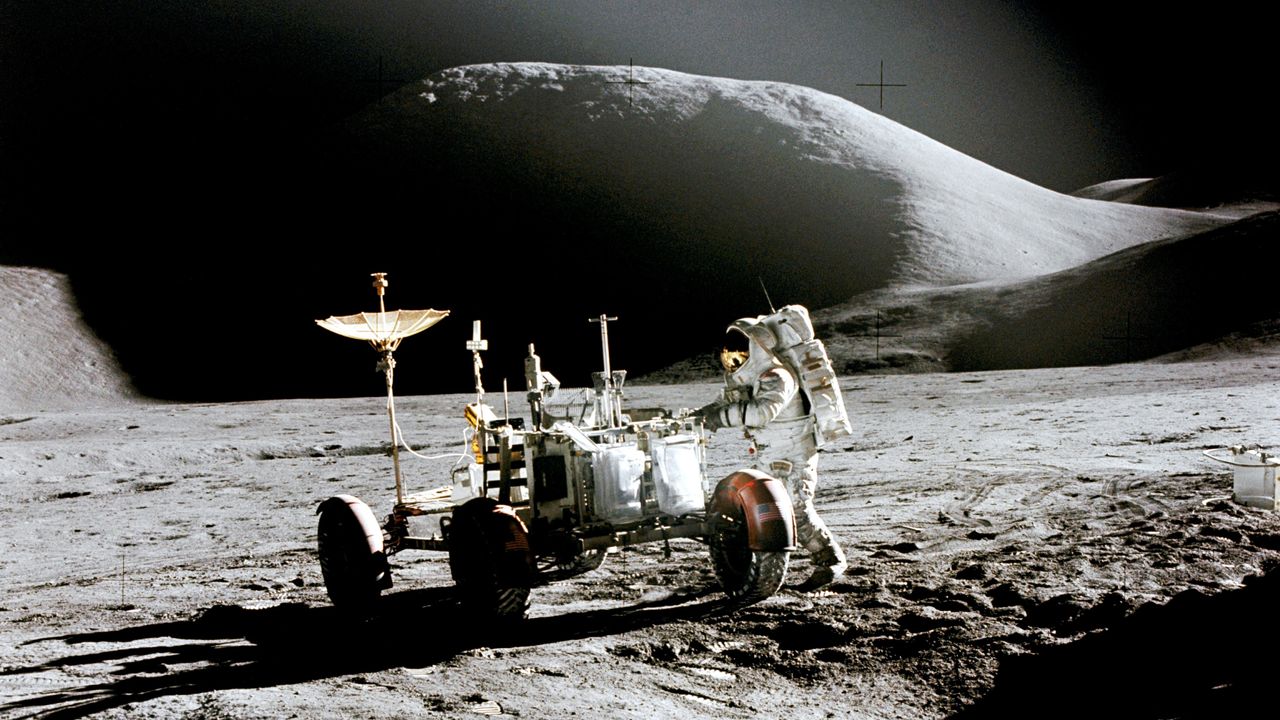
Breaking space news, the latest updates on rocket launches, skywatching events and more!

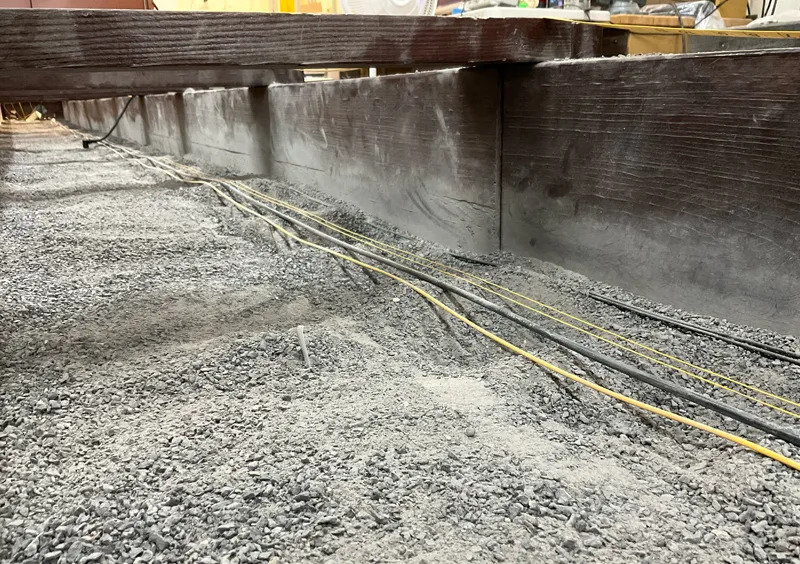
A photo of yellow and black wires laid on top of a grayish rocky surface next to a cement wall.

Fiber-optic cables lie on the surface and beneath crushed basalt in an indoor lab at Los Alamos National Laboratory to determine whether they could be used on the surface of the moon to detect moonquakes. The crushed basalt simulates the lunar surface. (Image credit: Los Alamos National Laboratory)

Fiber optics could be particularly well suited to the lunar environment. On Earth, such cables are typically buried to reduce noise, but experiments suggest that on the airless moon, cables placed right on the surface can still capture strong signals.

As part of the first study, published in February 2026 in the journal Icarus, researchers buried the fiber optics at multiple depths in an indoor lab at Los Alamos and analyzed data from the sensors that recorded regional earthquakes, as well as simulated seismic waves, revealing burial depth did not significantly impact the clarity of the signal. This, in turn, could significantly simplify deployment, allowing robotic missions to unspool miles of sensing lines without the need for digging or complex installation.

Meanwhile, the second study, published March 17 in the journal Earth and Space Science, found that thicker, stiffer fiber-optic cables with consistent contact with the lunar surface produce stronger signals. However, increasing cable thickness also adds weight, highlighting a key trade-off for space missions, Donahue said in the statement.

Beyond moonquakes, the same technology could also help track how far dust and debris spread during spacecraft landings, which is an important factor in assessing sandblast-related risks for future lunar operations.

If validated on the moon, the approach could transform how scientists study not just lunar activity, but planetary bodies more broadly — including Earth. For now, it points to a compelling possibility: The next leap in lunar exploration might rely on leveraging fiber-optic technology.

Tags: CuriosityNASArocket launchspace mission
No Result
View All Result

Recent Posts

  • Future Artemis missions could use fiber-optic cables to monitor moonquakes
  • Watch all your favorite sci-fi content like ‘For All Mankind’ and ‘Star City’ anywhere with this exclusive deal and get a free $50 Amazon Gift Card and 77% off NordVPN
  • Hubble revisits the Crab Nebula after 25 years | Space photo of the day for March 24, 2026
  • NASA Unveils Initiatives to Achieve America’s National Space Policy
  • Arriving safely on Venus and Titan: Different atmospheres affect heat shields differently, study shows

Categories

  • Excursions
  • Kepler Mission
  • NASA
  • NASA Breaking News
  • Physical Preparation
  • Preparation
  • Space News
  • Space Station News
  • Spacewalks
  • Tours
  • Uncategorized
  • Weightlessness Training
  • What Not to Pack
  • What to Pack

Meta

  • Log in
  • Entries feed
  • Comments feed
  • WordPress.org
  • Home
  • Start Here
  • Preparing for Your Trip
  • Space Tourism Companies
  • Space Tours
  • Contact

© 2026 JNews - Premium WordPress news & magazine theme by Jegtheme.

No Result
View All Result
  • About
  • Contact
  • Feeds
  • Frequently Asked Questions
  • Preparing for Your Trip
    • Insurance and Legal Waivers
    • Physical and Medical Requirements
    • Training Programs
    • What to Expect
  • Privacy Policy
  • Space Tourism Companies
    • Axiom Space
    • Blue Origin
    • Blue Origin vs Virgin Galactic
    • Comparison Chart: Features, Pricing, Booking
    • SpaceX
    • Virgin Galactic
    • World View (stratospheric balloon flights)
  • Space Tours
    • Custom & Luxury Packages
    • Duration, Training, Costs
    • Experiences
    • Future Moon/Mars Options
    • Orbital Flights
    • Parabolic Flight Experiences
    • Private Missions
    • Stratospheric Balloon Flights
    • Suborbital Flights
    • Zero-Gravity Flights
  • Spaceflight Technologies
    • Space Tourism Balloon
  • Start Here
    • How to Book a Space Tour
    • Intro to Commercial Spaceflight
    • Is Space Tourism Safe?
    • Space Travel FAQs
    • View Earth from the Edge
    • What to Pack
  • Tours in Space is your launchpad to the world of space tourism

© 2026 JNews - Premium WordPress news & magazine theme by Jegtheme.