• Home
  • About
  • FAQ
  • Feeds
  • Glossary
  • Contact
Tours In Space
  • Home
  • Start Here
    • Intro to Commercial Spaceflight
    • How to Book a Space Tour
    • Is Space Tourism Safe?
    • Space Travel FAQs
    • View Earth from the Edge
    • What to Pack
  • Preparing for Your Trip
    • Insurance and Legal Waivers
    • Physical and Medical Requirements
    • Training Programs
    • What to Expect
  • Space Tourism Companies
    • Axiom Space
    • Blue Origin
    • SpaceX
    • Virgin Galactic
    • World View (stratospheric balloon flights)
    • Blue Origin vs Virgin Galactic
    • Comparison Chart: Features, Pricing, Booking
  • Space Tours
    • Custom & Luxury Packages
    • Duration, Training, Costs
    • Experiences
    • Future Moon/Mars Options
    • Orbital Flights
    • Parabolic Flight Experiences
    • Private Missions
    • Stratospheric Balloon Flights
    • Suborbital Flights
    • Zero-Gravity Flights
  • Spaceflight Technologies
    • Space Tourism Balloon
No Result
View All Result
  • Home
  • Start Here
    • Intro to Commercial Spaceflight
    • How to Book a Space Tour
    • Is Space Tourism Safe?
    • Space Travel FAQs
    • View Earth from the Edge
    • What to Pack
  • Preparing for Your Trip
    • Insurance and Legal Waivers
    • Physical and Medical Requirements
    • Training Programs
    • What to Expect
  • Space Tourism Companies
    • Axiom Space
    • Blue Origin
    • SpaceX
    • Virgin Galactic
    • World View (stratospheric balloon flights)
    • Blue Origin vs Virgin Galactic
    • Comparison Chart: Features, Pricing, Booking
  • Space Tours
    • Custom & Luxury Packages
    • Duration, Training, Costs
    • Experiences
    • Future Moon/Mars Options
    • Orbital Flights
    • Parabolic Flight Experiences
    • Private Missions
    • Stratospheric Balloon Flights
    • Suborbital Flights
    • Zero-Gravity Flights
  • Spaceflight Technologies
    • Space Tourism Balloon
No Result
View All Result
Tours In Space
No Result
View All Result
Home Space News

Scientists discover mirror of our solar system in 2 exoplanets forming around a star

Ensign by Ensign
March 24, 2026
in Space News
0
189
SHARES
1.5k
VIEWS
Share on FacebookShare on Twitter

Astronomers have observed two planets forming around a distant infant star, thus discovering a planetary system that offers us a look at the appearance of the solar system over 4 billion years ago.

The infant star in question is named WISPIT 2, and it’s located around 437 light-years away with an estimated age of around 5.4 million years old. If that makes this star sound anything but an infant, consider that our middle-aged star, the sun, is 4.6 <em>billion years old.

WISPIT 2 is surrounded by a donut-shaped cloud of gas and dust called a protoplanetary disk in which scientists have now detected two planets, designated WISPIT 2b and WISPIT 2c. And excitingly, there are structural hints with WISPIT 2’s protoplanetary disk of more forming protoplanets. “WISPIT 2 is the best look into our own past that we have to date,” discovery team leader Chloe Lawlor of the University of Galway, Ireland, said in a statement. “These structures suggest that more planets are currently forming, which we will eventually detect.”

Article continues below


You may like

WISPIT 2 is only the second system in which astronomers have successfully detected two forming planets. The other system, PDS 70, lacks the extended disk and the distinct gaps and bands seen around WISPIT 2. That means that this system offers an unparalleled look at how planetary systems like our own solar system are formed.

“WISPIT 2 gives us a critical laboratory not just to observe the formation of a single planet but an entire planetary system,” team member Christian Ginski of the University of Galway said in the statement.

The discovery history of WISPIT 2

WISPIT 2b was the first infant planet discovered around this infant star, detected last year and determined to have a mass around five times that of Jupiter and orbiting its parent star at a distance equivalent to 60 times the distance between Earth and the sun.

Following this discovery, astronomers found hints of an additional object closer to WISPIT 2, confirming this to be a planet using the Very Large Telescope (VLT) and the VLT Interferometer (VLTI). The newly found planet, WISPIT 2c, orbits its parent star at around 15 times the distance between Earth and the sun, meaning it’s about four times closer to its star than WISPIT 2b is.

Breaking space news, the latest updates on rocket launches, skywatching events and more!

The researchers then captured an image of this forming planet using the VLT’s Spectro-Polarimetric High-Contrast Exoplanet Research (SPHERE) instrument, further confirming it is a planet with another VLT instrument, GRAVITY+.

“Critically, our study made use of the recent upgrade to GRAVITY+ without which we would not have been able to get such a clear detection of the planet so close to its star,” team member Guillaume Bourdarot of the Max Planck Institute for Extraterrestrial Physics in Germany said in the statement.
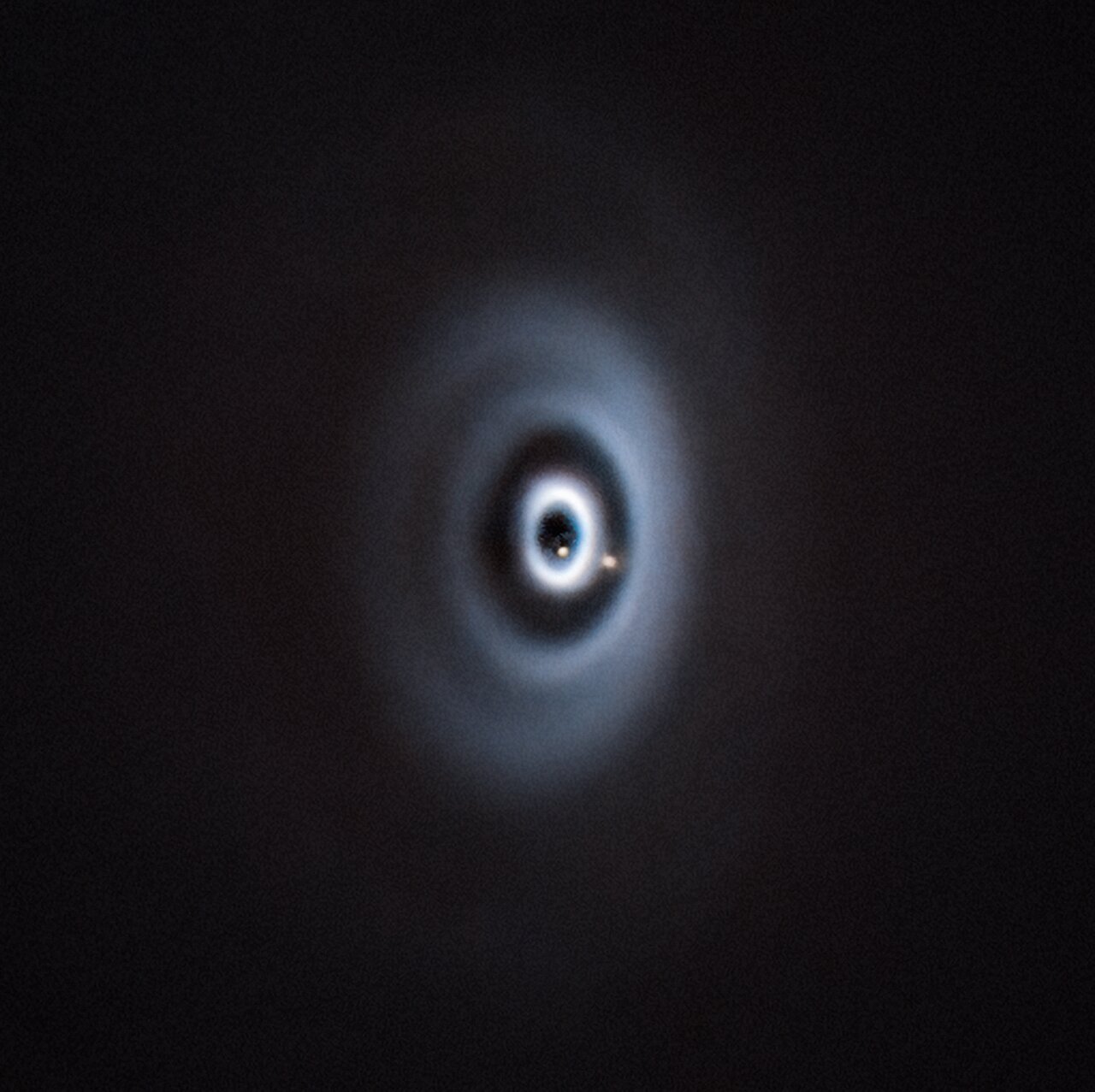
Concentric gray wispy rings have two glowing dots stashed within.

The young star WISPIT 2 as seen by the VLT with two forming protoplanets indicated by dark gaps in the protoplanetary disk (Image credit: ESO/C. Lawlor, R. F. van Capelleveen et al.)

Both WISPIT 2b and WISPIT 2c are carving grooves in the protoplanetary disk around their parent star. This is happening because, as they orbit the star, their gravitational influences collect material from the disk to facilitate their growth.

At least one more planet is indicated in the system by a less-pronounced gap —further out from the system’s central star than WISPIT 2b sits. The team hopes this third planet will be visible with the Extremely Large Telescope (ELT), currently under construction in the Atacama Desert region of northern Chile.

“We suspect there may be a third planet carving out this gap, potentially of Saturn’s mass, owing to the gap’s being much narrower and shallower,” Lawlor said.

The team’s research was published on Tuesday (March 24) in The Astrophysical Journal Letters.

Tags: rocket launch
No Result
View All Result

Recent Posts

  • ‘It was an incredible moment’: One photographer’s journey to capture the March 3 total lunar eclipse over Malaysia
  • Rocket shines under the northern lights | Space photo of the day for March 25, 2026
  • Like ‘accelerating from stationary to supersonic flight’: Europe’s Hera probe boosts speed, stays on course for November asteroid rendezvous
  • Europe plans EPIC SpaceX mission to send 4 astronauts to the ISS before its retirement
  • Scientists finally solve century-old mystery of star with unexpected X-ray emissions

Categories

  • Excursions
  • Kepler Mission
  • NASA
  • NASA Breaking News
  • Physical Preparation
  • Preparation
  • Space News
  • Space Station News
  • Spacewalks
  • Tours
  • Uncategorized
  • Weightlessness Training
  • What Not to Pack
  • What to Pack

Meta

  • Log in
  • Entries feed
  • Comments feed
  • WordPress.org
  • Home
  • Start Here
  • Preparing for Your Trip
  • Space Tourism Companies
  • Space Tours
  • Contact

© 2026 JNews - Premium WordPress news & magazine theme by Jegtheme.

No Result
View All Result
  • About
  • Contact
  • Feeds
  • Frequently Asked Questions
  • Preparing for Your Trip
    • Insurance and Legal Waivers
    • Physical and Medical Requirements
    • Training Programs
    • What to Expect
  • Privacy Policy
  • Space Tourism Companies
    • Axiom Space
    • Blue Origin
    • Blue Origin vs Virgin Galactic
    • Comparison Chart: Features, Pricing, Booking
    • SpaceX
    • Virgin Galactic
    • World View (stratospheric balloon flights)
  • Space Tours
    • Custom & Luxury Packages
    • Duration, Training, Costs
    • Experiences
    • Future Moon/Mars Options
    • Orbital Flights
    • Parabolic Flight Experiences
    • Private Missions
    • Stratospheric Balloon Flights
    • Suborbital Flights
    • Zero-Gravity Flights
  • Spaceflight Technologies
    • Space Tourism Balloon
  • Start Here
    • How to Book a Space Tour
    • Intro to Commercial Spaceflight
    • Is Space Tourism Safe?
    • Space Travel FAQs
    • View Earth from the Edge
    • What to Pack
  • Tours in Space is your launchpad to the world of space tourism

© 2026 JNews - Premium WordPress news & magazine theme by Jegtheme.