• Home
  • About
  • FAQ
  • Feeds
  • Glossary
  • Contact
Tours In Space
  • Home
  • Start Here
    • Intro to Commercial Spaceflight
    • How to Book a Space Tour
    • Is Space Tourism Safe?
    • Space Travel FAQs
    • View Earth from the Edge
    • What to Pack
  • Preparing for Your Trip
    • Insurance and Legal Waivers
    • Physical and Medical Requirements
    • Training Programs
    • What to Expect
  • Space Tourism Companies
    • Axiom Space
    • Blue Origin
    • SpaceX
    • Virgin Galactic
    • World View (stratospheric balloon flights)
    • Blue Origin vs Virgin Galactic
    • Comparison Chart: Features, Pricing, Booking
  • Space Tours
    • Custom & Luxury Packages
    • Duration, Training, Costs
    • Experiences
    • Future Moon/Mars Options
    • Orbital Flights
    • Parabolic Flight Experiences
    • Private Missions
    • Stratospheric Balloon Flights
    • Suborbital Flights
    • Zero-Gravity Flights
  • Spaceflight Technologies
    • Space Tourism Balloon
No Result
View All Result
  • Home
  • Start Here
    • Intro to Commercial Spaceflight
    • How to Book a Space Tour
    • Is Space Tourism Safe?
    • Space Travel FAQs
    • View Earth from the Edge
    • What to Pack
  • Preparing for Your Trip
    • Insurance and Legal Waivers
    • Physical and Medical Requirements
    • Training Programs
    • What to Expect
  • Space Tourism Companies
    • Axiom Space
    • Blue Origin
    • SpaceX
    • Virgin Galactic
    • World View (stratospheric balloon flights)
    • Blue Origin vs Virgin Galactic
    • Comparison Chart: Features, Pricing, Booking
  • Space Tours
    • Custom & Luxury Packages
    • Duration, Training, Costs
    • Experiences
    • Future Moon/Mars Options
    • Orbital Flights
    • Parabolic Flight Experiences
    • Private Missions
    • Stratospheric Balloon Flights
    • Suborbital Flights
    • Zero-Gravity Flights
  • Spaceflight Technologies
    • Space Tourism Balloon
No Result
View All Result
Tours In Space
No Result
View All Result
Home Space News

100 new alien worlds: Scientists find hidden haul in data from NASA exoplanet-hunting spacecraft

Ensign by Ensign
March 26, 2026
in Space News
0
100 new alien worlds: Scientists find hidden haul in data from NASA exoplanet-hunting spacecraft
189
SHARES
1.5k
VIEWS
Share on FacebookShare on Twitter

Astronomers have discovered over 100 new worlds beyond the solar system hiding in data collected by NASA’s exoplanet-hunting spacecraft TESS (Transiting Exoplanet Survey Satellite), and it’s thanks to artificial intelligence. The technique also identified a further 2,000 or so candidate extrasolar planets, or exoplanets, around half of which were hitherto undetected.

Considering that there are around 6,000 exoplanets currently in NASA’s exoplanet catalog, confirming those candidate worlds would represent a major boost in our hunt for planets around other stars. The innovative new AI program behind this discovery is called RAVEN, and was developed by researchers at the University of Warwick in the U.K.

TESS spots exoplanets by recording the tiny dips in starlight they cause when they pass in front of the face of the parent star, a passage called a “transit.” RAVEN studied TESS observations of over 2.2 million stars collected during the NASA spacecraft’s first four years, hunting for planets so close to their home stars that they complete an orbit in just 16 Earth days. The AI pipeline could therefore help to confirm how common these tight-orbit planets are and the kind of systems in which they are most often found.

Article continues below


You may like

“This represents one of the best characterized samples of close-in planets and will help us identify the most promising systems for future study,” team leader Marina Lafarga Magro of the University of Warwick said in a statement.

RAVEN’s eagle eye is scanning the Neptunian desert

Since the first exoplanets were discovered in the mid-1990s, the exoplanet catalog has burgeoned to over 6,000 confirmed entries, but thousands of candidates identified by exoplanet-hunting space missions like TESS, Kepler and CHEOPS (Characterizing Exoplanet Satellite) remain unconfirmed.

That is because scientists need to determine whether small dips in starlight are actually caused by transiting exoplanets or if they have another, non-planetary cause. This means making these confirmations more rapidly and confidently is a major challenge that astronomers are eager to ease.

“The challenge lies in identifying if the dimming is indeed caused by a planet in orbit around the star or by something else, like eclipsing binary stars, which is what RAVEN tries to answer,” RAVEN head developer Andreas Hadjigeorghiou of the University of Warwick said in the statement. “Its strength stems from our carefully created dataset of hundreds of thousands of realistically simulated planets and other astrophysical events that can masquerade as planets.”

Breaking space news, the latest updates on rocket launches, skywatching events and more!

Hadjigeorghiou developer explained that the team trained machine learning models to identify patterns in the data that can tell astronomers the type of event that has been detected, something that AI models excel at. RAVEN is designed to handle the whole exoplanet-detection process in one go — from detecting the signal to vetting it with machine learning and then statistically validating it. That means that it has an additional edge over other contemporary tools that only focus on specific parts of this process, Hadjigeorghiou said.
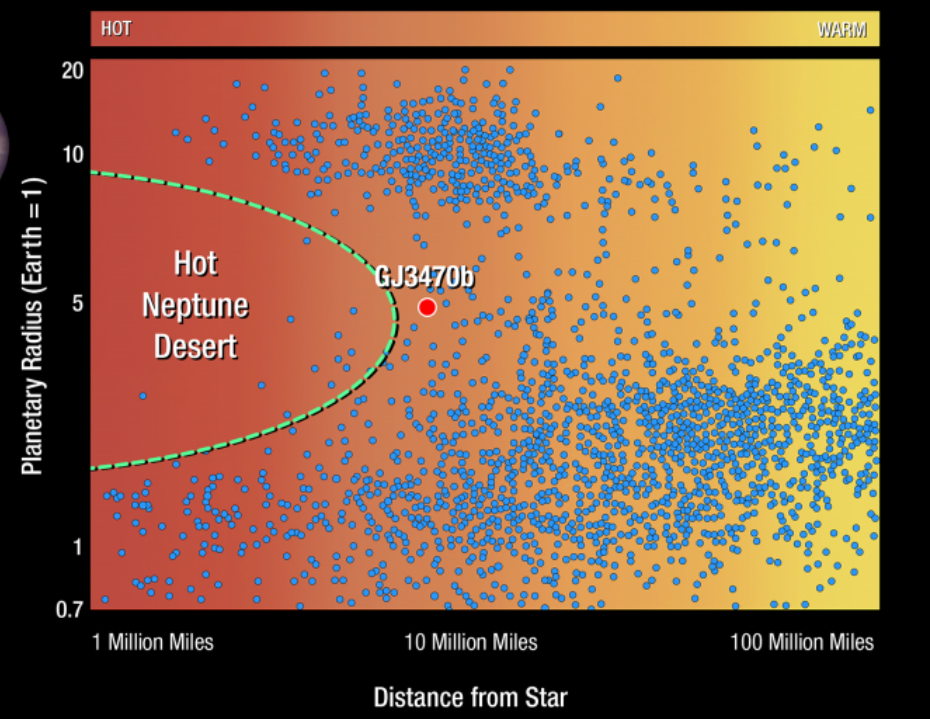
A graph showing the distribution of exoplanets with Neptune like sizes marking out the hot Neptunian desert.

(Image credit: NASA, ESA and A. Feild (STScI))

“RAVEN allows us to analyze enormous datasets consistently and objectively,” senior team member and University of Warwick researcher David Armstrong said in the statement. “Because the pipeline is well-tested and carefully validated, this is not just a list of potential planets — it is also reliable enough to use as a sample to map the prevalence of distinct types of planets around sun-like stars.”

Within the candidate close-in planets, researchers could then determine the types of planets and their populations in detail. This revealed that around 10% of stars like the sun host a close-in planet, validating findings made by TESS’s exoplanet-hunting predecessor Kepler.


What to read next

RAVEN was also able to help researchers determine just how rare close-in Neptune-size worlds are, finding that they occur around just 0.08% of sun-like stars. This absence of these worlds close to their parent star is referred to as the “Neptunian desert” by astronomers.

“For the first time, we can put a precise number on just how empty this ‘desert’ is,” leader of the Neptunian desert study team, Kaiming Cui of the University of Warwick said in the statement. “These measurements show that TESS can now match, and in some cases surpass, Kepler for studying planetary populations.”

The RAVEN results demonstrate the power of AI to search through vast swathes of astronomical data to spot subtle effects.

The team’s research was published across three papers in the journal Monthly Notices of the Royal Astronomical Society and is also available on the paper repository site arXiv.

Tags: NASArocket launch
No Result
View All Result

Recent Posts

  • Rattling the Roman Space Telescope | Space photo of the day for March 26, 2026
  • Incredible new NASA images reveal Saturn in a new light — and it’s all thanks to a telescope team-up from Webb and Hubble
  • Who is Artemis? Meet the Greek goddess who inspired NASA’s return to the moon
  • These 45 exoplanets may be the best places to search for alien life
  • Aim for the stars for under $15 with this Estes 2441 Mini Arcas Model Rocket Kit at Walmart, now 17% cheaper in the spring sales

Categories

  • Excursions
  • Kepler Mission
  • NASA
  • NASA Breaking News
  • Physical Preparation
  • Preparation
  • Space News
  • Space Station News
  • Spacewalks
  • Tours
  • Uncategorized
  • Weightlessness Training
  • What Not to Pack
  • What to Pack

Meta

  • Log in
  • Entries feed
  • Comments feed
  • WordPress.org
  • Home
  • Start Here
  • Preparing for Your Trip
  • Space Tourism Companies
  • Space Tours
  • Contact

© 2026 JNews - Premium WordPress news & magazine theme by Jegtheme.

No Result
View All Result
  • About
  • Contact
  • Feeds
  • Frequently Asked Questions
  • Preparing for Your Trip
    • Insurance and Legal Waivers
    • Physical and Medical Requirements
    • Training Programs
    • What to Expect
  • Privacy Policy
  • Space Tourism Companies
    • Axiom Space
    • Blue Origin
    • Blue Origin vs Virgin Galactic
    • Comparison Chart: Features, Pricing, Booking
    • SpaceX
    • Virgin Galactic
    • World View (stratospheric balloon flights)
  • Space Tours
    • Custom & Luxury Packages
    • Duration, Training, Costs
    • Experiences
    • Future Moon/Mars Options
    • Orbital Flights
    • Parabolic Flight Experiences
    • Private Missions
    • Stratospheric Balloon Flights
    • Suborbital Flights
    • Zero-Gravity Flights
  • Spaceflight Technologies
    • Space Tourism Balloon
  • Start Here
    • How to Book a Space Tour
    • Intro to Commercial Spaceflight
    • Is Space Tourism Safe?
    • Space Travel FAQs
    • View Earth from the Edge
    • What to Pack
  • Tours in Space is your launchpad to the world of space tourism

© 2026 JNews - Premium WordPress news & magazine theme by Jegtheme.