• Home
  • About
  • FAQ
  • Feeds
  • Glossary
  • Contact
Tours In Space
  • Home
  • Start Here
    • Intro to Commercial Spaceflight
    • How to Book a Space Tour
    • Is Space Tourism Safe?
    • Space Travel FAQs
    • View Earth from the Edge
    • What to Pack
  • Preparing for Your Trip
    • Insurance and Legal Waivers
    • Physical and Medical Requirements
    • Training Programs
    • What to Expect
  • Space Tourism Companies
    • Axiom Space
    • Blue Origin
    • SpaceX
    • Virgin Galactic
    • World View (stratospheric balloon flights)
    • Blue Origin vs Virgin Galactic
    • Comparison Chart: Features, Pricing, Booking
  • Space Tours
    • Custom & Luxury Packages
    • Duration, Training, Costs
    • Experiences
    • Future Moon/Mars Options
    • Orbital Flights
    • Parabolic Flight Experiences
    • Private Missions
    • Stratospheric Balloon Flights
    • Suborbital Flights
    • Zero-Gravity Flights
  • Spaceflight Technologies
    • Space Tourism Balloon
No Result
View All Result
  • Home
  • Start Here
    • Intro to Commercial Spaceflight
    • How to Book a Space Tour
    • Is Space Tourism Safe?
    • Space Travel FAQs
    • View Earth from the Edge
    • What to Pack
  • Preparing for Your Trip
    • Insurance and Legal Waivers
    • Physical and Medical Requirements
    • Training Programs
    • What to Expect
  • Space Tourism Companies
    • Axiom Space
    • Blue Origin
    • SpaceX
    • Virgin Galactic
    • World View (stratospheric balloon flights)
    • Blue Origin vs Virgin Galactic
    • Comparison Chart: Features, Pricing, Booking
  • Space Tours
    • Custom & Luxury Packages
    • Duration, Training, Costs
    • Experiences
    • Future Moon/Mars Options
    • Orbital Flights
    • Parabolic Flight Experiences
    • Private Missions
    • Stratospheric Balloon Flights
    • Suborbital Flights
    • Zero-Gravity Flights
  • Spaceflight Technologies
    • Space Tourism Balloon
No Result
View All Result
Tours In Space
No Result
View All Result
Home Uncategorized

Government use of commercial procurement models has limitations in space

Ensign by Ensign
March 27, 2026
in Uncategorized
0
Government use of commercial procurement models has limitations in space
189
SHARES
1.5k
VIEWS
Share on FacebookShare on Twitter
image

WASHINGTON — While government agencies are increasingly turning to commercial contracting mechanisms for space capabilities, that does not necessarily translate to additional business opportunities for the companies offering them.

During a panel at the Satellite 2026 conference March 26, executives of several companies developing advanced technologies such as in-space assembly and maneuvering vehicles said the government is, for the foreseeable future, the only customer for their capabilities.

“The idea that we can rely on commercial customers for a lot of what we do is, for us at least, not accurate,” said Eric Romo, president and chief operating officer of Impulse Space, a company developing highly maneuverable orbital transfer vehicles.

He argued that some of the capabilities his company is developing have little or no commercial demand. “The reality is that we make high-performance space vehicles that are made to run down foreign actors,” he said. “There’s not a lot of commercial uses for that. We don’t sell F-22s to commercial industry.”

The challenge, he and other panelists said, is that government agencies are pushing toward more commercial models for procurement, including for hardware for which they are the only customer.

Subscribe Today
Get unlimited access to SpaceNews.com and our digital magazine with a monthly, quarterly or annual subscription.

Discounted Access
Learn more about savings available for academic, government and military readers on SpaceNews subscriptions.

“The government is increasingly relying on commercial and planning for commercial to provide capabilities,” said Joe Landon, co-founder and president of Rendezvous Robotics, a startup developing in-space assembly technologies.

“There is a certain degree of risk there for the ability to deliver that capability, but also a big opportunity for the companies and their investors if we really can develop that capability,” he said.

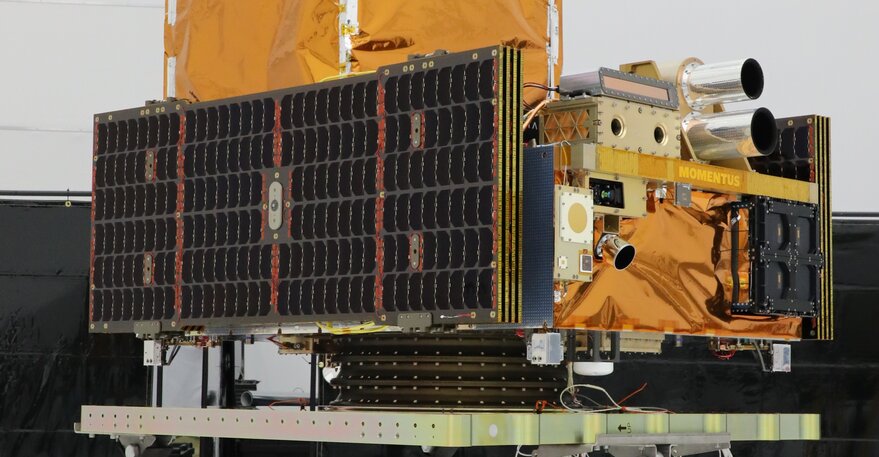
John Rood, chief executive of in-space transportation company Momentus, said he has heard from people in the government who want to buy more products and services commercially. That works in mature markets, he said, like communications, but may be less effective for technologies for use in space superiority.

“It probably won’t be developed commercially, or until very late,” he said. “It will not be the speed of relevance. It will not be in the period of relevance when you need it.”

Romo said one issue with commercial acquisitions is when government agencies want to acquire a specialized capability as a one-off acquisition. The Space Force and NASA, he said, often want to “buy one off the line” at a commercial price.

“The problem is that there is no commercial price for these more capable systems,” he said, because they are specialized for government needs.

He contrasted NASA’s approach to the Commercial Lunar Payload Services program, which buys lunar landers one at a time optimized for a specific mission, with the Commercial Orbital Transportation Services program that helped companies develop cargo vehicles for the International Space Station, followed by contracts for a series of missions.

The former approach, he argued, is not good for industry as companies seek to win contracts for individual landers that end up with low margins. “Competition is great, but competition where everybody competes themselves down to zero gross margins is not good,” he said.

There is some role for the government to help stimulate additional customers for capabilities it is seeking to purchase commercially. “I think the way NASA is approaching it, they’re showing a lot of success,” Rood said, citing its support for technology development for commercial applications.

For the Space Force, he said that while specific products might be specialized for military applications, there are other ways it can help companies generate demand, such as strategic financing and technology development funding.

“I think that’s been a very hit-and-miss activity. I would say the batting average is not very high right now,” he said. “You could see, for a relatively small number of dollars, substantially greater capabilities developed.”

Romo was more skeptical the Space Force should have a role in stimulating commercial demand.

“I think Space Force has a particularly competitive job to be done,” he said. “If they added that requirement that I’m now going to make the F-22 something that United Airlines wants, I just don’t think that’s a reasonable thing.”

Tags: NASAspace station
No Result
View All Result

Recent Posts

  • U.S. GSSAP satellites execute GEO handoff to monitor China’s Shijian-29 spacecraft
  • Space Command begins phased move to Alabama 
  • Government use of commercial procurement models has limitations in space
  • Turning growth into profits remains a challenge as space demand grows
  • Xona raises $170 million for satellite navigation network

Categories

  • Excursions
  • Kepler Mission
  • NASA
  • NASA Breaking News
  • Physical Preparation
  • Preparation
  • Space News
  • Space Station News
  • Spacewalks
  • Tours
  • Uncategorized
  • Weightlessness Training
  • What Not to Pack
  • What to Pack

Meta

  • Log in
  • Entries feed
  • Comments feed
  • WordPress.org
  • Home
  • Start Here
  • Preparing for Your Trip
  • Space Tourism Companies
  • Space Tours
  • Contact

© 2026 JNews - Premium WordPress news & magazine theme by Jegtheme.

No Result
View All Result
  • About
  • Contact
  • Feeds
  • Frequently Asked Questions
  • Preparing for Your Trip
    • Insurance and Legal Waivers
    • Physical and Medical Requirements
    • Training Programs
    • What to Expect
  • Privacy Policy
  • Space Tourism Companies
    • Axiom Space
    • Blue Origin
    • Blue Origin vs Virgin Galactic
    • Comparison Chart: Features, Pricing, Booking
    • SpaceX
    • Virgin Galactic
    • World View (stratospheric balloon flights)
  • Space Tours
    • Custom & Luxury Packages
    • Duration, Training, Costs
    • Experiences
    • Future Moon/Mars Options
    • Orbital Flights
    • Parabolic Flight Experiences
    • Private Missions
    • Stratospheric Balloon Flights
    • Suborbital Flights
    • Zero-Gravity Flights
  • Spaceflight Technologies
    • Space Tourism Balloon
  • Start Here
    • How to Book a Space Tour
    • Intro to Commercial Spaceflight
    • Is Space Tourism Safe?
    • Space Travel FAQs
    • View Earth from the Edge
    • What to Pack
  • Tours in Space is your launchpad to the world of space tourism

© 2026 JNews - Premium WordPress news & magazine theme by Jegtheme.