

by Erica Marchand
Los Angeles CA (SPX) Mar 30, 2026
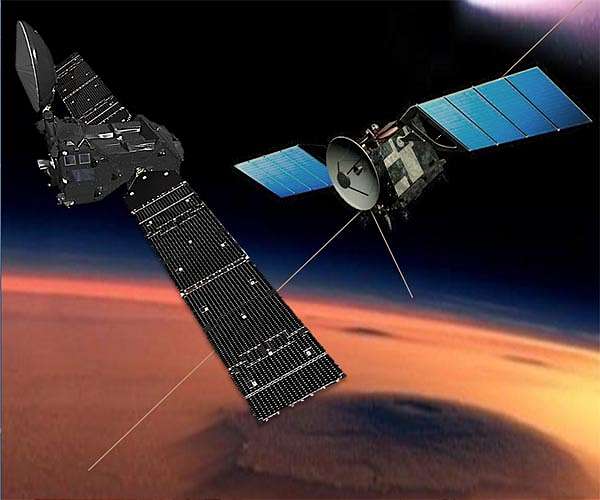
What happens when a solar superstorm slams into Mars? ESA scientists now have their clearest answer yet, thanks to coordinated observations by the agency’s Mars Express and ExoMars Trace Gas Orbiter (TGO).
In May 2024, the largest solar storm in more than two decades struck Earth, driving the atmosphere into overdrive and producing vivid auroras visible as far south as Mexico. The same storm also engulfed Mars, where ESA’s two orbiters were fortuitously in position to record the impact on the Red Planet’s upper atmosphere.
A new study led by ESA Research Fellow Jacob Parrott, to be published in Nature Communications, reports that Mars’s upper atmosphere was inundated with electrons during the event. According to Parrott, “The impact was remarkable: Mars’s upper atmosphere was flooded by electrons. It was the biggest response to a solar storm we’ve ever seen at Mars.”
The storm produced a dramatic rise in electron densities in two distinct atmospheric layers at altitudes of roughly 110 and 130 kilometers. Electron numbers increased by about 45 percent in the lower layer and by approximately 278 percent in the higher layer, representing the highest electron densities ever recorded in that region of the martian atmosphere.
The superstorm also affected spacecraft systems. Both Mars Express and TGO experienced computer errors linked to the intense space weather environment, a known hazard when highly energetic particles bombard electronics in orbit. The orbiters are equipped with radiation-hardened components and dedicated systems to detect, correct, and recover from such errors, and both spacecraft quickly resumed normal operations after the disturbances.
To probe how the storm altered Mars’s atmosphere, the team employed a radio occultation technique now being pioneered at the Red Planet. In this experiment, Mars Express transmitted a radio signal toward TGO just as Mars Express was dropping behind the martian horizon from TGO’s perspective. As the signal passed through different layers of the atmosphere, it was bent and refracted before being received by TGO, allowing scientists to reconstruct temperature, density, and electron profiles with altitude.
Radio occultation has a long heritage in planetary exploration when spacecraft send signals back to Earth, but only in the past few years has ESA begun to use orbiter-to-orbiter links at Mars. Mars Express and TGO typically use their radios to relay data between orbiters and surface assets such as rovers, but in this case they doubled as a powerful atmospheric probe. Observations from NASA’s MAVEN mission provided an independent check on the electron density measurements.
“This technique has actually been used for decades to explore the Solar System, but using signals beamed from a spacecraft to Earth,” notes Colin Wilson, ESA project scientist for Mars Express and TGO and a co-author of the study. “It’s only in the past five years or so that we’ve started using it at Mars between two spacecraft, such as Mars Express and TGO, which usually use those radios to beam data between orbiters and rovers. It’s great to see it in action.”
The superstorm played out very differently at Earth and Mars, underscoring the contrasting space environments of the two worlds. At Earth, the global magnetic field deflects much of the incoming solar particles and channels some of them toward the poles, where they generate auroras. This magnetic shield muted the response of Earth’s upper atmosphere compared with the extreme electron buildup observed at Mars, which lacks a global magnetic field and is more directly exposed to the solar wind.
Understanding how solar activity affects planets and spacecraft is central to space weather forecasting across the Solar System. At Earth, severe solar storms can threaten astronauts, damage satellites, and disrupt power grids, radio links, and navigation systems. At Mars, the same processes can endanger orbiting hardware and alter the atmosphere in ways that influence both climate evolution and communications with spacecraft.
Because the Sun emits radiation and plasma in an irregular and often unpredictable way, capturing events like the May 2024 storm requires a measure of luck. Parrott explains that the team managed to carry out their orbiter-to-orbiter radio occultation just 10 minutes after a major solar flare struck Mars. With only two such occultation observations per week currently scheduled at Mars, the timing of this measurement was unusually fortunate.
The study follows the aftermath of three separate solar events that formed parts of the same extended storm. These included a powerful flare of electromagnetic radiation, a burst of high-energy particles, and a coronal mass ejection (CME) in which the Sun hurled a large cloud of magnetized plasma into space. Together, these phenomena drove fast streams of energetic, magnetized plasma and X-rays toward Mars.
When this solar onslaught reached the planet, the incoming particles and radiation collided with neutral atoms in the upper atmosphere, knocking electrons free and generating a dense population of charged particles. This process, known as ionization, transformed the structure of Mars’s ionosphere and created the extraordinary electron enhancements reported in the new work.
According to Wilson, the results deepen scientists’ understanding of how solar storms deposit energy and particles into Mars’s atmosphere over time. Mars is known to have lost vast quantities of water and most of its original atmosphere to space, likely driven in large part by the continuous flow of charged particles in the solar wind and episodes of extreme space weather. Studies of modern storms offer clues to how these processes may have shaped Mars’s climate history.
The findings also have immediate practical implications for future missions. The composition and structure of a planet’s atmosphere strongly influence how radio waves propagate, affecting both communications and radar sounding experiments. If Mars’s upper atmosphere becomes saturated with electrons during intense solar activity, radio signals used to probe the subsurface or to communicate with landers and rovers could be degraded or temporarily blocked.
As ESA plans future campaigns at Mars and at other planets, accounting for such space weather driven variability will be essential. Solar activity cycles, individual storm forecasts, and in situ monitoring by orbiters will all feed into mission design and operations to reduce risk and maximize science return under changing space conditions.
ESA already operates a fleet of spacecraft dedicated to monitoring the Sun and its effects. Solar Orbiter continuously observes the star from close range and has tracked major events including the May 2024 superstorm. It will soon be joined by Smile, a mission focused on how Earth’s magnetic field responds to the solar wind, scheduled for launch in 2026, and later by Vigil, due around 2031, which will monitor solar activity from a special vantage point to provide early warnings of potentially hazardous eruptions.
Research Report:Martian ionospheric response during the May 2024 solar superstorm
Related Links
ExoMars at ESA
Mars News and Information at MarsDaily.com
Lunar Dreams and more