

by Staff Writers for Penn News
University Park PA (SPX) Mar 30, 2026
Tardigrades, commonly known as water bears, may be better suited by a new name: Tardiguardians of the Galaxy. Unlike the fictional ragtag team of unenthusiastic heroes, the microscopic animals are providing real insight into how humans could adapt extraterrestrial resources to support space exploration, as well as whether such resources could help protect against the Earthly contaminants that humans might shed.
Co-led by Penn State Altoona Professor of Microbiology Corien Bakermans, an international research team recently found that tardigrade activity – a key indicator of their health – was significantly reduced when they were placed in simulated Martian regolith. That is the loose mineral deposits covering a planet’s or moon’s bedrock, similar to soil on Earth. However, simply washing the regolith with water prior to introducing the tardigrades appeared to remove some harmful element and mostly mitigate the impact on their activity. The findings, published in International Journal of Astrobiology, are a small step towards a giant leap for humanity, according to Bakermans.
“When considering sending people to non-Earth environments, we need to understand two things: how the environment will impact the people and how the people will impact the environment,” said Bakermans, who coordinates the Penn State Altoona’s biology program. “With this research, we’re looking at a potential resource for being able to grow plants as part of establishing a healthy community – but we’re also looking at whether there are any inherent damaging conditions in the regolith that could help protect against contamination from Earth, which is a goal of planetary protection.”
Planetary protection refers to keeping extraterrestrial bodies safe from Earth contaminants and vice versa. It also strives to keep the science enabled by space exploration – whether by humans or robot – as free of contaminants as possible. The practice was agreed upon by multiple countries and is regulated by several space agencies, including NASA.
In other words, Bakermans said, if a planet contains its own defense mechanism for extraterrestrial invaders in the regolith covering its surface, then that may be one less concern for those planning space missions. However, such a mechanism would likely mean that humans hoping to establish a base would be unable to adapt the regolith to support their needs, like growing food. If the defense were strong enough, it could also directly harm humans.
“We know a lot about bacteria and fungi in simulated regolith, but very little about how they impact animals – even microscopic animals, like tardigrades,” Bakermans said, explaining that simulated regolith is designed to precisely mimic the mineral and chemical composition of what is available on Mars’ surface. “We investigated the specific, isolated impact of the regolith on tardigrades.”
The researchers used two Martian regolith simulants, both of which mimic the regolith that NASA’s Curiosity Rover sampled from the Rocknest deposit at the Gale Crater, south of the planet’s equator. One simulant, MGS-1, was developed first to serve as a “global” regolith representing the planet’s surface at large. The other, OUCM-1, was developed later to more closely imitate the specific sampling area, with specific attention to chemical composition in addition to mineral makeup.
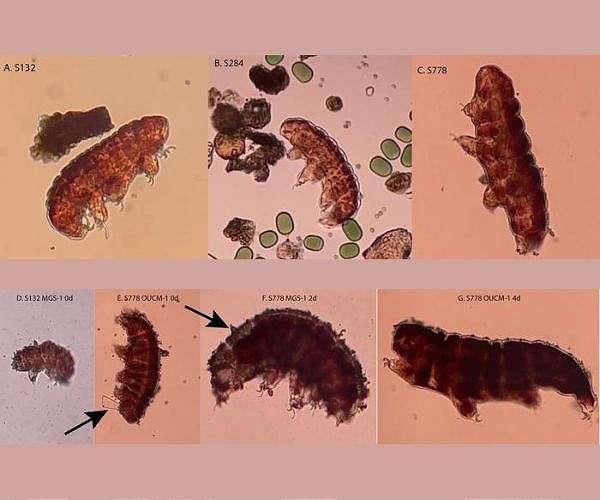
Bakermans mixed active tardigrades with samples of each regolith simulant and used a microscope to check their activity levels over several days.
“For the MGS-1 simulant, we saw significant inhibition – reduced activity – within two days,” Bakermans said. “It was very damaging compared to OUCM-1, which was still inhibitory but much less so.”
Tardigrades have two states: active and dormant. In their dormant state, which is typically achieved via severe dehydration, they can survive the vacuum of space, the depths of the ocean and nearly everything in between. When made active via rehydration, tardigrades are slightly more delicate but still capable of remaining active in freezing temperatures, changing food availability and other difficult conditions. The tardigrades exposed to MGS-1, however, did not exhibit activity after only two days of exposure.
“We were a little surprised by how damaging MGS-1 was,” Bakermans said. “We theorized that there might be something specific in the simulant that could be washed away.”
The researchers rinsed MGS-1 with water and mixed it with fresh tardigrades. Those tardigrades had almost no reduced activity.
“It seems that there is something very damaging in MGS-1 that can dissolve in water – maybe salts or some other compound,” Bakermans said, noting the team was investigating further. “That was unexpected, but it is good in a sense, because it means that the regolith’s defense mechanism could stop contaminants. At the same time, it can be washed to help support plant growth or prevent damage to humans who come in contact with it.”
Water is scarce in space, so washing regolith is not a perfect solution, but Bakermans said understanding that the harmful component can be washed away is helpful in building a useful knowledge base.
In addition to studying the effects of specific regolith constituents, the researchers are also exploring additional conditions – such as atmospheric pressure and temperature differences – that may impact activity.
“Regolith is not the only component, of course,” Bakermans said. “But we are beginning to tease apart components of this overall system where any single piece could be a drawback or benefit the larger understanding of planetary protection.”
Research Report:Short-term survival of tardigrades (Ramazzottius cf. varieornatus and Hypsibius exemplaris) in martian regolith simulants (MGS-1 and OUCM-1)
Related Links
Penn State
Mars News and Information at MarsDaily.com
Lunar Dreams and more