• Home
  • About
  • FAQ
  • Feeds
  • Glossary
  • Contact
Tours In Space
  • Home
  • Start Here
    • Intro to Commercial Spaceflight
    • How to Book a Space Tour
    • Is Space Tourism Safe?
    • Space Travel FAQs
    • View Earth from the Edge
    • What to Pack
  • Preparing for Your Trip
    • Insurance and Legal Waivers
    • Physical and Medical Requirements
    • Training Programs
    • What to Expect
  • Space Tourism Companies
    • Axiom Space
    • Blue Origin
    • SpaceX
    • Virgin Galactic
    • World View (stratospheric balloon flights)
    • Blue Origin vs Virgin Galactic
    • Comparison Chart: Features, Pricing, Booking
  • Space Tours
    • Custom & Luxury Packages
    • Duration, Training, Costs
    • Experiences
    • Future Moon/Mars Options
    • Orbital Flights
    • Parabolic Flight Experiences
    • Private Missions
    • Stratospheric Balloon Flights
    • Suborbital Flights
    • Zero-Gravity Flights
  • Spaceflight Technologies
    • Space Tourism Balloon
No Result
View All Result
  • Home
  • Start Here
    • Intro to Commercial Spaceflight
    • How to Book a Space Tour
    • Is Space Tourism Safe?
    • Space Travel FAQs
    • View Earth from the Edge
    • What to Pack
  • Preparing for Your Trip
    • Insurance and Legal Waivers
    • Physical and Medical Requirements
    • Training Programs
    • What to Expect
  • Space Tourism Companies
    • Axiom Space
    • Blue Origin
    • SpaceX
    • Virgin Galactic
    • World View (stratospheric balloon flights)
    • Blue Origin vs Virgin Galactic
    • Comparison Chart: Features, Pricing, Booking
  • Space Tours
    • Custom & Luxury Packages
    • Duration, Training, Costs
    • Experiences
    • Future Moon/Mars Options
    • Orbital Flights
    • Parabolic Flight Experiences
    • Private Missions
    • Stratospheric Balloon Flights
    • Suborbital Flights
    • Zero-Gravity Flights
  • Spaceflight Technologies
    • Space Tourism Balloon
No Result
View All Result
Tours In Space
No Result
View All Result
Home Space News

1st results from Blue Ghost lunar lander reveal how much we still don’t know about the moon

Ensign by Ensign
April 6, 2026
in Space News
0
1st results from Blue Ghost lunar lander reveal how much we still don’t know about the moon
189
SHARES
1.5k
VIEWS
Share on FacebookShare on Twitter

The first science results from a private spacecraft on the moon are challenging long-standing ideas about how our natural satellite evolved.

Researchers analyzing data from Firefly Aerospace’s Blue Ghost lander, which landed on the moon in March 2025 and operated for about two weeks on the lunar surface, said the new measurements cast doubt on the decades-old view of the moon as divided between a hotter near side — the face visible from Earth — and cooler regions elsewhere.

“We need to take a second look at how we define the hot region on the moon,” Seiichi Nagihara, a geophysicist at Texas Tech University and principal investigator of Blue Ghost’s heat-flow probe, said at at the Lunar and Planetary Science Conference in Texas in March.


You may like

The prevailing idea stems in part from observations that most of the moon’s lava flows are concentrated on the near side, forming the dark plains, or lunar maria, visible from Earth. Samples returned during the Apollo missions have linked this to higher concentrations of heat-producing radioactive elements such as thorium, whose decay likely fueled ancient volcanic eruptions, while much of the rest of the moon remained comparatively cooler.

The car-sized Blue Ghost deliberately targeted Mare Crisium — a volcanic plain “far outside” the traditionally defined heat-rich region — where the interior was expected to be cooler, Nagihara said.

Previous measurements of this kind, from NASA’s Apollo 15 and Apollo 17 missions over 50 years ago, were taken at the edges of major impact basins — Mare Imbrium and Mare Serenitatis, respectively — both geologically complex regions.

“This time we wanted to go to a relatively simpler place,” Nagihara said, “so we just landed in the middle of the Mare [Crisium].”
Breaking space news, the latest updates on rocket launches, skywatching events and more!

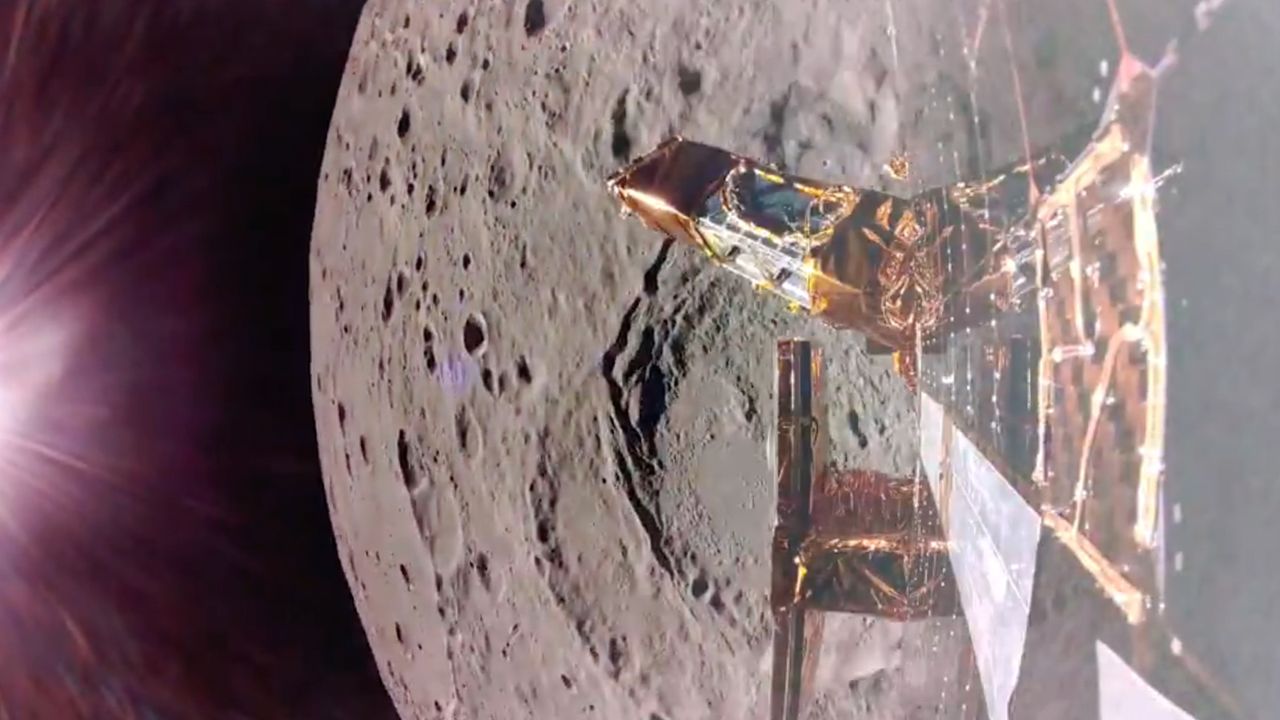
Firefly Aerospace's Blue Ghost lunar lander snapped this shot of the moon from an altitude of about 62 miles (100 kilometers) on Feb. 24, 2025.

Firefly Aerospace’s Blue Ghost lunar lander snapped this shot of the moon from an altitude of about 62 miles (100 kilometers) on Feb. 24, 2025. (Image credit: Firefly Aerospace)

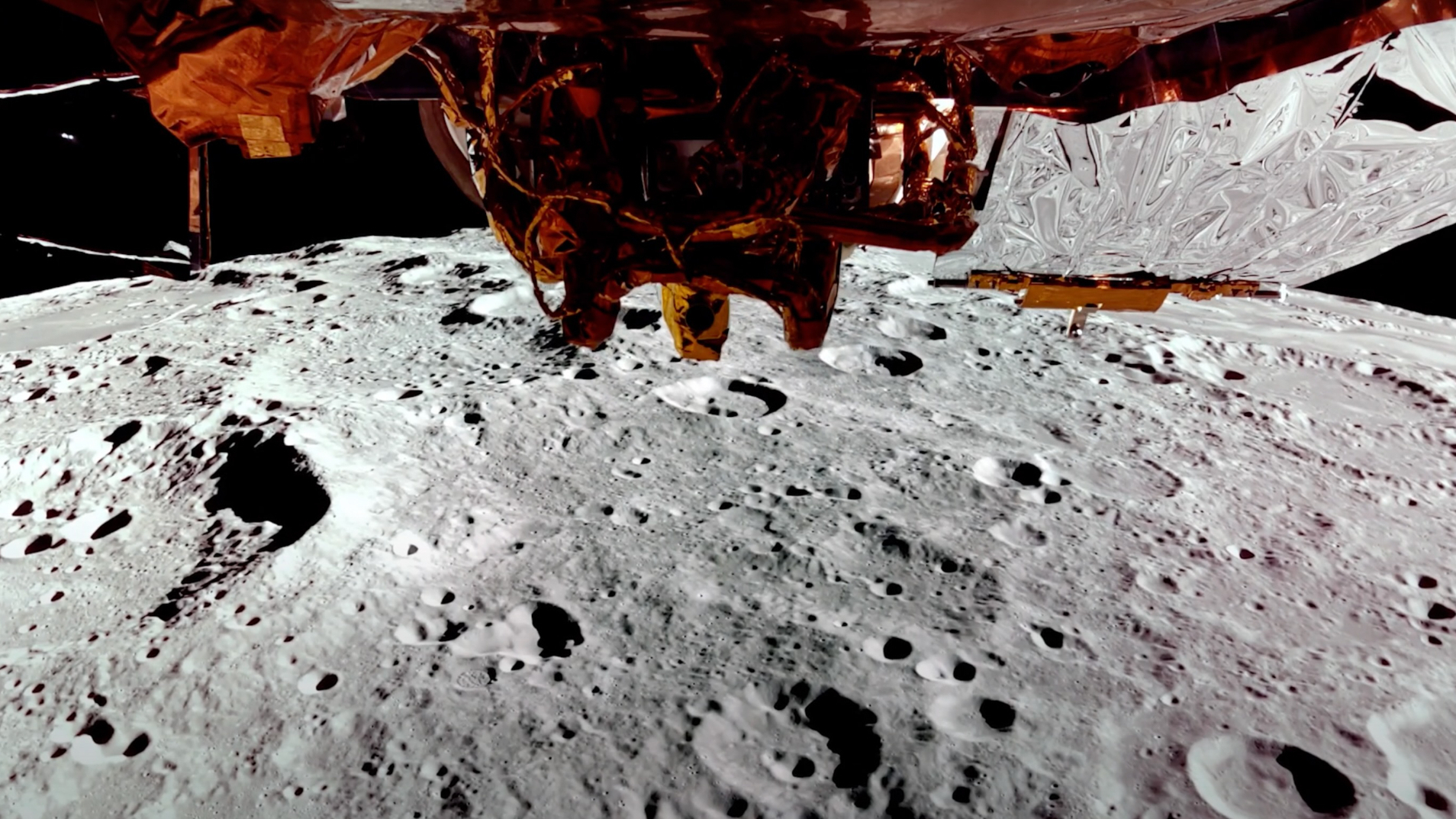
To estimate how much heat is escaping from the moon’s interior at the landing site, scientists used one of the lander’s 10 instruments, LISTER — a drill-based heat probe mounted on the underside of the spacecraft — to take measurements at incremental depths below the surface.

Before the mission, researchers had hoped LISTER would penetrate deeper than 1 meter into the subsurface, where temperatures are less affected by extreme day-night cycles. But as the instrument drilled using compressed nitrogen gas, it encountered dense, rocky soil that made excavation difficult, Nagihara said.

“It didn’t go that well,” he recalled. “We kept trying for a while, but it didn’t make much progress.”


What to read next

LISTER ultimately drilled to a depth of close to 36 inches (98 centimeters) within 24 hours, taking eight measurements along the way. Those measurements show heat flow at the landing site was comparable to values recorded during NASA’s Apollo 15 and Apollo 17 missions.
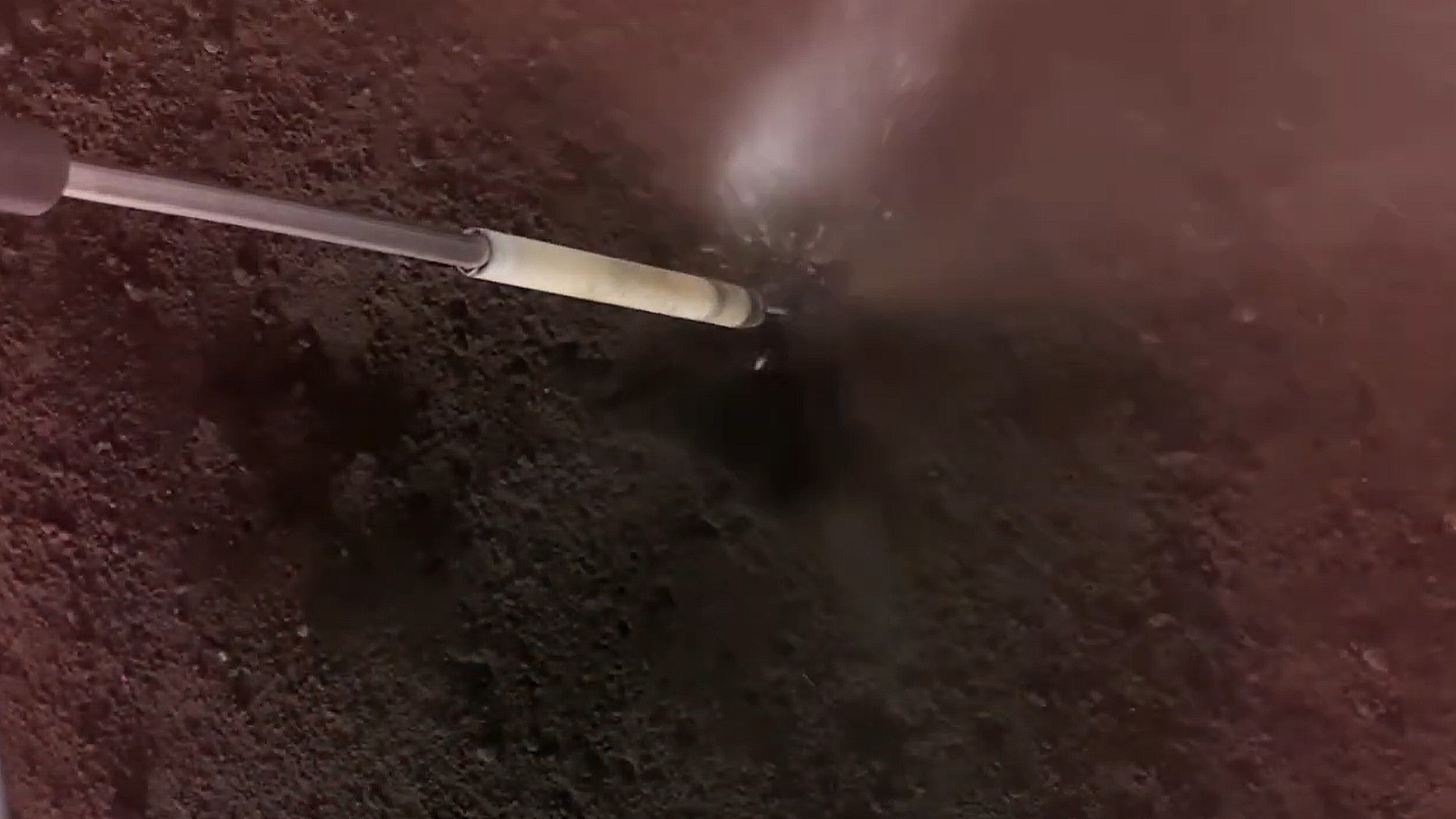
a long, thin metal tube extends into a black-grey dusty surface, and a cloud of dust and sparks forms where the two meet

The Lunar Instrumentation for Subsurface Thermal Exploration with Rapidity (LISTER) experiment aboard Firefly Aerospace’s Blue Ghost moon lander drills into the lunar surface in March 2025. (Image credit: Firefly Aerospace)

The result suggests that heat-producing elements such as thorium may be more widely distributed beneath the lunar surface than previously thought, researchers say.

One possible explanation is that volcanism may have been more active in some regions simply because the crust there is thinner, making it easier for magma to reach the surface, said Robert Grimm, a planetary geophysicist at the Southwest Research Institute during his March 17 presentation at the conference.

Grimm, who is the principal investigator of another instrument aboard Blue Ghost — the Lunar Magnetotelluric Sounder (LMS) — presented results from the device, which measured magnetic and electrical fields at the surface to infer temperatures inside the moon. Those findings suggest that heat-producing radioactive elements may be concentrated relatively close to the surface, within the crust, he said.

Scientists agree that more data will be needed to settle the debate. “We need more measurements,” Nagihara said.

That evidence may soon be on the way, as a growing fleet of robotic missions are set to explore regions of the moon beyond the Apollo landing sites with instruments designed to probe its interior in greater detail.

The push comes as NASA ramps up efforts to return humans to the moon under its Artemis program, a multibillion-dollar initiative aimed at establishing a sustained presence on the lunar surface and building the infrastructure needed for future exploration through the end of the decade.

Tags: future explorationNASArocket launch
No Result
View All Result

Recent Posts

  • Falcon 9 launches Cygnus cargo spacecraft to the ISS
  • NASA Science, Cargo Launch Aboard Northrop Grumman CRS-24
  • This Week In Space podcast: Episode 205 — All About Artemis
  • SpaceX launches huge ‘Cygnus XL’ cargo ship carrying over 5 tons of supplies to ISS astronauts (video)
  • Artemis 3 and beyond: What’s next for NASA after Artemis 2 moon success

Categories

  • Excursions
  • Kepler Mission
  • NASA
  • NASA Breaking News
  • Physical Preparation
  • Preparation
  • Space News
  • Space Station News
  • Spacewalks
  • Tours
  • Uncategorized
  • Weightlessness Training
  • What Not to Pack
  • What to Pack

Meta

  • Log in
  • Entries feed
  • Comments feed
  • WordPress.org
  • Home
  • Start Here
  • Preparing for Your Trip
  • Space Tourism Companies
  • Space Tours
  • Contact

© 2026 JNews - Premium WordPress news & magazine theme by Jegtheme.

No Result
View All Result
  • About
  • Contact
  • Feeds
  • Frequently Asked Questions
  • Preparing for Your Trip
    • Insurance and Legal Waivers
    • Physical and Medical Requirements
    • Training Programs
    • What to Expect
  • Privacy Policy
  • Space Tourism Companies
    • Axiom Space
    • Blue Origin
    • Blue Origin vs Virgin Galactic
    • Comparison Chart: Features, Pricing, Booking
    • SpaceX
    • Virgin Galactic
    • World View (stratospheric balloon flights)
  • Space Tours
    • Custom & Luxury Packages
    • Duration, Training, Costs
    • Experiences
    • Future Moon/Mars Options
    • Orbital Flights
    • Parabolic Flight Experiences
    • Private Missions
    • Stratospheric Balloon Flights
    • Suborbital Flights
    • Zero-Gravity Flights
  • Spaceflight Technologies
    • Space Tourism Balloon
  • Start Here
    • How to Book a Space Tour
    • Intro to Commercial Spaceflight
    • Is Space Tourism Safe?
    • Space Travel FAQs
    • View Earth from the Edge
    • What to Pack
  • Tours in Space is your launchpad to the world of space tourism

© 2026 JNews - Premium WordPress news & magazine theme by Jegtheme.