• Home
  • About
  • FAQ
  • Feeds
  • Glossary
  • Contact
Tours In Space
  • Home
  • Start Here
    • Intro to Commercial Spaceflight
    • How to Book a Space Tour
    • Is Space Tourism Safe?
    • Space Travel FAQs
    • View Earth from the Edge
    • What to Pack
  • Preparing for Your Trip
    • Insurance and Legal Waivers
    • Physical and Medical Requirements
    • Training Programs
    • What to Expect
  • Space Tourism Companies
    • Axiom Space
    • Blue Origin
    • SpaceX
    • Virgin Galactic
    • World View (stratospheric balloon flights)
    • Blue Origin vs Virgin Galactic
    • Comparison Chart: Features, Pricing, Booking
  • Space Tours
    • Custom & Luxury Packages
    • Duration, Training, Costs
    • Experiences
    • Future Moon/Mars Options
    • Orbital Flights
    • Parabolic Flight Experiences
    • Private Missions
    • Stratospheric Balloon Flights
    • Suborbital Flights
    • Zero-Gravity Flights
  • Spaceflight Technologies
    • Space Tourism Balloon
No Result
View All Result
  • Home
  • Start Here
    • Intro to Commercial Spaceflight
    • How to Book a Space Tour
    • Is Space Tourism Safe?
    • Space Travel FAQs
    • View Earth from the Edge
    • What to Pack
  • Preparing for Your Trip
    • Insurance and Legal Waivers
    • Physical and Medical Requirements
    • Training Programs
    • What to Expect
  • Space Tourism Companies
    • Axiom Space
    • Blue Origin
    • SpaceX
    • Virgin Galactic
    • World View (stratospheric balloon flights)
    • Blue Origin vs Virgin Galactic
    • Comparison Chart: Features, Pricing, Booking
  • Space Tours
    • Custom & Luxury Packages
    • Duration, Training, Costs
    • Experiences
    • Future Moon/Mars Options
    • Orbital Flights
    • Parabolic Flight Experiences
    • Private Missions
    • Stratospheric Balloon Flights
    • Suborbital Flights
    • Zero-Gravity Flights
  • Spaceflight Technologies
    • Space Tourism Balloon
No Result
View All Result
Tours In Space
No Result
View All Result
Home Space News

Galaxy starves its supermassive black hole, loses 95% of its brightness

Ensign by Ensign
April 8, 2026
in Space News
0
Galaxy starves its supermassive black hole, loses 95% of its brightness
189
SHARES
1.5k
VIEWS
Share on FacebookShare on Twitter

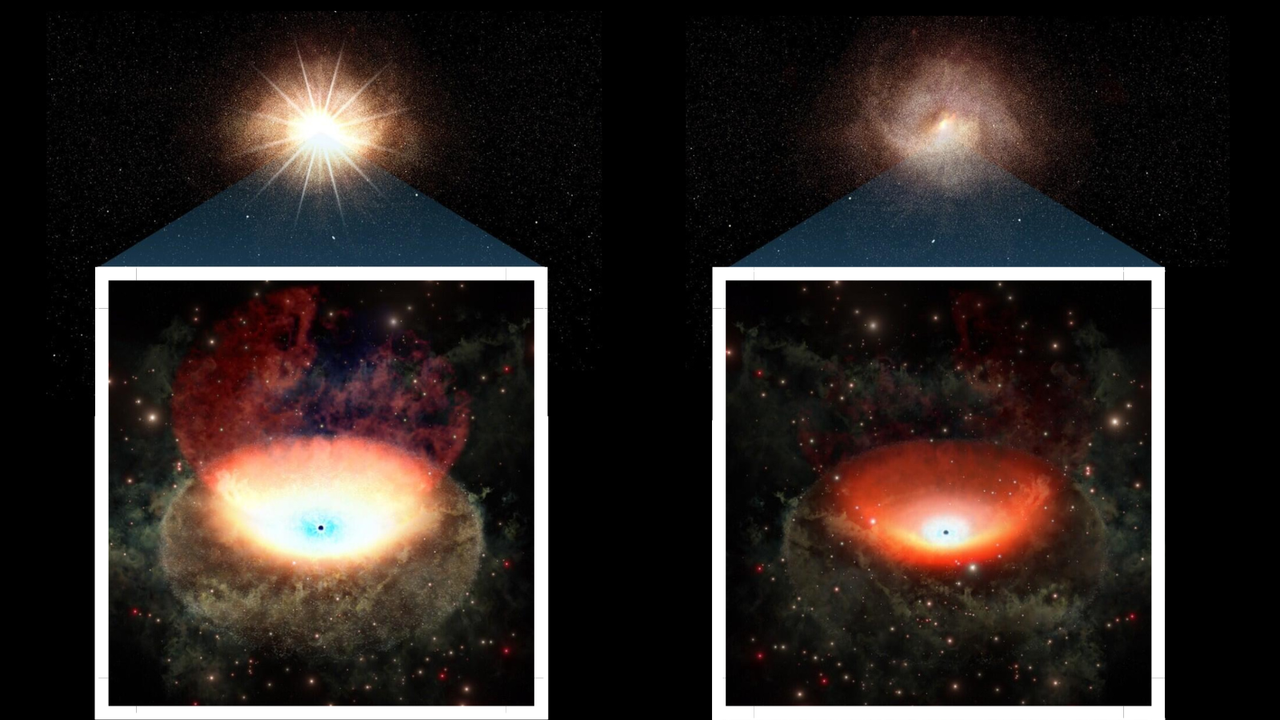
Astronomers watched a distant galaxy cut off the “food,” or general matter, flowing to its central supermassive black hole. As the regions around feeding black holes are often brighter than the combined light of every star in their host galaxy, this led to a radical change in brightness occurring over just 20 years. The starvation of this central black hole was marked by the galaxy dimming by 95%, dropping to 5% of its original brightness.

The discovery is remarkable because it demonstrates that the activity of supermassive black holes can radically change over timespans similar in scale to a human lifetime — rather than over thousands of years as current models suggest. As the first evidence of this rapid “starvation” the discovery could prompt a change in current black hole feeding models that suggest such changes take much longer to proceed.

While all galaxies are thought to have supermassive black holes with masses millions or even billions of times that of the sun at their hearts, not all of these cosmic titans are actively feeding. For instance, Sagittarius A* (Sgr A*), the supermassive black hole at the heart of the Milky Way, exists on a diet akin to a human eating one grain of rice every one million years.


You may like

When supermassive black holes are surrounded by a wealth of gas and dust, their immense gravitational influence causes this disk-shaped structure, called an accretion disk, to glow brightly. This cosmic larder region with a feeding black hole at its heart is called an active galactic nucleus (AGN), and can get so bright it outshines the combined light of every star in the surrounding host galaxy. When the flow of gas to the accretion disk is slowed, and the black hole’s larder is not restocked, the AGN’s brightness lowers. That is exactly what seems to be happening in this galaxy.

“It is fascinating that an active galactic nucleus can change its brightness so dramatically over such a short period of time, and that this fading appears to be caused by a large change in the accretion rate onto the supermassive black hole,” team leader Tomoki Morokuma of Chiba Institute of Technology said in a statement. “Using wide-field survey data, such as those from Hyper Suprime-Cam, we hope to discover more objects like this and learn how the activity of supermassive black holes shuts down and restarts.”

Supermassive black hole is put on a strict diet

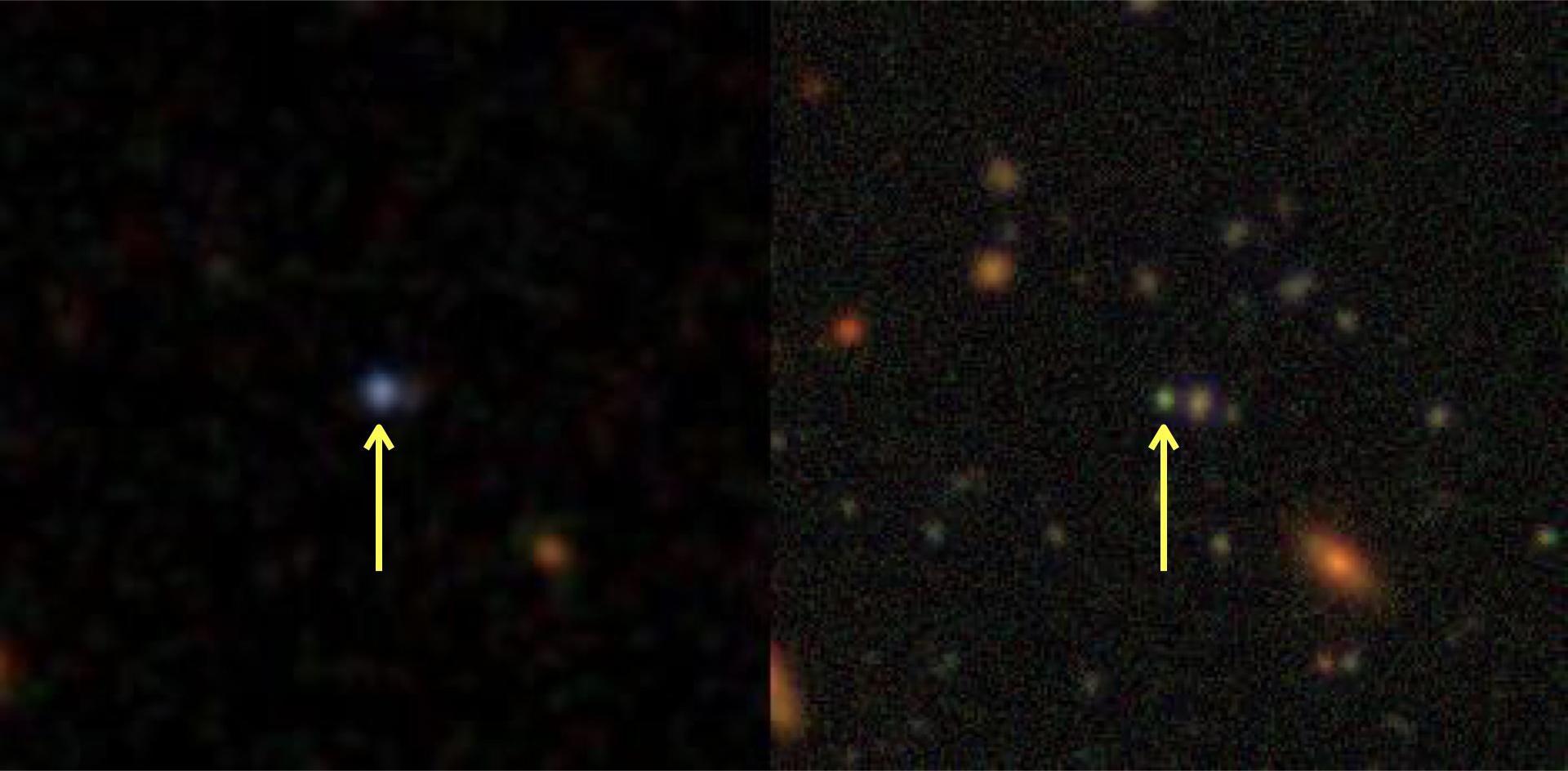
The international team of astronomers discovered that this black hole in the galaxy J0218−0036 was gradually being starved when they dived into two decades of archival astronomical data and compared images from the Sloan Digital Sky Survey (SDSS) with those from Hyper Suprime-Cam (HSC) on the Subaru Telescope.

This revealed a decline in brightness of 95% over 20 years. This is extreme compared to the usual variability of AGN brightness, which is around 30%. The team continued their investigation of the AGN using observations taken over 70 years, and by collecting new data from this AGN using the Gran Telescopio Canarias (GTC), the Subaru Telescope and the W. M. Keck Observatory, as well as an array of radio telescopes. This allowed them to track changes in brightness over a range of wavelengths from X-rays to infrared radiation.
Breaking space news, the latest updates on rocket launches, skywatching events and more!

On the left, a hazy blue dot. On the right, the same dot but more faded.

Visible-light images of the galaxy J0218−0036 (redshift 1.8; about 10 billion light-years away), indicated by the yellow arrows. The image on the left was taken by the Sloan Digital Sky Survey (SDSS), and the image on the right by Hyper Suprime-Cam (HSC) on the Subaru Telescope. Because HSC has higher sensitivity than SDSS, many additional faint objects are visible in the HSC image. Comparing the brightnesses in the two images shows that the galaxy faded dramatically between about 2002 (SDSS) and 2018 (HSC). (Image credit: SDSS, HSC-SSP/NAOJ)

Following this investigation, the team determined the rate at which gas was flowing from the accretion disk to this supermassive black hole had been cut by around 98% over the course of just seven years. That told the researchers the supply of matter to the accretion disk was rapidly decreasing.

The researchers confirmed this was a case of the food supply of this black hole being staunched, by ruling out the possibility that a cloud of gas had passed in front of the accretion disk, temporarily blocking its light. They determined that such blocking couldn’t account for changes across all the different wavelengths of light they studied.

Though the cut in gas supply to this AGN and the end of replenishment of the accretion disk that is gradually feeding this supermassive black hole are certain, what the team can’t be completely sure of is what is causing this cessation. Even with that mechanism shrouded in mystery, this research shows that changes in the mass accretion of supermassive black holes don’t always take thousands of years, as previously thought.

“This object shows rapid variability that cannot be explained by standard models. It provides an important test case for developing new theoretical models,” team member Toshihiro Kawaguchi of the University of Toyama said. “We will investigate what physical conditions could reproduce the observed behavior.”

The team’s research was published in the journal Publications of the Astronomical Society of Japan (PASJ).

Tags: rocket launch
No Result
View All Result

Recent Posts

  • ‘Audible screams of delight’ from NASA scientists over micrometeorite impacts on the moon witnessed by Artemis 2 astronauts
  • Artemis 2 astronauts spy the Milky Way | Space photo of the day for April 8, 2026
  • Artemis 2 moon astronauts capture space history — on their iPhones
  • Galaxy starves its supermassive black hole, loses 95% of its brightness
  • ‘It just made it even more special’: Being so far from Earth makes you appreciate our planet even more, Artemis 2 astronaut says

Categories

  • Excursions
  • Kepler Mission
  • NASA
  • NASA Breaking News
  • Physical Preparation
  • Preparation
  • Space News
  • Space Station News
  • Spacewalks
  • Tours
  • Uncategorized
  • Weightlessness Training
  • What Not to Pack
  • What to Pack

Meta

  • Log in
  • Entries feed
  • Comments feed
  • WordPress.org
  • Home
  • Start Here
  • Preparing for Your Trip
  • Space Tourism Companies
  • Space Tours
  • Contact

© 2026 JNews - Premium WordPress news & magazine theme by Jegtheme.

No Result
View All Result
  • About
  • Contact
  • Feeds
  • Frequently Asked Questions
  • Preparing for Your Trip
    • Insurance and Legal Waivers
    • Physical and Medical Requirements
    • Training Programs
    • What to Expect
  • Privacy Policy
  • Space Tourism Companies
    • Axiom Space
    • Blue Origin
    • Blue Origin vs Virgin Galactic
    • Comparison Chart: Features, Pricing, Booking
    • SpaceX
    • Virgin Galactic
    • World View (stratospheric balloon flights)
  • Space Tours
    • Custom & Luxury Packages
    • Duration, Training, Costs
    • Experiences
    • Future Moon/Mars Options
    • Orbital Flights
    • Parabolic Flight Experiences
    • Private Missions
    • Stratospheric Balloon Flights
    • Suborbital Flights
    • Zero-Gravity Flights
  • Spaceflight Technologies
    • Space Tourism Balloon
  • Start Here
    • How to Book a Space Tour
    • Intro to Commercial Spaceflight
    • Is Space Tourism Safe?
    • Space Travel FAQs
    • View Earth from the Edge
    • What to Pack
  • Tours in Space is your launchpad to the world of space tourism

© 2026 JNews - Premium WordPress news & magazine theme by Jegtheme.