• Home
  • About
  • FAQ
  • Feeds
  • Glossary
  • Contact
Tours In Space
  • Home
  • Start Here
    • Intro to Commercial Spaceflight
    • How to Book a Space Tour
    • Is Space Tourism Safe?
    • Space Travel FAQs
    • View Earth from the Edge
    • What to Pack
  • Preparing for Your Trip
    • Insurance and Legal Waivers
    • Physical and Medical Requirements
    • Training Programs
    • What to Expect
  • Space Tourism Companies
    • Axiom Space
    • Blue Origin
    • SpaceX
    • Virgin Galactic
    • World View (stratospheric balloon flights)
    • Blue Origin vs Virgin Galactic
    • Comparison Chart: Features, Pricing, Booking
  • Space Tours
    • Custom & Luxury Packages
    • Duration, Training, Costs
    • Experiences
    • Future Moon/Mars Options
    • Orbital Flights
    • Parabolic Flight Experiences
    • Private Missions
    • Stratospheric Balloon Flights
    • Suborbital Flights
    • Zero-Gravity Flights
  • Spaceflight Technologies
    • Space Tourism Balloon
No Result
View All Result
  • Home
  • Start Here
    • Intro to Commercial Spaceflight
    • How to Book a Space Tour
    • Is Space Tourism Safe?
    • Space Travel FAQs
    • View Earth from the Edge
    • What to Pack
  • Preparing for Your Trip
    • Insurance and Legal Waivers
    • Physical and Medical Requirements
    • Training Programs
    • What to Expect
  • Space Tourism Companies
    • Axiom Space
    • Blue Origin
    • SpaceX
    • Virgin Galactic
    • World View (stratospheric balloon flights)
    • Blue Origin vs Virgin Galactic
    • Comparison Chart: Features, Pricing, Booking
  • Space Tours
    • Custom & Luxury Packages
    • Duration, Training, Costs
    • Experiences
    • Future Moon/Mars Options
    • Orbital Flights
    • Parabolic Flight Experiences
    • Private Missions
    • Stratospheric Balloon Flights
    • Suborbital Flights
    • Zero-Gravity Flights
  • Spaceflight Technologies
    • Space Tourism Balloon
No Result
View All Result
Tours In Space
No Result
View All Result
Home Uncategorized

Ariane 6 launches Sentinel-1D radar imaging satellite

Ensign by Ensign
November 5, 2025
in Uncategorized
0
Ariane 6 launches Sentinel-1D radar imaging satellite
189
SHARES
1.5k
VIEWS
Share on FacebookShare on Twitter
image

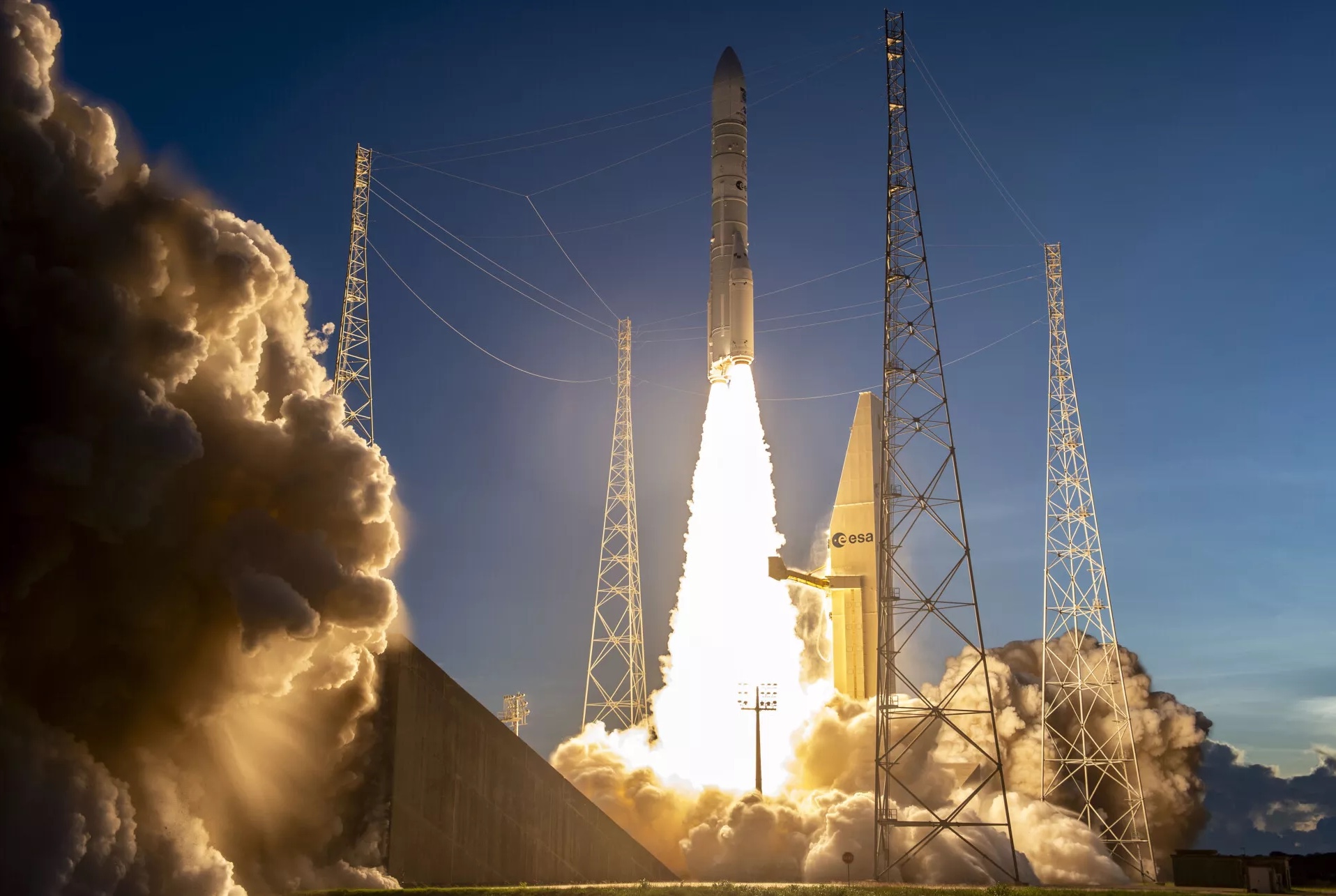
WASHINGTON — An Ariane 6 successfully launched a radar imaging satellite Nov. 4 after European agencies chose to use a larger rocket to ensure an earlier launch.

The Ariane 6 lifted off from the European spaceport in Kourou, French Guiana, at 4:02 p.m. Eastern. The payload, Sentinel-1D, separated from the upper stage 33½ minutes after liftoff.

Sentinel-1D, a 2,184-kilogram satellite built by Thales Alenia Space for the European Space Agency (ESA) and the European Commission’s Copernicus program, operates in a sun-synchronous orbit at 693 kilometers. It carries a C-band synthetic aperture radar and an Automatic Identification System (AIS) payload.

Like earlier Sentinel-1 satellites, Sentinel-1D will be used for Earth observation applications such as agriculture, flood monitoring and tracking ground motion, said Mauro Facchini, head of the Copernicus unit in DEFIS, the European Commission directorate responsible for space, during an Oct. 30 briefing.

The AIS payload detects ships and compares that data with radar imagery. “You can compare and combine the data,” Facchini said, allowing analysts to “check those vessels that are not transmitting,” such as ships involved in smuggling or piracy.

Subscribe Today
Get unlimited access to SpaceNews.com and our digital magazine with a monthly, quarterly or annual subscription.

Discounted Access
Learn more about savings available for academic, government and military readers on SpaceNews subscriptions.

Sentinel-1D replaces Sentinel-1A, which remains in operation more than 11 years after its launch but is showing signs of degradation, particularly in its propulsion system.

“It’s still working well, but in a degraded mode,” said Simonetta Cheli, ESA’s director of Earth observation, at the briefing. “We cannot take the risk, and that’s why we tried to launch 1D as fast as possible.”

Pierre Potin, head of ESA’s Copernicus Space Office, said that because of those propulsion concerns, ESA plans to begin lowering Sentinel-1A’s orbit once Sentinel-1D is commissioned. He said doing so is a requirement of a “responsible space agency” to ensure the satellite reenters within 25 years after the end of its mission.

Sentinel-1D joins Sentinel-1C, a similar radar imaging satellite launched last December on a Vega C rocket, marking that vehicle’s return to flight after a December 2022 launch failure.

ESA announced in January that it had signed a contract with Arianespace to launch Sentinel-1D on Ariane 6 but did not specify at the time why it was not flying on another Vega C.

At the Oct. 30 briefing, officials said Ariane 6 offered a faster path to orbit than Vega C. “We need to make sure that 1D is up and running as fast as possible, and this was really the reason why we were looking at best timing and the most urgent option,” Cheli said.

While ESA and other European agencies have in recent years launched some satellites on SpaceX’s Falcon 9, they chose not to in this case. “We needed to find the best European vehicles to launch these satellites as soon as possible,” Facchini said, referring to both Sentinel-1C and -1D. “We are trying to launch as much as possible with European vehicles.”

“Ariane 6 was the launcher able to launch Sentinel-1D at the requested slot by the customer,” said Caroline Arnoux, senior vice president and head of the Ariane 6 business unit at Arianespace. “So it was the best launcher for this mission.”

This was the third Ariane 6 launch this year and the fourth overall. One more Ariane 6 mission is scheduled for later this year, carrying two Galileo navigation satellites.

All Ariane 6 missions to date have used the Ariane 62 configuration, which has two solid-rocket boosters. The first flight of the Ariane 64, with four boosters, was expected this year, but Arianespace said Oct. 16 that it has been delayed to early 2026.

Tags: SpaceX
No Result
View All Result

Recent Posts

  • Germany outlines military space priorities in new strategy
  • Saturn’s rings will seem to disappear on Nov. 23: Here’s how to catch the illusion
  • Does the universe have extra dimensions hiding in plain sight?
  • Canon 8×20 IS binocular review
  • European Parliament member sees support for EU Space Act there

Categories

  • Excursions
  • Kepler Mission
  • NASA
  • NASA Breaking News
  • Physical Preparation
  • Preparation
  • Space News
  • Space Station News
  • Spacewalks
  • Tours
  • Uncategorized
  • Weightlessness Training
  • What Not to Pack
  • What to Pack

Meta

  • Log in
  • Entries feed
  • Comments feed
  • WordPress.org
  • Home
  • Start Here
  • Preparing for Your Trip
  • Space Tourism Companies
  • Space Tours
  • Contact

© 2025 JNews - Premium WordPress news & magazine theme by Jegtheme.

No Result
View All Result
  • About
  • Contact
  • Feeds
  • Frequently Asked Questions
  • Preparing for Your Trip
    • Insurance and Legal Waivers
    • Physical and Medical Requirements
    • Training Programs
    • What to Expect
  • Privacy Policy
  • Space Tourism Companies
    • Axiom Space
    • Blue Origin
    • Blue Origin vs Virgin Galactic
    • Comparison Chart: Features, Pricing, Booking
    • SpaceX
    • Virgin Galactic
    • World View (stratospheric balloon flights)
  • Space Tours
    • Custom & Luxury Packages
    • Duration, Training, Costs
    • Experiences
    • Future Moon/Mars Options
    • Orbital Flights
    • Parabolic Flight Experiences
    • Private Missions
    • Stratospheric Balloon Flights
    • Suborbital Flights
    • Zero-Gravity Flights
  • Spaceflight Technologies
    • Space Tourism Balloon
  • Start Here
    • How to Book a Space Tour
    • Intro to Commercial Spaceflight
    • Is Space Tourism Safe?
    • Space Travel FAQs
    • View Earth from the Edge
    • What to Pack
  • Tours in Space is your launchpad to the world of space tourism

© 2025 JNews - Premium WordPress news & magazine theme by Jegtheme.