• Home
  • About
  • FAQ
  • Feeds
  • Glossary
  • Contact
Tours In Space
  • Home
  • Start Here
    • Intro to Commercial Spaceflight
    • How to Book a Space Tour
    • Is Space Tourism Safe?
    • Space Travel FAQs
    • View Earth from the Edge
    • What to Pack
  • Preparing for Your Trip
    • Insurance and Legal Waivers
    • Physical and Medical Requirements
    • Training Programs
    • What to Expect
  • Space Tourism Companies
    • Axiom Space
    • Blue Origin
    • SpaceX
    • Virgin Galactic
    • World View (stratospheric balloon flights)
    • Blue Origin vs Virgin Galactic
    • Comparison Chart: Features, Pricing, Booking
  • Space Tours
    • Custom & Luxury Packages
    • Duration, Training, Costs
    • Experiences
    • Future Moon/Mars Options
    • Orbital Flights
    • Parabolic Flight Experiences
    • Private Missions
    • Stratospheric Balloon Flights
    • Suborbital Flights
    • Zero-Gravity Flights
  • Spaceflight Technologies
    • Space Tourism Balloon
No Result
View All Result
  • Home
  • Start Here
    • Intro to Commercial Spaceflight
    • How to Book a Space Tour
    • Is Space Tourism Safe?
    • Space Travel FAQs
    • View Earth from the Edge
    • What to Pack
  • Preparing for Your Trip
    • Insurance and Legal Waivers
    • Physical and Medical Requirements
    • Training Programs
    • What to Expect
  • Space Tourism Companies
    • Axiom Space
    • Blue Origin
    • SpaceX
    • Virgin Galactic
    • World View (stratospheric balloon flights)
    • Blue Origin vs Virgin Galactic
    • Comparison Chart: Features, Pricing, Booking
  • Space Tours
    • Custom & Luxury Packages
    • Duration, Training, Costs
    • Experiences
    • Future Moon/Mars Options
    • Orbital Flights
    • Parabolic Flight Experiences
    • Private Missions
    • Stratospheric Balloon Flights
    • Suborbital Flights
    • Zero-Gravity Flights
  • Spaceflight Technologies
    • Space Tourism Balloon
No Result
View All Result
Tours In Space
No Result
View All Result
Home Space News

Comet Lemmon photos are plagued by satellite streaks. Here’s how amateur astronomers face the problem

Ensign by Ensign
November 11, 2025
in Space News
0
Comet Lemmon photos are plagued by satellite streaks. Here’s how amateur astronomers face the problem
190
SHARES
1.5k
VIEWS
Share on FacebookShare on Twitter

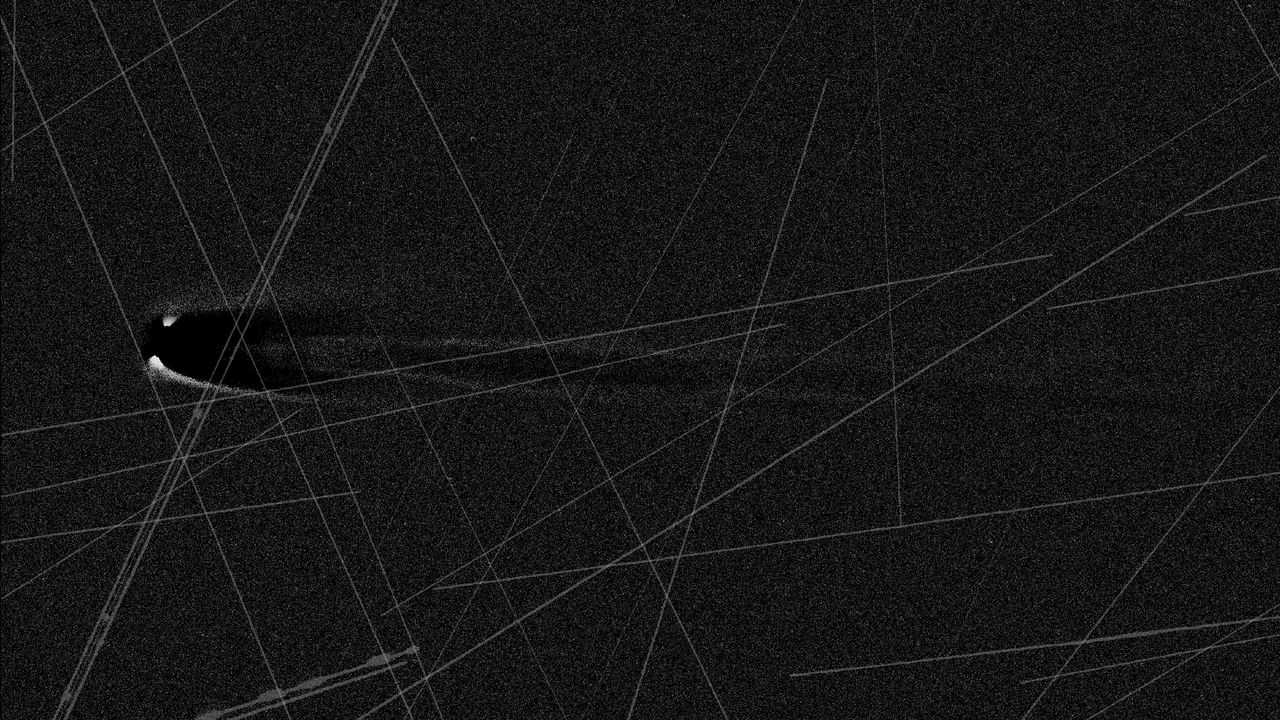
An image of a comet in black and white with lines streaking across the image.

A composite image of Comet Lemmon revealing where bright pixels were rejected by an image-stacking algorithm. (Image credit: Dan Bartlett)

Recent months have seen space fans revel in a wealth of spectacular astrophotography depicting the evolution of Comet Lemmon’s glowing coma and twisting tail as it journeyed through a Northern Hemisphere night sky swarming with satellites.

While the vast majority of photographers opted to post sanitized views of Comet Lemmon, others intentionally compiled their images to reveal the incredible number of satellites that crossed the night sky over the course of multiple exposures.

Three views of Comet Lemmon #cometlemmon (C/2026 A6) from Oct 26: wide in the evening twilight above Arcturus, and a telephoto closeup, without satellites (subtracted via stacking) & with the many satellites that crossed the field in 20 min., most #Starlink. Details in Alt Text pic.twitter.com/hUBwDd3zzfOctober 28, 2025

In each instance, Comet Lemmon is shown surrounded by a crazed network of thin, web-like lines, each of which represents the path of an orbiting satellite over the course of a short camera exposure.


You may like

“Photographically, if someone is attempting to take a single image of a target and needs the image to be ‘clean’ — free of manmade objects — well, that image is nearly impossible to obtain,” astrophotographer Dan Bartlett told Space.com in an email. “Every single subframe I take (prior to stacking) now contains at least one, and usually more than one satellite streak.”

There are currently about 13,000 operational satellites orbiting Earth, of which about 8,900 are SpaceX Starlink craft. This number is set to exponentially increase, with SpaceX alone aiming to orbit up to 42,000 of its internet-beaming spacecraft, while competing companies aim to add thousands more satellites to their own “megaconstellations.”
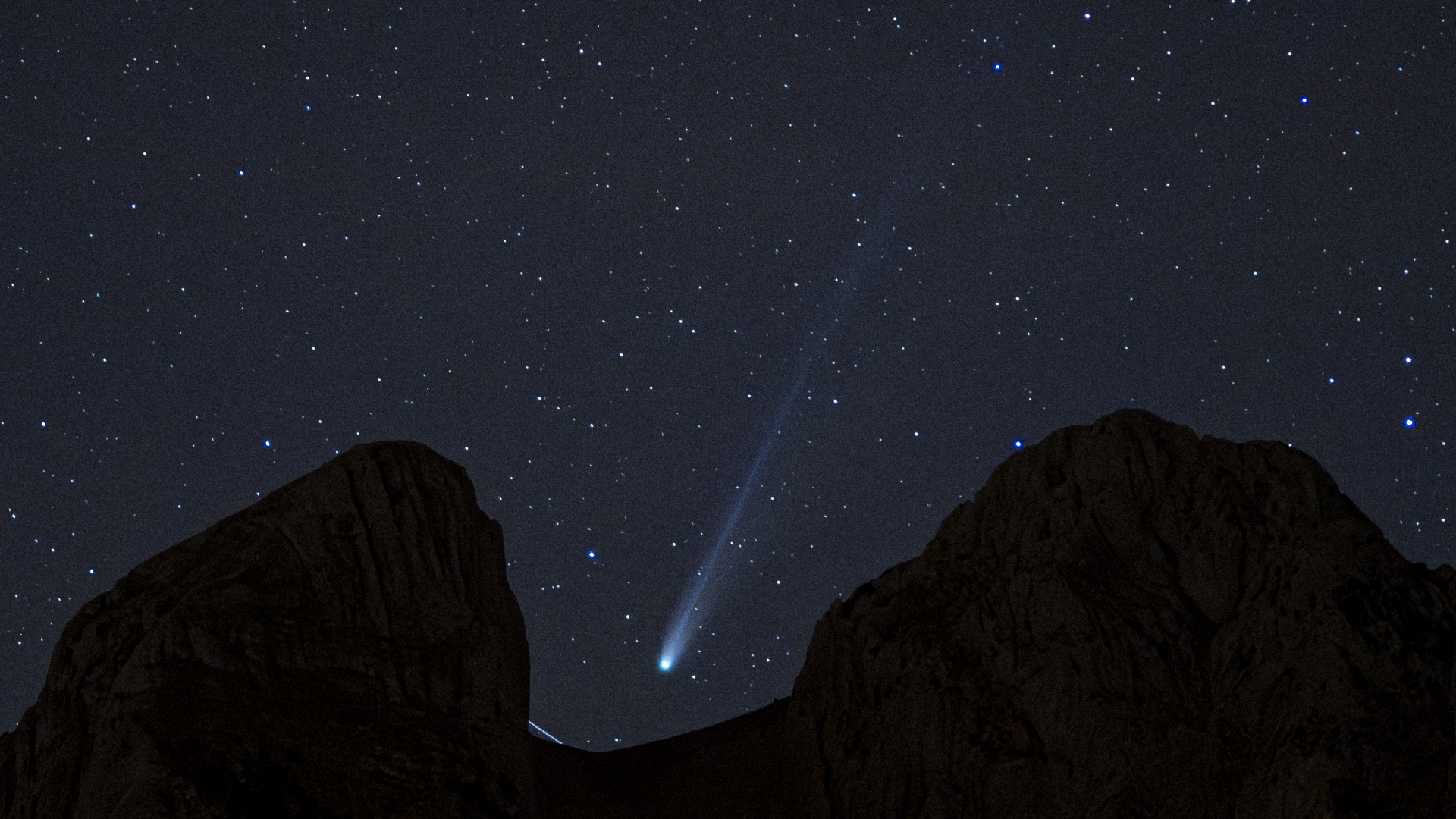
A white streak of a comet's tail can be seen in the center of the image as it streaks diagonally from top right to lower left between the dark silhouette of rocks blocking part of the starry night sky

Comet Lemmon streaks over Spain. (Image credit: Anadolu / Getty Images)

Thankfully, astrophotographers have access to powerful editing tools that allow them to remove the unsightly streaks with ease.

“Despite the enormous increase in satellite traffic over the past few years, eliminating the satellite trails in post processing is actually fairly simple using the right tools,” explained Bartlett. “I certainly don’t like seeing so many satellites everywhere I point my telescope or even a good pair of binoculars, but we’re still not at the point where you can’t enjoy the night sky (there can be a thrill seen visually when a satellite passes through your field of view).”

Breaking space news, the latest updates on rocket launches, skywatching events and more!

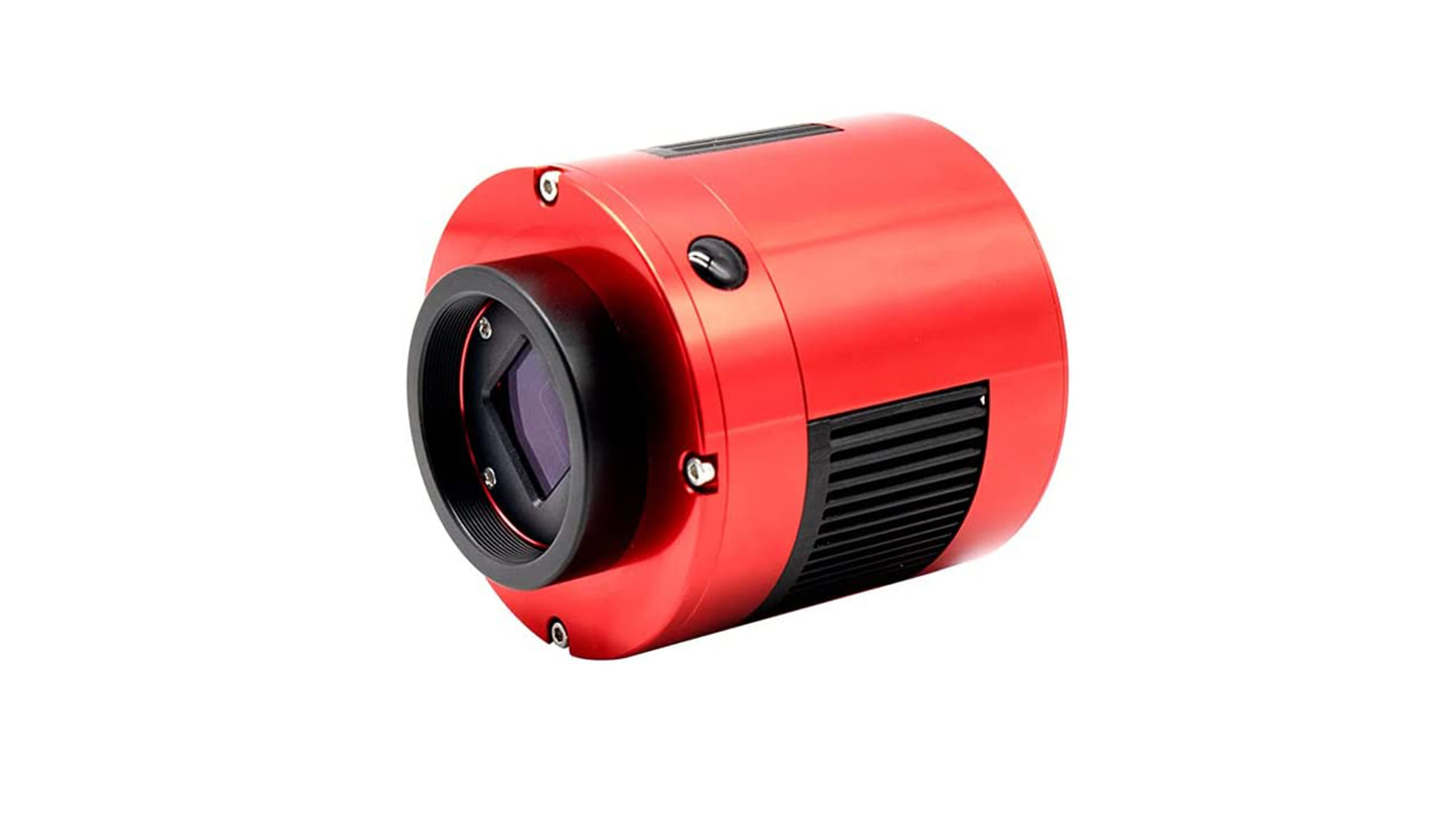
ZWO ASI533MC Pro

A product photo of the ZWO ASI1533MC Pro Camera

(Image credit: Amazon)

Looking to capture detailed images of the night sky for yourself? The ZWO ASI533MC Pro camera is the best dedicated astro camera out there, in our opinion. It features zero amp glow, 80% quantum efficiency and a 20FPS frame rate. It also features a 9MP sensor and you can check out our ZWO ASI533MC Pro review for a more in-depth look.

Astrophotographers combat satellite streaks by capturing a multitude of short exposures over the course of a single session. The images are then combined and subjected to an algorithm that determines a median value for each pixel before rejecting outlier pixels with values that exceed set parameters.

“If you take at least a dozen images to stack, then you can use a combine method called Sigma Rejection,” said astrophotographer Chris Schur in an email to Space.com. “This is available in nearly all astronomical imaging processing software. A single shot to up to about 6 images, the sigma does not have enough data to reject all the trails. So that’s why comet and deep-sky imagers take sets of at least a dozen images as a normal process, so that the stacking software has a good set to perform its algorithm.”

Image 1 of 5

The end result is a gorgeous composite image of an ancient solar system comet, which has been locked in an orbital dance around the sun since the creation of the planets over four billion years ago.

Stargazers looking to capture their own views of the night sky should check out our picks for the best cameras and lenses for astrophotography, along with our guide to observing and photographing comets.

<em>Editor’s Note: If you would like to share your comet astrophotography with Space.com’s readers, then please send your photo(s), along with your comments, name and the times and dates of your shoot to spacephotos@space.com.

Tags: EMMrocket launchStarlink
No Result
View All Result

Recent Posts

  • NGA Rapid Capabilities Office to embrace speed and risk-taking
  • Scolese puts talent at center of NRO transition as he prepares to step down
  • Bringing imagery and communications under one roof
  • Eutelsat and Station Satcom sign agreement to scale LEO services for maritime fleet
  • ‘Thor’ hammered down 15 years ago, and it’s still the only Marvel movie to do the God of Thunder justice

Categories

  • Excursions
  • Kepler Mission
  • NASA
  • NASA Breaking News
  • Physical Preparation
  • Preparation
  • Space News
  • Space Station News
  • Spacewalks
  • Tours
  • Uncategorized
  • Weightlessness Training
  • What Not to Pack
  • What to Pack

Meta

  • Log in
  • Entries feed
  • Comments feed
  • WordPress.org
  • Home
  • Start Here
  • Preparing for Your Trip
  • Space Tourism Companies
  • Space Tours
  • Contact

© 2026 JNews - Premium WordPress news & magazine theme by Jegtheme.

No Result
View All Result
  • About
  • Contact
  • Feeds
  • Frequently Asked Questions
  • Preparing for Your Trip
    • Insurance and Legal Waivers
    • Physical and Medical Requirements
    • Training Programs
    • What to Expect
  • Privacy Policy
  • Space Tourism Companies
    • Axiom Space
    • Blue Origin
    • Blue Origin vs Virgin Galactic
    • Comparison Chart: Features, Pricing, Booking
    • SpaceX
    • Virgin Galactic
    • World View (stratospheric balloon flights)
  • Space Tours
    • Custom & Luxury Packages
    • Duration, Training, Costs
    • Experiences
    • Future Moon/Mars Options
    • Orbital Flights
    • Parabolic Flight Experiences
    • Private Missions
    • Stratospheric Balloon Flights
    • Suborbital Flights
    • Zero-Gravity Flights
  • Spaceflight Technologies
    • Space Tourism Balloon
  • Start Here
    • How to Book a Space Tour
    • Intro to Commercial Spaceflight
    • Is Space Tourism Safe?
    • Space Travel FAQs
    • View Earth from the Edge
    • What to Pack
  • Tours in Space is your launchpad to the world of space tourism

© 2026 JNews - Premium WordPress news & magazine theme by Jegtheme.