• Home
  • About
  • FAQ
  • Feeds
  • Glossary
  • Contact
Tours In Space
  • Home
  • Start Here
    • Intro to Commercial Spaceflight
    • How to Book a Space Tour
    • Is Space Tourism Safe?
    • Space Travel FAQs
    • View Earth from the Edge
    • What to Pack
  • Preparing for Your Trip
    • Insurance and Legal Waivers
    • Physical and Medical Requirements
    • Training Programs
    • What to Expect
  • Space Tourism Companies
    • Axiom Space
    • Blue Origin
    • SpaceX
    • Virgin Galactic
    • World View (stratospheric balloon flights)
    • Blue Origin vs Virgin Galactic
    • Comparison Chart: Features, Pricing, Booking
  • Space Tours
    • Custom & Luxury Packages
    • Duration, Training, Costs
    • Experiences
    • Future Moon/Mars Options
    • Orbital Flights
    • Parabolic Flight Experiences
    • Private Missions
    • Stratospheric Balloon Flights
    • Suborbital Flights
    • Zero-Gravity Flights
  • Spaceflight Technologies
    • Space Tourism Balloon
No Result
View All Result
  • Home
  • Start Here
    • Intro to Commercial Spaceflight
    • How to Book a Space Tour
    • Is Space Tourism Safe?
    • Space Travel FAQs
    • View Earth from the Edge
    • What to Pack
  • Preparing for Your Trip
    • Insurance and Legal Waivers
    • Physical and Medical Requirements
    • Training Programs
    • What to Expect
  • Space Tourism Companies
    • Axiom Space
    • Blue Origin
    • SpaceX
    • Virgin Galactic
    • World View (stratospheric balloon flights)
    • Blue Origin vs Virgin Galactic
    • Comparison Chart: Features, Pricing, Booking
  • Space Tours
    • Custom & Luxury Packages
    • Duration, Training, Costs
    • Experiences
    • Future Moon/Mars Options
    • Orbital Flights
    • Parabolic Flight Experiences
    • Private Missions
    • Stratospheric Balloon Flights
    • Suborbital Flights
    • Zero-Gravity Flights
  • Spaceflight Technologies
    • Space Tourism Balloon
No Result
View All Result
Tours In Space
No Result
View All Result
Home Space News

Comet C/2025 K1 (ATLAS) splits into 3 pieces after a close brush with the sun (video)

Ensign by Ensign
November 17, 2025
in Space News
0
Comet C/2025 K1 (ATLAS) splits into 3 pieces after a close brush with the sun (video)
189
SHARES
1.5k
VIEWS
Share on FacebookShare on Twitter

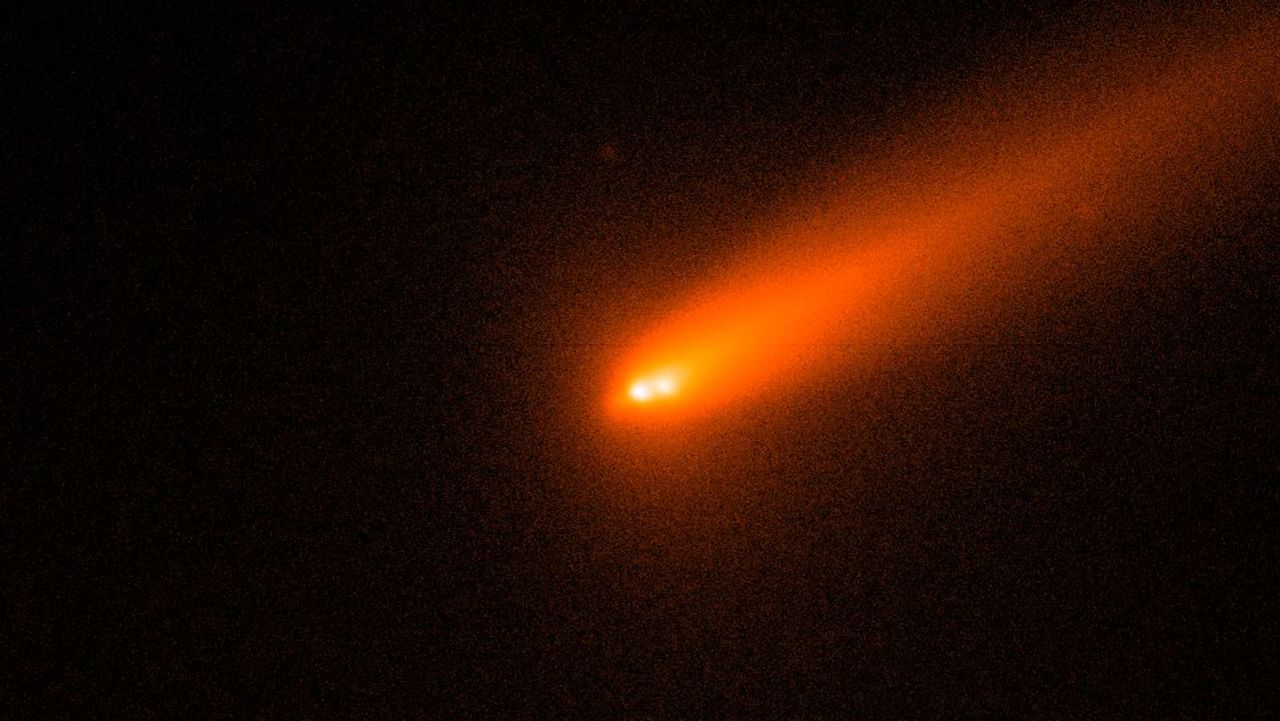
Astronomers have captured striking footage of the solar system comet C/2025 K1 (ATLAS) breaking apart on the nights following Nov. 11 after it was destabilized by a close brush with the sun in early October.

Comet C/2025 K1 (ATLAS) brightened significantly in the months following its May 2025 discovery. As it got closer to the sun and heated up, the frozen gases in its core turned into gas and formed a reflective cloud around it known as a coma. Solar wind caused this gas to blow out behind it, forming the characteristic tail seen on most visible comets.

Sadly, C/2025 K1 (ATLAS) didn’t brighten enough to become a naked eye comet. However, its close approach to the sun on Oct. 8 does appear to have wreaked havoc with the comet’s structural integrity, setting the stage for the dramatic fragmentation of its ancient nucleus. Luckily for us, the fragmentation was captured on Nov. 11-12 by astronomers using the 1.82 m Copernicus telescope at the Asiago Observatory in Italy.


You may like

The telescopic observations revealed that the comet had split into three large pieces by the night of Nov. 11. “From a first quick analysis of the images, we can confirm that there are definitely two fairly similar pieces, whose maximum brightness is separated by about 2,000 km,” wrote research astronomer Mazzotta Epifani in a statement published to the Italian National Institute for Astrophysics website, translated by Google. “Furthermore, we suspect the presence of a third, smaller and fainter fragment to the left of the pair,” observes Mazzotta Epifani.

Astronomer Gianluca Masi of the Virtual Telescope Project also captured spectacular views of the cometary fragmentation on the nights of Nov. 12-13, revealing a large section of the nucleus falling away from the sunward chunk.
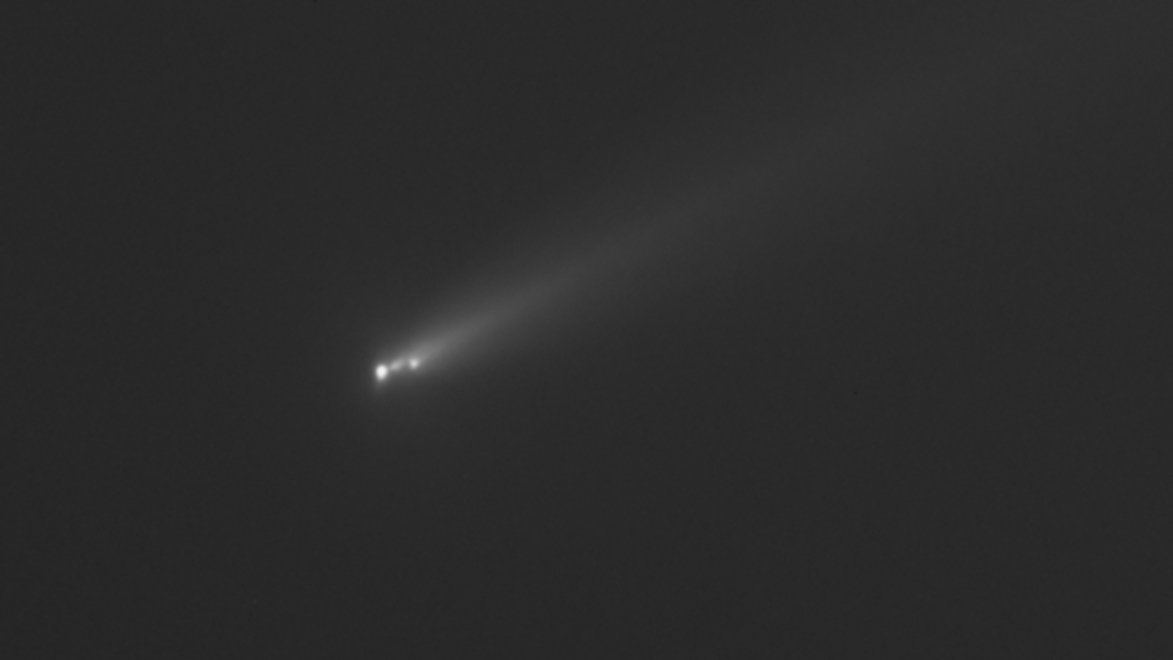
Three bright points of white light are pictured against a dark background representing the nucleus of a fractured comet, with a diffuse, hazy tail streaming away to the upper right of the image.

An image of C/2025 K1 (ATLAS) captured by Gianluca Masi of the Virtual Telescope Project. (Image credit: Gianluca Masi, Virtual Telescope Project)

“The animation shows how fragments appeared after the break-up of the original nucleus of C/2025 K1 evolved in 24 hours,” Masi told Space.com in an email. “Thanks to the good seeing (no atmospheric turbulence) and the high resolution provided by the telescope I used, I could record some precious details of such a dramatic event”.

Comet C/2025 K1 (ATLAS) is thought to have originated in a distant part of the solar system known as the Kuiper belt and may well have disintegrated during its first voyage into the inner solar system. As such, it represents a pristine time capsule, an analysis of which could help shed light on the composition of the planetary nebula that gave rise to the worlds we know today.

Breaking space news, the latest updates on rocket launches, skywatching events and more!

C/2025 K1 ATLAS is not related to the interstellar comet 3I/ATLAS, which has been dominating the news in recent weeks thanks to its exotic nature and conspiracy theories asserting that it was a color-shifting alien spacecraft. Rather, both comets’ names stem from the Asteroid Terrestrial-Impact Last Alert System (ATLAS) program by which they were discovered.

Photographers hoping to capture their own views of distant solar system comets should check out our roundups of the best smart telescopes, cameras and lenses for astrophotography, along with our guide to imaging the ancient solar system wanderers.

<em>Editor’s Note: If you would like to share your cometary astrophotography with Space.com’s readers, then please send your photo(s), comments, and your name and location to spacephotos@space.com.

Tags: rocket launch
No Result
View All Result

Recent Posts

  • Germany outlines military space priorities in new strategy
  • Saturn’s rings will seem to disappear on Nov. 23: Here’s how to catch the illusion
  • Does the universe have extra dimensions hiding in plain sight?
  • Canon 8×20 IS binocular review
  • European Parliament member sees support for EU Space Act there

Categories

  • Excursions
  • Kepler Mission
  • NASA
  • NASA Breaking News
  • Physical Preparation
  • Preparation
  • Space News
  • Space Station News
  • Spacewalks
  • Tours
  • Uncategorized
  • Weightlessness Training
  • What Not to Pack
  • What to Pack

Meta

  • Log in
  • Entries feed
  • Comments feed
  • WordPress.org
  • Home
  • Start Here
  • Preparing for Your Trip
  • Space Tourism Companies
  • Space Tours
  • Contact

© 2026 JNews - Premium WordPress news & magazine theme by Jegtheme.

No Result
View All Result
  • About
  • Contact
  • Feeds
  • Frequently Asked Questions
  • Preparing for Your Trip
    • Insurance and Legal Waivers
    • Physical and Medical Requirements
    • Training Programs
    • What to Expect
  • Privacy Policy
  • Space Tourism Companies
    • Axiom Space
    • Blue Origin
    • Blue Origin vs Virgin Galactic
    • Comparison Chart: Features, Pricing, Booking
    • SpaceX
    • Virgin Galactic
    • World View (stratospheric balloon flights)
  • Space Tours
    • Custom & Luxury Packages
    • Duration, Training, Costs
    • Experiences
    • Future Moon/Mars Options
    • Orbital Flights
    • Parabolic Flight Experiences
    • Private Missions
    • Stratospheric Balloon Flights
    • Suborbital Flights
    • Zero-Gravity Flights
  • Spaceflight Technologies
    • Space Tourism Balloon
  • Start Here
    • How to Book a Space Tour
    • Intro to Commercial Spaceflight
    • Is Space Tourism Safe?
    • Space Travel FAQs
    • View Earth from the Edge
    • What to Pack
  • Tours in Space is your launchpad to the world of space tourism

© 2026 JNews - Premium WordPress news & magazine theme by Jegtheme.