

BREMEN, Germany — A U.S. government official warned that a draft European space law could “stifle innovation,” as other countries also assess the potential impacts of the proposed legislation.
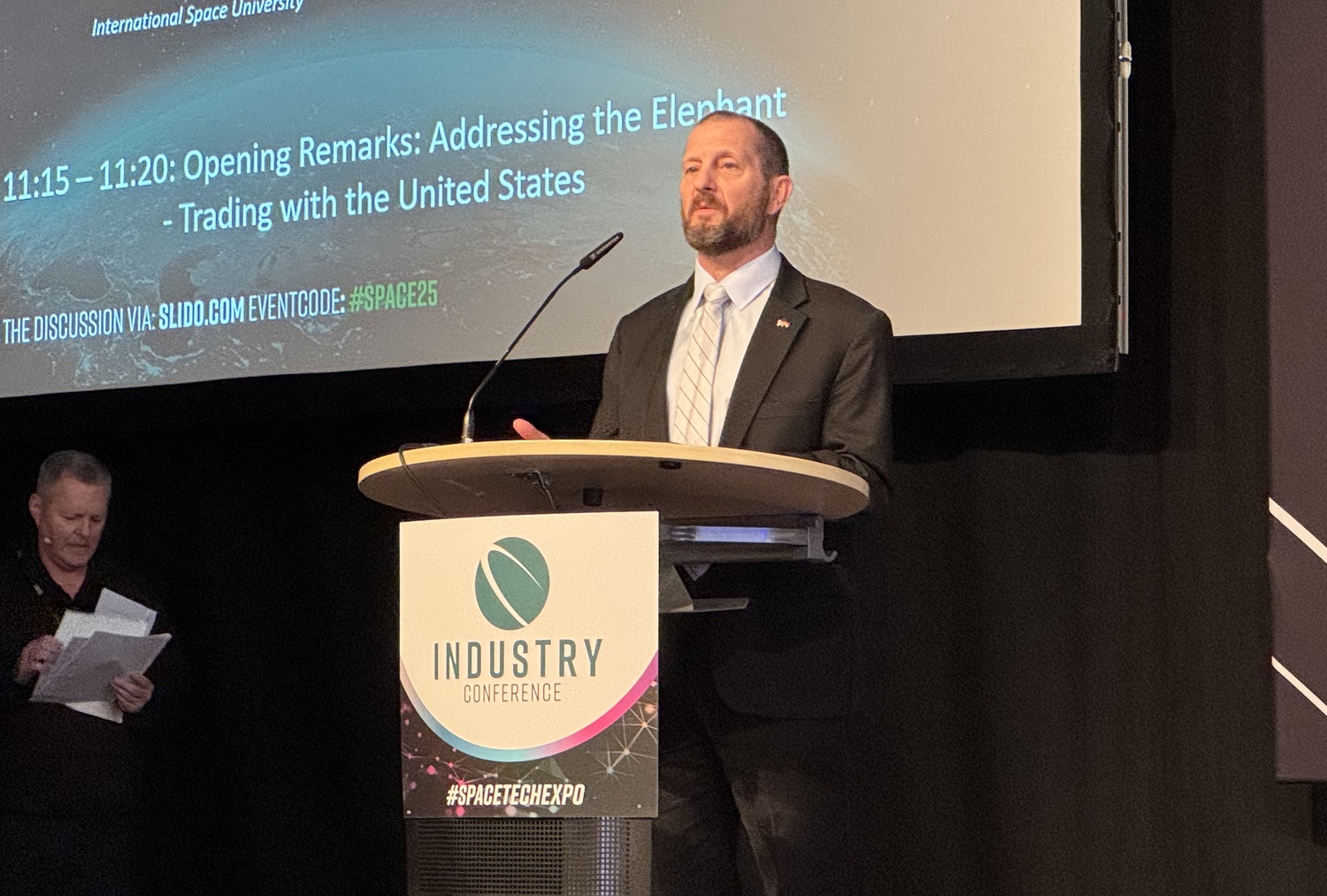
Speaking at Space Tech Expo Europe on Nov. 18, Scott Woodard, consul general at the U.S. Consulate in Hamburg, reiterated concerns about the proposed European Union Space Act, whose first draft was released in June. The act is intended to harmonize European space regulations and establish rules for topics such as space safety.
“We want to collaborate with Europe efficiently and fairly, with predictable rules that support innovation,” he said. “We hear concerns from both U.S. and European firms that certain proposed regulations stifle innovation, exclude U.S. participation and place financial burdens on U.S. companies.”
“Our view here is simple: No one can regulate their way to a technological lead,” he added, citing an August executive order calling for streamlined regulations for the U.S. space industry. “We hope the final EU Space Act will take a similarly forward-leaning approach.”
The U.S. State Department submitted formal comments on the draft law Nov. 4 as part of the European Commission’s public comment process. “As a general matter, the United States expresses deep concern regarding measures in the proposed act that would impose unacceptable regulatory burdens on U.S. providers of space services to European customers,” it wrote.
The department requested several changes, including more clarity about implementation, the process for mutual recognition of national space regulations and revisions to specific provisions.
One example is the act’s definition of a “giga-constellation” as a satellite system with more than 1,000 spacecraft, a category that currently applies only to U.S. operators. The State Department said it was unclear why such a threshold was needed and warned it could “result in additional burdens and restrictions on U.S. operators providing services for people abroad, including EU citizens.”
American companies and trade groups echoed those concerns. SpaceX called for the act to be “radically simplified” in areas related to space safety, saying it includes “prescribed regulatory requirements that will simply become stale and impractical as technologies mature.”
The U.S. Chamber of Commerce criticized the “excessive compliance costs” the act would impose on non-European companies, arguing that could “inadvertently slow investment and service deployment within Europe and to European customers.”
The United States is not alone in evaluating the act’s effects. Naomi Pryde, partner and global co-chair for space exploration and innovation at law firm DLA Piper in the United Kingdom, said she has been asked to determine what additional costs U.K. companies would incur to comply.
“Everyone is going to have reasonably significant costs at the outset in order to comply,” she said during a panel discussion at the conference. Those costs could be “significantly more” for non-EU countries like the U.K., she added.
Liechtenstein is not a member of the EU but is part of the European Economic Area (EEA), said Bianca Lins, lead for space in the Liechtenstein Office for Communications. Since the EU Space Act covers issues like a single market for space services in Europe, “it’s going to be incorporated into the EEA agreement and also means we have to transpose it into national law.”
Her concern, she said, is that the act “does not really consider the international obligations that every sovereign state has,” including responsibilities under the Outer Space Treaty. She expected Liechtenstein, Iceland and Norway — the other EEA states outside the EU — to submit comments on those issues.
Rodolphe Muñoz, team leader for space situational awareness and space traffic management in the European Commission’s directorate responsible for space, defended the act during the panel discussion.
“The U.S. is entitled to have the position they want, and we respect it,” he said. He noted the “very open, very transparent” discussions about the draft legislation during the 13th U.S.-EU Space Dialogue in Washington in September.
He said the commission is reviewing the nearly 120 comments submitted before the public comment period closed. Denmark, which holds the rotating presidency of the EU Council, aims to produce a revised draft before its term ends in December. That could set up a first vote by the European Parliament in summer 2026.
Muñoz argued that despite the criticism, most feedback was constructive. “The first page is quite critical,” he said of the State Department’s 13-page submission, “but the 12 others, which are the technical elements, are a piece of cake.”
“I prefer a position where the first page is rather negative and 12 others are manageable than the contrary: a very good idea but not feasible,” he said.