• Home
  • About
  • FAQ
  • Feeds
  • Glossary
  • Contact
Tours In Space
  • Home
  • Start Here
    • Intro to Commercial Spaceflight
    • How to Book a Space Tour
    • Is Space Tourism Safe?
    • Space Travel FAQs
    • View Earth from the Edge
    • What to Pack
  • Preparing for Your Trip
    • Insurance and Legal Waivers
    • Physical and Medical Requirements
    • Training Programs
    • What to Expect
  • Space Tourism Companies
    • Axiom Space
    • Blue Origin
    • SpaceX
    • Virgin Galactic
    • World View (stratospheric balloon flights)
    • Blue Origin vs Virgin Galactic
    • Comparison Chart: Features, Pricing, Booking
  • Space Tours
    • Custom & Luxury Packages
    • Duration, Training, Costs
    • Experiences
    • Future Moon/Mars Options
    • Orbital Flights
    • Parabolic Flight Experiences
    • Private Missions
    • Stratospheric Balloon Flights
    • Suborbital Flights
    • Zero-Gravity Flights
  • Spaceflight Technologies
    • Space Tourism Balloon
No Result
View All Result
  • Home
  • Start Here
    • Intro to Commercial Spaceflight
    • How to Book a Space Tour
    • Is Space Tourism Safe?
    • Space Travel FAQs
    • View Earth from the Edge
    • What to Pack
  • Preparing for Your Trip
    • Insurance and Legal Waivers
    • Physical and Medical Requirements
    • Training Programs
    • What to Expect
  • Space Tourism Companies
    • Axiom Space
    • Blue Origin
    • SpaceX
    • Virgin Galactic
    • World View (stratospheric balloon flights)
    • Blue Origin vs Virgin Galactic
    • Comparison Chart: Features, Pricing, Booking
  • Space Tours
    • Custom & Luxury Packages
    • Duration, Training, Costs
    • Experiences
    • Future Moon/Mars Options
    • Orbital Flights
    • Parabolic Flight Experiences
    • Private Missions
    • Stratospheric Balloon Flights
    • Suborbital Flights
    • Zero-Gravity Flights
  • Spaceflight Technologies
    • Space Tourism Balloon
No Result
View All Result
Tours In Space
No Result
View All Result
Home Space News

AI helps build the most detailed Milky Way simulation ever, mapping 100 billion stars

Ensign by Ensign
November 21, 2025
in Space News
0
AI helps build the most detailed Milky Way simulation ever, mapping 100 billion stars
189
SHARES
1.5k
VIEWS
Share on FacebookShare on Twitter
image

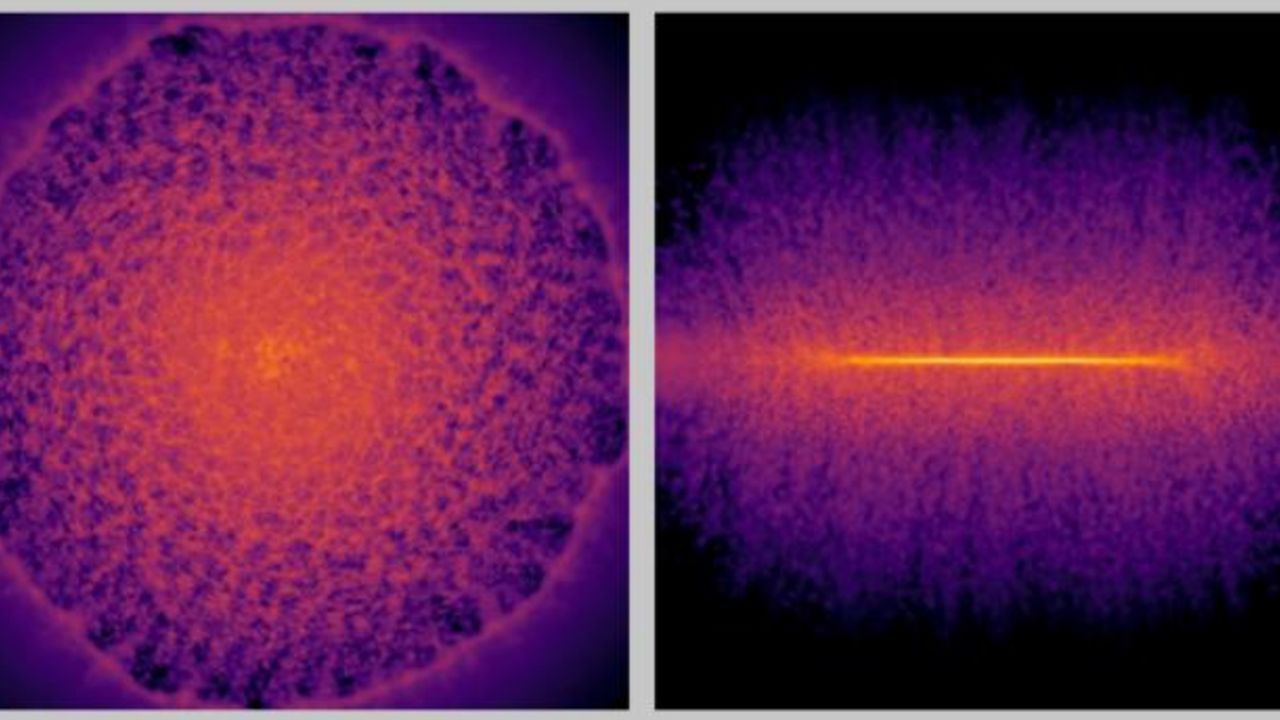
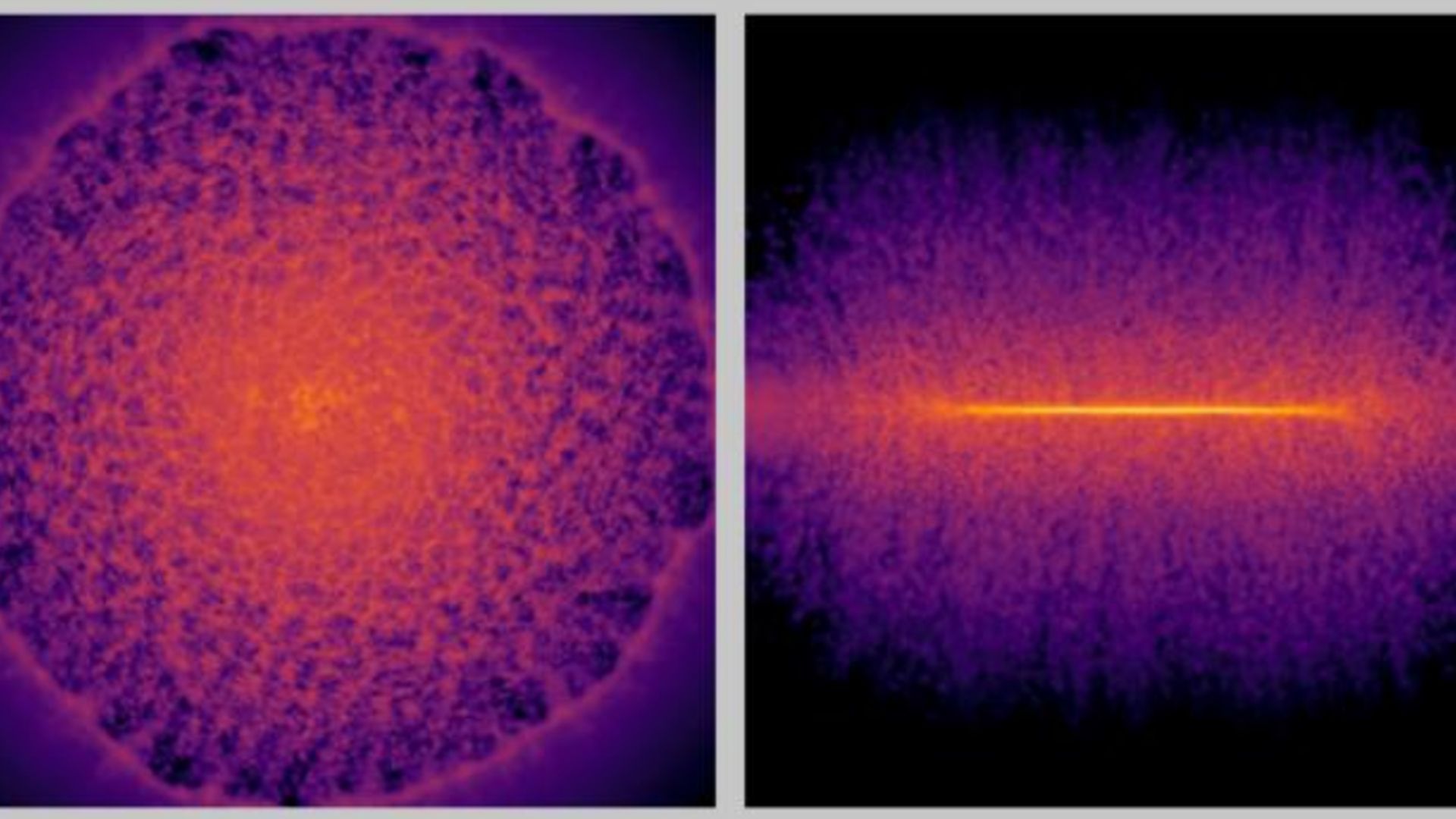
The most detailed supercomputer simulation ever of our Milky Way galaxy has been created by combining machine learning with numerical models. By running 100 times faster than the next most detailed models, the program gives astronomers the chance to map billions of years of the evolution of our galaxy in months rather than decades.

The new simulation contains 100 billion particles representing stars, which is roughly the same number of stars that call the Milky Way home. The previous best-resolution simulations could only manage a billion stars, and were slow. To model a million years of galactic evolution in detail would take 315 hours, or 13 days, in real-time, meaning that to simulate a billion years using those previous best-resolution simulations would take almost 36 years of real computing time.

Now, a team led by Keiya Hirashima of the RIKEN Center for Interdisciplinary Theoretical and Mathematical Sciences in Japan has developed a new supercomputer-powered simulation that is faster and has far greater star-resolution, thanks to a new methodology that allows both short- and long-time scale events to be included.


Best picks for you

In comparison, the previous best-resolution simulations only had a billion particles. Each particle would represent 100 stars, but this then smoothed over the details, such as the effect that a single supernova can have on the surrounding gaseous environment. The previous best simulation therefore favored long-term events over short-term phenomena connected to individual stars, but often it is the short-term phenomena that influences the larger scale, longer-term galactic evolution.

To process simulations at shorter timescales would require more computing power, but Hirashima’s team have been able to side-step this barrier by developing a new methodology. It takes a deep-learning surrogate model — think of it as a kind of training model — and applies it to high-resolution supernova data so that it learns to predict how the supernova remnant expands into the interstellar medium over the course of 100,000 years. This expansion blows away gas and dust in the interstellar medium and enriches it with new elements forged by the supernova blast, altering the distribution and chemistry of the interstellar medium. The gas and dust is then eventually converted into the next generation of stars to inhabit the galaxy.

By integrating the surrogate model with numerical simulations describing the overall dynamics of the Milky Way, Hirashima’s team were able to incorporate the effects of shorter timescale supernova events into the larger timescale galactic processes.

The new methodology also sped things up, with a million years of simulation time taking just 2.78 hours to render. At that rate, it would take just 115 days, not 36 years, to simulate a billion years’ worth of galactic evolution.

Breaking space news, the latest updates on rocket launches, skywatching events and more!

“I believe that integrating AI with high-performance computing marks a fundamental shift in how we tackle multi-scale, multi-physics problems across the computational sciences,” said Hirashima in a statement.

The methodology need not be constrained to astrophysics either; with a little tweaking, it could be used to simulate climate change, oceanic or weather models where small-scale events influence larger scale processes.

In the context of galactic evolution, and testing models of how our galaxy formed, how its structure developed and how its chemistry has flourished, the methodology could be transformative.

“This achievement also shows that AI-accelerated simulations can move beyond pattern recognition to become a genuine tool for scientific discovery, helping us trace how the elements that formed life itself emerged without our galaxy,” said Hirashima.

The results of the new simulation were published as part of an international supercomputing conference called SC ’25.

Tags: rocket launch
No Result
View All Result

Recent Posts

  • Germany outlines military space priorities in new strategy
  • Saturn’s rings will seem to disappear on Nov. 23: Here’s how to catch the illusion
  • Does the universe have extra dimensions hiding in plain sight?
  • Canon 8×20 IS binocular review
  • European Parliament member sees support for EU Space Act there

Categories

  • Excursions
  • Kepler Mission
  • NASA
  • NASA Breaking News
  • Physical Preparation
  • Preparation
  • Space News
  • Space Station News
  • Spacewalks
  • Tours
  • Uncategorized
  • Weightlessness Training
  • What Not to Pack
  • What to Pack

Meta

  • Log in
  • Entries feed
  • Comments feed
  • WordPress.org
  • Home
  • Start Here
  • Preparing for Your Trip
  • Space Tourism Companies
  • Space Tours
  • Contact

© 2025 JNews - Premium WordPress news & magazine theme by Jegtheme.

No Result
View All Result
  • About
  • Contact
  • Feeds
  • Frequently Asked Questions
  • Preparing for Your Trip
    • Insurance and Legal Waivers
    • Physical and Medical Requirements
    • Training Programs
    • What to Expect
  • Privacy Policy
  • Space Tourism Companies
    • Axiom Space
    • Blue Origin
    • Blue Origin vs Virgin Galactic
    • Comparison Chart: Features, Pricing, Booking
    • SpaceX
    • Virgin Galactic
    • World View (stratospheric balloon flights)
  • Space Tours
    • Custom & Luxury Packages
    • Duration, Training, Costs
    • Experiences
    • Future Moon/Mars Options
    • Orbital Flights
    • Parabolic Flight Experiences
    • Private Missions
    • Stratospheric Balloon Flights
    • Suborbital Flights
    • Zero-Gravity Flights
  • Spaceflight Technologies
    • Space Tourism Balloon
  • Start Here
    • How to Book a Space Tour
    • Intro to Commercial Spaceflight
    • Is Space Tourism Safe?
    • Space Travel FAQs
    • View Earth from the Edge
    • What to Pack
  • Tours in Space is your launchpad to the world of space tourism

© 2025 JNews - Premium WordPress news & magazine theme by Jegtheme.