
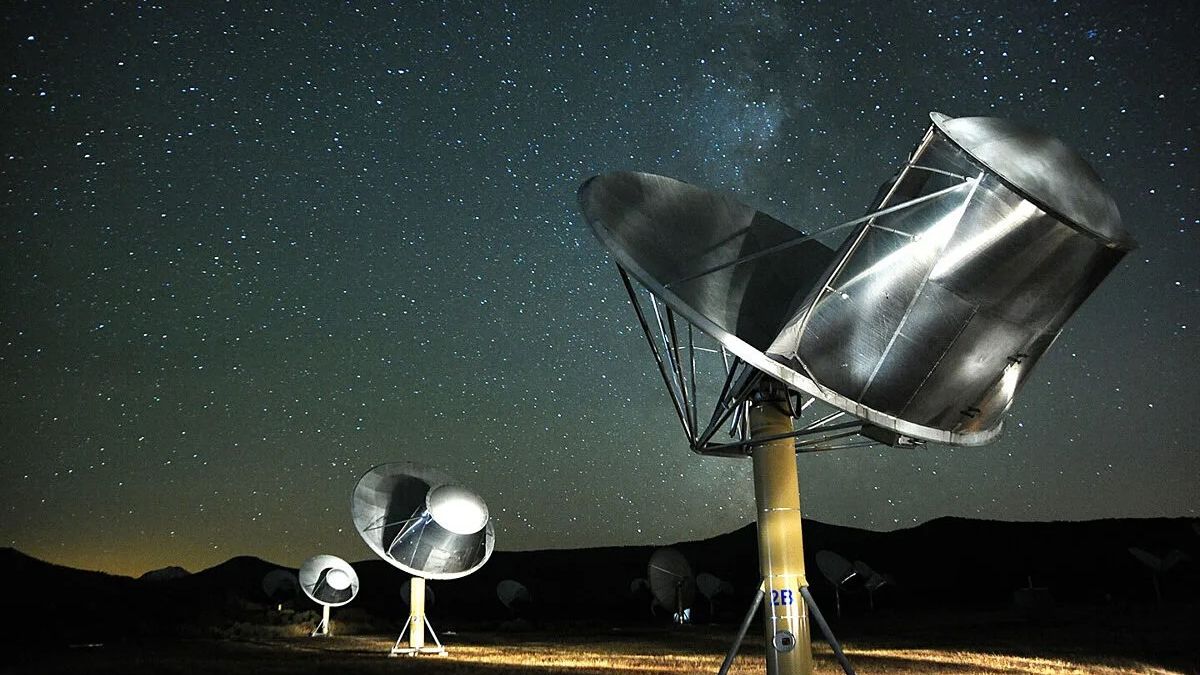

SETI might not have succeeded in finding alien life yet because space weather around other stars could be disrupting aliens’ attempts to send radio messages out, according to a new study that tries to make sense of why the universe seems so quiet.
“Space weather” describes the electromagnetic disturbances produced by gusts of radiation in a stellar wind or coronal mass ejections (CMEs) from a star. These events spew a lot of plasma and electrons into interplanetary space around a star, and plasma and electrons are like kryptonite to coherent radio signals.
The other reason why SETI looks for narrowband signals, with bandwidths of just a few hertz, is that nothing known in nature produces such a tightly constrained radio signal. So, if we detected one, we’d know it was more than likely artificial.
However, until now no one had quantified the effects of plasma and electrons spewed out by activity on stars. If a technological species on a distant exoplanet wanted to beam a message into deep space, the space weather in its home system could negatively affect the characteristics of that signal.
“SETI searches are often optimized for extremely narrow signals,” Vishal Gajjar, of the SETI Institute in Mountain View, California, said in a statement. “If a signal gets broadened by its own star’s environment, it can slip below our detection thresholds, even if it’s there, potentially helping explain some of the radio silence we’ve seen in technosignature searches.”
The most likely impact of space weather on narrowband radio signals is something called diffractive scintillation. This can cause a signal to become smeared across a much wider range of frequencies when it interacts with plasma from a star. Whereas the initial narrowband signal might have a strong power across just a few frequencies, the smearing spreads that power across more frequencies, reducing the strength of the signal.
However, identifying the problem was only the first step. Gajjar and his SETI Institute colleague Grayce Brown wanted to take it one step further and quantify the effect of space weather so that it can become easier to mitigate during SETI searches.
To do so, the duo first had to quantify the effect in our own neighborhood, analyzing radio signals between Earth and space missions exploring our solar system. Gajjar and Brown calibrated how fluctuations in the solar wind and bursts from CMEs can affect narrowband signals, and averaged that over time. They then used the example of our sun as a basis for calibrating the broadening effect of space weather on signals around two main types of stars: sun-like stars, and red dwarfs, which are the smallest, coolest type of star, making up three-quarters of all the stars in the Milky Way galaxy.
Stars much more massive than the sun were left out of the study, since their lifetimes are likely too short for technological life to have time to develop on any orbiting planets.
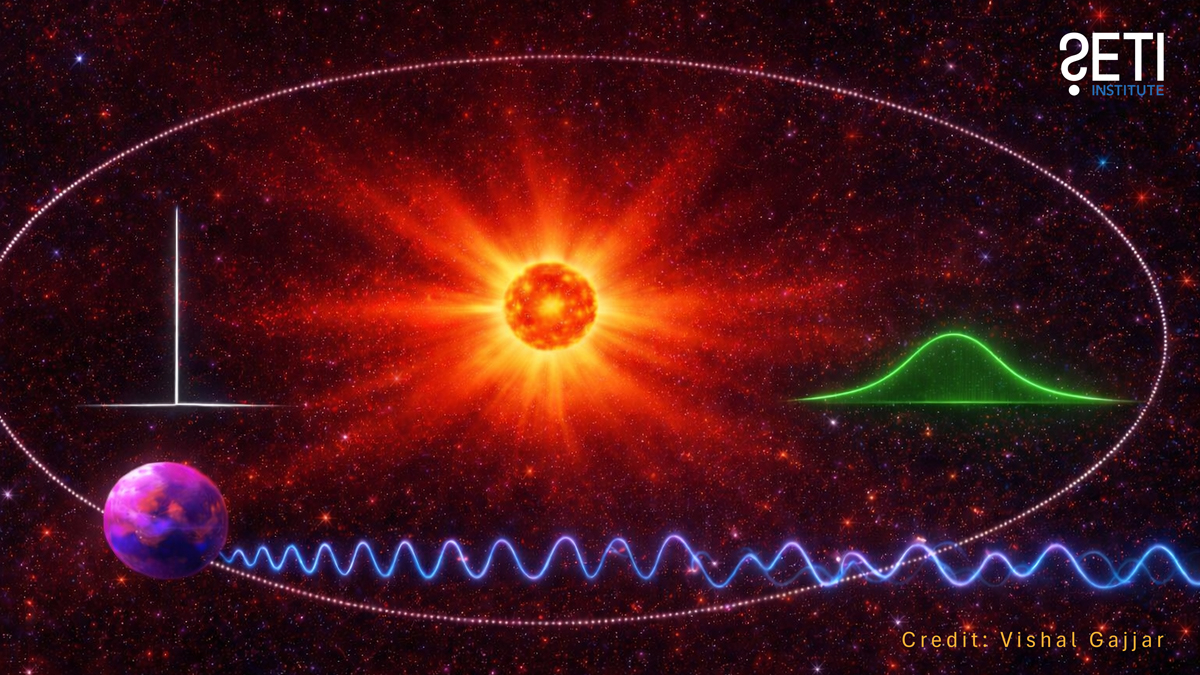
To emphasize their point, Gajjar and Brown simulated a SETI search of the million closest sun-like and red dwarf stars and incorporated the effects of space weather based on the known activity of such stars.
The simulation depicted a search for alien signals in the region around 1 GHz, which is the most common frequency band in which to search. Radio emission from interstellar hydrogen, for example, is at 1.42 GHz.
According to the simulation, 70% of stars result in signals being broadened in frequency by more than 1 Hz, and 30% of stars produce a broadening of more than 10 Hz, particularly red dwarf stars, which are noted for their strong stellar activity.
Even more seriously, were a CME to occur at the time a signal is transmitted, it could incur a broadening in excess of 1,000 Hz, rendering a signal completely invisible to detectors focused on very narrowband signals.
However, now that we know that this can happen, efforts can be made to minimize its effect — just like how we can estimate the degree of dispersion by the interstellar medium, or how algorithms can remove the Doppler drifting in frequency caused by the motion of a transmitter on a planet orbiting its star.
“By quantifying how stellar activity can reshape narrowband signals, we can design searches that are better matched to what actually arrives at Earth, not just what might be transmitted,” said Brown.
For 66 years and counting, SETI has been searching for evidence of technological life in the universe but has so far found nothing. For example, the citizen science project SETI@home, which began in 1999, is down to its last 100 candidate signals and hopes are not high that any of them will turn out to be ET.
Some researchers refer to this failure to find technological aliens as the “Great Silence,” but could this space weather effect quantified by Gajjar and Brown be the cause? It is possible that it has at least contributed to the Great Silence, depending upon how many transmitting species are out there. However, just as we monitor the sun and space weather in our solar system, it would seem fair to expect aliens sufficiently technologically proficient to beam messages into the cosmos to also know of their own star’s space weather, and wait for calmer periods before transmitting.
This cannot be guaranteed, though, especially if the transmitter is always switched on (which would suck up a lot of power), or if it is an automated transmitter. Gajjar and Brown propose that far from a “Great Silence,” the universe could be awash with noisy messages, and we’ve just not been tuned in enough to hear them.
The research was published on March 5 in The Astrophysical Journal.