• Home
  • About
  • FAQ
  • Feeds
  • Glossary
  • Contact
Tours In Space
  • Home
  • Start Here
    • Intro to Commercial Spaceflight
    • How to Book a Space Tour
    • Is Space Tourism Safe?
    • Space Travel FAQs
    • View Earth from the Edge
    • What to Pack
  • Preparing for Your Trip
    • Insurance and Legal Waivers
    • Physical and Medical Requirements
    • Training Programs
    • What to Expect
  • Space Tourism Companies
    • Axiom Space
    • Blue Origin
    • SpaceX
    • Virgin Galactic
    • World View (stratospheric balloon flights)
    • Blue Origin vs Virgin Galactic
    • Comparison Chart: Features, Pricing, Booking
  • Space Tours
    • Custom & Luxury Packages
    • Duration, Training, Costs
    • Experiences
    • Future Moon/Mars Options
    • Orbital Flights
    • Parabolic Flight Experiences
    • Private Missions
    • Stratospheric Balloon Flights
    • Suborbital Flights
    • Zero-Gravity Flights
  • Spaceflight Technologies
    • Space Tourism Balloon
No Result
View All Result
  • Home
  • Start Here
    • Intro to Commercial Spaceflight
    • How to Book a Space Tour
    • Is Space Tourism Safe?
    • Space Travel FAQs
    • View Earth from the Edge
    • What to Pack
  • Preparing for Your Trip
    • Insurance and Legal Waivers
    • Physical and Medical Requirements
    • Training Programs
    • What to Expect
  • Space Tourism Companies
    • Axiom Space
    • Blue Origin
    • SpaceX
    • Virgin Galactic
    • World View (stratospheric balloon flights)
    • Blue Origin vs Virgin Galactic
    • Comparison Chart: Features, Pricing, Booking
  • Space Tours
    • Custom & Luxury Packages
    • Duration, Training, Costs
    • Experiences
    • Future Moon/Mars Options
    • Orbital Flights
    • Parabolic Flight Experiences
    • Private Missions
    • Stratospheric Balloon Flights
    • Suborbital Flights
    • Zero-Gravity Flights
  • Spaceflight Technologies
    • Space Tourism Balloon
No Result
View All Result
Tours In Space
No Result
View All Result
Home Space News

Why are some stars always visible while others come and go with the seasons?

Ensign by Ensign
March 14, 2026
in Space News
0
Why are some stars always visible while others come and go with the seasons?
189
SHARES
1.5k
VIEWS
Share on FacebookShare on Twitter

<em>This article was originally published at The Conversation. The publication contributed the article to Space.com’s Expert Voices: Op-Ed & Insights.

Vahe Peroomian is a Professor of Physics and Astronomy at the USC Dornsife College of Letters, Arts and Sciences.

As a space scientist, every time I go outside with my family, I tell my children to look up at the sky. The front door of our home looks southeast, and on winter nights the constellation Orion hangs majestically just above the horizon as soon as it grows dark enough to see stars.

Article continues below


You may like

One summer night, my son came running in and exclaimed, “Dad, Orion’s not there!” It was time for his first real astronomy lesson.

We went outside and I asked him to find the Big Dipper, the easily identifiable pattern of stars that make up a portion of the constellation Ursa Major. I reminded him that we could always see the Big Dipper no matter what time of the year it was.

So, why is it that Orion is not always visible in the night sky, and certainly not in the same location month after month, while the Big Dipper always is? The answer is intimately tied to a few concepts: how astronomers measure the length of a day, the motion of the Earth around the sun during a year, and the cadence with which stars rise and set night after night.

Sidereal time

If you look eastward at the same hour for two nights in a row, you’ll find that the stars seem to be in the same place. But they’re not, and this movement becomes apparent if you continue observing at the same hour for a week or more. A combination of the Earth’s daily rotation on its axis and its yearly orbit around the Sun cause them to appear to move across the sky.

Breaking space news, the latest updates on rocket launches, skywatching events and more!

Earth spins on its axis, which runs from the South Pole through the center of the Earth to the North Pole, once a day. Astronomers measure a day in two different ways: They measure a solar day, 24 hours long, with the position of the sun from high noon to high noon. They measure a sidereal day with respect to distant stars that are fixed in the sky. A sidereal day is 23 hours and 56 minutes long.

The constellation Orion – and every star in the night sky – will appear in exactly the same place every 23 hours and 56 minutes. Because of this slight offset, stars will appear to rise four minutes earlier every 24 hours on successive nights. Over the course of a month, a star that was close to the eastern horizon at 10 p.m. will now be much higher in the sky, having risen two hours earlier.

So while the constellation Orion appears close to the horizon at sunset in late December, it is nearly overhead in February and March.


What to read next

You can use an interactive star chart to see this phenomenon. Do you want to find Orion in August in North America? Just wake up at 4:30 a.m. and look eastward.

Unlike Orion, the Big Dipper is always visible at night in most of the Northern Hemisphere. This is because of how Earth’s daily rotation is projected onto the stars.
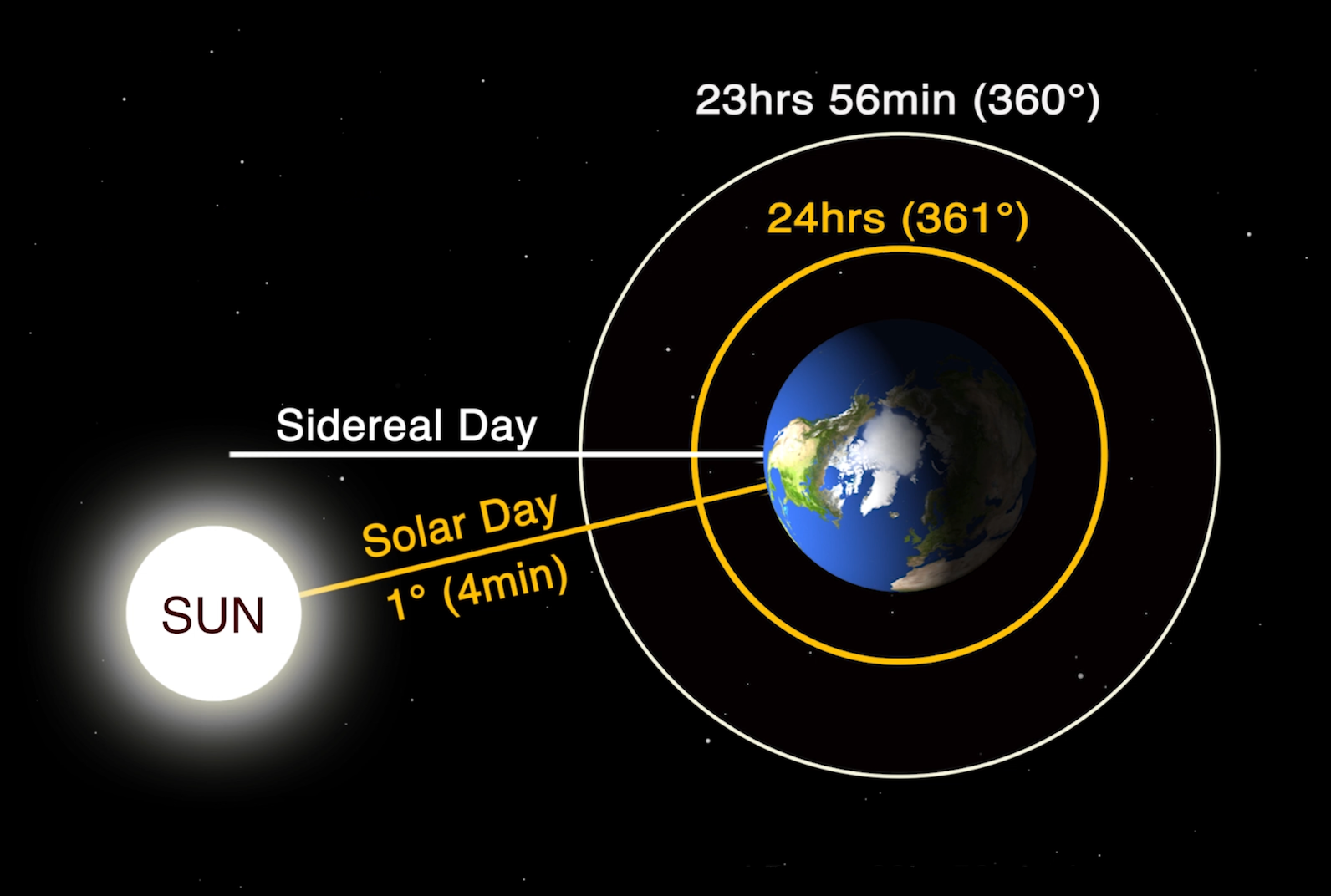
an illustration of earth next to the sun on a starry background, with two lines extending from it. one is marked &quot;sidereal day&quot; and the other &quot;solar day&quot;. two circles encompass earth, one labelled &quot;24&quot; hours the same color as the &quot;solar day&quot; line, and the other &quot;23 hours and 56 minutes,&quot; the same color as the &quot;sidereal day&quot; line

An illustration depicting the difference between a sidereal day and a solar day. (Image credit: James O’Donoghue/CC BY 3.0)

Circumpolar stars

Astronomers use a common set of reference points to project Earth’s north and south poles, and the equator, onto the celestial sphere, an imaginary sphere encompassing the sky.

The idea of the celestial sphere evolved in ancient times from the notion that the Earth was the unmoving center of the universe. The projection of Earth’s equator delineates the celestial equator, and the poles project onto the north and south celestial poles.

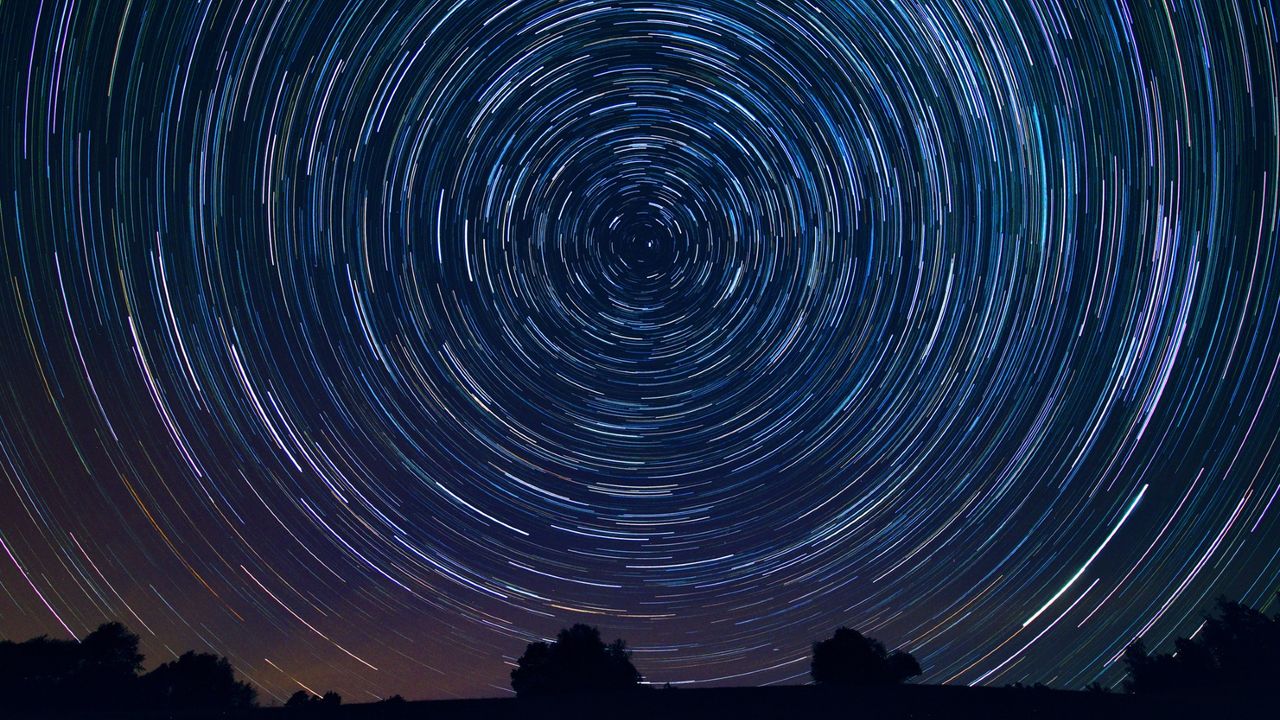
The motion of stars near the celestial poles differs from how Orion and other constellations behave. Presently, the north celestial pole is very close to the star Polaris, also known as the North Star. Stars close to Polaris never rise or set. They appear to circle counterclockwise around that star as the Earth spins on its rotation axis once a day.

The number of these circumpolar stars increases as you move toward the North Pole. There are no circumpolar stars at the equator. Every star and constellation rises in the east and sets in the west because Earth rotates west to east on its axis.

If you are standing at the North Pole, every northern constellation is circumpolar, circling the North Star and never rising or setting. The pattern is similar in the Southern Hemisphere, with the southern constellations circling clockwise around the south celestial pole.

Earth’s precession

Millennia ago, people charted the path of the Sun through the constellations of the zodiac, which birthed the practice of astrology.

What does it mean for the sun to be in Sagittarius, for example? It means that to see the constellation Sagittarius, you have to be looking toward the sun. That would make it daytime, when the stars are not visible. Wait for nightfall, and you can see Gemini high in the sky. Six months later, the sun is in Gemini, and Sagittarius is visible in the night sky. This pattern repeats year after year, as the Earth orbits the sun. Your zodiac signs depend on which constellation the sun was in when you were born.
The Ecliptic: Crash Course Kids #37.2 – YouTube
The Ecliptic: Crash Course Kids #37.2 - YouTube

Watch On

There is one other change in the night sky that occurs on time scales much longer than a human lifetime. Because of the gravitational influence of the sun, and to a lesser extent Jupiter, on Earth’s daily rotation, Earth’s spin axis precesses, or moves in a circle, like a toy top spun on a table.

Because of this motion, which also subtly changes Earth’s orbit in space, Polaris will no longer be the North Star a thousand years from now. Wait 12,000 years, and the bright star Vega will be closest to the north celestial pole, more than 50 degrees across the night sky from its present location near Polaris.

Another consequence of this motion, sometimes referred to as the precession of the equinoxes, is that today the constellations of the zodiac no longer align with the traditional dates associated with them.

For example, when horoscopes and astrological signs were originally devised, the sun was in the constellation Sagittarius from Nov. 22 to Dec. 21. However, because of precession over thousands of years, the sun now crosses this constellation from Dec. 18 to Jan. 19. It spends the early part of December in Ophiuchus, which is not part of the traditional 12 constellations of the zodiac.

These changes in the night sky take weeks, months or even hundreds of years to be visible. If you’re not that patient, you can fly to the opposite hemisphere to see Orion upside down and the night sky turning in the opposite direction above.

Tags: rocket launch
No Result
View All Result

Recent Posts

  • Get cleaner photos of the night sky by using these tips to clean your camera lens without scratching it
  • Boys from the Dwarf: Looking back at ‘Red Dwarf’, the sci-fi show that had a huge impact on my childhood
  • Why are some stars always visible while others come and go with the seasons?
  • Galaxy season: Spring brings deep space wonder to the northern hemisphere night sky
  • iMetalX emerges from stealth with technology to model resident space objects

Categories

  • Excursions
  • Kepler Mission
  • NASA
  • NASA Breaking News
  • Physical Preparation
  • Preparation
  • Space News
  • Space Station News
  • Spacewalks
  • Tours
  • Uncategorized
  • Weightlessness Training
  • What Not to Pack
  • What to Pack

Meta

  • Log in
  • Entries feed
  • Comments feed
  • WordPress.org
  • Home
  • Start Here
  • Preparing for Your Trip
  • Space Tourism Companies
  • Space Tours
  • Contact

© 2026 JNews - Premium WordPress news & magazine theme by Jegtheme.

No Result
View All Result
  • About
  • Contact
  • Feeds
  • Frequently Asked Questions
  • Preparing for Your Trip
    • Insurance and Legal Waivers
    • Physical and Medical Requirements
    • Training Programs
    • What to Expect
  • Privacy Policy
  • Space Tourism Companies
    • Axiom Space
    • Blue Origin
    • Blue Origin vs Virgin Galactic
    • Comparison Chart: Features, Pricing, Booking
    • SpaceX
    • Virgin Galactic
    • World View (stratospheric balloon flights)
  • Space Tours
    • Custom & Luxury Packages
    • Duration, Training, Costs
    • Experiences
    • Future Moon/Mars Options
    • Orbital Flights
    • Parabolic Flight Experiences
    • Private Missions
    • Stratospheric Balloon Flights
    • Suborbital Flights
    • Zero-Gravity Flights
  • Spaceflight Technologies
    • Space Tourism Balloon
  • Start Here
    • How to Book a Space Tour
    • Intro to Commercial Spaceflight
    • Is Space Tourism Safe?
    • Space Travel FAQs
    • View Earth from the Edge
    • What to Pack
  • Tours in Space is your launchpad to the world of space tourism

© 2026 JNews - Premium WordPress news & magazine theme by Jegtheme.