• Home
  • About
  • FAQ
  • Feeds
  • Glossary
  • Contact
Tours In Space
  • Home
  • Start Here
    • Intro to Commercial Spaceflight
    • How to Book a Space Tour
    • Is Space Tourism Safe?
    • Space Travel FAQs
    • View Earth from the Edge
    • What to Pack
  • Preparing for Your Trip
    • Insurance and Legal Waivers
    • Physical and Medical Requirements
    • Training Programs
    • What to Expect
  • Space Tourism Companies
    • Axiom Space
    • Blue Origin
    • SpaceX
    • Virgin Galactic
    • World View (stratospheric balloon flights)
    • Blue Origin vs Virgin Galactic
    • Comparison Chart: Features, Pricing, Booking
  • Space Tours
    • Custom & Luxury Packages
    • Duration, Training, Costs
    • Experiences
    • Future Moon/Mars Options
    • Orbital Flights
    • Parabolic Flight Experiences
    • Private Missions
    • Stratospheric Balloon Flights
    • Suborbital Flights
    • Zero-Gravity Flights
  • Spaceflight Technologies
    • Space Tourism Balloon
No Result
View All Result
  • Home
  • Start Here
    • Intro to Commercial Spaceflight
    • How to Book a Space Tour
    • Is Space Tourism Safe?
    • Space Travel FAQs
    • View Earth from the Edge
    • What to Pack
  • Preparing for Your Trip
    • Insurance and Legal Waivers
    • Physical and Medical Requirements
    • Training Programs
    • What to Expect
  • Space Tourism Companies
    • Axiom Space
    • Blue Origin
    • SpaceX
    • Virgin Galactic
    • World View (stratospheric balloon flights)
    • Blue Origin vs Virgin Galactic
    • Comparison Chart: Features, Pricing, Booking
  • Space Tours
    • Custom & Luxury Packages
    • Duration, Training, Costs
    • Experiences
    • Future Moon/Mars Options
    • Orbital Flights
    • Parabolic Flight Experiences
    • Private Missions
    • Stratospheric Balloon Flights
    • Suborbital Flights
    • Zero-Gravity Flights
  • Spaceflight Technologies
    • Space Tourism Balloon
No Result
View All Result
Tours In Space
No Result
View All Result
Home Space News

Hubble and NASA space telescopes track ‘game-changing’ gamma-ray burst back to neutron star collision in ‘forbidden’ region of the universe

Ensign by Ensign
March 15, 2026
in Space News
0
Hubble and NASA space telescopes track ‘game-changing’ gamma-ray burst back to neutron star collision in ‘forbidden’ region of the universe
189
SHARES
1.5k
VIEWS
Share on FacebookShare on Twitter

Astronomers have tracked a powerful blast of radiation called a gamma-ray burst (GRB) back to its source, finding a collision between extreme stellar remnants called neutron stars within colliding galaxies. This could reveal more about these extraordinary collisions, thought to be the only events in the universe capable of generating heavy elements like the gold and silver we wear on our fingers and around our necks.

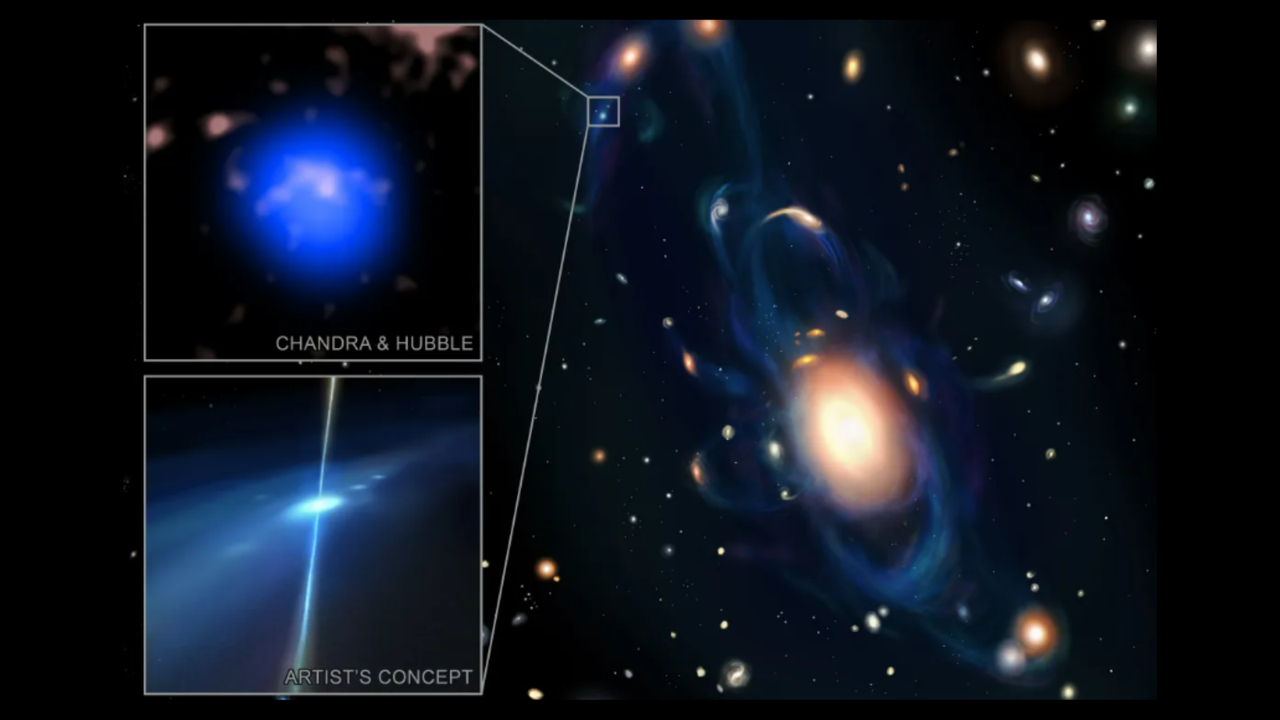
The GRB, designated GRB 230906A, was spotted on Sept. 23, 2023, by an array of NASA space telescopes, including the Chandra X-ray Observatory, the Fermi Gamma-ray Space Telescope, the Neil Gehrels Swift Observatory, and the Hubble Space Telescope. GRB 230906A was tracked back to a neutron star merger within a tiny galaxy that is itself embedded in a river of gas 600,000 light-years long, or about six times as long as the width of our entire galaxy.

Previously, collisions between neutron stars, which are born when massive stars run out of fuel for nuclear fusion and “die” in supernova explosions, had only been observed in medium to large galaxies. Thus, these results show that these merger events between extreme dead stars can occur in more diminutive galaxies

Article continues below


You may like

“Finding a neutron star collision where we did is game-changing,” discovery team-leader Simone Dichiara of Penn State University said in a statement. “It may be the key to unlocking not one, but two important questions in astrophysics.”

The first conundrum Dichiara refers to, which could be solved by a neutron star merger in an unprecedented location, is the fact that when astronomers trace GRBs back to their points of origin, they often seem to occur away from dense galactic cores where collisions should be more common, and sometimes away from galaxies altogether.

The other puzzle relates to the fact that, though neutron star collisions are believed to generate the only environments violent and turbulent enough to forge elements heavier than iron, like gold, silver, and platinum, these elements are often detected in stars that lie far from galactic centers and which should have formed before it was possible to be enriched with such heavy elements.

‘A collision within a collision’

This neutron star collision was initially detected via GRB 230906A by Fermi, with astronomers then precisely pinpointing the location where the merger occurred using Chandra, Swift, and Hubble.

“Chandra’s pinpoint X-ray localization made this study possible,” team member Brendan O’Connor, of Carnegie Mellon University, said. “Without it, we couldn’t have tied the burst to any specific source. And once Chandra told us exactly where to look, Hubble’s extraordinary sensitivity revealed the tiny, extremely faint galaxy at that position. We were only able to make this discovery after we put all the pieces together.”
Breaking space news, the latest updates on rocket launches, skywatching events and more!

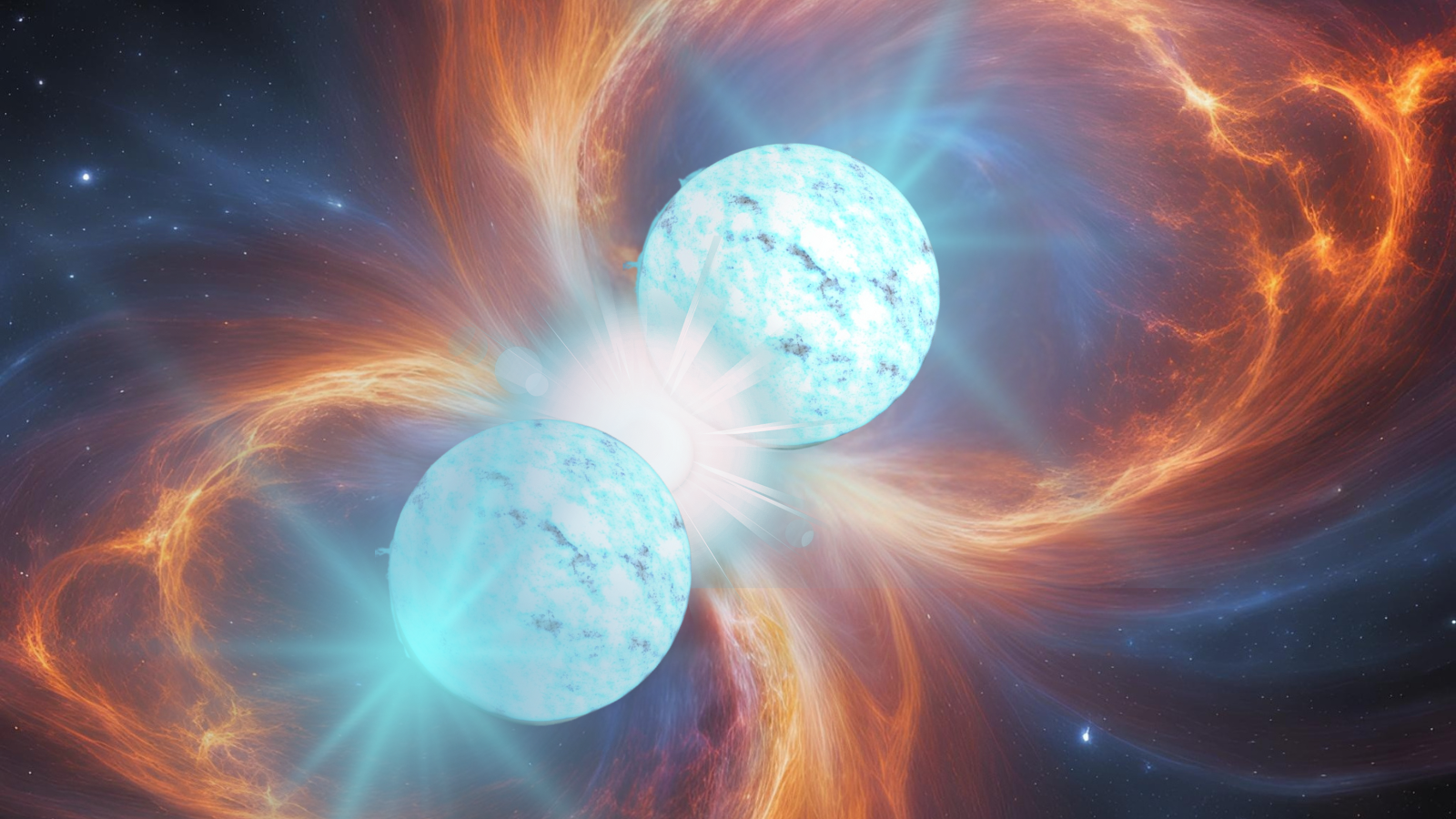
An illustration shows two neutron stars colliding and merging

An illustration shows two neutron stars colliding and merging (Image credit: Robert Lea (created with Canva))

The stream of gas within which the team discovered the home galaxy of this merger is thought to have been created when a group of galaxies collided hundreds of millions of years ago. This event stripped gas and dust from these galaxies, forming a gas stream and leaving to drift in intergalactic space.

“We found a collision within a collision,” team member Eleonora Troja of the University of Rome in Italy said. “The galaxy collision triggered a wave of star formation that, over hundreds of millions of years, led to the birth and eventual collision of these neutron stars.”

The discovery hints that some GRBs appear to originate from beyond the limits of galaxies because their points of origin are actually tiny galaxies that are too faint to be seen.

As for the heavy element enrichment of stars that dwell far from the galactic center, the team theorizes highly explosive neutron star mergers like the one that launched GRB 230906A could not only forge such elements but could also disperse them to the very edge of galaxies.

The team’s research is set to appear in the Astrophysical Journal Letters.

Tags: NASArocket launch
No Result
View All Result

Recent Posts

  • Sophia and Kepler to marry orbital compute with optical links
  • From spa to boat party: 10 epic events for the Aug. 12, 2026, total solar eclipse in Spain and Iceland
  • Rocket Lab wins contract for three more iQPS launches
  • ‘The most special thing that will ever happen in my life’: Artemis 2 astronauts describe their epic moon mission
  • Falcon 9 launches Cygnus cargo spacecraft to the ISS

Categories

  • Excursions
  • Kepler Mission
  • NASA
  • NASA Breaking News
  • Physical Preparation
  • Preparation
  • Space News
  • Space Station News
  • Spacewalks
  • Tours
  • Uncategorized
  • Weightlessness Training
  • What Not to Pack
  • What to Pack

Meta

  • Log in
  • Entries feed
  • Comments feed
  • WordPress.org
  • Home
  • Start Here
  • Preparing for Your Trip
  • Space Tourism Companies
  • Space Tours
  • Contact

© 2026 JNews - Premium WordPress news & magazine theme by Jegtheme.

No Result
View All Result
  • About
  • Contact
  • Feeds
  • Frequently Asked Questions
  • Preparing for Your Trip
    • Insurance and Legal Waivers
    • Physical and Medical Requirements
    • Training Programs
    • What to Expect
  • Privacy Policy
  • Space Tourism Companies
    • Axiom Space
    • Blue Origin
    • Blue Origin vs Virgin Galactic
    • Comparison Chart: Features, Pricing, Booking
    • SpaceX
    • Virgin Galactic
    • World View (stratospheric balloon flights)
  • Space Tours
    • Custom & Luxury Packages
    • Duration, Training, Costs
    • Experiences
    • Future Moon/Mars Options
    • Orbital Flights
    • Parabolic Flight Experiences
    • Private Missions
    • Stratospheric Balloon Flights
    • Suborbital Flights
    • Zero-Gravity Flights
  • Spaceflight Technologies
    • Space Tourism Balloon
  • Start Here
    • How to Book a Space Tour
    • Intro to Commercial Spaceflight
    • Is Space Tourism Safe?
    • Space Travel FAQs
    • View Earth from the Edge
    • What to Pack
  • Tours in Space is your launchpad to the world of space tourism

© 2026 JNews - Premium WordPress news & magazine theme by Jegtheme.