• Home
  • About
  • FAQ
  • Feeds
  • Glossary
  • Contact
Tours In Space
  • Home
  • Start Here
    • Intro to Commercial Spaceflight
    • How to Book a Space Tour
    • Is Space Tourism Safe?
    • Space Travel FAQs
    • View Earth from the Edge
    • What to Pack
  • Preparing for Your Trip
    • Insurance and Legal Waivers
    • Physical and Medical Requirements
    • Training Programs
    • What to Expect
  • Space Tourism Companies
    • Axiom Space
    • Blue Origin
    • SpaceX
    • Virgin Galactic
    • World View (stratospheric balloon flights)
    • Blue Origin vs Virgin Galactic
    • Comparison Chart: Features, Pricing, Booking
  • Space Tours
    • Custom & Luxury Packages
    • Duration, Training, Costs
    • Experiences
    • Future Moon/Mars Options
    • Orbital Flights
    • Parabolic Flight Experiences
    • Private Missions
    • Stratospheric Balloon Flights
    • Suborbital Flights
    • Zero-Gravity Flights
  • Spaceflight Technologies
    • Space Tourism Balloon
No Result
View All Result
  • Home
  • Start Here
    • Intro to Commercial Spaceflight
    • How to Book a Space Tour
    • Is Space Tourism Safe?
    • Space Travel FAQs
    • View Earth from the Edge
    • What to Pack
  • Preparing for Your Trip
    • Insurance and Legal Waivers
    • Physical and Medical Requirements
    • Training Programs
    • What to Expect
  • Space Tourism Companies
    • Axiom Space
    • Blue Origin
    • SpaceX
    • Virgin Galactic
    • World View (stratospheric balloon flights)
    • Blue Origin vs Virgin Galactic
    • Comparison Chart: Features, Pricing, Booking
  • Space Tours
    • Custom & Luxury Packages
    • Duration, Training, Costs
    • Experiences
    • Future Moon/Mars Options
    • Orbital Flights
    • Parabolic Flight Experiences
    • Private Missions
    • Stratospheric Balloon Flights
    • Suborbital Flights
    • Zero-Gravity Flights
  • Spaceflight Technologies
    • Space Tourism Balloon
No Result
View All Result
Tours In Space
No Result
View All Result
Home Space News

Astronomers missed a space explosion as powerful as a billion suns — until they spotted its echo

Ensign by Ensign
March 20, 2026
in Space News
0
Astronomers missed a space explosion as powerful as a billion suns — until they spotted its echo
189
SHARES
1.5k
VIEWS
Share on FacebookShare on Twitter

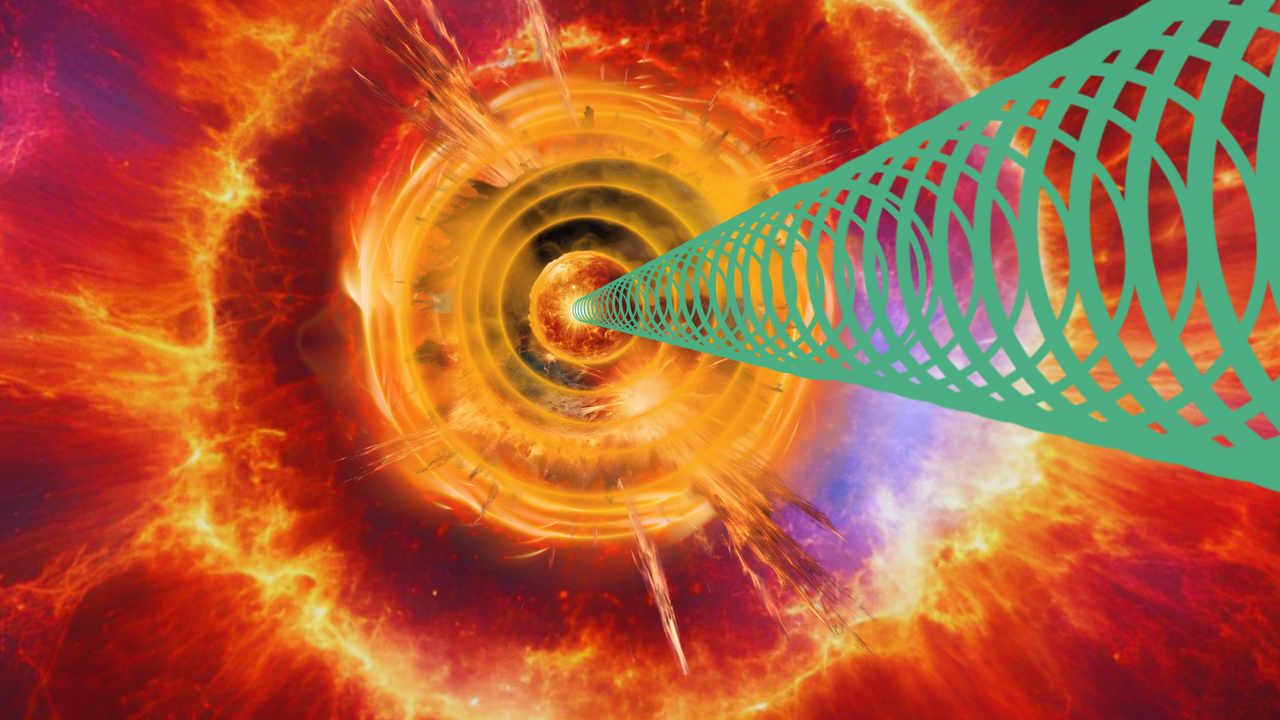
A cosmic explosion with an energy level equivalent to the output of a billion of suns went unnoticed by astronomers — until they caught the “echo” of this so-called gamma-ray burst, that is.

Considering all of our advances in astronomy and the fact that we have space telescopes with the ability to spot objects that existed up to 13.3 billion years ago, it may seem unlikely that some of the most powerful explosions in the cosmos since the Big Bang can escape our notice. But often, they do. And this includes gamma-ray bursts (GRBs), which are launched when massive stars go supernova and birth black holes.

Despite their huge energy outputs, GRBs have to be orientated toward Earth to be observed. However, even when missed, these cosmic blasts can be observed via their “echoes” as the impact bounces off surrounding gas and dust, resulting in a gradually fading afterglow. And the detection of the radio signal ASKAP J005512-255834 — thanks to the Australian SKA Pathfinder (ASKAP) radio telescope located in Western Australia — represents the most conclusive detection of such an explosive echo to date.

Article continues below


You may like

“GRBs are powerful pencil-beam explosions of energy that follow the birth of a black hole due to stellar collapse or compact object mergers,” discovery team member Ashna Gulati of the University of Sydney told Space.com. “As these jets interact with the surrounding medium, they slow down and become spherical. If a GRB jet is not pointed towards us, the initial jet can go unseen. But later, as that jet ploughs through the surrounding medium, we can see the fading afterglow of the initial unseen explosion — called an ‘orphan afterglow.'”

These orphan afterglows have been predicted for decades, but have thus far proved elusive due to the fact that there is no bright, high-energy burst of radiation to signal their existence.

“This is the most convincing ‘orphan afterglow’ candidate to date and only the second candidate to be identified.” Gulati explained. “It is akin to an echo because we didn’t capture the initial blast but we did see the blast’s interaction with the environment. The GRB was missed because the initial jet was pointed away from us and because the jets are too narrow, so it could have just missed the detector.”

Cosmic detective work

The team identified ASKAP J005512-255834 as an orphan afterglow after comparing its luminosity, energy and velocity with known explosive transients including GRBs, supernovas, and tidal disruption events (TDEs) in which black holes rip up and devour stars.

Breaking space news, the latest updates on rocket launches, skywatching events and more!

What really stood out to the team was the fact that ASKAP J005512-255834 brightened rapidly over a matter of weeks, continuing to emit radio waves for over 1,000 Earth-days as it faded. This sets the explosion apart because radio transients like this usually evolve very quickly or flare more than once. The explosion at hand did neither, instead resembling the echo of a single, very powerful explosion.

The scientists were able to track the origin of this explosive event to a small, bright galaxy located around 1.7 light-years away. The galaxy has an irregular structure and is in the midst of intense star formation. The explosive event did not take place within the heart of this galaxy, though, instead taking place in an off-center, dense, star-birthing region of it: likely a star cluster. That indicated to the team that the echo they saw could not be the result of a star being ripped apart by a supermassive black hole in a TDE.

“The origin point of this GRB resides in a chaotic galaxy, so most likely a stellar collapse occurred in a region of high star formation. The transient is not in the center of the galaxy where supermassive black holes reside,” Gulati said. “Also, a potential star cluster at the transient location does not have the mass it would take to hold a supermassive black hole.”


What to read next

Still, this doesn’t completely rule out the possibility that the echo is the result of a TDE.
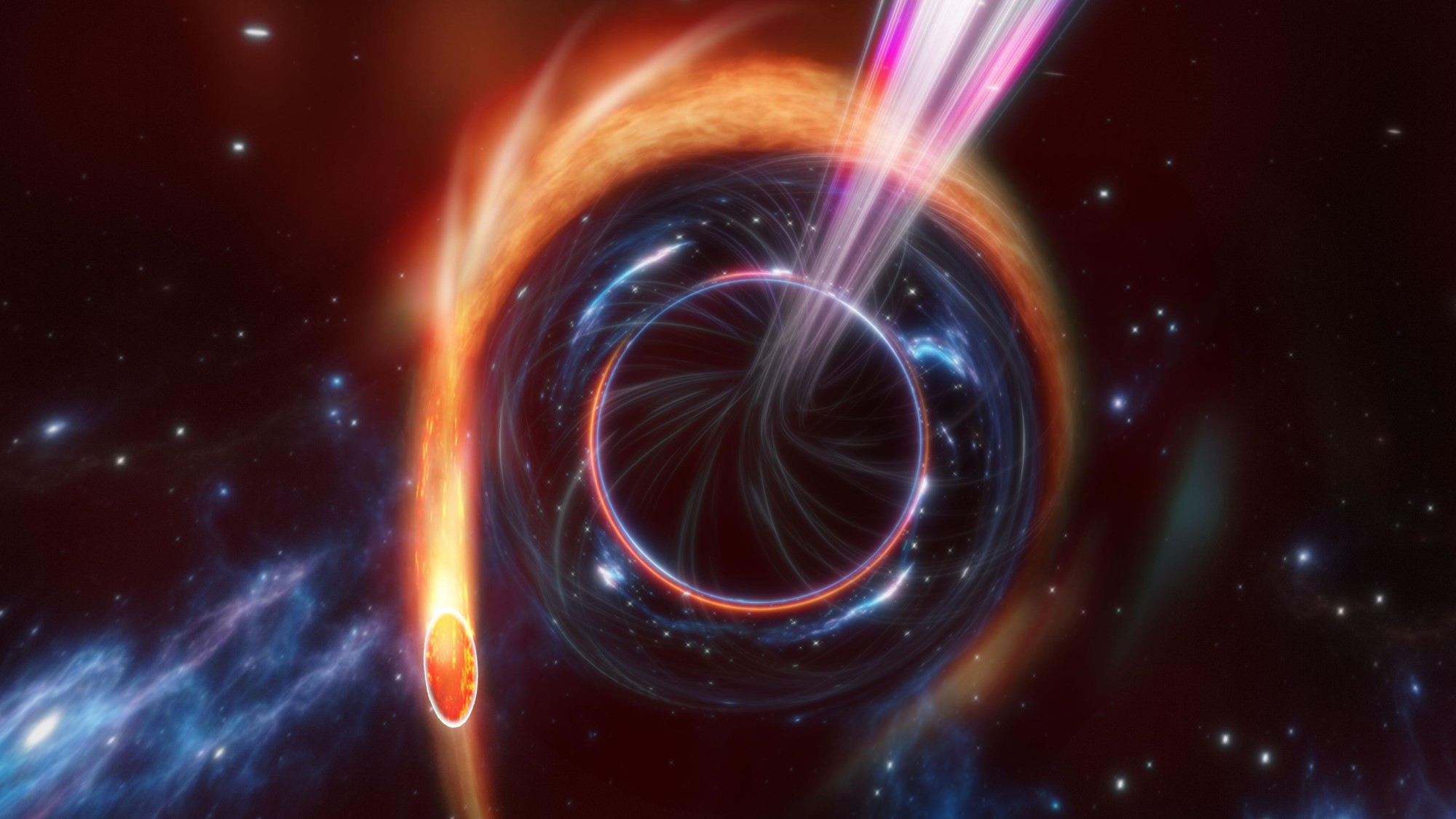
An artist's depiction of a supermassive black hole blasting out a jet of "leftovers" as it devours a star. It looks like a dark circle at the center surrounded by a warped yellow orb. There's a bright pink beam shooting out of the dark circle.

An illustration of a tidal disruption event in which a black hole rips up and devours a star. (Image credit: Carl Knox – OzGrav, ARC Centre of Excellence for Gravitational Wave Discovery, Swinburne University of Technology)

There is a possibility that the original explosive event involved a star being ripped apart by an elusive intermediate mass black hole.

These are black holes with masses in between that of galaxy-dominating supermassive black holes, with masses equivalent to millions, or even billions, of times that of the sun, and stellar-mass black holes with masses up to hundreds of times that of our star born when massive stars die in supernova explosions.

Whatever the cause of this orphan afterglow, this discovery offers astronomers a template that could help discover more of these echoes of high-energy explosions.

“We now have a very well-studied object that allows us to check what we are looking for when something like this object shows up again,” Gulati concluded.

The team’s research was published on Tuesday (March 17) The Astrophysical Journal.

No Result
View All Result

Recent Posts

  • We chat to legendary space shuttle commander Eileen Collins about her new documentary, ‘Spacewoman’ (interview)
  • This Week In Space podcast: Episode 202 — Artemis Imminent
  • Artemis Accords nations grapple with how to handle emergencies and ‘harmful interference’ on the moon
  • The loneliest places in the universe might actually be some of the best places for life
  • Officina Stellare wins $2 million contract for lasercom ground station in Spain

Categories

  • Excursions
  • Kepler Mission
  • NASA
  • NASA Breaking News
  • Physical Preparation
  • Preparation
  • Space News
  • Space Station News
  • Spacewalks
  • Tours
  • Uncategorized
  • Weightlessness Training
  • What Not to Pack
  • What to Pack

Meta

  • Log in
  • Entries feed
  • Comments feed
  • WordPress.org
  • Home
  • Start Here
  • Preparing for Your Trip
  • Space Tourism Companies
  • Space Tours
  • Contact

© 2026 JNews - Premium WordPress news & magazine theme by Jegtheme.

No Result
View All Result
  • About
  • Contact
  • Feeds
  • Frequently Asked Questions
  • Preparing for Your Trip
    • Insurance and Legal Waivers
    • Physical and Medical Requirements
    • Training Programs
    • What to Expect
  • Privacy Policy
  • Space Tourism Companies
    • Axiom Space
    • Blue Origin
    • Blue Origin vs Virgin Galactic
    • Comparison Chart: Features, Pricing, Booking
    • SpaceX
    • Virgin Galactic
    • World View (stratospheric balloon flights)
  • Space Tours
    • Custom & Luxury Packages
    • Duration, Training, Costs
    • Experiences
    • Future Moon/Mars Options
    • Orbital Flights
    • Parabolic Flight Experiences
    • Private Missions
    • Stratospheric Balloon Flights
    • Suborbital Flights
    • Zero-Gravity Flights
  • Spaceflight Technologies
    • Space Tourism Balloon
  • Start Here
    • How to Book a Space Tour
    • Intro to Commercial Spaceflight
    • Is Space Tourism Safe?
    • Space Travel FAQs
    • View Earth from the Edge
    • What to Pack
  • Tours in Space is your launchpad to the world of space tourism

© 2026 JNews - Premium WordPress news & magazine theme by Jegtheme.