• Home
  • About
  • FAQ
  • Feeds
  • Glossary
  • Contact
Tours In Space
  • Home
  • Start Here
    • Intro to Commercial Spaceflight
    • How to Book a Space Tour
    • Is Space Tourism Safe?
    • Space Travel FAQs
    • View Earth from the Edge
    • What to Pack
  • Preparing for Your Trip
    • Insurance and Legal Waivers
    • Physical and Medical Requirements
    • Training Programs
    • What to Expect
  • Space Tourism Companies
    • Axiom Space
    • Blue Origin
    • SpaceX
    • Virgin Galactic
    • World View (stratospheric balloon flights)
    • Blue Origin vs Virgin Galactic
    • Comparison Chart: Features, Pricing, Booking
  • Space Tours
    • Custom & Luxury Packages
    • Duration, Training, Costs
    • Experiences
    • Future Moon/Mars Options
    • Orbital Flights
    • Parabolic Flight Experiences
    • Private Missions
    • Stratospheric Balloon Flights
    • Suborbital Flights
    • Zero-Gravity Flights
  • Spaceflight Technologies
    • Space Tourism Balloon
No Result
View All Result
  • Home
  • Start Here
    • Intro to Commercial Spaceflight
    • How to Book a Space Tour
    • Is Space Tourism Safe?
    • Space Travel FAQs
    • View Earth from the Edge
    • What to Pack
  • Preparing for Your Trip
    • Insurance and Legal Waivers
    • Physical and Medical Requirements
    • Training Programs
    • What to Expect
  • Space Tourism Companies
    • Axiom Space
    • Blue Origin
    • SpaceX
    • Virgin Galactic
    • World View (stratospheric balloon flights)
    • Blue Origin vs Virgin Galactic
    • Comparison Chart: Features, Pricing, Booking
  • Space Tours
    • Custom & Luxury Packages
    • Duration, Training, Costs
    • Experiences
    • Future Moon/Mars Options
    • Orbital Flights
    • Parabolic Flight Experiences
    • Private Missions
    • Stratospheric Balloon Flights
    • Suborbital Flights
    • Zero-Gravity Flights
  • Spaceflight Technologies
    • Space Tourism Balloon
No Result
View All Result
Tours In Space
No Result
View All Result
Home Space News

The loneliest places in the universe might actually be some of the best places for life

Ensign by Ensign
March 21, 2026
in Space News
0
The loneliest places in the universe might actually be some of the best places for life
189
SHARES
1.5k
VIEWS
Share on FacebookShare on Twitter

A world, cold and alone, drifting through the inky blackness between star systems. Sounds pretty desolate, right? We’re talking about free-floating planets, those cosmic wanderers that don’t bother with orbiting a sun, just cruising solo through the void.

Astronomers reckon there could be a whole bunch of these vagabond rogue planets out there, maybe as many as 21 for every star in our Milky Way galaxy. That’s a truly staggering number, a cosmic fleet sailing in eternal night. For a long time, we figured these lonely giants were just that: lonely. Definitely not the kind of place you’d pack a swimsuit. But what if they’re not so lonely after all?

Now, picture a moon, an exomoon if you will, clinging to one of these rogue planets. No star for warmth, just the cold embrace of interstellar space. How could anything possibly stay warm enough for, say, liquid water, which we think is pretty important for life? Well, here’s where things get interesting.

Article continues below


You may like

When a planet gets booted from its star system, its exomoons can get a bit … strange. Their orbits get stretched and squeezed, and all that gravitational tug-of-war generates something we call tidal heating. It’s like kneading dough, but with entire celestial bodies, warming them from the inside out. So, while there’s no sun, there’s a built-in furnace.

But figuring out how to keep those exomoons cozy and warm was a real head-scratcher. Early models, bless their hearts, tried to cook up scenarios where thick, carbon dioxide-rich atmospheres could trap enough heat from that tidal flexing to keep water sloshing around, according to a new paper appearing in the preprint journal arXiv.

The idea was that CO2 would act like a big, insulating blanket. The problem? Carbon dioxide is a bit finicky. Under the immense pressures needed to trap enough heat, it tends to condense, turning from a gas into a liquid or even a solid, leading to what we call atmospheric collapse. Not exactly conducive to a long-term liquid water party. It was a clever idea, but it just didn’t hold water. Literally.

Here’s the delightful twist: It turns out hydrogen, that most abundant and unassuming element, might be the unsung hero. Instead of relying on temperamental CO2, a new breed of models shows that exomoons with thick, hydrogen-dominated atmospheres can be surprisingly good at holding onto heat.

Breaking space news, the latest updates on rocket launches, skywatching events and more!

It’s all thanks to a process called collision-induced absorption, or CIA. Essentially, when hydrogen molecules get squished together in a dense atmosphere, they briefly team up to absorb infrared radiation, effectively trapping heat. This ingenious mechanism can keep surface temperatures just right for liquid water, potentially for truly mind-boggling stretches of time — we’re talking up to 4.3 billion years.
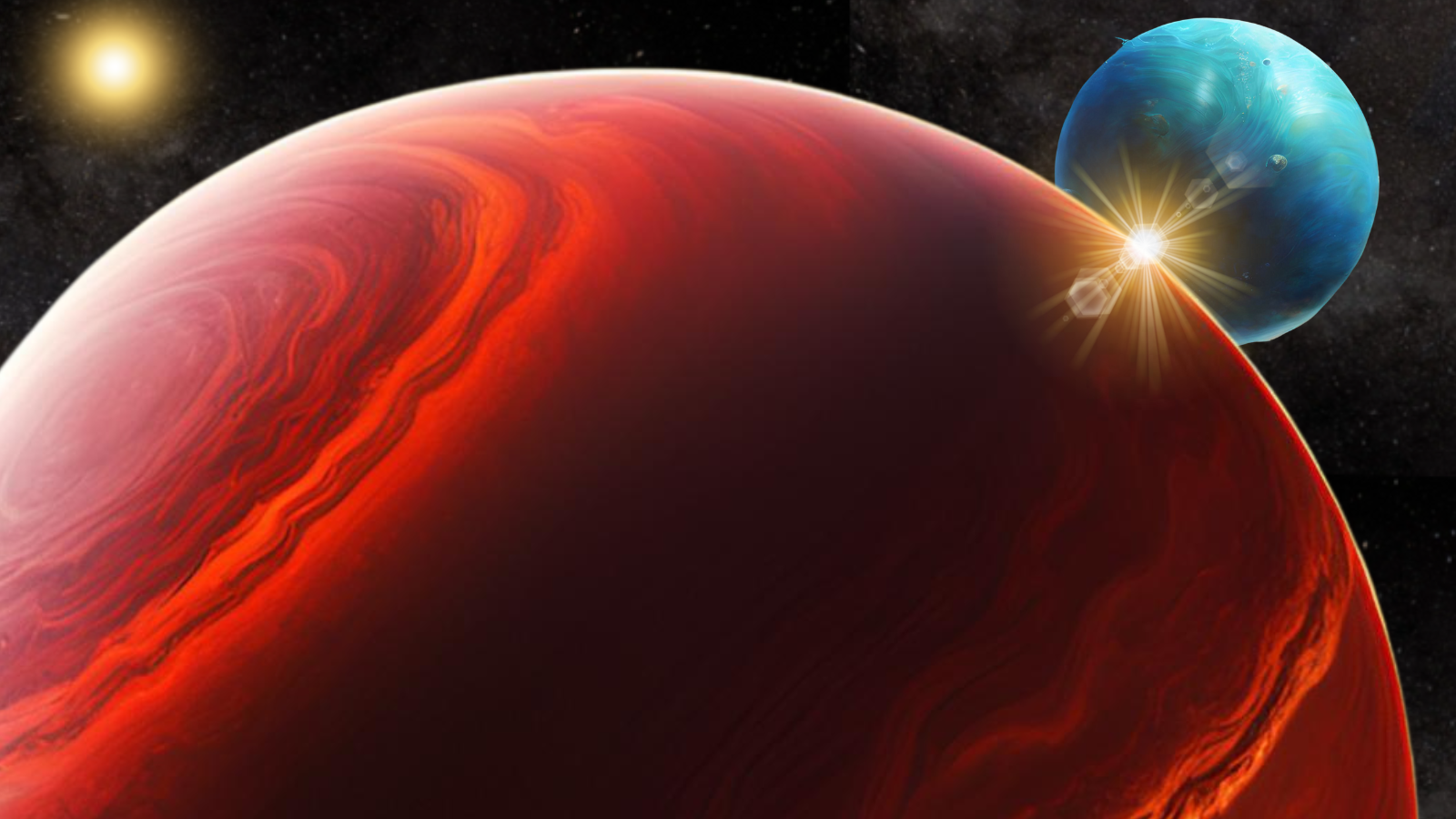
a large red orb streaked with wavy lines of lighter reds, with a smaller blue-green orb nearby on a starry background

An illustration showing the gas giant planet HD 206893 B and its potential exomoon (Image credit: Robert Lea (created with Canva))

So, how did astronomers cook up this new recipe for habitability? They didn’t just pull it out of a hat. They used some seriously sophisticated tools, combining a radiative transfer code called HELIOS to model how heat moves through the atmosphere with an equilibrium condensation chemistry code named GGchem to figure out the precise chemical makeup of these bizarre worlds. It’s a grand challenge tackled with clever computational solutions, painting a picture of these extreme exomoons where tidal heating and those thick, hydrogen-rich atmospheres conspire to create billions of years of potentially habitable surface conditions.

Now, before you go packing your bags for a hydrogen moon vacation, it’s important to remember that science is a journey, not a destination. This self-consistent atmospheric model, while brilliant, is still built on a few approximations and assumptions. For instance, the HELIOS code, while powerful, assumes a constant gravitational pull, which might get a little wonky for super-thick atmospheres on moons with low gravity.


What to read next

And the models are currently only looking at “dry” atmospheres, not considering how water vapor itself might influence the temperature profile, or how condensation might affect things. Also, GGchem calculates chemistry for each atmospheric layer in isolation, without thinking about how atoms and molecules might move between those layers.

And hey, just because a world can have liquid water doesn’t automatically mean it’s teeming with life. We’re still learning the intricate dance of habitability.

But here’s the exciting bit: this is just the beginning of understanding these rogue worlds. Future research will undoubtedly dive deeper, exploring other atmospheric compositions beyond just hydrogen, and pushing the models further by adding in more complex atmospheric physics, like clouds and more nuanced ways to handle water vapor.

This new understanding of exomoons around free-floating planets throws open a massive, unexpected cosmic real estate market for life. Who knew the loneliest places in the universe might actually be some of the coziest, just waiting for us to figure out their secrets?

Tags: rocket launch
No Result
View All Result

Recent Posts

  • We chat to legendary space shuttle commander Eileen Collins about her new documentary, ‘Spacewoman’ (interview)
  • This Week In Space podcast: Episode 202 — Artemis Imminent
  • Artemis Accords nations grapple with how to handle emergencies and ‘harmful interference’ on the moon
  • The loneliest places in the universe might actually be some of the best places for life
  • Officina Stellare wins $2 million contract for lasercom ground station in Spain

Categories

  • Excursions
  • Kepler Mission
  • NASA
  • NASA Breaking News
  • Physical Preparation
  • Preparation
  • Space News
  • Space Station News
  • Spacewalks
  • Tours
  • Uncategorized
  • Weightlessness Training
  • What Not to Pack
  • What to Pack

Meta

  • Log in
  • Entries feed
  • Comments feed
  • WordPress.org
  • Home
  • Start Here
  • Preparing for Your Trip
  • Space Tourism Companies
  • Space Tours
  • Contact

© 2026 JNews - Premium WordPress news & magazine theme by Jegtheme.

No Result
View All Result
  • About
  • Contact
  • Feeds
  • Frequently Asked Questions
  • Preparing for Your Trip
    • Insurance and Legal Waivers
    • Physical and Medical Requirements
    • Training Programs
    • What to Expect
  • Privacy Policy
  • Space Tourism Companies
    • Axiom Space
    • Blue Origin
    • Blue Origin vs Virgin Galactic
    • Comparison Chart: Features, Pricing, Booking
    • SpaceX
    • Virgin Galactic
    • World View (stratospheric balloon flights)
  • Space Tours
    • Custom & Luxury Packages
    • Duration, Training, Costs
    • Experiences
    • Future Moon/Mars Options
    • Orbital Flights
    • Parabolic Flight Experiences
    • Private Missions
    • Stratospheric Balloon Flights
    • Suborbital Flights
    • Zero-Gravity Flights
  • Spaceflight Technologies
    • Space Tourism Balloon
  • Start Here
    • How to Book a Space Tour
    • Intro to Commercial Spaceflight
    • Is Space Tourism Safe?
    • Space Travel FAQs
    • View Earth from the Edge
    • What to Pack
  • Tours in Space is your launchpad to the world of space tourism

© 2026 JNews - Premium WordPress news & magazine theme by Jegtheme.