• Home
  • About
  • FAQ
  • Feeds
  • Glossary
  • Contact
Tours In Space
  • Home
  • Start Here
    • Intro to Commercial Spaceflight
    • How to Book a Space Tour
    • Is Space Tourism Safe?
    • Space Travel FAQs
    • View Earth from the Edge
    • What to Pack
  • Preparing for Your Trip
    • Insurance and Legal Waivers
    • Physical and Medical Requirements
    • Training Programs
    • What to Expect
  • Space Tourism Companies
    • Axiom Space
    • Blue Origin
    • SpaceX
    • Virgin Galactic
    • World View (stratospheric balloon flights)
    • Blue Origin vs Virgin Galactic
    • Comparison Chart: Features, Pricing, Booking
  • Space Tours
    • Custom & Luxury Packages
    • Duration, Training, Costs
    • Experiences
    • Future Moon/Mars Options
    • Orbital Flights
    • Parabolic Flight Experiences
    • Private Missions
    • Stratospheric Balloon Flights
    • Suborbital Flights
    • Zero-Gravity Flights
  • Spaceflight Technologies
    • Space Tourism Balloon
No Result
View All Result
  • Home
  • Start Here
    • Intro to Commercial Spaceflight
    • How to Book a Space Tour
    • Is Space Tourism Safe?
    • Space Travel FAQs
    • View Earth from the Edge
    • What to Pack
  • Preparing for Your Trip
    • Insurance and Legal Waivers
    • Physical and Medical Requirements
    • Training Programs
    • What to Expect
  • Space Tourism Companies
    • Axiom Space
    • Blue Origin
    • SpaceX
    • Virgin Galactic
    • World View (stratospheric balloon flights)
    • Blue Origin vs Virgin Galactic
    • Comparison Chart: Features, Pricing, Booking
  • Space Tours
    • Custom & Luxury Packages
    • Duration, Training, Costs
    • Experiences
    • Future Moon/Mars Options
    • Orbital Flights
    • Parabolic Flight Experiences
    • Private Missions
    • Stratospheric Balloon Flights
    • Suborbital Flights
    • Zero-Gravity Flights
  • Spaceflight Technologies
    • Space Tourism Balloon
No Result
View All Result
Tours In Space
No Result
View All Result
Home Space News

‘This is really intolerable’: Astronomers protest giant orbiting mirror project and SpaceX’s million AI satellites

Ensign by Ensign
March 22, 2026
in Space News
0
‘This is really intolerable’: Astronomers protest giant orbiting mirror project and SpaceX’s million AI satellites
189
SHARES
1.5k
VIEWS
Share on FacebookShare on Twitter

Astronomers are up in arms, protesting against a proposed constellation of tens of thousands of orbiting mirrors intended to reflect light onto ground-based solar power plants and SpaceX’s envisioned one million orbiting data centers.

The projects, which have been put forward to the U.S. Federal Communications Commission (FCC) for approval, would destroy the night sky as we know it and obscure the views of astronomical telescopes all over the world, hampering scientific progress, according to experts.

“This is really intolerable,” Robert Massey, the deputy executive director at the British Royal Astronomical Society (RAS), told Space.com. “It’s absolutely the destruction of a central part of human heritage.”

Article continues below


You may like

RAS, the oldest astronomical society in the world, has joined the growing army of research institutions filing objections to the FCC against the proposals by SpaceX and California-based startup Reflect Orbital.

SpaceX announced its plans to launch one million data centers to space in January. The company’s founder and CEO, Elon Musk, said on X at that time that moving power-hungry computing infrastructure into space is necessary to fully unleash the powers of AI. Reflect Orbital, founded by former SpaceX intern Ben Nowack, has ambitions to launch 50,000 orbiting mirrors into space, each one about 180 feet (55 meters) wide.

If those plans were to pass, the sky as humankind has known it for millions of years would change beyond recognition.

“If you have a direct view of this, it would be several times as bright as the full moon,” said Massey. “That’s extraordinarily bright.”

Breaking space news, the latest updates on rocket launches, skywatching events and more!

Even if seen at an angle, the orbiting mirror would be as bright as Venus, the brightest object in the night sky after the moon.

“Imagine a stream of satellites with that kind of magnitude crossing the sky,” said Massey. “It would absolutely transform our view of the sky.”

Add to that the million proposed SpaceX data centers, which, although dimmer, would also be visible to the naked eye. Due to the vast size of these planned constellations, there would be thousands of shining dots as bright as stars criss-crossing the firmament at any given moment.


What to read next

Massey estimates the sky would become up to three times brighter as a result of the vast quantity of Reflect Orbital’s sun-reflecting mirrors. That brightening would affect the entire planet, including remote locations that are now considered dark sky sanctuaries, where astronomers build their sky-observing machines.

The European Southern Observatory (ESO), an international astronomy research organization that operates some of the world’s largest telescopes, has also filed objections against the two proposals.

ESO astronomer Olivier Hainaut told Space.com that the Very Large Telescope in Chile would lose up to 10% of pixels in every image if SpaceX’s one million orbiting data centers were to materialize. That number could rise to up to 30% for some kinds of observations.

“That’s a huge loss,” Hainaut said. “We keep our technical losses below 3%, and the total weather losses are about 10%.”

The overall increase in sky brightness caused by the Reflect Orbital mirror constellation would mean astronomers would have to triple exposure times when taking images.

“We wouldn’t be able to observe our faint targets anymore,” Hainaut said. “It would be disastrous.”
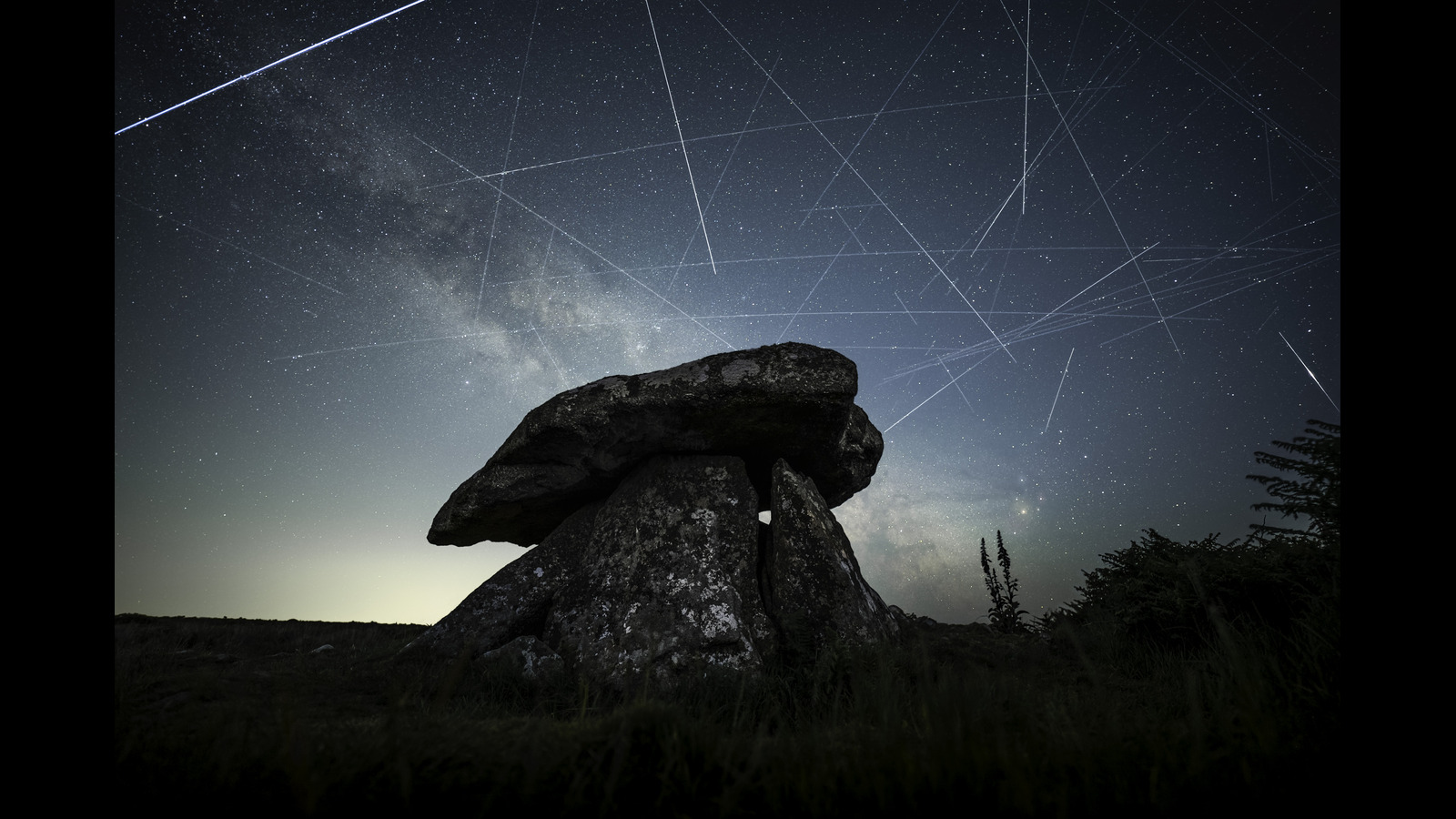
Satellites are pictured leaving long 'trails' in the night sky in a composite image featuring the Milky Way hanging over a stone monument.

Satellites leave long streaks in the night sky in this composite image by astrophotographer Josh Dury. (Image credit: Josh Dury)

Fabio Felchi, a light pollution researcher at Istituto Superiore “Enrico Fermi”​ Mantova in Italy, told Space.com that “the only option we have to save the starry night as it was for billions of years is to put a limit on the total number of satellites in orbit.”

He added that a safe limit has already been passed and called for “a red-line policy on this, as there is for most other pollutants.”

Noelia Noel, an astrophysicist at the University of Surrey in the U.K., said that the two proposals “mark a critical moment in how we manage humanity’s presence in space.”

“While innovation in satellite technology brings clear societal benefits, scaling to hundreds of thousands or even millions of bright objects — or deliberately illuminating the Earth from orbit — risks fundamentally altering the night sky,” she said. “This would have profound consequences not only for astronomy but also for ecosystems, our cultural heritage, and our collective relationship with the cosmos.”

Some worry that the FCC is in favor of those proposals, as it’s fast-tracking their evaluation without expecting the companies to carry out environmental impact assessments, astronomer and dark sky consultant John Barentine previously told Space.com.

“The presumption now is that the application should be approved and that it should be up to the people who might object to prove that there’s a problem of some kind,” said Barentine. “The fact that they have fast-tracked this application, which has potentially tremendous effects not only for astronomy but for the environment too, and to do so without engaging in a full environmental review, is worrisome.”

Tags: Elon Muskrocket launchSpaceX
No Result
View All Result

Recent Posts

  • See the delicate crescent moon dance with the ‘Seven Sisters’ of the Pleiades tonight
  • What if the next great astronomer isn’t human? How AI is revolutionizing our study of the cosmos
  • ‘This is really intolerable’: Astronomers protest giant orbiting mirror project and SpaceX’s million AI satellites
  • Russian cargo spacecraft suffers glitch after launching toward International Space Station
  • We chat to legendary space shuttle commander Eileen Collins about her new documentary, ‘Spacewoman’ (interview)

Categories

  • Excursions
  • Kepler Mission
  • NASA
  • NASA Breaking News
  • Physical Preparation
  • Preparation
  • Space News
  • Space Station News
  • Spacewalks
  • Tours
  • Uncategorized
  • Weightlessness Training
  • What Not to Pack
  • What to Pack

Meta

  • Log in
  • Entries feed
  • Comments feed
  • WordPress.org
  • Home
  • Start Here
  • Preparing for Your Trip
  • Space Tourism Companies
  • Space Tours
  • Contact

© 2026 JNews - Premium WordPress news & magazine theme by Jegtheme.

No Result
View All Result
  • About
  • Contact
  • Feeds
  • Frequently Asked Questions
  • Preparing for Your Trip
    • Insurance and Legal Waivers
    • Physical and Medical Requirements
    • Training Programs
    • What to Expect
  • Privacy Policy
  • Space Tourism Companies
    • Axiom Space
    • Blue Origin
    • Blue Origin vs Virgin Galactic
    • Comparison Chart: Features, Pricing, Booking
    • SpaceX
    • Virgin Galactic
    • World View (stratospheric balloon flights)
  • Space Tours
    • Custom & Luxury Packages
    • Duration, Training, Costs
    • Experiences
    • Future Moon/Mars Options
    • Orbital Flights
    • Parabolic Flight Experiences
    • Private Missions
    • Stratospheric Balloon Flights
    • Suborbital Flights
    • Zero-Gravity Flights
  • Spaceflight Technologies
    • Space Tourism Balloon
  • Start Here
    • How to Book a Space Tour
    • Intro to Commercial Spaceflight
    • Is Space Tourism Safe?
    • Space Travel FAQs
    • View Earth from the Edge
    • What to Pack
  • Tours in Space is your launchpad to the world of space tourism

© 2026 JNews - Premium WordPress news & magazine theme by Jegtheme.