• Home
  • About
  • FAQ
  • Feeds
  • Glossary
  • Contact
Tours In Space
  • Home
  • Start Here
    • Intro to Commercial Spaceflight
    • How to Book a Space Tour
    • Is Space Tourism Safe?
    • Space Travel FAQs
    • View Earth from the Edge
    • What to Pack
  • Preparing for Your Trip
    • Insurance and Legal Waivers
    • Physical and Medical Requirements
    • Training Programs
    • What to Expect
  • Space Tourism Companies
    • Axiom Space
    • Blue Origin
    • SpaceX
    • Virgin Galactic
    • World View (stratospheric balloon flights)
    • Blue Origin vs Virgin Galactic
    • Comparison Chart: Features, Pricing, Booking
  • Space Tours
    • Custom & Luxury Packages
    • Duration, Training, Costs
    • Experiences
    • Future Moon/Mars Options
    • Orbital Flights
    • Parabolic Flight Experiences
    • Private Missions
    • Stratospheric Balloon Flights
    • Suborbital Flights
    • Zero-Gravity Flights
  • Spaceflight Technologies
    • Space Tourism Balloon
No Result
View All Result
  • Home
  • Start Here
    • Intro to Commercial Spaceflight
    • How to Book a Space Tour
    • Is Space Tourism Safe?
    • Space Travel FAQs
    • View Earth from the Edge
    • What to Pack
  • Preparing for Your Trip
    • Insurance and Legal Waivers
    • Physical and Medical Requirements
    • Training Programs
    • What to Expect
  • Space Tourism Companies
    • Axiom Space
    • Blue Origin
    • SpaceX
    • Virgin Galactic
    • World View (stratospheric balloon flights)
    • Blue Origin vs Virgin Galactic
    • Comparison Chart: Features, Pricing, Booking
  • Space Tours
    • Custom & Luxury Packages
    • Duration, Training, Costs
    • Experiences
    • Future Moon/Mars Options
    • Orbital Flights
    • Parabolic Flight Experiences
    • Private Missions
    • Stratospheric Balloon Flights
    • Suborbital Flights
    • Zero-Gravity Flights
  • Spaceflight Technologies
    • Space Tourism Balloon
No Result
View All Result
Tours In Space
No Result
View All Result
Home Space News

Astronauts complete prep for new ISS solar array on 1st NASA spacewalk in 10 months

Ensign by Ensign
March 22, 2026
in Space News
0
Astronauts complete prep for new ISS solar array on 1st NASA spacewalk in 10 months
189
SHARES
1.5k
VIEWS
Share on FacebookShare on Twitter

Two NASA astronauts prepared the International Space Station (ISS) for the addition of a new solar array on the first U.S. spacewalk in almost a year.

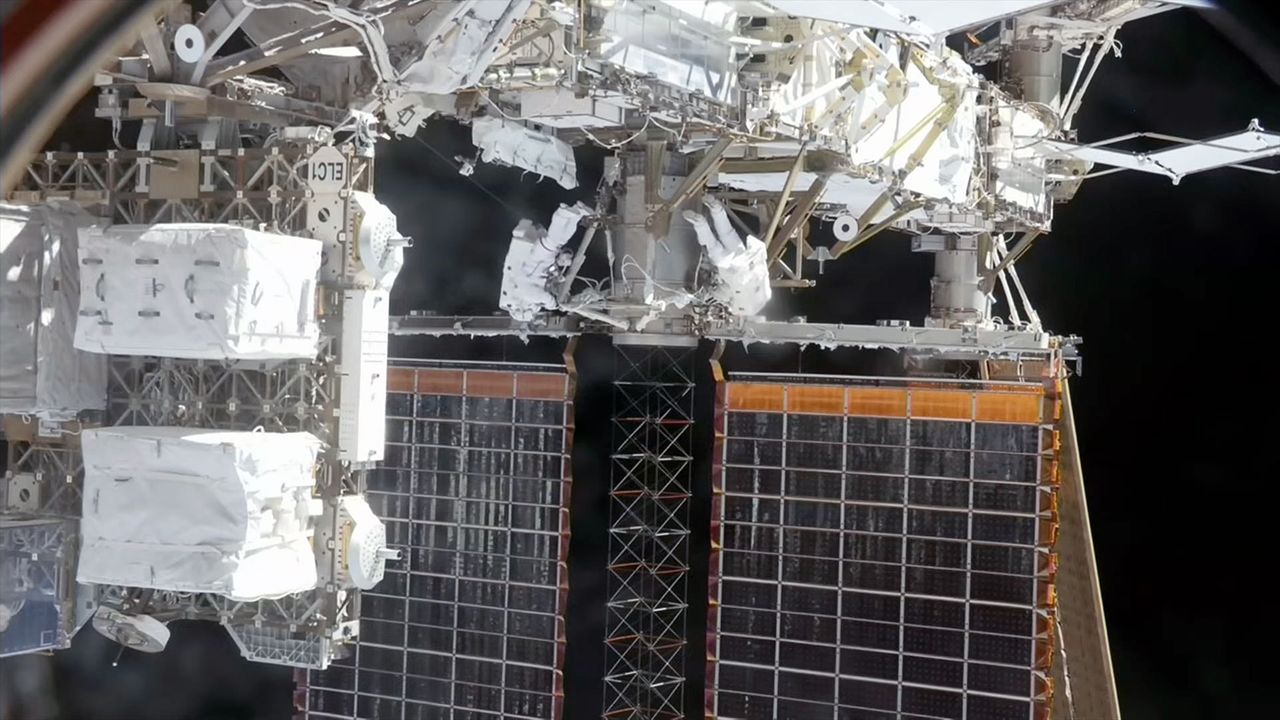
Expedition 74 crewmates Jessica Meir and Chris Williams ventured outside of the space station’s Quest airlock at 8:52 a.m. EDT (1252 GMT) on Wednesday (March 18) to install a mount for an advanced power-producing solar panel. The pair worked on the left (or port) side of the space station’s backbone truss, where they first assembled and then attached the bracket structure that will support an ISS Roll-Out Array (iROSA), to be installed on a future spacewalk.

Once unfurled, it will be the seventh of eight rollout arrays to be deployed since the upgrades began in 2021. The iROSA assemblies are smaller than the legacy four solar wings on the U.S. segment of the International Space Station. They also require no motor to unfurl to their 63-foot (19 meters) full length. The potential energy held by the rolled-up carbon composite booms is enough to unroll the panel in about six minutes.

Article continues below


You may like

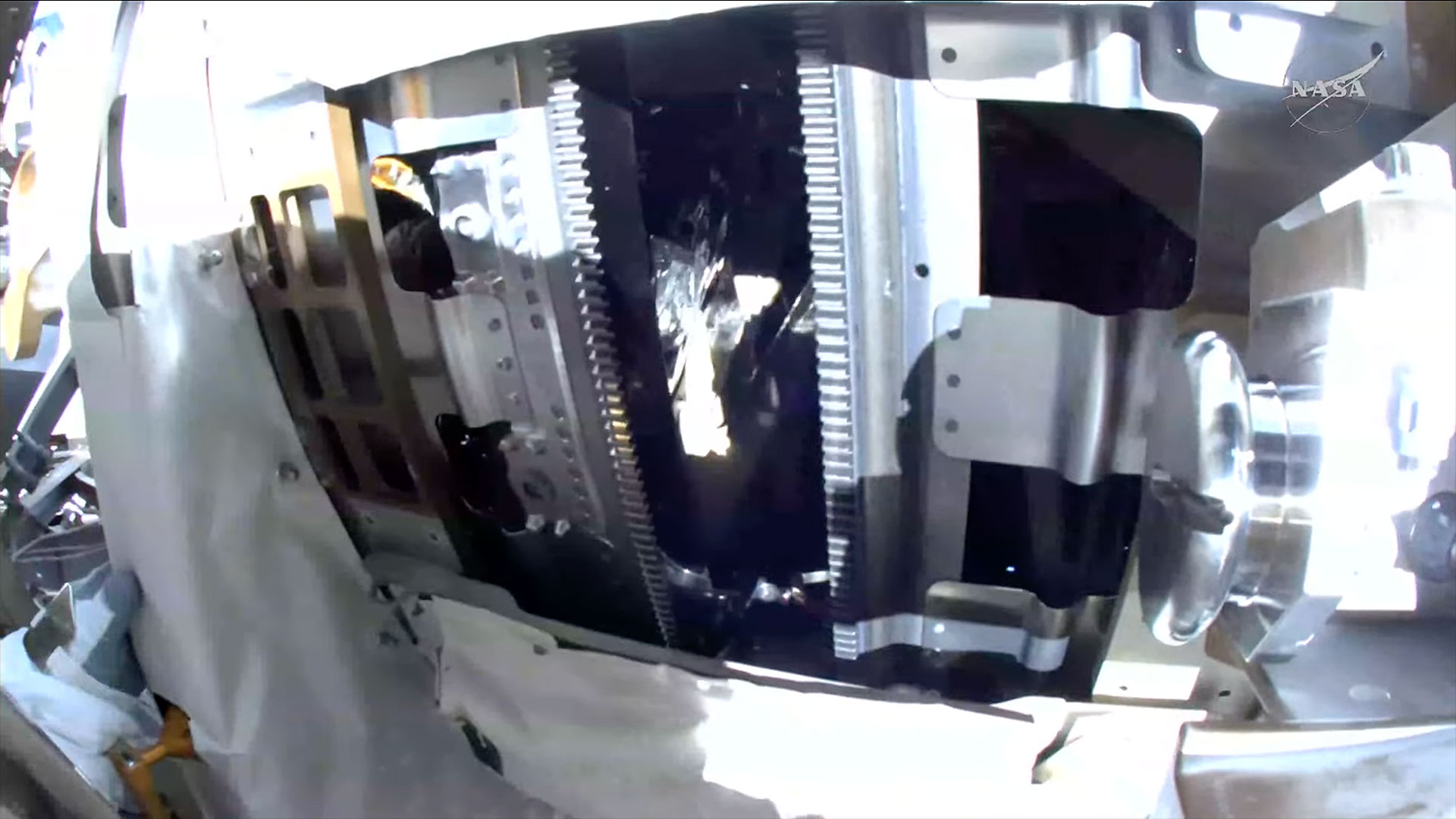
a view from a spacesuit helmet-mounted camera showing the gears for a space station's rotating solar arrays

The view from NASA astronaut Chris Williams’ spacesuit helmet-mounted camera shows the gears for one of the International Space Station’s rotating solar array wings during a spacewalk on Wednesday, March 18, 2026. (Image credit: NASA)

The space station’s original solar arrays have degraded, having exceeded their 15-year service life. When all of them are in place, the new iROSAs will increase the orbiting lab’s electricity supply by 20% to 30%.

The use on ISS also paved the way for NASA to use the technology for deep-space missions, including the Double Asteroid Redirection Test (DART) mission that demonstrated a method of planetary defense by changing the orbit of a small asteroid in 2022. NASA has also been planning to use roll-out solar arrays on its Gateway moon-orbiting space station, but it looks like that outpost may be canceled.

The additional power on the ISS will help support expanded commercial activities and the upcoming transition from the ISS to commercially operated space stations.

After completing work on the iROSA modification kit about five hours into the EVA, Williams moved over to photo-document the gears for the port-side SARJ, or solar array rotating joint, that allows the attached wings to track the sun. Meir concurrently worked on installing an electrical jumper to enable robotic servicing of the components that comprise the 2A power channel.

Breaking space news, the latest updates on rocket launches, skywatching events and more!

Meir and Williams then cleaned up their respective work areas and stowed equipment they had used before reentering the Quest airlock.

Citing the limited time remaining — the spacewalk had been planned to last about 6.5 hours — EVA managers in Mission Control deferred the planned swabbing for microorganisms on the exterior of the space station and the installation of a lens cover on a camera on the Canadarm2 robotic arm for a future outing. Neither of the two tasks was considered mission critical.

Wednesday’s spacewalk ended at 3:54 p.m. EDT (1954 GMT), 7 hours and 2 minutes after it began.


What to read next

“Well done!” said Meir to Williams just before he reentered the station’s hatch.

“It was a lot of work and a lot of fun,” Williams replied.

NASA had originally scheduled for the iROSA kit to be installed during an EVA in May 2025, but it was postponed in favor of relocating an antenna. NASA next planned for the same task to be accomplished during a spacewalk in January, but one of the then-assigned spacewalkers, Mike Fincke, had an undisclosed medical issue that required the excursion to be canceled and he and his crewmates to return to Earth a month early.

This was Williams’ first spacewalk and Meir’s fourth. She has now logged 28 hours and 46 minutes working outside in the vacuum of space, including being a part of the world’s first all-female EVA in 2019.

“Today, March 18, is exactly 61 years since Alexei Leonov became the very first human to step out boldly into the vacuum and blackness of space. Our international efforts in space exploration have evolved considerably since then, but the enormity of venturing outside the hatch in your own mini-spacecraft remains,” said Meir after closing the hatch.

“I can report that my fourth spacewalk feels even more special than my previous ones. That is because I shared the experience with first-time spacewalker Chris Williams. It is a tremendous experience to pass the torch to the next generation of explorers who will keep this space station running,” she said.

“Leonov said he felt like a grain of sand in the universe, a perspective one gains from the privilege of looking down on Earth from above like we did today. Like grains of sand, at least we are here drifting together. The view is always better when you are sharing it with a friend,” concluded Meir.

Wednesday’s spacewalk was the 278th EVA in support of the assembly, maintenance and upgrade of the International Space Station, totaling 1,760 hours and 28 minutes. It was also the first ISS spacewalk of 2026, the first by Expedition 74, and the first by American astronauts since May 1, 2025, when NASA’s Anne McClain and Nichole Ayers ventured outside the orbiting lab.

Tags: NASArocket launchspace station
No Result
View All Result

Recent Posts

  • Sophia and Kepler to marry orbital compute with optical links
  • From spa to boat party: 10 epic events for the Aug. 12, 2026, total solar eclipse in Spain and Iceland
  • Rocket Lab wins contract for three more iQPS launches
  • ‘The most special thing that will ever happen in my life’: Artemis 2 astronauts describe their epic moon mission
  • Falcon 9 launches Cygnus cargo spacecraft to the ISS

Categories

  • Excursions
  • Kepler Mission
  • NASA
  • NASA Breaking News
  • Physical Preparation
  • Preparation
  • Space News
  • Space Station News
  • Spacewalks
  • Tours
  • Uncategorized
  • Weightlessness Training
  • What Not to Pack
  • What to Pack

Meta

  • Log in
  • Entries feed
  • Comments feed
  • WordPress.org
  • Home
  • Start Here
  • Preparing for Your Trip
  • Space Tourism Companies
  • Space Tours
  • Contact

© 2026 JNews - Premium WordPress news & magazine theme by Jegtheme.

No Result
View All Result
  • About
  • Contact
  • Feeds
  • Frequently Asked Questions
  • Preparing for Your Trip
    • Insurance and Legal Waivers
    • Physical and Medical Requirements
    • Training Programs
    • What to Expect
  • Privacy Policy
  • Space Tourism Companies
    • Axiom Space
    • Blue Origin
    • Blue Origin vs Virgin Galactic
    • Comparison Chart: Features, Pricing, Booking
    • SpaceX
    • Virgin Galactic
    • World View (stratospheric balloon flights)
  • Space Tours
    • Custom & Luxury Packages
    • Duration, Training, Costs
    • Experiences
    • Future Moon/Mars Options
    • Orbital Flights
    • Parabolic Flight Experiences
    • Private Missions
    • Stratospheric Balloon Flights
    • Suborbital Flights
    • Zero-Gravity Flights
  • Spaceflight Technologies
    • Space Tourism Balloon
  • Start Here
    • How to Book a Space Tour
    • Intro to Commercial Spaceflight
    • Is Space Tourism Safe?
    • Space Travel FAQs
    • View Earth from the Edge
    • What to Pack
  • Tours in Space is your launchpad to the world of space tourism

© 2026 JNews - Premium WordPress news & magazine theme by Jegtheme.