

TAMPA, Fla. — Amazon vowed to double the annual launch rate for its low Earth orbit broadband constellation to more than 20 missions, hinging largely on rockets yet to prove themselves at scale.
With three more missions slated in the coming weeks, the company said March 23 it is on pace to complete 11 launches in the first year of deployment since kicking off a multibillion-dollar campaign for Amazon Leo in April 2025.
Amazon has booked more than 100 launches for the constellation, including missions with United Launch Alliance (ULA), Arianespace, Blue Origin and SpaceX.
But while 212 Amazon Leo satellites have been deployed so far, hundreds more are awaiting launch as the company seeks relief from a key U.S. Federal Communications Commission milestone that requires it to deploy half of its planned 3,232 first-generation satellites by July 30. Amazon is asking the FCC to extend that deadline by two years or waive it entirely.
“As of mid-March, we have six fully stacked payloads at our satellite processing facility in Florida — more than 200 satellites in total — and another payload being prepared in French Guiana,” Amazon said in a blog post.
Amazon says it can build as many as 30 satellites per week from its facility in Kirkland, Washington, though this rate has slowed to reflect launch vehicle readiness and availability.
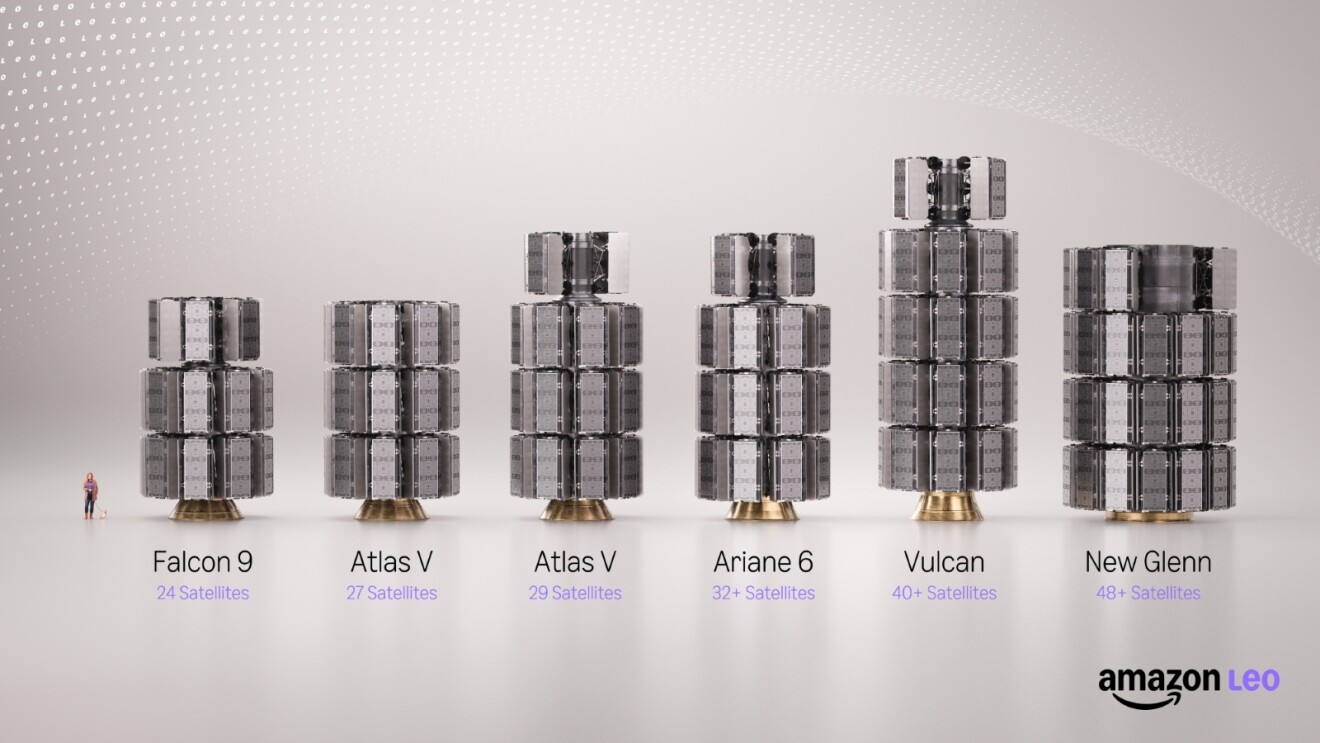
Next up is a ULA Atlas 5 mission March 29 that is set to carry 29 Amazon Leo satellites, up from the usual 27, following an engine upgrade enabling its heaviest payload to date.
Another Atlas 5 is due to fly next month, along with a second Ariane 64 launch for the constellation. The Ariane 64 mission last month was Arianespace’s first using the rocket’s more powerful four-booster variant and carried 32 satellites.
Doing the heavy lifting
According to Amazon, future upgrades will enable Ariane 64 to support even larger payloads.
Most launches for the constellation this year are due to use heavy-lift rockets, including Blue Origin’s New Glenn, expected to carry about 48 satellites initially, and ULA’s Vulcan Centaur, with capacity for around 40 from the start.
Amazon said it has also invested more than $200 million in upgrading ULA facilities at Cape Canaveral to help increase launch cadence and improve turnaround times.