• Home
  • About
  • FAQ
  • Feeds
  • Glossary
  • Contact
Tours In Space
  • Home
  • Start Here
    • Intro to Commercial Spaceflight
    • How to Book a Space Tour
    • Is Space Tourism Safe?
    • Space Travel FAQs
    • View Earth from the Edge
    • What to Pack
  • Preparing for Your Trip
    • Insurance and Legal Waivers
    • Physical and Medical Requirements
    • Training Programs
    • What to Expect
  • Space Tourism Companies
    • Axiom Space
    • Blue Origin
    • SpaceX
    • Virgin Galactic
    • World View (stratospheric balloon flights)
    • Blue Origin vs Virgin Galactic
    • Comparison Chart: Features, Pricing, Booking
  • Space Tours
    • Custom & Luxury Packages
    • Duration, Training, Costs
    • Experiences
    • Future Moon/Mars Options
    • Orbital Flights
    • Parabolic Flight Experiences
    • Private Missions
    • Stratospheric Balloon Flights
    • Suborbital Flights
    • Zero-Gravity Flights
  • Spaceflight Technologies
    • Space Tourism Balloon
No Result
View All Result
  • Home
  • Start Here
    • Intro to Commercial Spaceflight
    • How to Book a Space Tour
    • Is Space Tourism Safe?
    • Space Travel FAQs
    • View Earth from the Edge
    • What to Pack
  • Preparing for Your Trip
    • Insurance and Legal Waivers
    • Physical and Medical Requirements
    • Training Programs
    • What to Expect
  • Space Tourism Companies
    • Axiom Space
    • Blue Origin
    • SpaceX
    • Virgin Galactic
    • World View (stratospheric balloon flights)
    • Blue Origin vs Virgin Galactic
    • Comparison Chart: Features, Pricing, Booking
  • Space Tours
    • Custom & Luxury Packages
    • Duration, Training, Costs
    • Experiences
    • Future Moon/Mars Options
    • Orbital Flights
    • Parabolic Flight Experiences
    • Private Missions
    • Stratospheric Balloon Flights
    • Suborbital Flights
    • Zero-Gravity Flights
  • Spaceflight Technologies
    • Space Tourism Balloon
No Result
View All Result
Tours In Space
No Result
View All Result
Home Space News

Get one last look at the Pleiades before it disappears from the spring sky

Ensign by Ensign
March 24, 2026
in Space News
0
Get one last look at the Pleiades before it disappears from the spring sky
189
SHARES
1.5k
VIEWS
Share on FacebookShare on Twitter

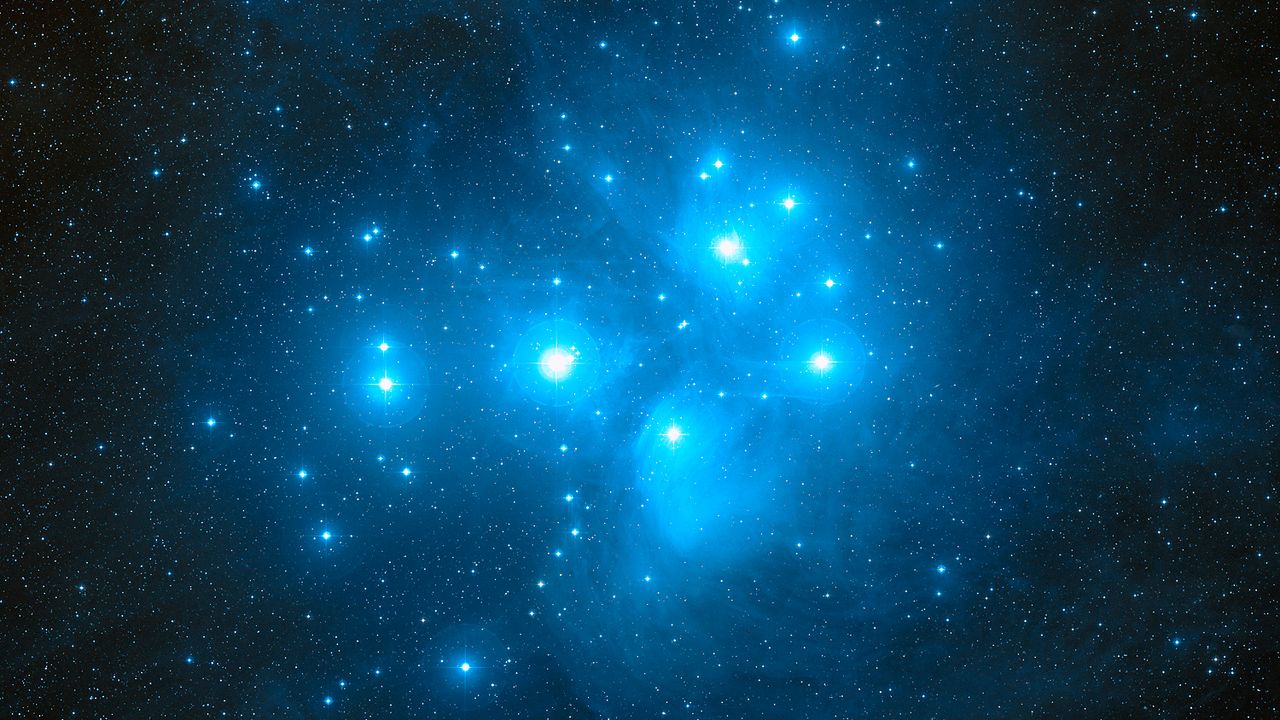
Head outside tonight and drink in the sight of the Pleiades open star cluster glistening close to the red star Aldebaran in the constellation Taurus, before the mesmerizing naked-eye jewel slips out of view with the changing of the seasons.

The Pleiades are at their most spectacular from October to March, after which the cluster slips ever lower in the spring sky, appearing closer to the horizon with each passing night. By late April, it will be lost to sight in the glare of the setting sun and won’t be seen again until the very end of June, when it will briefly shine close to the red light of Mars in the predawn sky.

On a clear night under dark skies, the Pleiades appear as a distinct haze of light that becomes easier to see when you look slightly to one side — a technique known as averted vision, which helps your eyes pick up faint objects.

Article continues below


You may like

The Pleiades is a vast collection of roughly 1,000 gravitationally bound blue-white stars, the seven most prominent of which are named after the daughters of the Titan Atlas from Greek mythology — Asterope, Alcyone, Celaeno, Maia, Electra, Taygete and Merope.

How to find the Pleiades

Finding the Pleiades is easy with a little help from the most recognizable constellation in the northern hemisphere night sky — Orion, the Hunter — which is currently shining about halfway up the southwestern sky after sunset through late March. Next, identify the three familiar stars of Orion’s Belt.

Draw an imaginary line from the leftmost star, Alnitak, through the rightmost star, Mintaka and out into space. Follow it past the red giant star Aldebaran and you’ll find the hazy light representing the stellar city of the Pleiades!
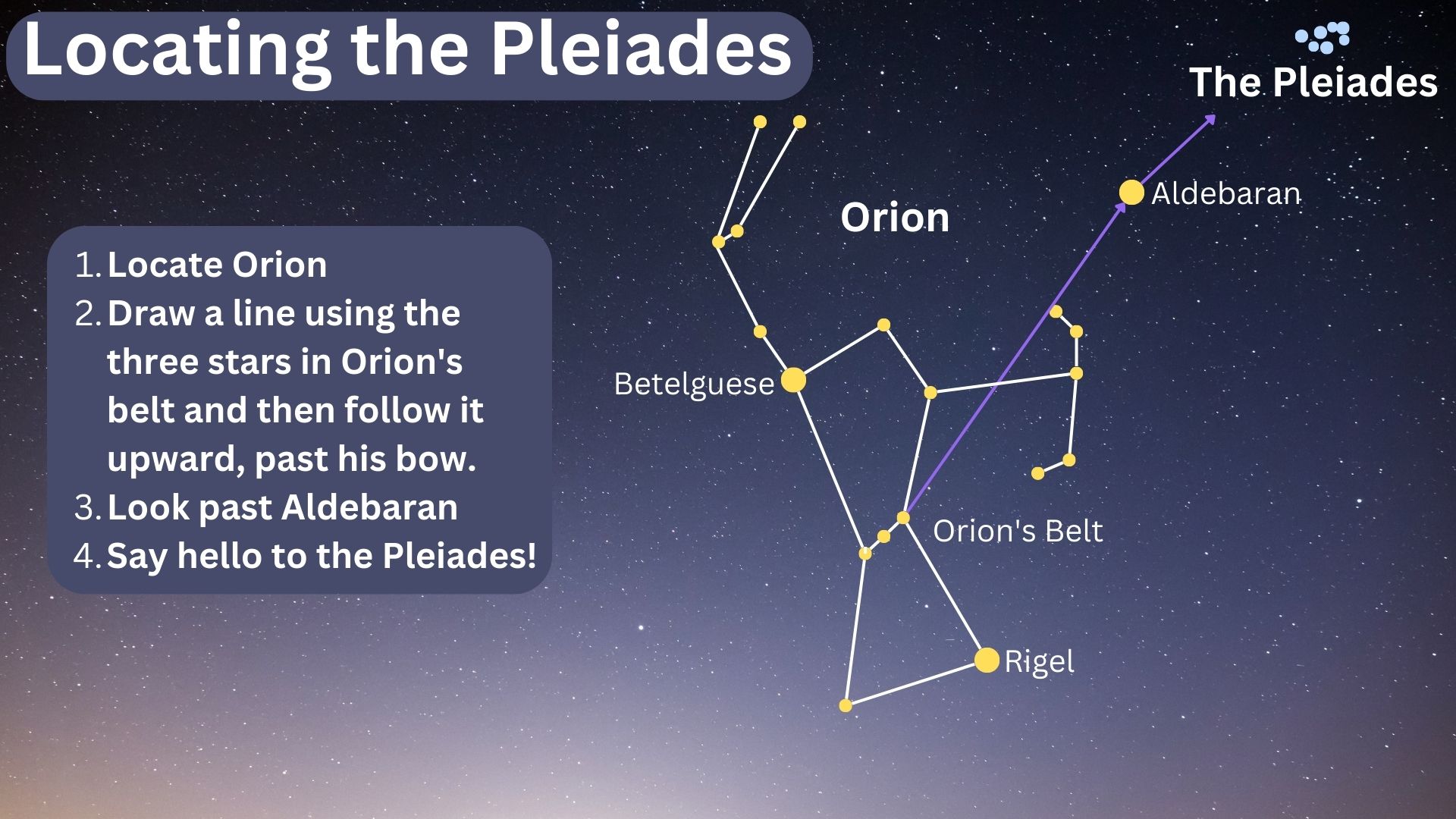
Pleiades location graphic showing how you can use Orion's belt to point to Aldebaran and then onto the Pleiades star cluster.

The Pleiades are easy to locate. (Image credit: Daisy Dobrijevic)

A pair of 10X50 binoculars can help to reveal the seven brightest stars of the Pleiades along with numerous fainter blue-white companions, while a small telescope enhances the view to reveal dozens more of the stellar grouping.

Breaking space news, the latest updates on rocket launches, skywatching events and more!

To view the cluster’s ancient light is to follow in the footsteps of the greatest astronomers ever to have walked the Earth, including the famed Italian scientist Galileo Galilei, who recorded the first ever telescopic observation of the Pleiades in his 1610 work Sidereus Nuncius, the Sidereal Messenger.

Today’s best Celestron Inspire 100AZ deals

Want to marvel at the stars of the Pleiades for yourself? Then be sure to read our roundup of the best telescopes and binoculars for observing the night sky, along with our picks of the best smartphone astronomy apps available in 2026.

<em>Editor’s Note: If you would like to share your photos of the Pleiades with Space.com’s readers, then please send your image(s), comments, name and location to spacephotos@space.com.

Tags: rocket launch
No Result
View All Result

Recent Posts

  • Future Artemis missions could use fiber-optic cables to monitor moonquakes
  • Watch all your favorite sci-fi content like ‘For All Mankind’ and ‘Star City’ anywhere with this exclusive deal and get a free $50 Amazon Gift Card and 77% off NordVPN
  • Hubble revisits the Crab Nebula after 25 years | Space photo of the day for March 24, 2026
  • NASA Unveils Initiatives to Achieve America’s National Space Policy
  • Arriving safely on Venus and Titan: Different atmospheres affect heat shields differently, study shows

Categories

  • Excursions
  • Kepler Mission
  • NASA
  • NASA Breaking News
  • Physical Preparation
  • Preparation
  • Space News
  • Space Station News
  • Spacewalks
  • Tours
  • Uncategorized
  • Weightlessness Training
  • What Not to Pack
  • What to Pack

Meta

  • Log in
  • Entries feed
  • Comments feed
  • WordPress.org
  • Home
  • Start Here
  • Preparing for Your Trip
  • Space Tourism Companies
  • Space Tours
  • Contact

© 2026 JNews - Premium WordPress news & magazine theme by Jegtheme.

No Result
View All Result
  • About
  • Contact
  • Feeds
  • Frequently Asked Questions
  • Preparing for Your Trip
    • Insurance and Legal Waivers
    • Physical and Medical Requirements
    • Training Programs
    • What to Expect
  • Privacy Policy
  • Space Tourism Companies
    • Axiom Space
    • Blue Origin
    • Blue Origin vs Virgin Galactic
    • Comparison Chart: Features, Pricing, Booking
    • SpaceX
    • Virgin Galactic
    • World View (stratospheric balloon flights)
  • Space Tours
    • Custom & Luxury Packages
    • Duration, Training, Costs
    • Experiences
    • Future Moon/Mars Options
    • Orbital Flights
    • Parabolic Flight Experiences
    • Private Missions
    • Stratospheric Balloon Flights
    • Suborbital Flights
    • Zero-Gravity Flights
  • Spaceflight Technologies
    • Space Tourism Balloon
  • Start Here
    • How to Book a Space Tour
    • Intro to Commercial Spaceflight
    • Is Space Tourism Safe?
    • Space Travel FAQs
    • View Earth from the Edge
    • What to Pack
  • Tours in Space is your launchpad to the world of space tourism

© 2026 JNews - Premium WordPress news & magazine theme by Jegtheme.