• Home
  • About
  • FAQ
  • Feeds
  • Glossary
  • Contact
Tours In Space
  • Home
  • Start Here
    • Intro to Commercial Spaceflight
    • How to Book a Space Tour
    • Is Space Tourism Safe?
    • Space Travel FAQs
    • View Earth from the Edge
    • What to Pack
  • Preparing for Your Trip
    • Insurance and Legal Waivers
    • Physical and Medical Requirements
    • Training Programs
    • What to Expect
  • Space Tourism Companies
    • Axiom Space
    • Blue Origin
    • SpaceX
    • Virgin Galactic
    • World View (stratospheric balloon flights)
    • Blue Origin vs Virgin Galactic
    • Comparison Chart: Features, Pricing, Booking
  • Space Tours
    • Custom & Luxury Packages
    • Duration, Training, Costs
    • Experiences
    • Future Moon/Mars Options
    • Orbital Flights
    • Parabolic Flight Experiences
    • Private Missions
    • Stratospheric Balloon Flights
    • Suborbital Flights
    • Zero-Gravity Flights
  • Spaceflight Technologies
    • Space Tourism Balloon
No Result
View All Result
  • Home
  • Start Here
    • Intro to Commercial Spaceflight
    • How to Book a Space Tour
    • Is Space Tourism Safe?
    • Space Travel FAQs
    • View Earth from the Edge
    • What to Pack
  • Preparing for Your Trip
    • Insurance and Legal Waivers
    • Physical and Medical Requirements
    • Training Programs
    • What to Expect
  • Space Tourism Companies
    • Axiom Space
    • Blue Origin
    • SpaceX
    • Virgin Galactic
    • World View (stratospheric balloon flights)
    • Blue Origin vs Virgin Galactic
    • Comparison Chart: Features, Pricing, Booking
  • Space Tours
    • Custom & Luxury Packages
    • Duration, Training, Costs
    • Experiences
    • Future Moon/Mars Options
    • Orbital Flights
    • Parabolic Flight Experiences
    • Private Missions
    • Stratospheric Balloon Flights
    • Suborbital Flights
    • Zero-Gravity Flights
  • Spaceflight Technologies
    • Space Tourism Balloon
No Result
View All Result
Tours In Space
No Result
View All Result
Home Space News

Like ‘accelerating from stationary to supersonic flight’: Europe’s Hera probe boosts speed, stays on course for November asteroid rendezvous

Ensign by Ensign
March 25, 2026
in Space News
0
Like ‘accelerating from stationary to supersonic flight’: Europe’s Hera probe boosts speed, stays on course for November asteroid rendezvous
189
SHARES
1.5k
VIEWS
Share on FacebookShare on Twitter

The European Space Agency’s Hera spacecraft has completed a major deep-space maneuver, setting it on course to rendezvous late this year with the asteroid system targeted by NASA’s DART mission back in 2022.

Hera launched on a SpaceX Falcon 9 rocket in October 2024, beginning its voyage to the Didymos binary asteroid system. Hera is designed to make follow-up observations of Dimorphos, the smaller of the two asteroids, which NASA’s DART (Double Asteroid Redirection Test) spacecraft slammed into in September 2022.

The Hera spacecraft made a flyby of Mars one year ago, in March 2025, testing its autonomous vision-based navigation and training its cameras on the Martian moon Deimos, while also setting itself on course for the Didymos system.

Article continues below


You may like

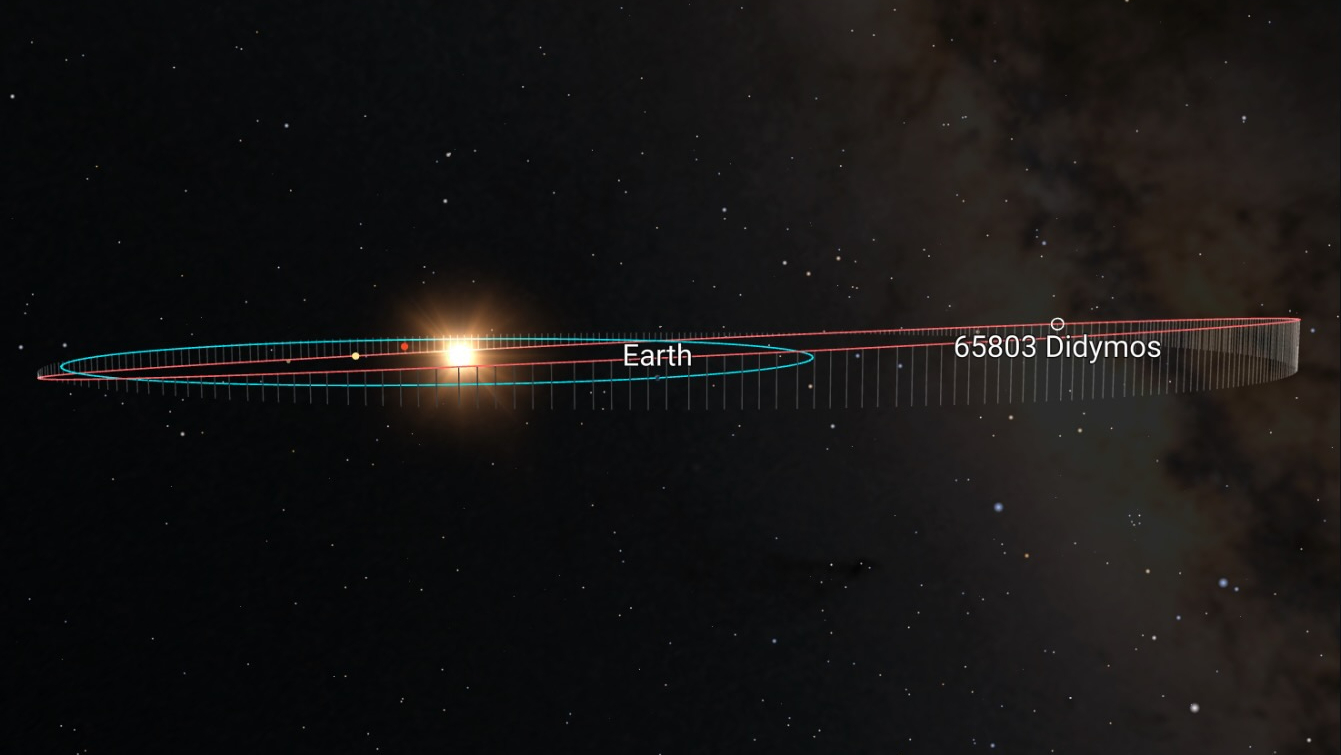
diagram of the solar system, showing the sun at the center and earth and the asteroid didymos off to the right

ESA’s Hera mission conducted a deep space maneuver in February/March 2026 to align the inclination of the spacecraft’s orbit around the sun with that of its destination — the Didymos binary asteroid system. (Image credit: ESA)

Hera is now set up for its rendezvous with the asteroids in November 2026, thanks to a campaign of carefully planned engine burns that it performed in February and March.

“We divided the deep-space maneuver into three engine burns, plus one much smaller correction maneuver, carried out over a period of around four weeks,” Francesco Castellini from the Flight Dynamics team at ESA’s European Space Operations Centre in Germany, said in a March 17 statement.

“This is the Hera mission’s largest maneuver in terms of fuel consumption, and we used it to test all of the systems that we will need during the braking and rendezvous maneuvers later this year as we arrive at Didymos,” Castellini added.

These maneuvers burned 123 kilograms (271 pounds) of onboard hydrazine fuel and changed the spacecraft’s velocity by 367 meters per second (1,204 feet per second) — about 821 mph (1,321 kph). This amounts to “a change comparable to an object accelerating from stationary to supersonic flight,” ESA officials wrote in the same statement. ESA’s Estrack network of deep space antennas confirmed the success of the engine burns.

Breaking space news, the latest updates on rocket launches, skywatching events and more!

Scientists are now beginning preparations for arrival at the asteroid system, including extensive onboard software updates.

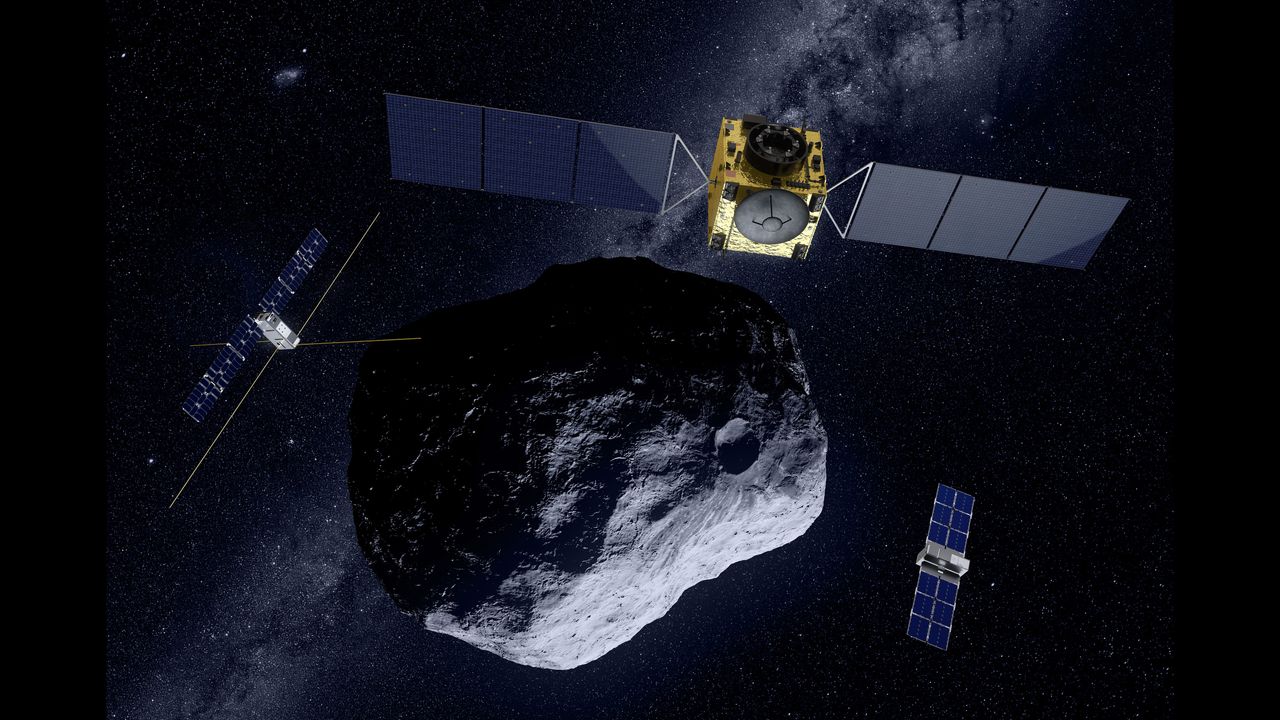
Hera will begin a series of precision burns in October to shift the spacecraft out of its interplanetary cruise phase and set up rendezvous with the Didymos system. The spacecraft and its 12 payloads will spend at least six months studying the system, beginning with early global studies and then deploying its Milani and Juventas cubesats, before then embarking on a more detailed mapping exercise. The primary mission will culminate in an experimental, close-up inspection of the DART impact crater from an altitude of around 1 kilometer (0.62 miles).

The aim of the series of detailed follow-up studies of Dimorphos is to help transform DART’s one-off kinetic impactor experiment into a repeatable, scalable asteroid-deflection method.

While humanity’s knowledge of our solar system’s small worlds is slowly growing thanks to missions from across the globe, such as NASA’s OSIRIS-REx (now OSIRIS-APEX), JAXA’s Hayabusa2 and China’s Tianwen-2, Hera will also be performing the first survey of a binary asteroid system.

Scientists recently revealed that DART slamming into the 560-foot-wide (170 m) Dimorphos also altered the orbit of Didymos, the much larger asteroid of the pair at roughly 2,788 feet (850 m) across. This unexpected outcome could provide new insights into binary asteroid systems and, crucially, how their orbits change after impacts.

Tags: NASArocket launchSpaceX
No Result
View All Result

Recent Posts

  • ‘It was an incredible moment’: One photographer’s journey to capture the March 3 total lunar eclipse over Malaysia
  • Rocket shines under the northern lights | Space photo of the day for March 25, 2026
  • Like ‘accelerating from stationary to supersonic flight’: Europe’s Hera probe boosts speed, stays on course for November asteroid rendezvous
  • Europe plans EPIC SpaceX mission to send 4 astronauts to the ISS before its retirement
  • Scientists finally solve century-old mystery of star with unexpected X-ray emissions

Categories

  • Excursions
  • Kepler Mission
  • NASA
  • NASA Breaking News
  • Physical Preparation
  • Preparation
  • Space News
  • Space Station News
  • Spacewalks
  • Tours
  • Uncategorized
  • Weightlessness Training
  • What Not to Pack
  • What to Pack

Meta

  • Log in
  • Entries feed
  • Comments feed
  • WordPress.org
  • Home
  • Start Here
  • Preparing for Your Trip
  • Space Tourism Companies
  • Space Tours
  • Contact

© 2026 JNews - Premium WordPress news & magazine theme by Jegtheme.

No Result
View All Result
  • About
  • Contact
  • Feeds
  • Frequently Asked Questions
  • Preparing for Your Trip
    • Insurance and Legal Waivers
    • Physical and Medical Requirements
    • Training Programs
    • What to Expect
  • Privacy Policy
  • Space Tourism Companies
    • Axiom Space
    • Blue Origin
    • Blue Origin vs Virgin Galactic
    • Comparison Chart: Features, Pricing, Booking
    • SpaceX
    • Virgin Galactic
    • World View (stratospheric balloon flights)
  • Space Tours
    • Custom & Luxury Packages
    • Duration, Training, Costs
    • Experiences
    • Future Moon/Mars Options
    • Orbital Flights
    • Parabolic Flight Experiences
    • Private Missions
    • Stratospheric Balloon Flights
    • Suborbital Flights
    • Zero-Gravity Flights
  • Spaceflight Technologies
    • Space Tourism Balloon
  • Start Here
    • How to Book a Space Tour
    • Intro to Commercial Spaceflight
    • Is Space Tourism Safe?
    • Space Travel FAQs
    • View Earth from the Edge
    • What to Pack
  • Tours in Space is your launchpad to the world of space tourism

© 2026 JNews - Premium WordPress news & magazine theme by Jegtheme.