• Home
  • About
  • FAQ
  • Feeds
  • Glossary
  • Contact
Tours In Space
  • Home
  • Start Here
    • Intro to Commercial Spaceflight
    • How to Book a Space Tour
    • Is Space Tourism Safe?
    • Space Travel FAQs
    • View Earth from the Edge
    • What to Pack
  • Preparing for Your Trip
    • Insurance and Legal Waivers
    • Physical and Medical Requirements
    • Training Programs
    • What to Expect
  • Space Tourism Companies
    • Axiom Space
    • Blue Origin
    • SpaceX
    • Virgin Galactic
    • World View (stratospheric balloon flights)
    • Blue Origin vs Virgin Galactic
    • Comparison Chart: Features, Pricing, Booking
  • Space Tours
    • Custom & Luxury Packages
    • Duration, Training, Costs
    • Experiences
    • Future Moon/Mars Options
    • Orbital Flights
    • Parabolic Flight Experiences
    • Private Missions
    • Stratospheric Balloon Flights
    • Suborbital Flights
    • Zero-Gravity Flights
  • Spaceflight Technologies
    • Space Tourism Balloon
No Result
View All Result
  • Home
  • Start Here
    • Intro to Commercial Spaceflight
    • How to Book a Space Tour
    • Is Space Tourism Safe?
    • Space Travel FAQs
    • View Earth from the Edge
    • What to Pack
  • Preparing for Your Trip
    • Insurance and Legal Waivers
    • Physical and Medical Requirements
    • Training Programs
    • What to Expect
  • Space Tourism Companies
    • Axiom Space
    • Blue Origin
    • SpaceX
    • Virgin Galactic
    • World View (stratospheric balloon flights)
    • Blue Origin vs Virgin Galactic
    • Comparison Chart: Features, Pricing, Booking
  • Space Tours
    • Custom & Luxury Packages
    • Duration, Training, Costs
    • Experiences
    • Future Moon/Mars Options
    • Orbital Flights
    • Parabolic Flight Experiences
    • Private Missions
    • Stratospheric Balloon Flights
    • Suborbital Flights
    • Zero-Gravity Flights
  • Spaceflight Technologies
    • Space Tourism Balloon
No Result
View All Result
Tours In Space
No Result
View All Result
Home Space News

Scientists finally solve century-old mystery of star with unexpected X-ray emissions

Ensign by Ensign
March 25, 2026
in Space News
0
Scientists finally solve century-old mystery of star with unexpected X-ray emissions
189
SHARES
1.5k
VIEWS
Share on FacebookShare on Twitter

Astronomers have used the XRISM (X-Ray Imaging and Spectroscopy Mission) X-ray spacecraft to discover that a star is being slowly devoured by an elusive stellar companion, solving a mystery that has baffled scientists for over a century.

The star in question is named gamma-Cas, located around 550 light-years away and visible with the unaided eye over Europe on clear nights as the peak of a distinctive “W” in the constellation Cassiopeia. The star gamma-Cas, which is 19 times the size of the sun and up to 65,000 times brighter than our star, first became a puzzle in 1866 when it was found to possess a bright hydrogen “fingerprint” unlike other stars such as the sun.

In the 1970s, this puzzle turned into a full-fledged mystery as astronomers also discovered gamma-Cas shines brightly in high-energy X-rays. These were estimated to originate from plasma burning at an incredible 150 million degrees, shining 40 times brighter than a typical massive star.

Article continues below


You may like

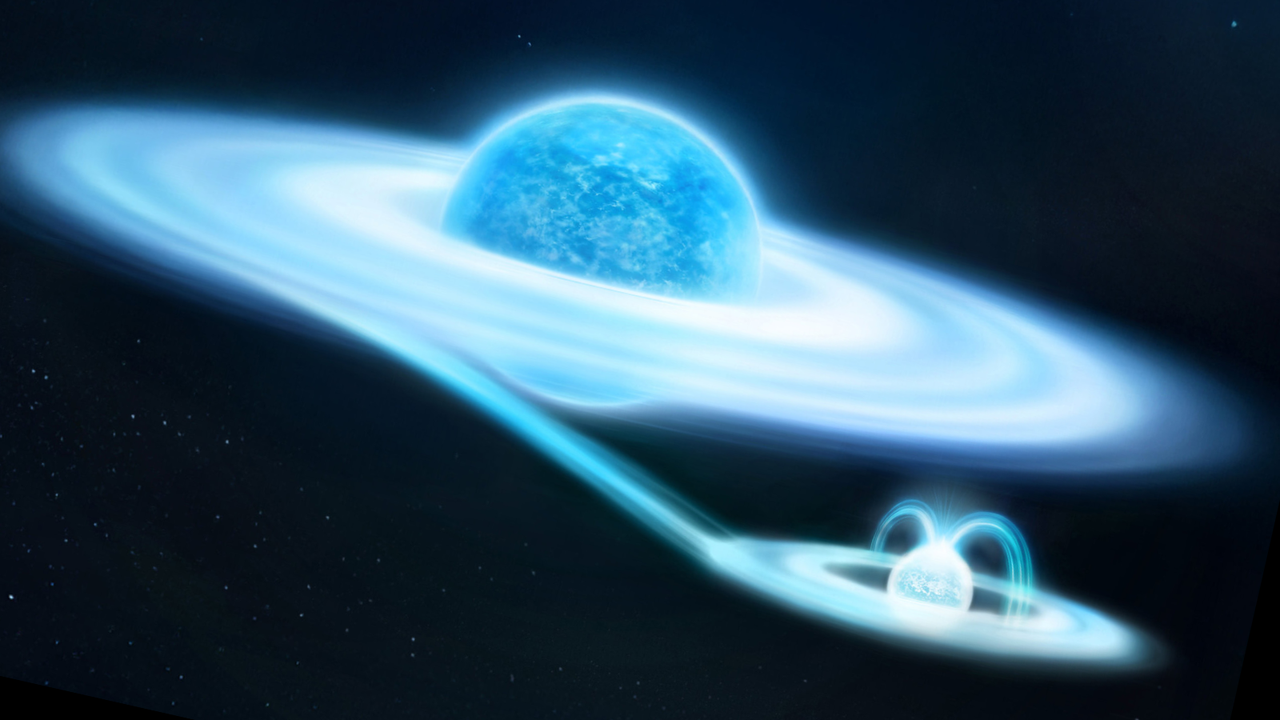
Decades later, scientists would theorize that these strange emissions came from a rotating disk of stellar material that had been ejected by the rapidly spinning star. Over time, such disks can build up and then disperse, causing the brightness of the star to fluctuate. Now, thanks to the sensitivity of XRISM (pronounced “crism”), astronomers have discovered the presence of a compact companion, likely a white dwarf star, that is pulling material away from gamma-Cas. White dwarfs are often called “dead stars” because they represent the core remnant of a star that exhausted its fuel supply needed for its intrinsic nuclear fusion processes.

“There has been an intense effort to solve the mystery of gamma-Cas across many research groups for many decades. And now, thanks to the high-precision observations of XRISM, we have finally done it,” team leader Yaël Nazé of the University of Liège, Belgium, said in a statement.

Two competing theories

The hydrogen feature of gamma-Cas resulted in the development of a new classification of stellar bodies, so-called Be stars (“B” representing massive, hot blue stars and “e” representing the unique hydrogen signal). Thanks to the proliferation of X-ray space telescopes like XRISM, XMM-Newton, Chandra and eROSITA, astronomers have now discovered over 20 stars with gamma-Cas-like X-ray emissions, resulting in a special family within the wider category of Be stars.

Scientists posited two explanations for the unusual X-ray emissions of stars like gamma-Cas. Either they are the result of the stars’ magnetic fields interacting with surrounding plasma disks, or they are the result of stripped material falling onto the surface of an unseen companion white dwarf star. This research confirms the validity of that latter theory.

Breaking space news, the latest updates on rocket launches, skywatching events and more!

“The previous work using XMM-Newton really cleared the way for XRISM, enabling us to eliminate numerous theories and prove which of the last two competing theories was correct,” Yaël said. “It’s extremely satisfying to have direct evidence to solve this mystery at long last.”
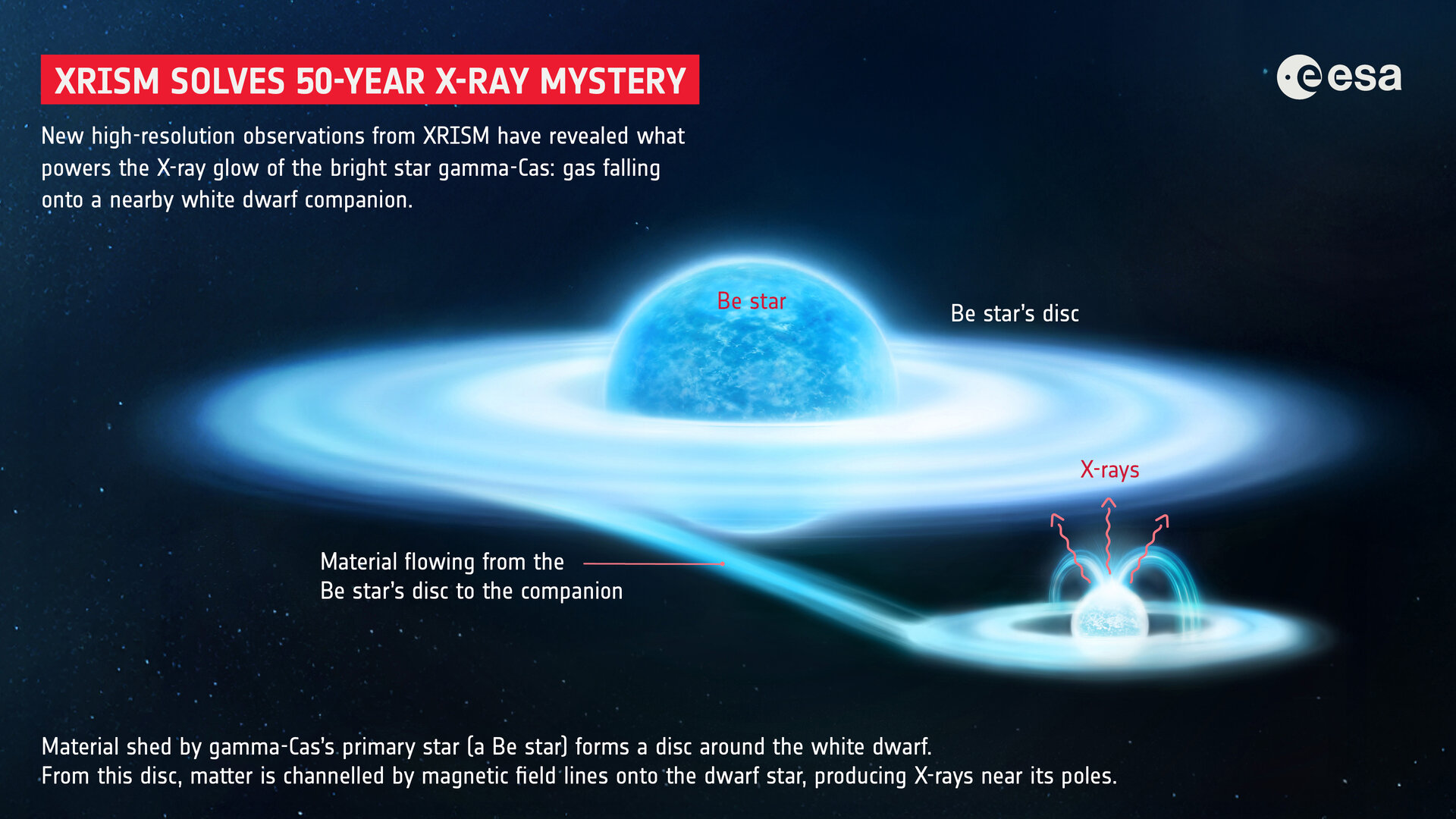
A diagram showing the same image as the header except labeled. X-rays are coming from the smaller star, the larger star is labeled as a "Be" star and the descriptions explain that matter is flowing from the larger star onto the smaller star, which is what's creating the X-rays.

A diagram explaining how a feeding companion caused the star gamma-Cas to emit mysterious X-rays. (Image credit: ESA, Y. Nazé)

There are still some puzzles surrounding gamma-Cas and other high-energy X-ray emitting stars. Such pairings between stars and white dwarfs were once expected to be common, especially for low-mass stars. Recently, however, scientists have found that such pairings are rarer than previously estimated and occur for high-mass Be stars.

“We think the key is in understanding how exactly the interactions take place between the two stars,” Yaël added. “Now that we know the true nature of gamma-Cas, we can create models specifically for this class of stellar systems, and update our understanding of binary evolution accordingly.”

The team’s research was published on Tuesday (March 24) in the journal Astronomy & Astrophysics.

Tags: rocket launch
No Result
View All Result

Recent Posts

  • ‘It was an incredible moment’: One photographer’s journey to capture the March 3 total lunar eclipse over Malaysia
  • Rocket shines under the northern lights | Space photo of the day for March 25, 2026
  • Like ‘accelerating from stationary to supersonic flight’: Europe’s Hera probe boosts speed, stays on course for November asteroid rendezvous
  • Europe plans EPIC SpaceX mission to send 4 astronauts to the ISS before its retirement
  • Scientists finally solve century-old mystery of star with unexpected X-ray emissions

Categories

  • Excursions
  • Kepler Mission
  • NASA
  • NASA Breaking News
  • Physical Preparation
  • Preparation
  • Space News
  • Space Station News
  • Spacewalks
  • Tours
  • Uncategorized
  • Weightlessness Training
  • What Not to Pack
  • What to Pack

Meta

  • Log in
  • Entries feed
  • Comments feed
  • WordPress.org
  • Home
  • Start Here
  • Preparing for Your Trip
  • Space Tourism Companies
  • Space Tours
  • Contact

© 2026 JNews - Premium WordPress news & magazine theme by Jegtheme.

No Result
View All Result
  • About
  • Contact
  • Feeds
  • Frequently Asked Questions
  • Preparing for Your Trip
    • Insurance and Legal Waivers
    • Physical and Medical Requirements
    • Training Programs
    • What to Expect
  • Privacy Policy
  • Space Tourism Companies
    • Axiom Space
    • Blue Origin
    • Blue Origin vs Virgin Galactic
    • Comparison Chart: Features, Pricing, Booking
    • SpaceX
    • Virgin Galactic
    • World View (stratospheric balloon flights)
  • Space Tours
    • Custom & Luxury Packages
    • Duration, Training, Costs
    • Experiences
    • Future Moon/Mars Options
    • Orbital Flights
    • Parabolic Flight Experiences
    • Private Missions
    • Stratospheric Balloon Flights
    • Suborbital Flights
    • Zero-Gravity Flights
  • Spaceflight Technologies
    • Space Tourism Balloon
  • Start Here
    • How to Book a Space Tour
    • Intro to Commercial Spaceflight
    • Is Space Tourism Safe?
    • Space Travel FAQs
    • View Earth from the Edge
    • What to Pack
  • Tours in Space is your launchpad to the world of space tourism

© 2026 JNews - Premium WordPress news & magazine theme by Jegtheme.