
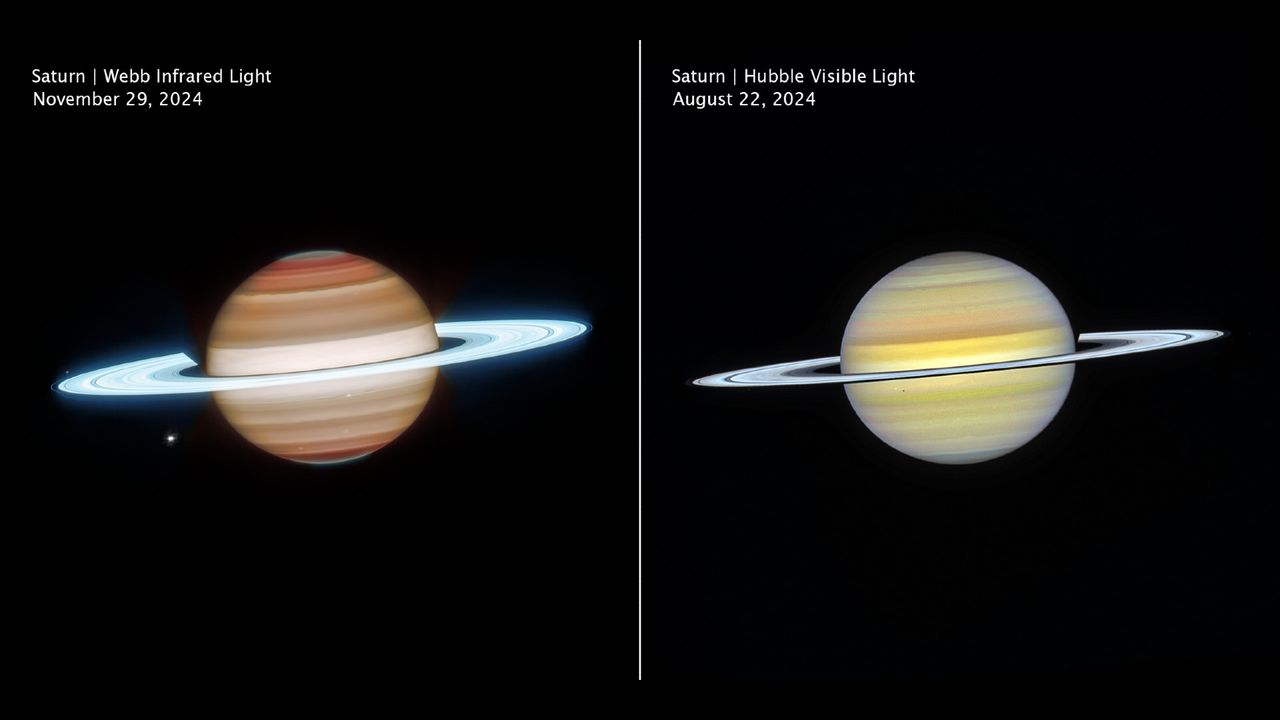

Stunning new views of Saturn offer the most detailed portrait yet of the ringed planet, showcasing the combined power of NASA’s most advanced space telescopes.
Using observations from the James Webb Space Telescope (JWST) and the Hubble Space Telescope, astronomers have created the most comprehensive look at Saturn to date, blending infrared, visible and ultraviolet light into a single, richly layered image, according to a statement from NASA.
Article continues below
Each space telescope brings a distinct perspective. Hubble captures crisp, long-term visible-light views of Saturn’s cloud bands and atmospheric changes, while the JWST peers deeper into the planet’s atmosphere in infrared, revealing heat patterns and structures hidden beneath the upper cloud layers.
The Hubble data, captured in August 2024 as part of the long-running Outer Planet Atmospheres Legacy (OPAL) program, was followed about 14 weeks later by Webb observations taken through Director’s Discretionary Time, showing Saturn shifting from northern summer toward its 2025 equinox. Saturn’s long seasonal cycles — each lasting about seven Earth years — also provide important context for interpreting changes in the planet’s atmosphere and rings over time.
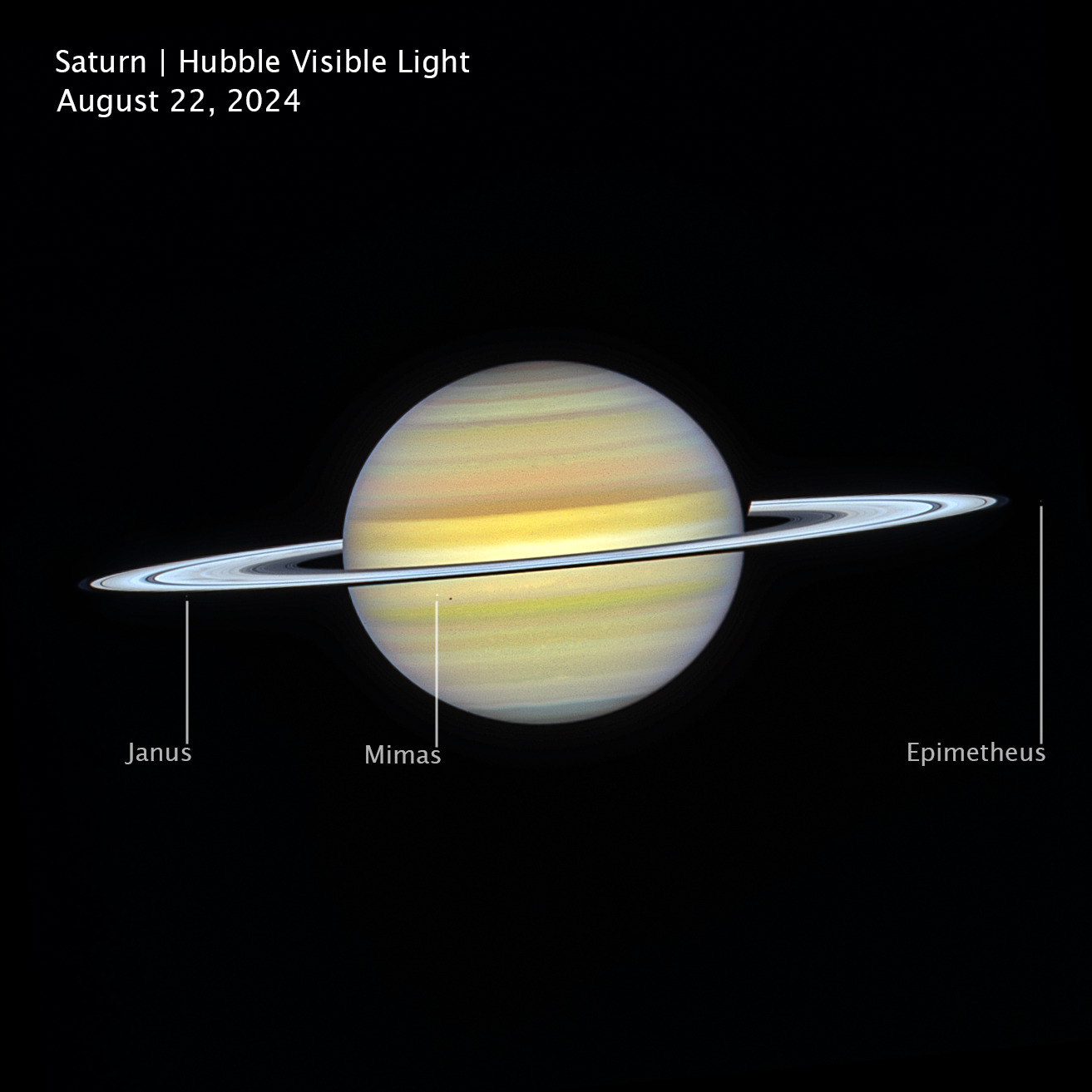
Together, the observations present Saturn as a layered and dynamic world. Hubble’s visible-light view shows the planet’s softly banded atmosphere, while Webb’s infrared observations reveal additional structure, including deeper atmospheric layers, a meandering jet stream in the northern mid-latitudes, possible auroral activity, and several storms scattered across the southern hemisphere.
The combined data highlights how Saturn’s appearance changes across different wavelengths, offering a more complete view of its atmosphere, according to the NASA statement.
The images also provide complementary views of Saturn’s rings. In Hubble’s data, the rings, made of water ice, appear bright in reflected sunlight, with clearly defined structure. In Webb’s infrared view, the rings shine even more prominently, standing out against the darker background of space and revealing additional detail in the ring system.
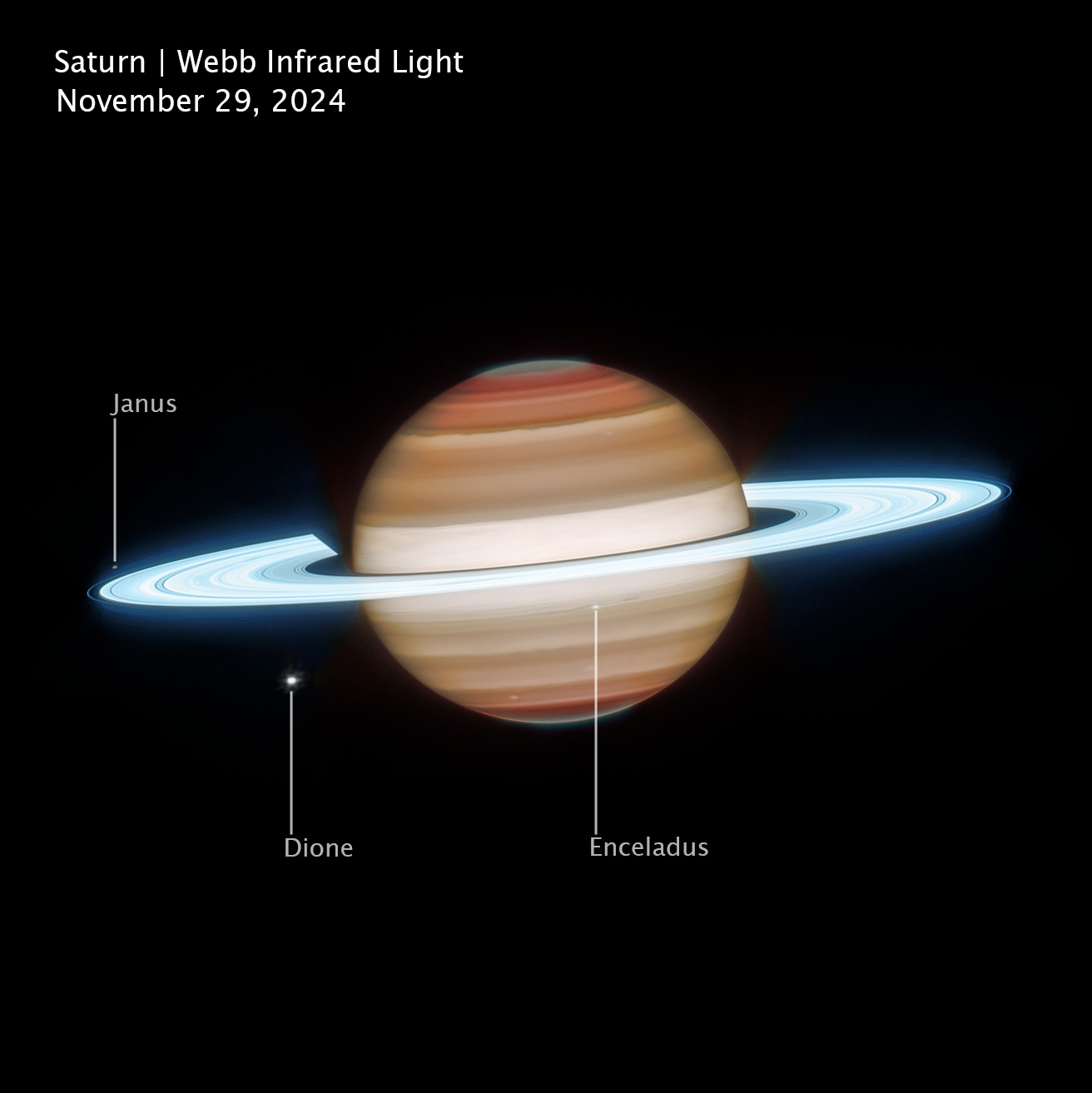
Subtle differences between the telescopes’ views also reveal ring features like spokes and structure in the thick central region, as well as differing perspectives of the outer ring, which appears thin and sharply defined in Webb’s image but only faintly visible in Hubble’s, according to the statement.
Seasonal context adds further value to the observations. Hubble’s OPAL program has been tracking changes in the outer planets for more than a decade, providing a long-term record of Saturn’s atmosphere. The new Webb observations build on that dataset, offering a broader, multiwavelength perspective as the planet continues its progression toward its next equinox.
The new dataset underscores the power of combining multiple observatories. By integrating Webb’s infrared sensitivity with Hubble’s long-standing visible-light record, scientists can construct a far more complete picture of planetary behavior than either telescope could achieve alone.
As both observatories continue their missions, researchers plan to build on these observations, tracking Saturn’s evolving atmosphere, monitoring storm systems and refining models of its complex climate. With this new composite view, Saturn isn’t just a distant gas giant — it’s a dynamic world whose hidden layers are finally coming into focus.