• Home
  • About
  • FAQ
  • Feeds
  • Glossary
  • Contact
Tours In Space
  • Home
  • Start Here
    • Intro to Commercial Spaceflight
    • How to Book a Space Tour
    • Is Space Tourism Safe?
    • Space Travel FAQs
    • View Earth from the Edge
    • What to Pack
  • Preparing for Your Trip
    • Insurance and Legal Waivers
    • Physical and Medical Requirements
    • Training Programs
    • What to Expect
  • Space Tourism Companies
    • Axiom Space
    • Blue Origin
    • SpaceX
    • Virgin Galactic
    • World View (stratospheric balloon flights)
    • Blue Origin vs Virgin Galactic
    • Comparison Chart: Features, Pricing, Booking
  • Space Tours
    • Custom & Luxury Packages
    • Duration, Training, Costs
    • Experiences
    • Future Moon/Mars Options
    • Orbital Flights
    • Parabolic Flight Experiences
    • Private Missions
    • Stratospheric Balloon Flights
    • Suborbital Flights
    • Zero-Gravity Flights
  • Spaceflight Technologies
    • Space Tourism Balloon
No Result
View All Result
  • Home
  • Start Here
    • Intro to Commercial Spaceflight
    • How to Book a Space Tour
    • Is Space Tourism Safe?
    • Space Travel FAQs
    • View Earth from the Edge
    • What to Pack
  • Preparing for Your Trip
    • Insurance and Legal Waivers
    • Physical and Medical Requirements
    • Training Programs
    • What to Expect
  • Space Tourism Companies
    • Axiom Space
    • Blue Origin
    • SpaceX
    • Virgin Galactic
    • World View (stratospheric balloon flights)
    • Blue Origin vs Virgin Galactic
    • Comparison Chart: Features, Pricing, Booking
  • Space Tours
    • Custom & Luxury Packages
    • Duration, Training, Costs
    • Experiences
    • Future Moon/Mars Options
    • Orbital Flights
    • Parabolic Flight Experiences
    • Private Missions
    • Stratospheric Balloon Flights
    • Suborbital Flights
    • Zero-Gravity Flights
  • Spaceflight Technologies
    • Space Tourism Balloon
No Result
View All Result
Tours In Space
No Result
View All Result
Home Uncategorized

U.S. GSSAP satellites execute GEO handoff to monitor China’s Shijian-29 spacecraft

Ensign by Ensign
March 27, 2026
in Uncategorized
0
U.S. GSSAP satellites execute GEO handoff to monitor China’s Shijian-29 spacecraft
189
SHARES
1.5k
VIEWS
Share on FacebookShare on Twitter
image

HELSINKI — Commercial space tracking data shows U.S. satellites coordinating maneuvers to maintain proximity and continuous observation of a pair of Chinese spacecraft in geostationary orbit.

Observations by commercial space domain awareness provider Comspoc show USA 324 and USA 325, a pair of U.S. Geosynchronous Space Situational Awareness Program (GSSAP) satellites, executing a “handoff” operation between 14–18 March while tracking China’s Shiiian-29A and 29B satellites.

The geostationary orbit (GEO) is a belt 35,786 kilometers above the equator at which satellites’ orbital velocity matches the rotation of the Earth. Raising or lowering an orbit above or below GEO allows them to drift either west or east along the GEO belt respectively, allowing repositioning.

“For 4 days from 14-18 March, USA 324 and USA 325 (GSSAP) positioned themselves on opposite sides of China’s Shijian-29A and 29B — a coordinated “bracket” providing observation angles from both east and west, followed by a handoff for continuous watch on the Chinese pair,” the COMSPOC Operations Team wrote in a post on X.

USA 324 (GSSAP-5) had closed to within roughly 63 km of Shijian-29A by March 19, a relatively close distance in GEO that enables detailed observation while remaining within apparent safety margins. USA 325 (GSSAP-6), which had been tracking the pair since early January, performed a burn to depart the area, around 73 degrees East, March 18, completing the surveillance handover.

Subscribe Today
Get unlimited access to SpaceNews.com and our digital magazine with a monthly, quarterly or annual subscription.

Discounted Access
Learn more about savings available for academic, government and military readers on SpaceNews subscriptions.

🛰️ GEO INSPECTION EVENT: US satellites hand off on China’s SJ-29 pair

For 4 days from 14-18 March, USA 324 and USA 325 (GSSAP) positioned themselves on opposite sides of China’s Shijian-29A & 29B — a coordinated “bracket” providing observation angles from both east and west,… pic.twitter.com/Pogr3u635G

— COMSPOC_OPS (@COMSPOC_OPS) March 26, 2026

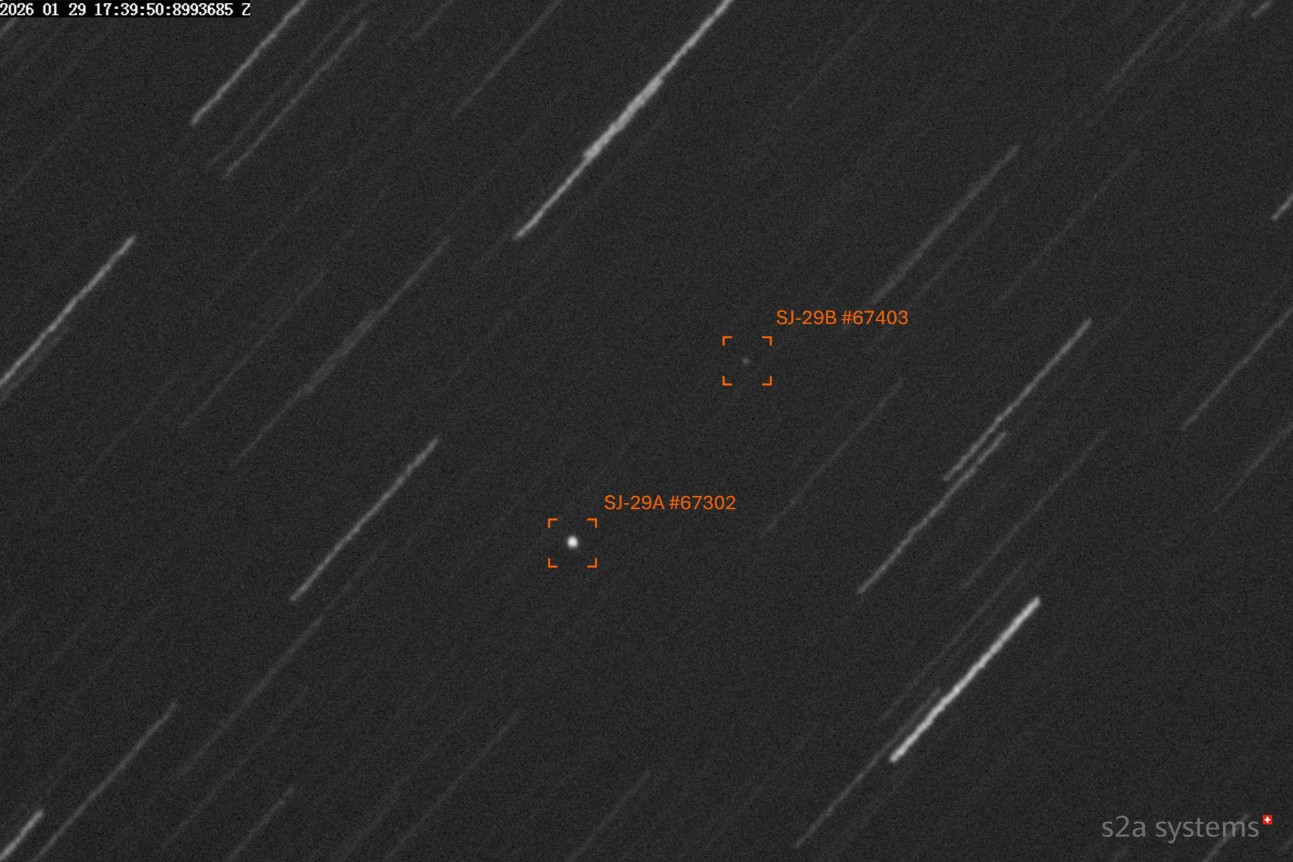
The Shijian-29 pair, part of a broad, experimental and often classified series of satellites, were launched towards GEO in late December 2025 on a Long March 7A rocket. No images of the spacecraft were published, with China’s state-owned main space contractor CASC describing the pair as to be mainly used to “conduct verification tests of new technologies for space target detection.” 

This could be interpreted as being for space situational awareness (SSA) purposes, meaning the U.S. and China’s inspector satellites are, as characterized by COMSPOC “inspectors watching inspectors.” However, the capabilities and operational role of Shijian-29A and 29B remain unclear.

Ground-based observations of Shijian-29A and 29B in January by s2a Systems, a Swiss SSA firm, shed some further light on the pair. It suggests that Shijian-29A, developed by CASC’s Shanghai Academy of Spaceflight Technology (SAST), appears much brighter than Shijian-29B, developed by the Innovation Academy for Microsatellites of the Chinese Academy of Sciences (IAMCAS). It is unclear if this difference in apparent brightness is due to the respective size, shape or even coatings of the spacecraft.

The episode is the latest in a series of accelerating maneuvers and exchanges in GEO among major spacefaring powers, especially the U.S., China and Russia. These have fielded satellites capable of rendezvous and proximity operations (RPO), raising the question of the line between benign inspection and potential counterspace applications.

No Result
View All Result

Recent Posts

  • U.S. GSSAP satellites execute GEO handoff to monitor China’s Shijian-29 spacecraft
  • Space Command begins phased move to Alabama 
  • Government use of commercial procurement models has limitations in space
  • Turning growth into profits remains a challenge as space demand grows
  • Xona raises $170 million for satellite navigation network

Categories

  • Excursions
  • Kepler Mission
  • NASA
  • NASA Breaking News
  • Physical Preparation
  • Preparation
  • Space News
  • Space Station News
  • Spacewalks
  • Tours
  • Uncategorized
  • Weightlessness Training
  • What Not to Pack
  • What to Pack

Meta

  • Log in
  • Entries feed
  • Comments feed
  • WordPress.org
  • Home
  • Start Here
  • Preparing for Your Trip
  • Space Tourism Companies
  • Space Tours
  • Contact

© 2026 JNews - Premium WordPress news & magazine theme by Jegtheme.

No Result
View All Result
  • About
  • Contact
  • Feeds
  • Frequently Asked Questions
  • Preparing for Your Trip
    • Insurance and Legal Waivers
    • Physical and Medical Requirements
    • Training Programs
    • What to Expect
  • Privacy Policy
  • Space Tourism Companies
    • Axiom Space
    • Blue Origin
    • Blue Origin vs Virgin Galactic
    • Comparison Chart: Features, Pricing, Booking
    • SpaceX
    • Virgin Galactic
    • World View (stratospheric balloon flights)
  • Space Tours
    • Custom & Luxury Packages
    • Duration, Training, Costs
    • Experiences
    • Future Moon/Mars Options
    • Orbital Flights
    • Parabolic Flight Experiences
    • Private Missions
    • Stratospheric Balloon Flights
    • Suborbital Flights
    • Zero-Gravity Flights
  • Spaceflight Technologies
    • Space Tourism Balloon
  • Start Here
    • How to Book a Space Tour
    • Intro to Commercial Spaceflight
    • Is Space Tourism Safe?
    • Space Travel FAQs
    • View Earth from the Edge
    • What to Pack
  • Tours in Space is your launchpad to the world of space tourism

© 2026 JNews - Premium WordPress news & magazine theme by Jegtheme.