• Home
  • About
  • FAQ
  • Feeds
  • Glossary
  • Contact
Tours In Space
  • Home
  • Start Here
    • Intro to Commercial Spaceflight
    • How to Book a Space Tour
    • Is Space Tourism Safe?
    • Space Travel FAQs
    • View Earth from the Edge
    • What to Pack
  • Preparing for Your Trip
    • Insurance and Legal Waivers
    • Physical and Medical Requirements
    • Training Programs
    • What to Expect
  • Space Tourism Companies
    • Axiom Space
    • Blue Origin
    • SpaceX
    • Virgin Galactic
    • World View (stratospheric balloon flights)
    • Blue Origin vs Virgin Galactic
    • Comparison Chart: Features, Pricing, Booking
  • Space Tours
    • Custom & Luxury Packages
    • Duration, Training, Costs
    • Experiences
    • Future Moon/Mars Options
    • Orbital Flights
    • Parabolic Flight Experiences
    • Private Missions
    • Stratospheric Balloon Flights
    • Suborbital Flights
    • Zero-Gravity Flights
  • Spaceflight Technologies
    • Space Tourism Balloon
No Result
View All Result
  • Home
  • Start Here
    • Intro to Commercial Spaceflight
    • How to Book a Space Tour
    • Is Space Tourism Safe?
    • Space Travel FAQs
    • View Earth from the Edge
    • What to Pack
  • Preparing for Your Trip
    • Insurance and Legal Waivers
    • Physical and Medical Requirements
    • Training Programs
    • What to Expect
  • Space Tourism Companies
    • Axiom Space
    • Blue Origin
    • SpaceX
    • Virgin Galactic
    • World View (stratospheric balloon flights)
    • Blue Origin vs Virgin Galactic
    • Comparison Chart: Features, Pricing, Booking
  • Space Tours
    • Custom & Luxury Packages
    • Duration, Training, Costs
    • Experiences
    • Future Moon/Mars Options
    • Orbital Flights
    • Parabolic Flight Experiences
    • Private Missions
    • Stratospheric Balloon Flights
    • Suborbital Flights
    • Zero-Gravity Flights
  • Spaceflight Technologies
    • Space Tourism Balloon
No Result
View All Result
Tours In Space
No Result
View All Result
Home Uncategorized

China’s Kinetica-2 rocket debuts successfully, sending prototype cargo spacecraft to orbit

Ensign by Ensign
March 31, 2026
in Uncategorized
0
China’s Kinetica-2 rocket debuts successfully, sending prototype cargo spacecraft to orbit
189
SHARES
1.5k
VIEWS
Share on FacebookShare on Twitter
image

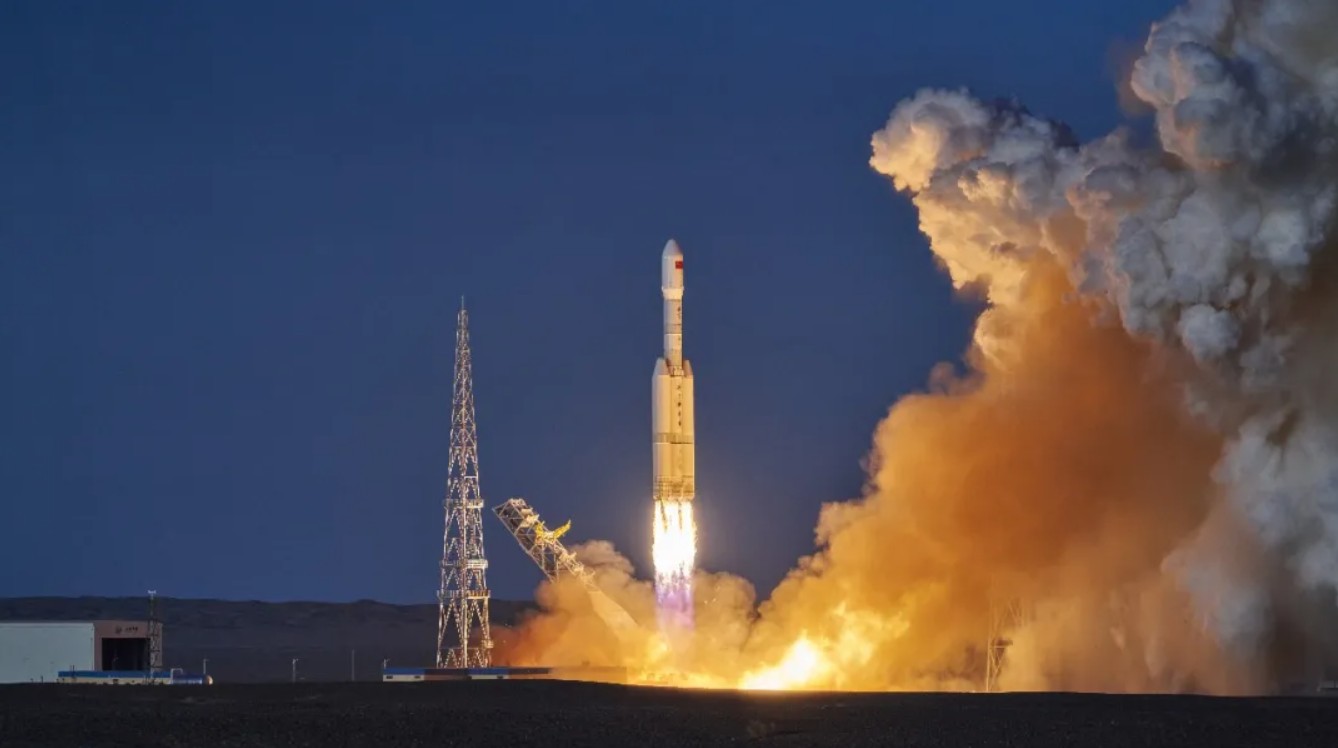
HELSINKI — Chinese firm CAS Space successfully reached orbit with the first launch of its Kinetica-2 launch vehicle Monday, with a prototype cargo spacecraft among the payloads.

The Kinetica-2 (Lijian-2) lifted off at 7:00 a.m. Eastern (1100 UTC) March 30 from the Dongfeng Commercial Aerospace Innovation Test Zone at Jiuquan Satellite Launch Center. CAS Space declared the mission a complete success, stating that the flight “served the country’s major strategies and major engineering projects.”

The successful launch is a new milestone in a broader effort by China to develop low-cost, high-cadence and potentially reusable rockets to boost its access to space and help construct major on-orbit infrastructure projects. It is also a step forward for low-cost cargo missions to the Tiangong space station.

Sign up for First Up: Get the latest updates on SpaceX, Artemis, NASA and more. From Jeff Foust, First Up is a recap of the day’s space industry news, including civil, commercial, and military space developments.

By submitting this form, you agree to the SpaceNews privacy policy and terms and conditions and to receive email from us and our partners. You can opt-out at any time.

Aboard the debut flight were the New Journey-01 and 02 (Xinzhengcheng-01 and 02) spacecraft and the TS-01, described in state media as an educational satellite. Airspace closure notices indicate a near-polar orbit for the three spacecraft.

New Journey-02 is a 4,200-kilogram prototype of the Qingzhou-1 spacecraft, which is one of two low-cost space station resupply spacecraft being developed under a program initiated by China’s human spaceflight agency, CMSEO, to support Tiangong. The spacecraft carries 27 experimental payloads totaling 1,020 kg, according to Global Times, and has a design lifetime of up to three years in orbit. 

The prototype was developed by the Innovation Academy for Microsatellites of the Chinese Academy of Sciences (IAMCAS). It is a prelude to the launch of the full Qingzhou-1 cargo spacecraft, expected within a year. 

New Journey-01 is described as a mini space lab, developed by a CAS-affiliated commercial entity using tech developed by CAS’s Aerospace Information Research Institute (AIRSAT). It carries multi-angle imaging cameras and a mini-space capsule with a porthole, and will conduct multiple on-orbit verifications based on commercial off-the-shelf devices.

Starting against a dozen proposals in 2023, we advanced to the final four and secured the Qingzhou bid. Today, we proudly watched our hard work lift off with the successful launch of the Qingzhou prototype spacecraft. Client-oriented service is the name of the game! pic.twitter.com/R7EmUa3Uh7

— CAS Space (@cas_space) March 30, 2026

Kinetica-2 is a 53-meter-long launcher with a 3.35m-diameter universal core stage. The core and boosters each use three YF‑102 kerosene-liquid oxygen engines developed by state-owned space giant CASC. It is designed to carry up to 12,000 kilograms to low Earth orbit or around 8,000 kg to a 500-kilometer-altitude sun-synchronous orbit, with plans for reusability. 

The launch was also China’s first of a common booster core design rocket. This modularized approach, CAS Space states, is part of plans for different configuration bundles of 0, 2 and 4 boosters, allowing payload capacities of between 2-20,000 kilograms to low Earth orbit. CAS Space is also working on a clustered booster recovery system for the series. The Kinetica-2 can also be used in combination with the new Lixun-1 upper stage which will allow access to higher orbits, such as a geostationary transfer orbit.

The rocket will support various scientific experimental satellite missions, as well as low-cost cargo transport and low Earth orbit satellite constellation deployment, according to CAS Space. Contracts for the construction of the Guowang and Thousand Sails megaconstellations are expected to drive demand for launch services, benefiting vehicles such as Kinetica-2. The emergence of these projects has also coincided with increasing payload capacity of planned rockets as well as growing funding for these startups. 

CAS Space is affiliated with the Chinese Academy of Sciences. It already operates the solid Kinetica-1 rocket and is working on a suborbital tourism business with its Lihong-1. The company conducted a first suborbital launch and capsule landing test in January and is also planning for an IPO.

The Kinetica-2 mission followed the launch of the classified Shiyan-33 spacecraft, part of an opaque, experimental Chinese satellite series. 

A Long March 2C with a YZ-1S upper stage lifted off at 12:11 a.m. Eastern (0411 UTC) March 27 from Jiuquan. Chinese state media described the mission tersely as for scientific experiments in space environment exploration.

The spacecraft was later tracked in a 495 by 505-km 97-degree inclination orbit by the U.S. Space Force. The Long March 2C and Kinetica-2 launches were China’s 17th and 18th orbital launch attempts of 2026.

Airspace closure notices suggest a possible first flight of the Tianlong-3 April 2 from Jiuquan by commercial launch firm Space Pioneer. If confirmed, the launch attempt will come almost two years after a near-disastrous first stage static fire test that climbed from its test facilities and crashed into a mountainside.

[embedded content]
Tags: orbital tourismspace capsulespace innovationspace station
No Result
View All Result

Recent Posts

  • Second Starlink satellite suffers anomaly, generating debris
  • Rocket Lab wins German approval for Mynaric deal
  • Varda flies navigation payload, heat shield tests on sixth reentry mission
  • ESA launches first Celeste satellites to test complementary LEO navigation layer
  • SpaceX launches Transporter-16 rideshare mission

Categories

  • Excursions
  • Kepler Mission
  • NASA
  • NASA Breaking News
  • Physical Preparation
  • Preparation
  • Space News
  • Space Station News
  • Spacewalks
  • Tours
  • Uncategorized
  • Weightlessness Training
  • What Not to Pack
  • What to Pack

Meta

  • Log in
  • Entries feed
  • Comments feed
  • WordPress.org
  • Home
  • Start Here
  • Preparing for Your Trip
  • Space Tourism Companies
  • Space Tours
  • Contact

© 2026 JNews - Premium WordPress news & magazine theme by Jegtheme.

No Result
View All Result
  • About
  • Contact
  • Feeds
  • Frequently Asked Questions
  • Preparing for Your Trip
    • Insurance and Legal Waivers
    • Physical and Medical Requirements
    • Training Programs
    • What to Expect
  • Privacy Policy
  • Space Tourism Companies
    • Axiom Space
    • Blue Origin
    • Blue Origin vs Virgin Galactic
    • Comparison Chart: Features, Pricing, Booking
    • SpaceX
    • Virgin Galactic
    • World View (stratospheric balloon flights)
  • Space Tours
    • Custom & Luxury Packages
    • Duration, Training, Costs
    • Experiences
    • Future Moon/Mars Options
    • Orbital Flights
    • Parabolic Flight Experiences
    • Private Missions
    • Stratospheric Balloon Flights
    • Suborbital Flights
    • Zero-Gravity Flights
  • Spaceflight Technologies
    • Space Tourism Balloon
  • Start Here
    • How to Book a Space Tour
    • Intro to Commercial Spaceflight
    • Is Space Tourism Safe?
    • Space Travel FAQs
    • View Earth from the Edge
    • What to Pack
  • Tours in Space is your launchpad to the world of space tourism

© 2026 JNews - Premium WordPress news & magazine theme by Jegtheme.