• Home
  • About
  • FAQ
  • Feeds
  • Glossary
  • Contact
Tours In Space
  • Home
  • Start Here
    • Intro to Commercial Spaceflight
    • How to Book a Space Tour
    • Is Space Tourism Safe?
    • Space Travel FAQs
    • View Earth from the Edge
    • What to Pack
  • Preparing for Your Trip
    • Insurance and Legal Waivers
    • Physical and Medical Requirements
    • Training Programs
    • What to Expect
  • Space Tourism Companies
    • Axiom Space
    • Blue Origin
    • SpaceX
    • Virgin Galactic
    • World View (stratospheric balloon flights)
    • Blue Origin vs Virgin Galactic
    • Comparison Chart: Features, Pricing, Booking
  • Space Tours
    • Custom & Luxury Packages
    • Duration, Training, Costs
    • Experiences
    • Future Moon/Mars Options
    • Orbital Flights
    • Parabolic Flight Experiences
    • Private Missions
    • Stratospheric Balloon Flights
    • Suborbital Flights
    • Zero-Gravity Flights
  • Spaceflight Technologies
    • Space Tourism Balloon
No Result
View All Result
  • Home
  • Start Here
    • Intro to Commercial Spaceflight
    • How to Book a Space Tour
    • Is Space Tourism Safe?
    • Space Travel FAQs
    • View Earth from the Edge
    • What to Pack
  • Preparing for Your Trip
    • Insurance and Legal Waivers
    • Physical and Medical Requirements
    • Training Programs
    • What to Expect
  • Space Tourism Companies
    • Axiom Space
    • Blue Origin
    • SpaceX
    • Virgin Galactic
    • World View (stratospheric balloon flights)
    • Blue Origin vs Virgin Galactic
    • Comparison Chart: Features, Pricing, Booking
  • Space Tours
    • Custom & Luxury Packages
    • Duration, Training, Costs
    • Experiences
    • Future Moon/Mars Options
    • Orbital Flights
    • Parabolic Flight Experiences
    • Private Missions
    • Stratospheric Balloon Flights
    • Suborbital Flights
    • Zero-Gravity Flights
  • Spaceflight Technologies
    • Space Tourism Balloon
No Result
View All Result
Tours In Space
No Result
View All Result
Home Space News

What will happen if Artemis 2 astronauts get hit by a solar storm during NASA’s ambitious moon mission?

Ensign by Ensign
March 31, 2026
in Space News
0
NASA announcing update to Artemis moon plans today: Watch it live
189
SHARES
1.5k
VIEWS
Share on FacebookShare on Twitter

Once the Artemis 2 astronauts get beyond the protective environment of Earth’s atmosphere and magnetic field, they will be subject to space radiation.

While en route to and from the moon, the four-person Artemis 2 crew will be vigilant, eyeing radiation detectors and listening for caution and warning alarms. They will also be outfitted with active dosimeters, devices that measure exposure to radiation, such as X-rays or gamma rays.

Artemis 2’s Orion spacecraft is relatively highly shielded. However, the astronauts would still take defensive measures if they encountered particularly high radiation levels — from a powerful solar storm, for example. The astronauts would establish a shelter utilizing central stowage bays, whose contents would be moved to a known “hot spot” within Orion. Doing so would create a lower-dose region in the capsule, helping to reduce the crew’s radiation exposure.


You may like

Radiation shielding

Artemis 2 will send NASA astronauts Reid Wiseman, Victor Glover and Christina Koch, and the Canadian Space Agency’s Jeremy Hansen, on a roughly 10-day trip around the moon and back to Earth. NASA is targeting a launch as early as April 1.

As its name suggests, Artemis 2 will be the second mission of NASA’s Artemis program. The first, Artemis 1, successfully sent an uncrewed Orion to lunar orbit and back in late 2022.

During Artemis 1, Orion spent more than 25 days in space and traveled a total of 1.4 million miles (2.25 million kilometers), gathering a wealth of valuable data about the deep-space environment and the capsule’s performance within it.
A circular logo with an astronaut floating above the Earth in space with the sun to the bottom right of the circle and the words "Space Radiation Analysis Group" at the top of the logo

NASA’s Space Radiation & Analyses Group is based at Johnson Space Center in Houston. (Image credit: SRAG)

“From the measurements on Artemis 1, we learned that the Orion is a good vehicle to be in during a radiation storm, as it is compact and dense and hence offers up good radiation shielding,” said Stuart George, radiation instrumentation lead at NASA’s Space Radiation Analysis Group (SRAG), based at Johnson Space Center in Houston.

Breaking space news, the latest updates on rocket launches, skywatching events and more!

“We learned that the Orion radiation storm shelter performs as expected and at different locations in the vehicle,” George told Space.com.
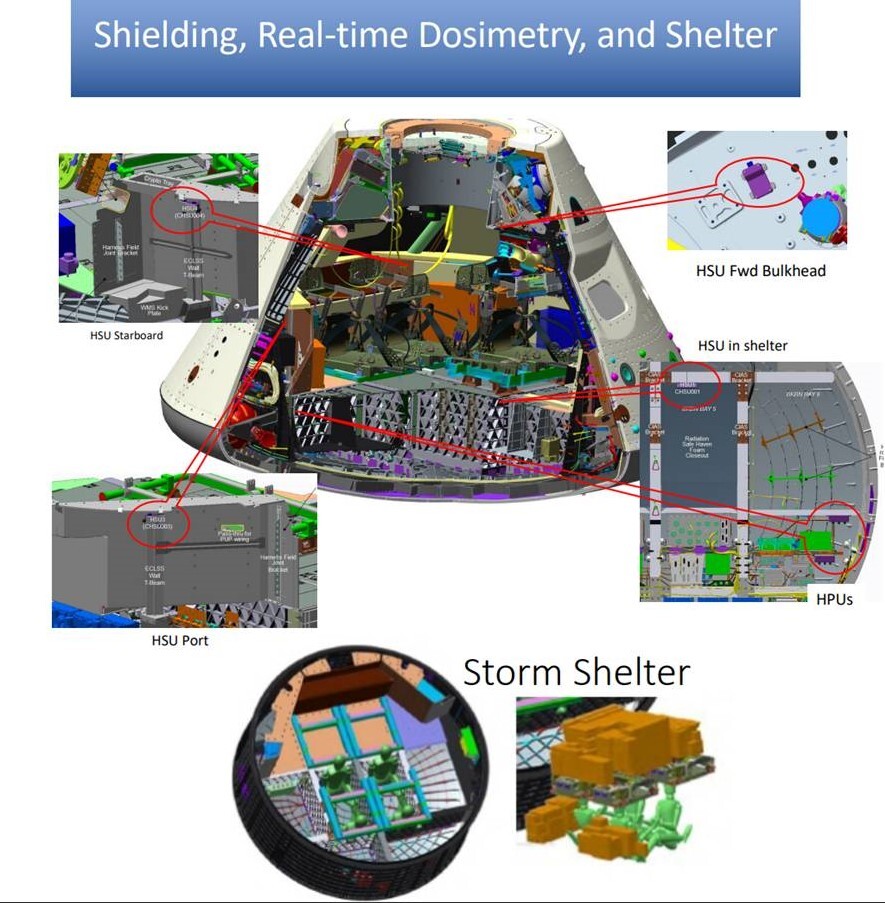
A figure showing the conical inside of the Orion spacecraft, with labels showing areas that could be converted into a storm shelter.

NASA’s Orion spacecraft, which is roughly 16.5 feet (5 meters) wide and stands 10.8 feet (3.3 m) tall, has areas that can be converted into a storm shelter. (Image credit: SRAG)

Artemis 1 carried an instrument-laden manikin and two torso-only “body phantoms,” which showed that doses to internal organs can be much lower than doses to skin during space weather events, said George.

The radiation exposure of the Artemis 2 crew will be gauged by Hybrid Electronic Radiation Assessors (HERA) and by small Crew Active Dosimeter badges that the crew will wear. There are six active HERA sensors deployed at various spots inside the Orion crew module.


What to read next

Additionally, NASA has again partnered with the German Space Agency DLR, using an updated model of its M-42 sensor — an M-42 EXT — for Artemis 2. The new version — four of which will fly on Orion during Artemis 2 — offers six times more resolution to distinguish between different types of energy, compared to the Artemis 1 version.
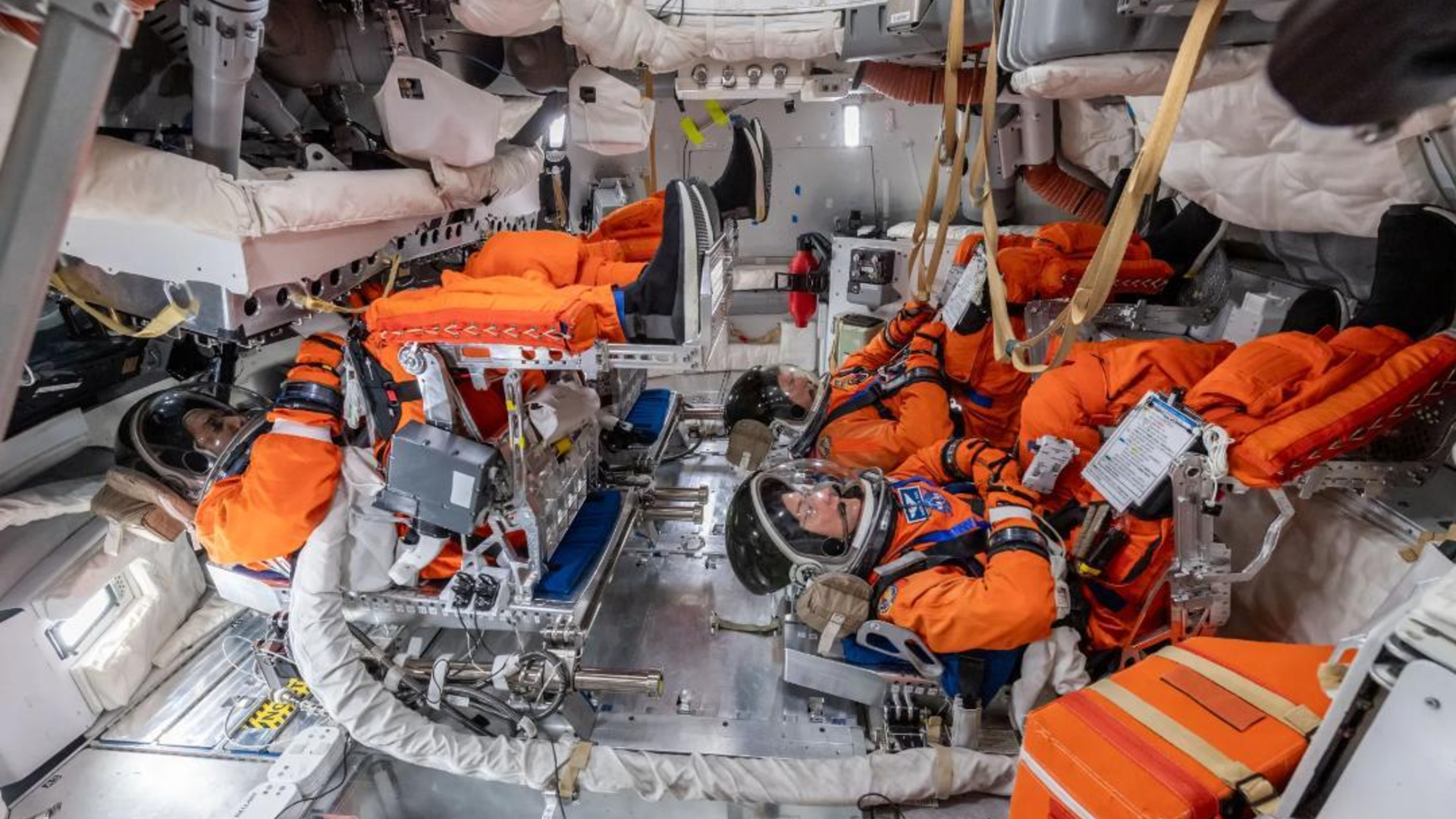
Four individuals wearing orange space suits and clear helmets are buckled into the floor of a full spacecraft

The Artemis 2 astronauts train for their ride aboard the four-person Orion spacecraft. (Image credit: NASA)

Shelter in place

What about “go, no-go” decision-making for Artemis 2 in regards to dealing with a space weather or other space radiation event?

“While background galactic cosmic rays are difficult to shield from due to their high energies, solar particle events generated by the sun are a different matter,” George said.

For solar particle events, NASA has predefined radiation dose rate levels after which the crew will work to construct a radiation shelter to reduce their exposure, said George.
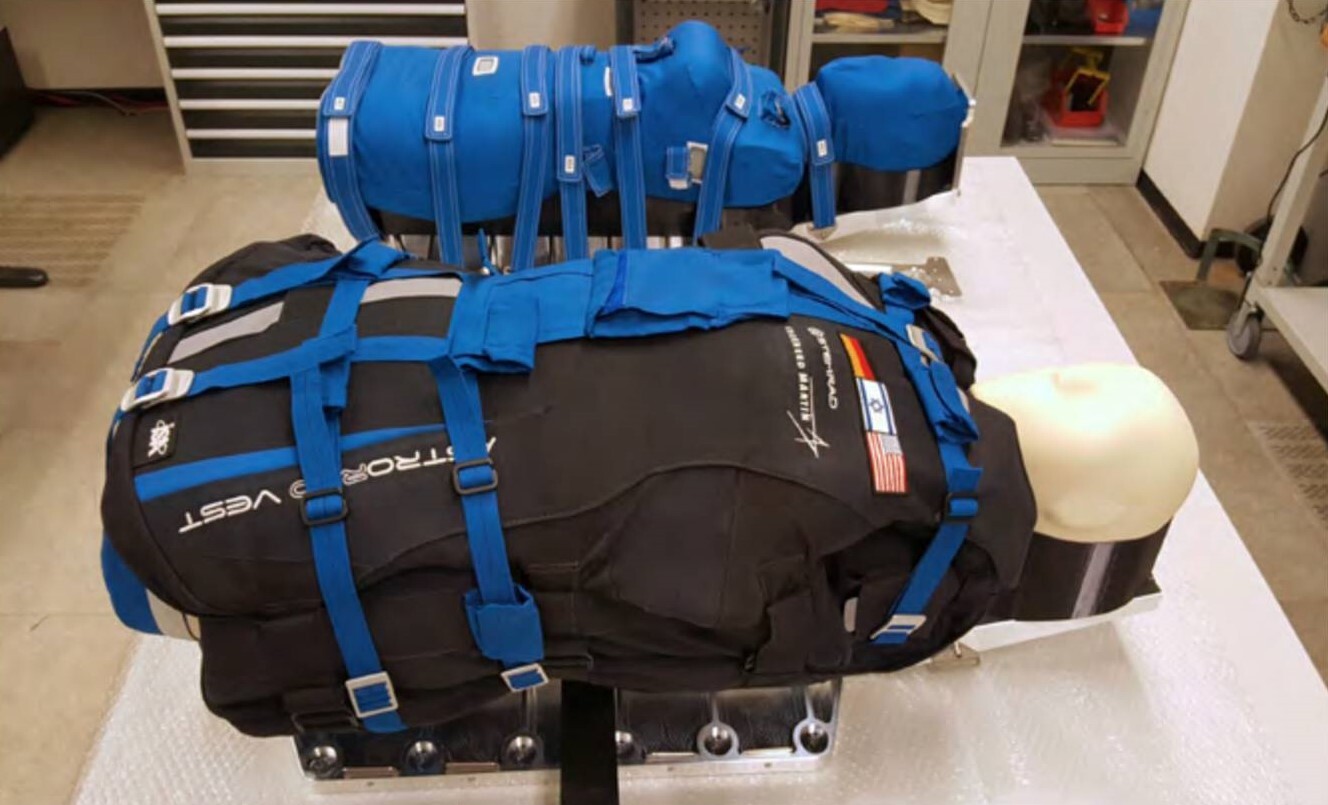
Two foam torsos lie on a long table

During NASA’s uncrewed Artemis 1 mission in late 2022, two identical “phantom” torsos named Helga and Zohar were outfitted with radiation detectors while flying aboard the Orion spacecraft. They measured the effects of radiation in space and tested the effectiveness of protective vests. (Image credit: NASA)

If that dose rate threshold is exceeded, he added, the Artemis 2 crew would take material out from spacecraft storage bays and place those objects along the least shielded wall of the Orion capsule to build a radiation shelter.

“In addition, if an event is particularly bad, there are some places in the capsule, such as storage bays and down by the toilet, that the crew can go to,” said George. Such areas would be pretty tight but would offer up even more shielding.

Tags: NASArocket launch
No Result
View All Result

Recent Posts

  • From spa to boat party: 10 epic events for the Aug. 12, 2026, total solar eclipse in Spain and Iceland
  • ‘The most special thing that will ever happen in my life’: Artemis 2 astronauts describe their epic moon mission
  • Falcon 9 launches Cygnus cargo spacecraft to the ISS
  • NASA Science, Cargo Launch Aboard Northrop Grumman CRS-24
  • This Week In Space podcast: Episode 205 — All About Artemis

Categories

  • Excursions
  • Kepler Mission
  • NASA
  • NASA Breaking News
  • Physical Preparation
  • Preparation
  • Space News
  • Space Station News
  • Spacewalks
  • Tours
  • Uncategorized
  • Weightlessness Training
  • What Not to Pack
  • What to Pack

Meta

  • Log in
  • Entries feed
  • Comments feed
  • WordPress.org
  • Home
  • Start Here
  • Preparing for Your Trip
  • Space Tourism Companies
  • Space Tours
  • Contact

© 2026 JNews - Premium WordPress news & magazine theme by Jegtheme.

No Result
View All Result
  • About
  • Contact
  • Feeds
  • Frequently Asked Questions
  • Preparing for Your Trip
    • Insurance and Legal Waivers
    • Physical and Medical Requirements
    • Training Programs
    • What to Expect
  • Privacy Policy
  • Space Tourism Companies
    • Axiom Space
    • Blue Origin
    • Blue Origin vs Virgin Galactic
    • Comparison Chart: Features, Pricing, Booking
    • SpaceX
    • Virgin Galactic
    • World View (stratospheric balloon flights)
  • Space Tours
    • Custom & Luxury Packages
    • Duration, Training, Costs
    • Experiences
    • Future Moon/Mars Options
    • Orbital Flights
    • Parabolic Flight Experiences
    • Private Missions
    • Stratospheric Balloon Flights
    • Suborbital Flights
    • Zero-Gravity Flights
  • Spaceflight Technologies
    • Space Tourism Balloon
  • Start Here
    • How to Book a Space Tour
    • Intro to Commercial Spaceflight
    • Is Space Tourism Safe?
    • Space Travel FAQs
    • View Earth from the Edge
    • What to Pack
  • Tours in Space is your launchpad to the world of space tourism

© 2026 JNews - Premium WordPress news & magazine theme by Jegtheme.