• Home
  • About
  • FAQ
  • Feeds
  • Glossary
  • Contact
Tours In Space
  • Home
  • Start Here
    • Intro to Commercial Spaceflight
    • How to Book a Space Tour
    • Is Space Tourism Safe?
    • Space Travel FAQs
    • View Earth from the Edge
    • What to Pack
  • Preparing for Your Trip
    • Insurance and Legal Waivers
    • Physical and Medical Requirements
    • Training Programs
    • What to Expect
  • Space Tourism Companies
    • Axiom Space
    • Blue Origin
    • SpaceX
    • Virgin Galactic
    • World View (stratospheric balloon flights)
    • Blue Origin vs Virgin Galactic
    • Comparison Chart: Features, Pricing, Booking
  • Space Tours
    • Custom & Luxury Packages
    • Duration, Training, Costs
    • Experiences
    • Future Moon/Mars Options
    • Orbital Flights
    • Parabolic Flight Experiences
    • Private Missions
    • Stratospheric Balloon Flights
    • Suborbital Flights
    • Zero-Gravity Flights
  • Spaceflight Technologies
    • Space Tourism Balloon
No Result
View All Result
  • Home
  • Start Here
    • Intro to Commercial Spaceflight
    • How to Book a Space Tour
    • Is Space Tourism Safe?
    • Space Travel FAQs
    • View Earth from the Edge
    • What to Pack
  • Preparing for Your Trip
    • Insurance and Legal Waivers
    • Physical and Medical Requirements
    • Training Programs
    • What to Expect
  • Space Tourism Companies
    • Axiom Space
    • Blue Origin
    • SpaceX
    • Virgin Galactic
    • World View (stratospheric balloon flights)
    • Blue Origin vs Virgin Galactic
    • Comparison Chart: Features, Pricing, Booking
  • Space Tours
    • Custom & Luxury Packages
    • Duration, Training, Costs
    • Experiences
    • Future Moon/Mars Options
    • Orbital Flights
    • Parabolic Flight Experiences
    • Private Missions
    • Stratospheric Balloon Flights
    • Suborbital Flights
    • Zero-Gravity Flights
  • Spaceflight Technologies
    • Space Tourism Balloon
No Result
View All Result
Tours In Space
No Result
View All Result
Home Space News

Pulsars to the extreme: Spinning dead stars found blasting radio signals from the ‘edge of their magnetic reach’

Ensign by Ensign
April 3, 2026
in Space News
0
Pulsars to the extreme: Spinning dead stars found blasting radio signals from the ‘edge of their magnetic reach’
189
SHARES
1.5k
VIEWS
Share on FacebookShare on Twitter

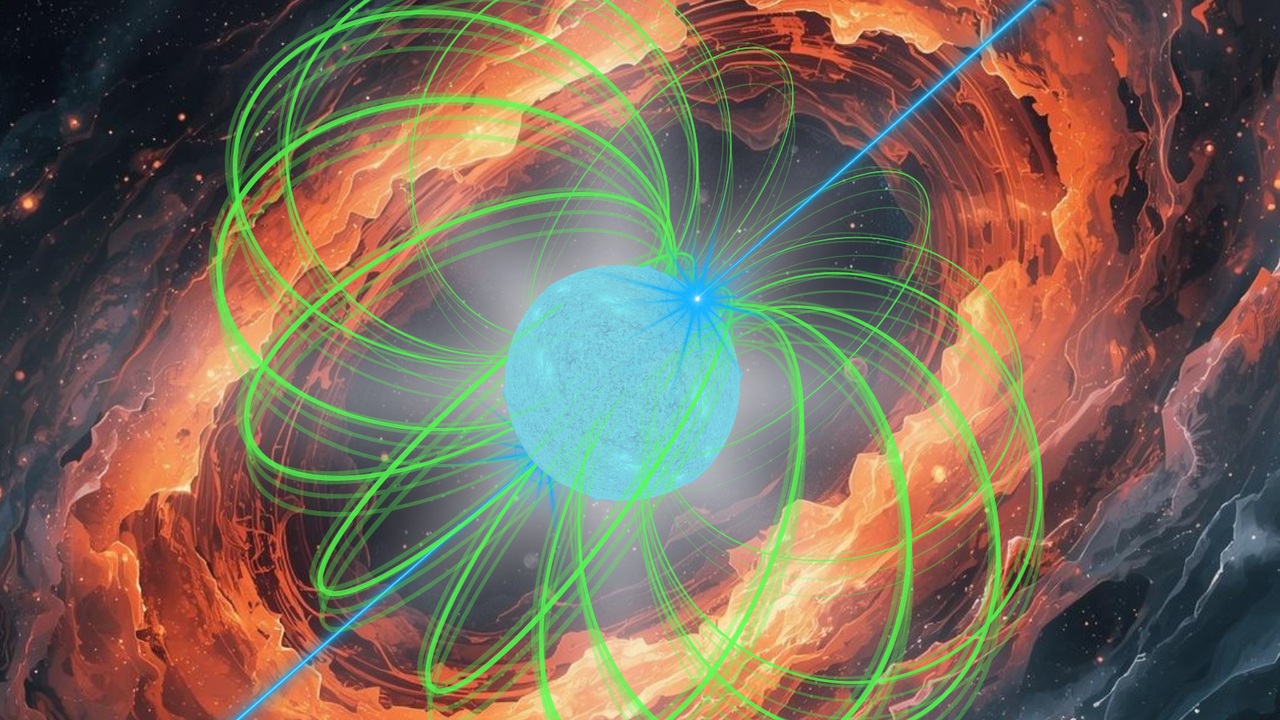
Astronomers have discovered that rapidly spinning dead stars called neutron stars at the heart of pulsars can blast out radio signals from their edges. The finding could overturn decades of thinking suggesting that pulsars only blast beams of radiation from close to their surfaces and at their poles.

Pulsars, like all neutron stars, are created when massive stars run out of fuel needed for their internal nuclear fusion process and thereby collapse, forming a stellar remnant with matter so dense that if a teaspoon of it were brought to Earth, it would weigh around 10 million tons. This collapse also generates the universe’s most powerful magnetic fields — and, like the cosmic equivalent of an ice skater drawing in their arms to increase their speed, the collapse can also speed up the spin of neutron stars to as much as 700 times a second.

When these rapidly spinning neutron stars blast out radiation from their poles, that radiation sweeps across the cosmos like beams of light from a cosmic lighthouse. And it is these cosmic lighthouses are known as pulsars. In fact, the rotation rate of pulsars are so accurate and well-regulated that they can be used as highly precise universal “clocks.”


You may like

The team behind the new research examined radio observations of around 200 rapidly spinning pulsars, or millisecond pulsars, comparing them to data collected in gamma-rays. This revealed radio waves emanating from two or more regions surrounding around 33% of these millisecond pulsars. Only 3% of slower-rotating neutron stars have been observed to emit radio waves from a region within their grasp besides their poles.

Then the fact that the more distant radio wave pulses aligned with gamma-ray blasts from these pulsars detected by NASA’s Fermi Space Telescope indicated to the team that both types of electromagnetic radiation were being emitted from the same non-polar and distant regions around these pulsars.

“As we are detecting signals both from the stars’ surfaces and from the very edge of their magnetic reach, this study shows that these tiny, fast-spinning stars are even more complex and surprising than we thought,” team member Simon Johnston from Australian science agency CSIRO (Commonwealth Scientific and Industrial Research Organisation) said in a statement.
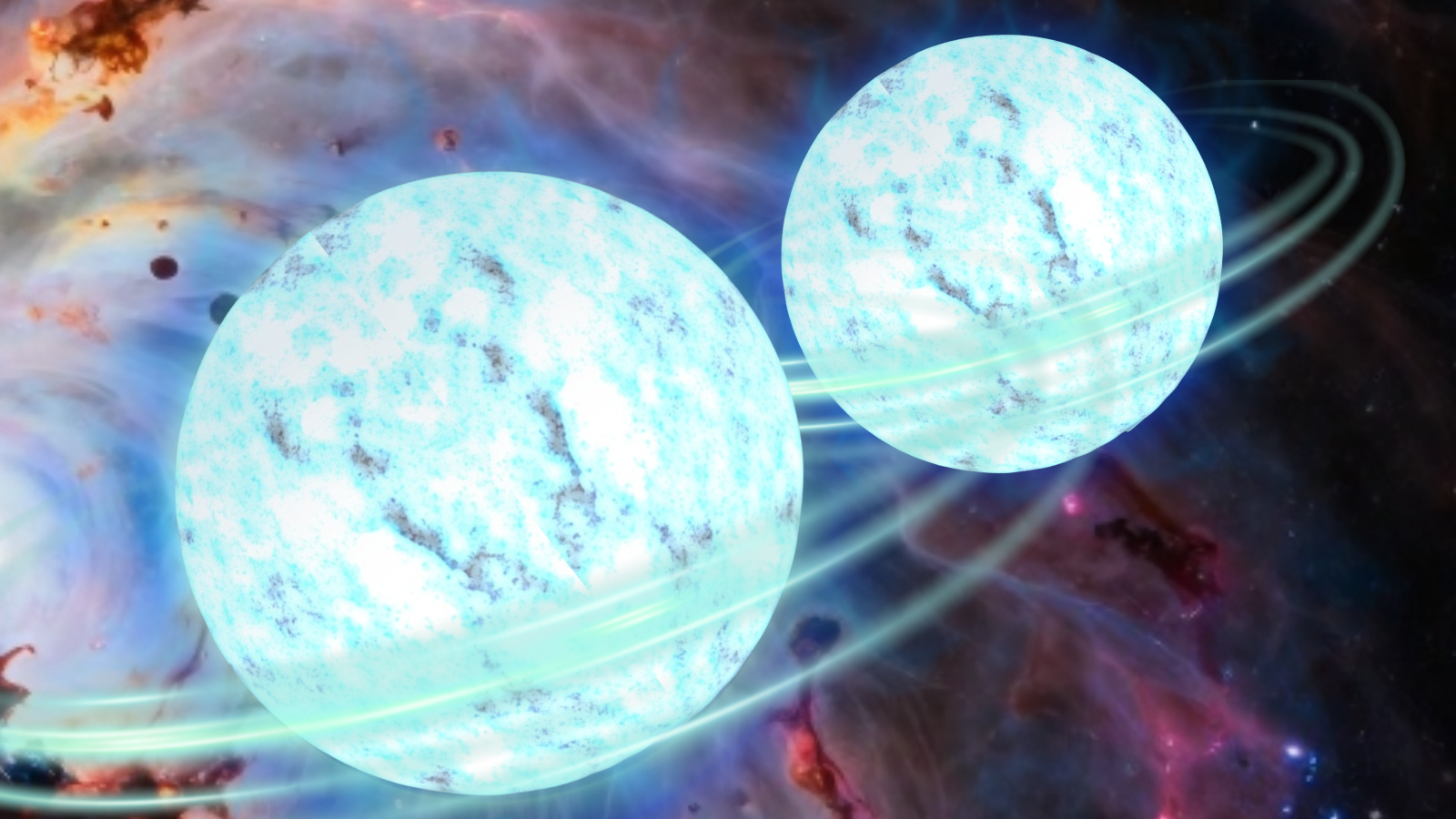
Two ice blue balls are illustrated moving toward one another.

An illustration showing two neutron stars meeting and merging. (Image credit: Robert Lea (created with Canva))

The team concluded that these factors indicate millisecond pulsars produce radio waves close to the poles of these dead stars and in a swirling “current sheet” of charged particles — that are more distant from the neutron star and beyond its magnetic fields — which sweep around with the motion of the dead star.

Breaking space news, the latest updates on rocket launches, skywatching events and more!

Current sheets were already known to be responsible for the gamma-ray emission of millisecond pulsars, so the alignment between radio waves and gamma-rays indicates a shared origin point.

This could also explain why some millisecond pulsars have strange, broken-up radio wave profiles. What astronomers observe, be it radio waves from the poles, from the current sheet, or both, depends on how the pulsar is oriented in relation to our telescopes.

One useful outcome of this research and its findings is the fact that millisecond pulsars should be easier to detect than astronomers had previously theorized. That’s because the radio waves are emanating over a wider range of directions rather than just in a narrow cone from the poles. That means a pulsar doesn’t have to be perfectly aligned with Earth to be observed via its radio emissions.

While this is good news for projects such as the measurement of ripples in spacetime called gravitational waves that use large arrays of pulsars, the team is still puzzled about how radio pulses can be generated so far away from neutron stars and the turbulent immediate environments they generate.

“Understanding where their signals come from — and why they look the way they do — is essential for using them as precision instruments,” team member Michael Kramer from the Max Planck Institute for Radio Astronomy (MPIfR), Germany, said in the statement.

The team’s results were published on March 25 in the journal Monthly Notices of the Royal Astronomical Society.

Tags: rocket launch
No Result
View All Result

Recent Posts

  • Watch Atlas V rocket launch its heaviest-ever payload early on April 4
  • Artemis 2 astronauts see Earth in the rear-view mirror | Space photo of the day for April 3, 2026
  • How to watch the new ‘lost’ Doctor Who episodes from anywhere in the world
  • NASA is sending astronauts back to the moon. Can you see the Artemis 4 landing sites from Earth?
  • Pulsars to the extreme: Spinning dead stars found blasting radio signals from the ‘edge of their magnetic reach’

Categories

  • Excursions
  • Kepler Mission
  • NASA
  • NASA Breaking News
  • Physical Preparation
  • Preparation
  • Space News
  • Space Station News
  • Spacewalks
  • Tours
  • Uncategorized
  • Weightlessness Training
  • What Not to Pack
  • What to Pack

Meta

  • Log in
  • Entries feed
  • Comments feed
  • WordPress.org
  • Home
  • Start Here
  • Preparing for Your Trip
  • Space Tourism Companies
  • Space Tours
  • Contact

© 2026 JNews - Premium WordPress news & magazine theme by Jegtheme.

No Result
View All Result
  • About
  • Contact
  • Feeds
  • Frequently Asked Questions
  • Preparing for Your Trip
    • Insurance and Legal Waivers
    • Physical and Medical Requirements
    • Training Programs
    • What to Expect
  • Privacy Policy
  • Space Tourism Companies
    • Axiom Space
    • Blue Origin
    • Blue Origin vs Virgin Galactic
    • Comparison Chart: Features, Pricing, Booking
    • SpaceX
    • Virgin Galactic
    • World View (stratospheric balloon flights)
  • Space Tours
    • Custom & Luxury Packages
    • Duration, Training, Costs
    • Experiences
    • Future Moon/Mars Options
    • Orbital Flights
    • Parabolic Flight Experiences
    • Private Missions
    • Stratospheric Balloon Flights
    • Suborbital Flights
    • Zero-Gravity Flights
  • Spaceflight Technologies
    • Space Tourism Balloon
  • Start Here
    • How to Book a Space Tour
    • Intro to Commercial Spaceflight
    • Is Space Tourism Safe?
    • Space Travel FAQs
    • View Earth from the Edge
    • What to Pack
  • Tours in Space is your launchpad to the world of space tourism

© 2026 JNews - Premium WordPress news & magazine theme by Jegtheme.