• Home
  • About
  • FAQ
  • Feeds
  • Glossary
  • Contact
Tours In Space
  • Home
  • Start Here
    • Intro to Commercial Spaceflight
    • How to Book a Space Tour
    • Is Space Tourism Safe?
    • Space Travel FAQs
    • View Earth from the Edge
    • What to Pack
  • Preparing for Your Trip
    • Insurance and Legal Waivers
    • Physical and Medical Requirements
    • Training Programs
    • What to Expect
  • Space Tourism Companies
    • Axiom Space
    • Blue Origin
    • SpaceX
    • Virgin Galactic
    • World View (stratospheric balloon flights)
    • Blue Origin vs Virgin Galactic
    • Comparison Chart: Features, Pricing, Booking
  • Space Tours
    • Custom & Luxury Packages
    • Duration, Training, Costs
    • Experiences
    • Future Moon/Mars Options
    • Orbital Flights
    • Parabolic Flight Experiences
    • Private Missions
    • Stratospheric Balloon Flights
    • Suborbital Flights
    • Zero-Gravity Flights
  • Spaceflight Technologies
    • Space Tourism Balloon
No Result
View All Result
  • Home
  • Start Here
    • Intro to Commercial Spaceflight
    • How to Book a Space Tour
    • Is Space Tourism Safe?
    • Space Travel FAQs
    • View Earth from the Edge
    • What to Pack
  • Preparing for Your Trip
    • Insurance and Legal Waivers
    • Physical and Medical Requirements
    • Training Programs
    • What to Expect
  • Space Tourism Companies
    • Axiom Space
    • Blue Origin
    • SpaceX
    • Virgin Galactic
    • World View (stratospheric balloon flights)
    • Blue Origin vs Virgin Galactic
    • Comparison Chart: Features, Pricing, Booking
  • Space Tours
    • Custom & Luxury Packages
    • Duration, Training, Costs
    • Experiences
    • Future Moon/Mars Options
    • Orbital Flights
    • Parabolic Flight Experiences
    • Private Missions
    • Stratospheric Balloon Flights
    • Suborbital Flights
    • Zero-Gravity Flights
  • Spaceflight Technologies
    • Space Tourism Balloon
No Result
View All Result
Tours In Space
No Result
View All Result
Home Space News

All eyes on Orion’s heat shield: Artemis 2 astronauts will hit Earth’s atmosphere at nearly 24,000 mph on April 10

Ensign by Ensign
April 9, 2026
in Space News
0
All eyes on Orion’s heat shield: Artemis 2 astronauts will hit Earth’s atmosphere at nearly 24,000 mph on April 10
189
SHARES
1.5k
VIEWS
Share on FacebookShare on Twitter

Now that NASA Artemis 2 mission has rounded the moon, taking astronauts Reid Wiseman, Victor Glover, Christina Koch and Jeremy Hansen farther from the Earth than any astronauts before them, the journey home is underway. What awaits them when they reenter Earth’s atmosphere?
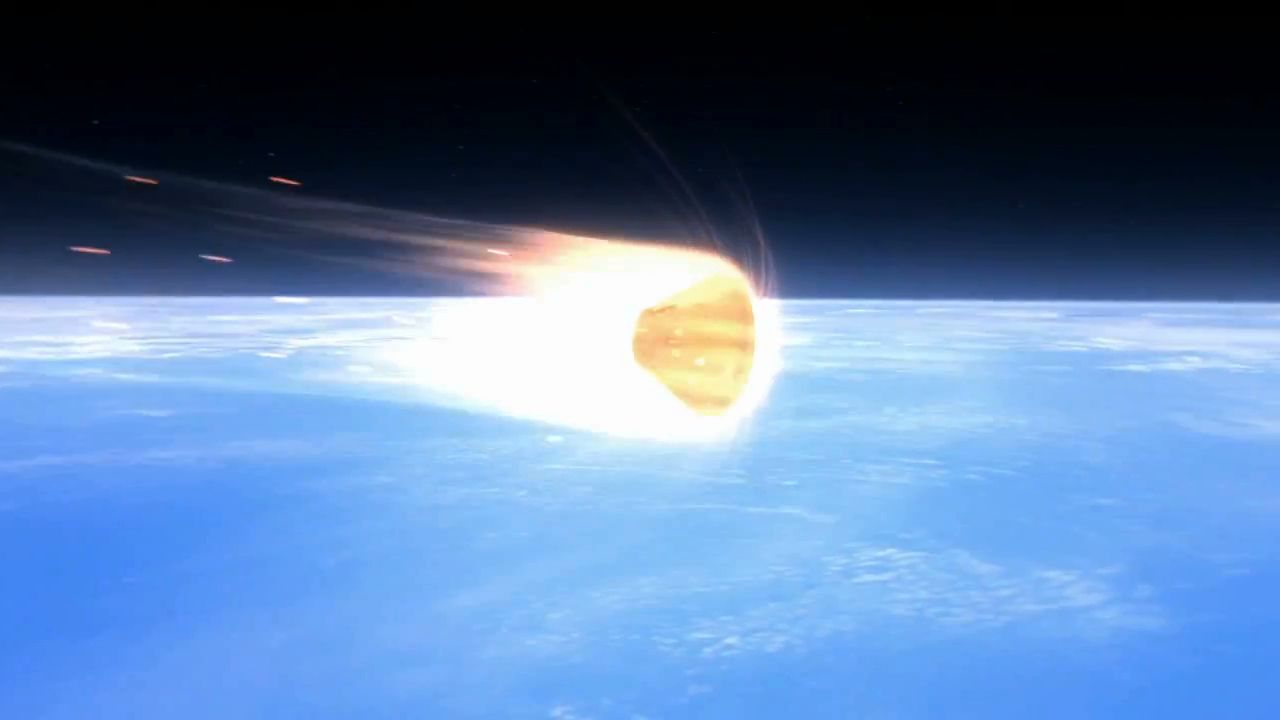
The final 100 or so miles of their 695,081-mile (1,118,624 kilometers) journey are potentially the most dangerous. At about 75 miles (120 km) above Earth, Artemis 2‘s Orion capsule will enter our atmosphere at an estimated 23,840 mph (38,367 kph). That’s fast enough to fly from New York to Tokyo in less than 20 minutes, were the capsule heading in that direction. Instead, it will be on target for a splashdown Friday evening (April 10), in the Pacific Ocean off the coast of San Diego.

What follows once it enters the atmosphere are eight dramatic minutes.


You may like

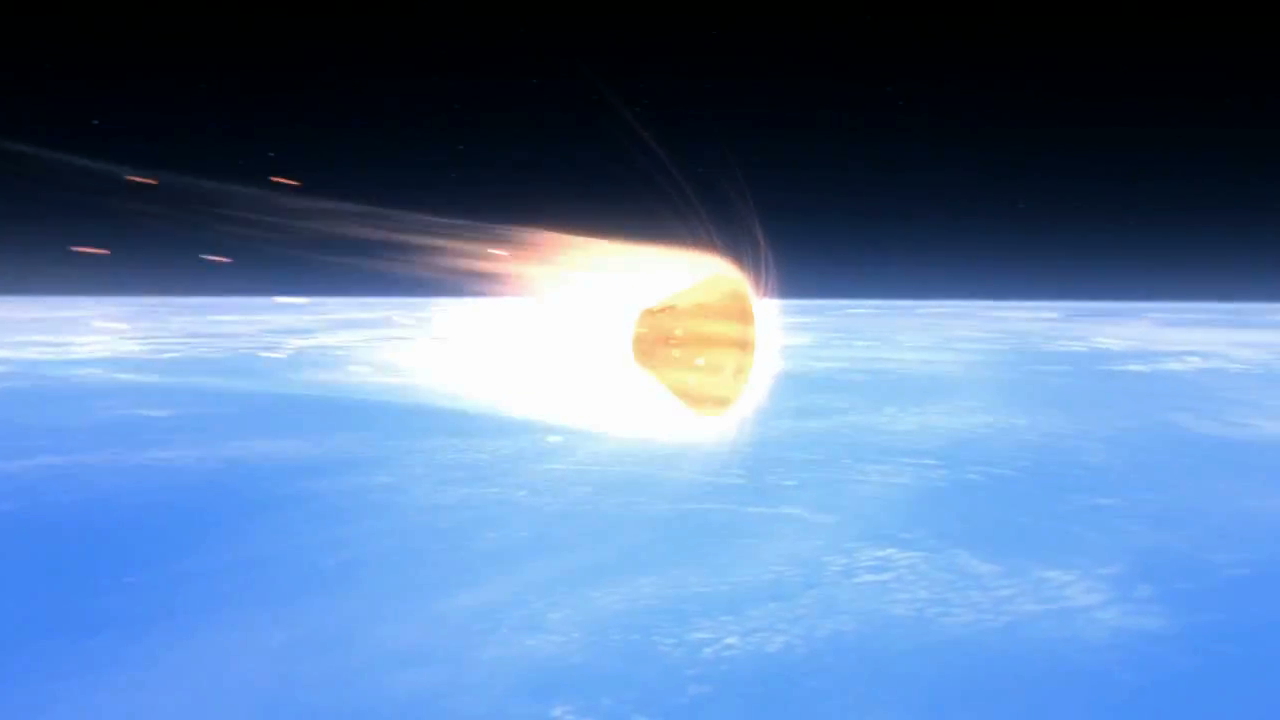
An artist's impression of the Orion capsule streaking through the atmosphere.

Artemis 2’s Orion capsule will hit Earth’s atmosphere at nearly 24,000 mph on April 10. A heat shield and 11 parachutes will help it survive the fiery trip and splash down safely. (Image credit: NASA)

Originally, the plan was for the Orion capsule to dip in and out of the atmosphere, like a skipping stone, to gradually shed some of its high velocity through sequential periods of friction with the atmosphere.

However, this approach was dropped following reentry of the Artemis 1 mission in December 2022, which saw an uncrewed Orion return to Earth from lunar orbit. On that mission, Orion’s protective heat shield, which prevents the capsule from burning up as the friction with the atmosphere raises temperatures to 2,760 degrees Celsius (5,000 degrees Fahrenheit), experienced substantial damage.

The heat shield is made from a titanium base covered in 186 blocks of a heat-resistant material called Avcoat, each of which is 1.5 inches (3.8 centimeters) thick. During Artemis 1’s atmospheric re-entry, gases trapped within the heat shield expanded in the high temperatures, ripping away char-covered fragments of Avcoat and reducing the effectiveness of the heat shield.

This could be dangerous to the astronauts on board Artemis 2. Therefore, Artemis 2’s Orion will instead enter Earth’s atmosphere at a steeper angle than originally planned, in order to reduce the time spent moving through the atmosphere at high velocity and temperature, and hopefully reducing the chances of damage.

Breaking space news, the latest updates on rocket launches, skywatching events and more!

During this stage of the descent, Orion will be engulfed in a fireball, flickering plasma igniting outside the window hatches. The descent will be rough and tumble, and for a short time communications with ground control will be cut off by the plasma envelope around the capsule — always a nerve-jangling moment, followed hopefully by relief as the capsule comes through the worst of it and communication is restored.

At this stage, Orion will be 26,500 feet (8,077 m) above the Pacific Ocean but still hurtling down at 325 mph (523 kph). Pyrotechnics will fire to release the first set of parachutes, the three forward-bay-cover chutes, which are 7 feet (2.1 m) across. At 25,000 feet (7,620 m), two larger drogue chutes, with a diameter of 23 feet (7 m), will deploy to stabilize the capsule further ahead of the release of the main parachutes at 9,500 feet (2,896 m) and a downward velocity of 130 mph (209 kph).

The main parachutes have a more complicated system. First, three pilot chutes will release, each 11 feet (3.4 m) in diameter, and these pilot chutes will pull out the three mains, which are a huge 116 feet (35.3 m) wide, each weighing 310 lbs (140 kilograms), with the Orion crew module dangling 265 feet (81 m) beneath them.


What to read next

These main parachutes will slow the capsule’s descent to less than 20 mph (32 kph), gentle enough for a successful splashdown in the Pacific Ocean off the coast of San Diego on Friday at 8:07 p.m. EDT (5:07 p.m. local time; 1207 GMT on April 11).

Then the recovery teams will swing into action, as U.S. Navy rescue helicopters from the USS John P. Murtha perform search and rescue operations. These assets will be deployed two hours before the scheduled splashdown.

The teams on board have trained repeatedly for this moment, including 12 dress rehearsals called underway recovery tests, or URTs, which involve a pretend capsule called the Crew Module Test Article. They’ve also done it once for real, with the uncrewed Orion capsule of the Artemis 1 mission.

If all goes to plan, the crew of Artemis 2 will be retrieved from their capsule, its hatch blown and the crew module buoyant on the waves as it rides floatation devices, safe and sound. In doing so, the astronauts will cement their place in history and pave the way for the Artemis 4 mission to finally go back and land on our moon in late 2028, almost 60 years after astronauts last stepped foot there.

Tags: NASArocket launch
No Result
View All Result

Recent Posts

  • Falcon 9 launches Cygnus cargo spacecraft to the ISS
  • NASA Science, Cargo Launch Aboard Northrop Grumman CRS-24
  • This Week In Space podcast: Episode 205 — All About Artemis
  • SpaceX launches huge ‘Cygnus XL’ cargo ship carrying over 5 tons of supplies to ISS astronauts (video)
  • Artemis 3 and beyond: What’s next for NASA after Artemis 2 moon success

Categories

  • Excursions
  • Kepler Mission
  • NASA
  • NASA Breaking News
  • Physical Preparation
  • Preparation
  • Space News
  • Space Station News
  • Spacewalks
  • Tours
  • Uncategorized
  • Weightlessness Training
  • What Not to Pack
  • What to Pack

Meta

  • Log in
  • Entries feed
  • Comments feed
  • WordPress.org
  • Home
  • Start Here
  • Preparing for Your Trip
  • Space Tourism Companies
  • Space Tours
  • Contact

© 2026 JNews - Premium WordPress news & magazine theme by Jegtheme.

No Result
View All Result
  • About
  • Contact
  • Feeds
  • Frequently Asked Questions
  • Preparing for Your Trip
    • Insurance and Legal Waivers
    • Physical and Medical Requirements
    • Training Programs
    • What to Expect
  • Privacy Policy
  • Space Tourism Companies
    • Axiom Space
    • Blue Origin
    • Blue Origin vs Virgin Galactic
    • Comparison Chart: Features, Pricing, Booking
    • SpaceX
    • Virgin Galactic
    • World View (stratospheric balloon flights)
  • Space Tours
    • Custom & Luxury Packages
    • Duration, Training, Costs
    • Experiences
    • Future Moon/Mars Options
    • Orbital Flights
    • Parabolic Flight Experiences
    • Private Missions
    • Stratospheric Balloon Flights
    • Suborbital Flights
    • Zero-Gravity Flights
  • Spaceflight Technologies
    • Space Tourism Balloon
  • Start Here
    • How to Book a Space Tour
    • Intro to Commercial Spaceflight
    • Is Space Tourism Safe?
    • Space Travel FAQs
    • View Earth from the Edge
    • What to Pack
  • Tours in Space is your launchpad to the world of space tourism

© 2026 JNews - Premium WordPress news & magazine theme by Jegtheme.