

<em>Updated 11:45 p.m. Eastern with post-splashdown comments.
WASHINGTON — The first human mission beyond Earth orbit in more than 50 years successfully concluded with a splashdown in the Pacific Ocean April 10.
The Orion spacecraft Integrity splashed down in the Pacific southwest of San Diego at 8:07 p.m. Eastern, ending the Artemis 2 mission. NASA reported the four astronauts on board — Reid Wiseman, Victor Glover, Christina Koch and Jeremy Hansen — were in good condition as recovery crews worked to extract them from the capsule and take them by helicopter to a U.S. Navy ship, the USS John P. Murtha.
“What a journey,” Wiseman, Artemis 2 commander, said moments after splashdown. He reported four “green” crewmembers, meaning all were in good shape.
“Everything we’ve been hearing from the surgeons is that the flight crew is happy and healthy and ready to come home to Houston,” Rick Henfling, Artemis 2 entry flight director, said at a post-splashdown briefing.
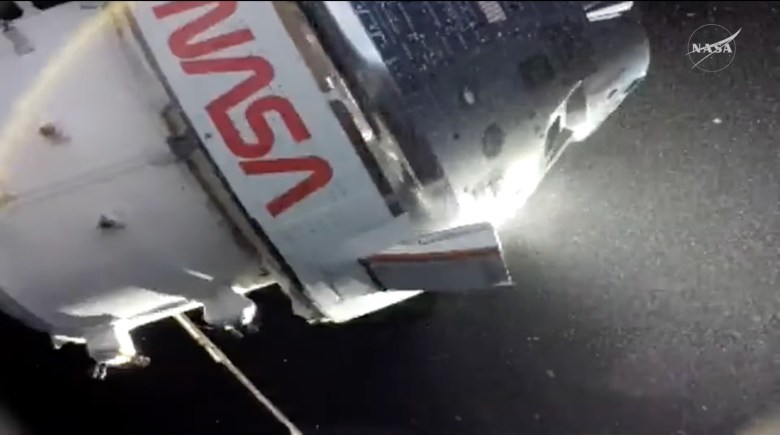
The splashdown capped a rapid-fire series of events in the mission’s final hour as the spacecraft returned to Earth. The Orion service module separated from the crew module at 7:33 p.m. Eastern. Four minutes later, the crew module performed an 18-second “raise burn” to align the capsule for reentry.
Reentry officially began at 7:53 p.m. Eastern when the spacecraft reached the “entry interface” altitude of 121.9 kilometers. It was around this time that the spacecraft reached its peak speed of 39,693 kilometers per hour.
Plasma from the reentry triggered a planned communications blackout lasting about six minutes as the spacecraft descended into the atmosphere and slowed down. Two drogue parachutes deployed at 8:03 p.m. Eastern at an altitude of 6,700 meters, followed a minute later by three main parachutes at an altitude of 1,800 meters.
The reentry was closely watched because of issues with the same heat shield design on the Artemis 1 mission in 2022. The shield suffered more erosion than expected, which an investigation linked to heat buildup in Avcoat material that created gases that, in turn, caused cracks. NASA modified the heat shield design for Artemis 3 and beyond, but modified the reentry trajectory for Artemis 2 to limit that heat buildup as temperatures reached up to 2,760 degrees Celsius.
“I’ve actually been thinking about entry since April 3, 2023,” said Glover in an April 8 press conference, referring to the day the crew was announced. “Riding a fireball through the atmosphere is profound.”
At the post-splashdown briefing, NASA officials said they gathered data on the heat shield’s performance in several ways, such as imagery from aircraft during the capsule’s descent and underwater imaging after splashdown and before the spacecraft was loaded onto the recovery ship.
Howard Hu, NASA Orion program manager, said some heat shield experts are on the ship to support initial reviews of the heat shield performance, which will continue once the capsule is returned to the Kennedy Space Center. That will be part of an initial 30-day post-mission report on Orion.

Relay race
The splashdown concluded an Artemis 2 mission that lasted more than nine days, starting with an April 1 launch on a Space Launch System rocket from the Kennedy Space Center. After spending a day in a highly elliptical Earth orbit, Orion fired its main engine to place the spacecraft on a free-return trajectory around the moon, making the astronauts on board the first to travel beyond Earth orbit since Apollo 17’s lunar landing mission in December 1972.
Orion made its closest approach to the moon April 6, passing 6,545 kilometers above the lunar surface. It also set a new record for the most distant crewed mission, flying 406,771 kilometers from Earth. By splashdown, the mission had traveled 1,126,922 kilometers.
Artemis 2 was primarily a test flight of the Orion spacecraft, which carried humans for the first time after two uncrewed test flights. Astronauts spent the mission testing capabilities ranging from Orion’s manual control to various elements of its life support system.
Orion passed most of those tests, with NASA reporting only a few issues with the spacecraft. That included a wastewater vent line that became clogged, limiting the ability to empty a urine tank for the spacecraft’s toilet.
NASA also reported leaks in valves used to pressurize propellant tanks in the spacecraft’s service module. While that did not impair the ability of Orion to perform minor maneuvers on its way to and from the moon, NASA officials said April 9 they will likely need to redesign that system before the next Orion mission to the moon, Artemis 4 in 2028.
“We have loved living in Orion,” Koch said at the April 8 press conference, despite the cramped conditions that often have them bumping into one another or discussing how to best position themselves to carry out their work. “Everything we do in here is a four-person activity, but it’s also a lot of fun.”
The astronauts’ insights as well as engineering data will feed into future missions. The next mission, Artemis 3, is scheduled for launch by mid-2027. It will remain in low Earth orbit, with astronauts testing the ability to rendezvous and dock with lunar lander prototypes being developed by Blue Origin and SpaceX. Artemis 4, the first crewed lunar landing attempt, will follow as soon as early 2028, with Artemis 5 to follow as early as late 2028.
“We are back in the business of sending astronauts to the moon,” NASA Administrator Jared Isaacman, who was on the recovery ship for splashdown, said on NASA’s webcast of the event. “This is just the beginning. We’re going to get back into doing this with frequency, sending missions to the moon until we land on it in 2028.”
Koch said the team has worked to identify and update things that have not worked quite right during the mission, keeping those future crews in mind. “We’ve really just worked to make sure that they are set up for success.”
“This is a relay race,” she said. “In fact, we have batons that we bought to symbolize physically that, and we plan to hand them to the next crew. Every single thing we do is with them in mind.”