

Artemis 2 has come home, but NASA still has its nose to the lunar grindstone.
The four astronauts of Artemis 2, the first crewed mission to the moon since Apollo 17 in 1972, splashed down safely off the coast of San Diego last night (April 10).
It was a big moment for NASA, but the agency doesn’t plan to rest on its laurels. The agency has even more ambitious plans in the years ahead — including putting boots down on the moon just a couple of years from now.
Artemis 2 launched on April 1, sending four astronauts — NASA’s Reid Wiseman, Victor Glover and Christina Koch, and Jeremy Hansen of the Canadian Space Agency — on a 10-day trip around the moon.
It was the first crewed mission of the Artemis program and the second overall, after Artemis 1, which launched an uncrewed Orion capsule to lunar orbit and back to Earth in late 2022.
The next mission, Artemis 3, was originally supposed to be a crewed trip to the lunar surface. But in late February, NASA Administrator Jared Isaacman announced a big change to the Artemis architecture. Artemis 3 will now stay in Earth orbit, testing Orion’s ability to dock with one or both of the program’s crewed lunar landers — SpaceX’s Starship and Blue Origin’s Blue Moon.
NASA wants to launch that mission in mid-2027. If all goes well, Artemis 4 will then put astronauts down near the moon’s south pole, using Orion and one of the privately developed Human Landing System (HLS) vehicles, in late 2028.
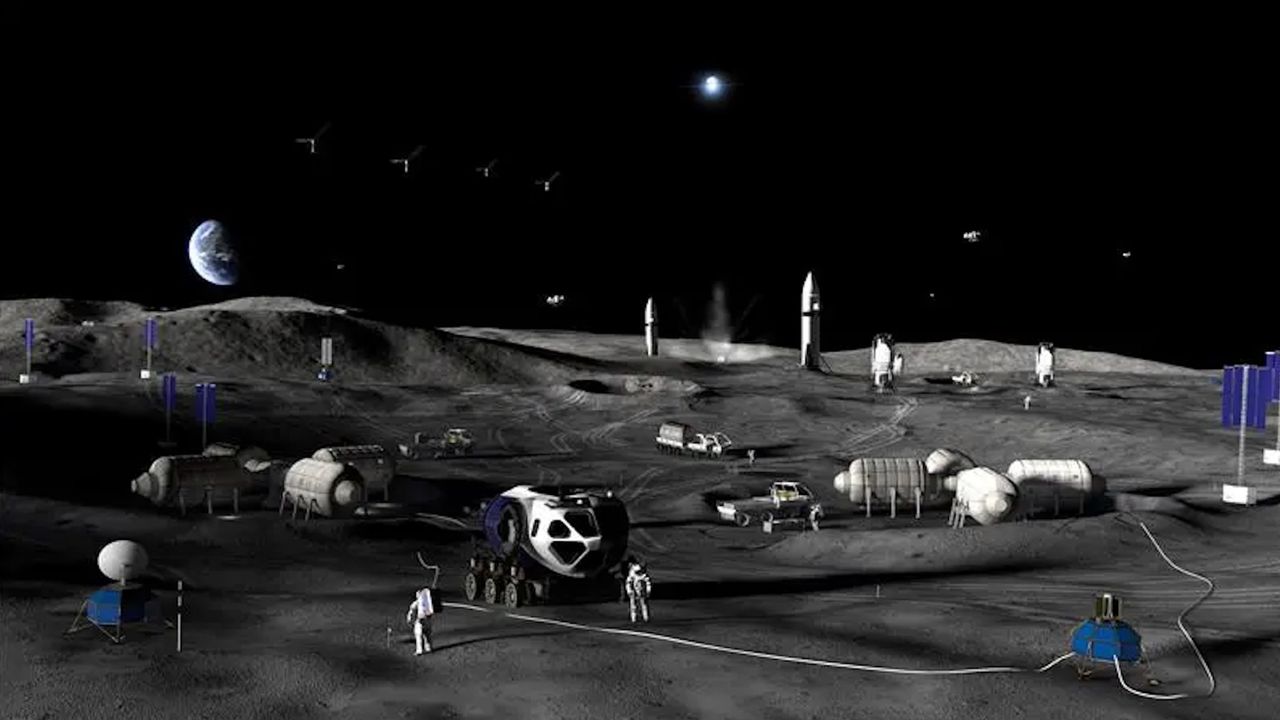
Things will only get more exciting from there. The crewed Artemis missions will keep coming, helping to establish a lunar base by 2032. Astronauts will live and work at this outpost for a long time after that, teaching NASA the skills and techniques it needs to make the next giant leap — to Mars.
That’s the plan, anyway. And there is some reason to hope it could actually happen. Artemis 1 and Artemis 2 were successful, after all, and the ball is already rolling on Artemis 3.
During an Artemis 2 press conference on Tuesday (April 7), for example, Isaacman revealed that agency officials had held “the first senior-level Artemis 3 mission design discussion” that very day.
“There are a lot of things, based on the information we have available today, from feedback from our vendors, that we know are achievable,” he added a bit later in the briefing. “And I think one of the questions probably will just be, what the initial orbit will be for Artemis 3.”
The options are low Earth orbit (LEO) and high Earth orbit for the mission, which will be crewed.
“There’s pros and cons for each of them,” Isaacman said. “We’re all going to be able to have some sense about which path we will likely go down based on launch cadence of our two HLS providers.”
And teams have already made significant progress on the Artemis 3 hardware, according to NASA Associate Administrator Amit Kshatriya. Some pieces of that mission’s Space Launch System rocket are already at the launch site, Kennedy Space Center in Florida, he said. And others will ship out from the agency’s Michoud Assembly Facility in Louisana later this month.
“So we’re, yes, in earnest, proceeding as quickly as we can,” Kshatriya told reporters on Thursday (April 9).
And we can expect to learn the identities of the Artemis 3 astronauts “soon,” he added during a post-splashdown news conference on Friday evening.
“I will not put units on that value,” Kshatriya said. “But soon.”
There are still some big hurdles to overcome, of course. For example, both HLS landers are unproven.
Blue Moon hasn’t flown at all yet. Starship has launched on 11 suborbital test flights to date, the last two of them fully successful. But the giant vehicle still hasn’t reached orbit, demonstrated off-Earth refueling (which it will need to do on moon or Mars missions) or been outfitted with a life-support system.
There are also some kinks to work out with Orion going forward. For instance, Integrity’s propulsion system sprang a helium leak during Artemis 2. (Orion’s service module uses helium to push propellant from its tanks into the engines.)
The observed leak rate is “still acceptable, but that will lead us to probably an extensive redesign of that valve system,” Kshatriya said on Thursday. “I don’t need those valves to hold pressure in the same way for a LEO orbiting mission, but for a lunar orbit mission, I do.”
Integrity’s toilet acted up a bit during Artemis 2, so engineers may need to make a few tweaks to that system as well.
Other issues will doubtless crop up as the Artemis missions proceed toward the program’s audacious goal. Humanity has never built an outpost on a world beyond Earth before, after all, so achieving that grand vision will be a heavy lift.
But Isaacman is confident that NASA is up to the challenge, pointing to the success of Artemis 2 as evidence.
“This is just the beginning,” he said just after the mission’s splashdown on Friday. “We are going to get back into doing this with frequency, sending missions to the moon, until we land on it in 2028 and start building our base.”