• Home
  • About
  • FAQ
  • Feeds
  • Glossary
  • Contact
Tours In Space
  • Home
  • Start Here
    • Intro to Commercial Spaceflight
    • How to Book a Space Tour
    • Is Space Tourism Safe?
    • Space Travel FAQs
    • View Earth from the Edge
    • What to Pack
  • Preparing for Your Trip
    • Insurance and Legal Waivers
    • Physical and Medical Requirements
    • Training Programs
    • What to Expect
  • Space Tourism Companies
    • Axiom Space
    • Blue Origin
    • SpaceX
    • Virgin Galactic
    • World View (stratospheric balloon flights)
    • Blue Origin vs Virgin Galactic
    • Comparison Chart: Features, Pricing, Booking
  • Space Tours
    • Custom & Luxury Packages
    • Duration, Training, Costs
    • Experiences
    • Future Moon/Mars Options
    • Orbital Flights
    • Parabolic Flight Experiences
    • Private Missions
    • Stratospheric Balloon Flights
    • Suborbital Flights
    • Zero-Gravity Flights
  • Spaceflight Technologies
    • Space Tourism Balloon
No Result
View All Result
  • Home
  • Start Here
    • Intro to Commercial Spaceflight
    • How to Book a Space Tour
    • Is Space Tourism Safe?
    • Space Travel FAQs
    • View Earth from the Edge
    • What to Pack
  • Preparing for Your Trip
    • Insurance and Legal Waivers
    • Physical and Medical Requirements
    • Training Programs
    • What to Expect
  • Space Tourism Companies
    • Axiom Space
    • Blue Origin
    • SpaceX
    • Virgin Galactic
    • World View (stratospheric balloon flights)
    • Blue Origin vs Virgin Galactic
    • Comparison Chart: Features, Pricing, Booking
  • Space Tours
    • Custom & Luxury Packages
    • Duration, Training, Costs
    • Experiences
    • Future Moon/Mars Options
    • Orbital Flights
    • Parabolic Flight Experiences
    • Private Missions
    • Stratospheric Balloon Flights
    • Suborbital Flights
    • Zero-Gravity Flights
  • Spaceflight Technologies
    • Space Tourism Balloon
No Result
View All Result
Tours In Space
No Result
View All Result
Home Space News

The moon’s oldest and darkest craters could be hiding the most water ice. That’s good news for future astronauts

Ensign by Ensign
April 14, 2026
in Space News
0
The moon’s oldest and darkest craters could be hiding the most water ice. That’s good news for future astronauts
189
SHARES
1.5k
VIEWS
Share on FacebookShare on Twitter

The moon’s stores of water-ice, hidden in permanently shadowed craters at the lunar south pole, probably arrived on the surface of our nearest neighbor gradually rather than in one big event, according to new research.

Furthermore, these ‘permanently’ shadowed craters are not as permanently shadowed as we thought, since changes in the moon‘s tilt with respect to Earth and the Sun means that the angle of illumination has also changed over the course of billions of years. Craters that were engulfed in cold shadows and capable of hosting water-ice 3 billion years ago are not necessarily in shadow now, and vice versa.

The new findings are quite timely, with the success of the Artemis 2 mission putting lunar exploration back on the map.


You may like

In the 1960s, some planetary scientists proposed that craters at the south pole of the moon, where the angle of the sun is so shallow that parts of the interior of the craters’ are rendered in permanent shadow, could be cold enough to host water-ice. However, when the Apollo missions brought back samples from the moon between 1969 and 1972, scientists found that the lunar regolith was bone dry.

So it was quite a surprise when, in 1994, the radar on NASA’s Clementine mission to the moon suggested the presence of water-ice, and this has since been supported by the likes of NASA’s Lunar Prospector and Lunar Reconnaissance Orbiter (LRO) missions.

Water-ice on the moon would be invaluable to astronauts living there in any future outpost. Water can be used for drinking, and it can be split into its component hydrogen and oxygen atoms for rocket fuel and air to breath.

The source of the moon’s water, however, has been a mystery. Was it brought to the moon long ago in one big cometary impact, or has it gradually gathered on the lunar surface over the history of the moon?

Breaking space news, the latest updates on rocket launches, skywatching events and more!

While we still cannot definitely say where the water came from, planetary scientists Paul Hayne of the Laboratory for Atmospheric and Space Physics at the University of Colorado, Boulder, Oded Aharonson of the Weizmann Institute in Israel and Norbert Schörghofer of the Planetary Science Institute in Arizona, are now able to say where it didn’t come from. Specifically, it did not come from one big event, like a single giant comet impact.
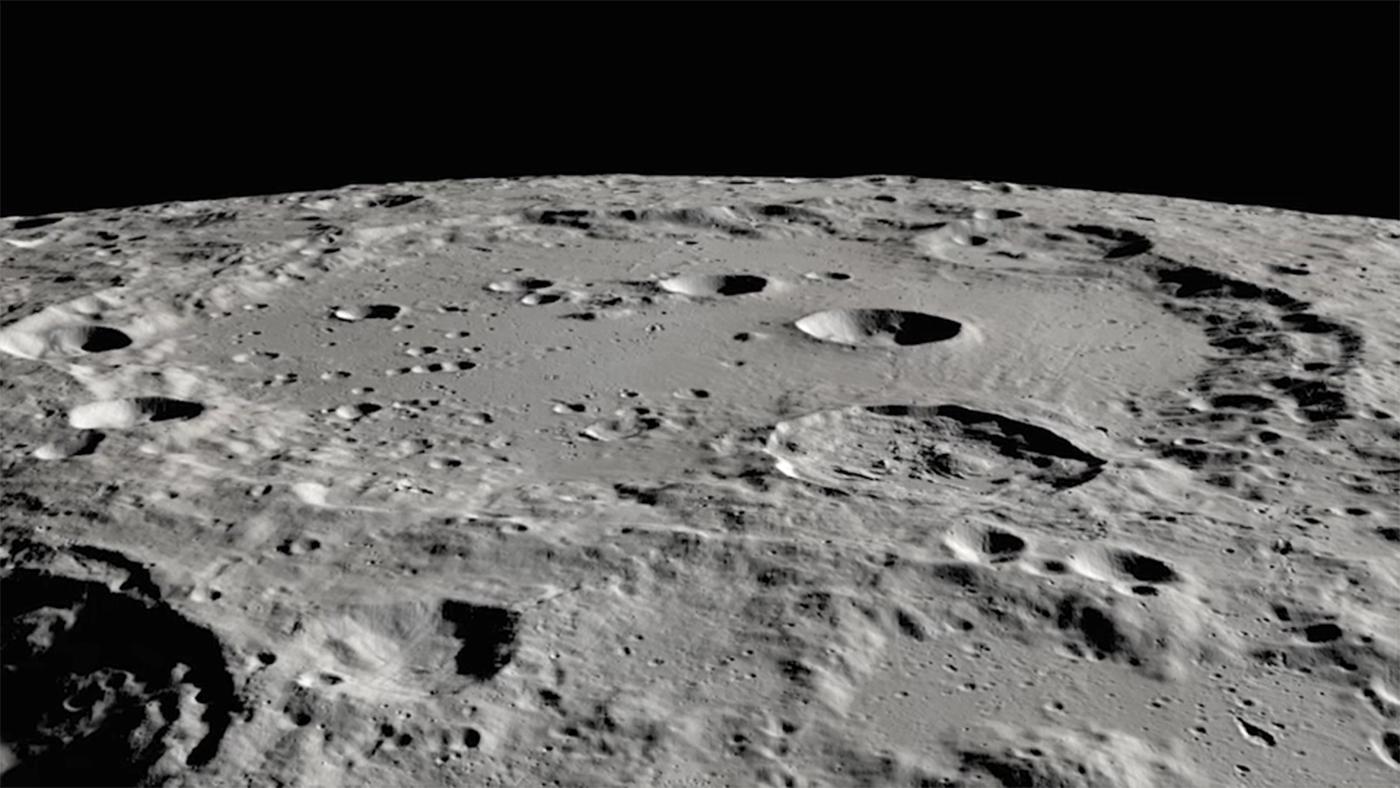
the grey cratered surface of the moon

The Clavius crater on the moon as seen by NASA’s Lunar Reconnaissance Orbiter. The SOFIA observatory has detected water ice in shadowed regions of this sunlit lunar location. (Image credit: NASA/Moon Trek/USGS/LRO)

Water-ice is not in every permanently shadowed crater, and the team used that fact as their starting point.

“What’s clear is that the ice has a patchy distribution,” said Hayne in a statement. “It’s not concentrated in the same quantities in every crater. And there was no great explanation for that.”


What to read next

The team worked backwards, employing surface temperature data from LRO’s Diviner instrument in conjunction with computer models of how the craters have evolved thermally. Key to this is including the fact that the moon’s tilt has changed over time, meaning that some of the craters that were shadowed three billion years ago are no longer, while others have slipped into shadow. When out in the light, the water-ice sublimates and is either lost to space or migrates to other shadowed areas that act as cold traps.

The team came up with a list of craters that have been permanently shadowed the longest and found that they are the same craters that LRO’s Lyman-Alpha Mapping Project (LAMP) instrument has found water-ice in.

For example, Haworth crater near the lunar south pole has been in permanent shadow for over 3 billion years and contains some of the strongest radar signals for water-ice.

“It looks like the moon’s oldest craters also have the most ice,” said Hayne. “That implies the moon has been accumulating water more or less continuously for as much as 3 or 3.5 billion years.”

Therefore, water’s introduction to the moon could not have come in one event long ago. Instead, the team suggest that it could have come from a multitude of smaller asteroid and comet impacts, or that it was belched up from the moon’s deep interior by the volcanism that wracked the lunar surface for large spells over three billion years ago, creating the lava plains that we see today as the lunar Maria.
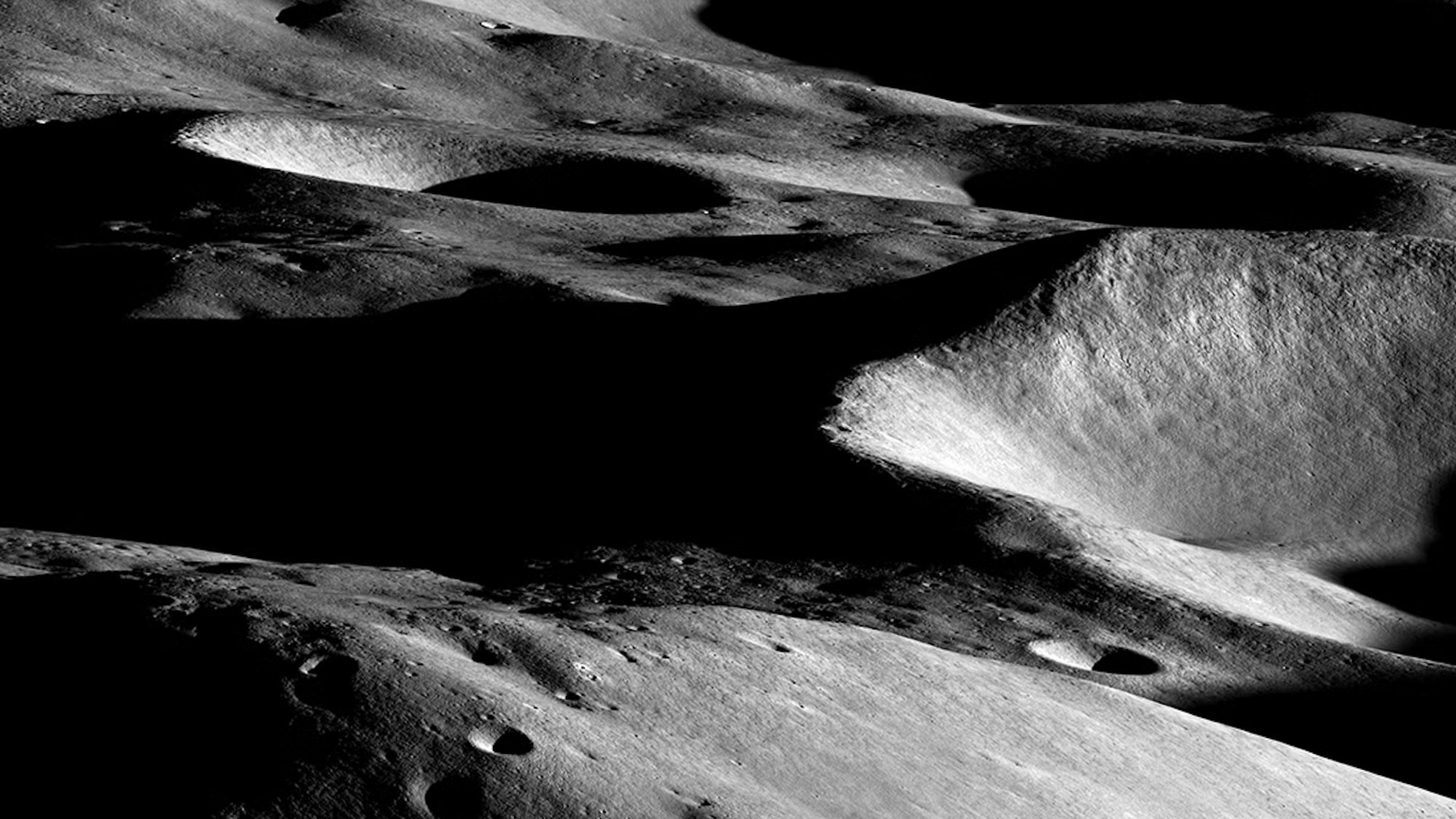
deep craters, some in shadow, on the grey surface of the moon

Shadows stretch around Malapert Massif, a mountain near the moon’s South Pole. (Image credit: NASA GSFC/Arizona State University)

It is even possible that the solar wind has had an impact on the presence of water on the moon.

“Through the solar wind, a constant stream of hydrogen bombards the moon, and some of that hydrogen can be converted to water on the lunar surface,” said Hayne.

To convert to water it would need to react with oxygen. A recent study has shown that atoms and molecules from Earth’s atmosphere, including oxygen, have been leaking out and making their way across space to the lunar surface for billions of years. Even water molecules could have been transported from Earth to the moon.

“Ultimately, the question of the source of the moon’s water will only be solved by sample analysis,” said Hayne. “We will need to go to the moon to analyze those samples there or find ways to bring them from the moon back to Earth.”

To that end, Hayne is leading development of a new instrument called the Lunar Compact Infrared Imaging System (L-CIRiS), which will be a thermal camera that will obtain more detailed observations of lunar craters that may contain water-ice. It will fly to the moon in late 2027 as part of the Commercial Lunar Payload Services (CLPS) program, on board the CP-22 lander being built by Intuitive Machines.

Hayne’s, Aharonson’s and Schörghofer’s research was published on April 7 in Nature Astronomy.

Tags: NASArocket launch
No Result
View All Result

Recent Posts

  • Scientists use rare ‘Einstein Cross’ to learn about young galaxy with surprisingly old stars
  • This Artemis 2 astronaut really loves Rise | Space photo of the day for April 14, 2026
  • Nutrition Research Arrives Aboard Space Station
  • The Lyrids are coming! How I watch meteor showers from the middle of a city
  • Talk about long distance! Watch the farthest-ever crew call in space between Artemis 2 and the ISS

Categories

  • Excursions
  • Kepler Mission
  • NASA
  • NASA Breaking News
  • Physical Preparation
  • Preparation
  • Space News
  • Space Station News
  • Spacewalks
  • Tours
  • Uncategorized
  • Weightlessness Training
  • What Not to Pack
  • What to Pack

Meta

  • Log in
  • Entries feed
  • Comments feed
  • WordPress.org
  • Home
  • Start Here
  • Preparing for Your Trip
  • Space Tourism Companies
  • Space Tours
  • Contact

© 2026 JNews - Premium WordPress news & magazine theme by Jegtheme.

No Result
View All Result
  • About
  • Contact
  • Feeds
  • Frequently Asked Questions
  • Preparing for Your Trip
    • Insurance and Legal Waivers
    • Physical and Medical Requirements
    • Training Programs
    • What to Expect
  • Privacy Policy
  • Space Tourism Companies
    • Axiom Space
    • Blue Origin
    • Blue Origin vs Virgin Galactic
    • Comparison Chart: Features, Pricing, Booking
    • SpaceX
    • Virgin Galactic
    • World View (stratospheric balloon flights)
  • Space Tours
    • Custom & Luxury Packages
    • Duration, Training, Costs
    • Experiences
    • Future Moon/Mars Options
    • Orbital Flights
    • Parabolic Flight Experiences
    • Private Missions
    • Stratospheric Balloon Flights
    • Suborbital Flights
    • Zero-Gravity Flights
  • Spaceflight Technologies
    • Space Tourism Balloon
  • Start Here
    • How to Book a Space Tour
    • Intro to Commercial Spaceflight
    • Is Space Tourism Safe?
    • Space Travel FAQs
    • View Earth from the Edge
    • What to Pack
  • Tours in Space is your launchpad to the world of space tourism

© 2026 JNews - Premium WordPress news & magazine theme by Jegtheme.