• Home
  • About
  • FAQ
  • Feeds
  • Glossary
  • Contact
Tours In Space
  • Home
  • Start Here
    • Intro to Commercial Spaceflight
    • How to Book a Space Tour
    • Is Space Tourism Safe?
    • Space Travel FAQs
    • View Earth from the Edge
    • What to Pack
  • Preparing for Your Trip
    • Insurance and Legal Waivers
    • Physical and Medical Requirements
    • Training Programs
    • What to Expect
  • Space Tourism Companies
    • Axiom Space
    • Blue Origin
    • SpaceX
    • Virgin Galactic
    • World View (stratospheric balloon flights)
    • Blue Origin vs Virgin Galactic
    • Comparison Chart: Features, Pricing, Booking
  • Space Tours
    • Custom & Luxury Packages
    • Duration, Training, Costs
    • Experiences
    • Future Moon/Mars Options
    • Orbital Flights
    • Parabolic Flight Experiences
    • Private Missions
    • Stratospheric Balloon Flights
    • Suborbital Flights
    • Zero-Gravity Flights
  • Spaceflight Technologies
    • Space Tourism Balloon
No Result
View All Result
  • Home
  • Start Here
    • Intro to Commercial Spaceflight
    • How to Book a Space Tour
    • Is Space Tourism Safe?
    • Space Travel FAQs
    • View Earth from the Edge
    • What to Pack
  • Preparing for Your Trip
    • Insurance and Legal Waivers
    • Physical and Medical Requirements
    • Training Programs
    • What to Expect
  • Space Tourism Companies
    • Axiom Space
    • Blue Origin
    • SpaceX
    • Virgin Galactic
    • World View (stratospheric balloon flights)
    • Blue Origin vs Virgin Galactic
    • Comparison Chart: Features, Pricing, Booking
  • Space Tours
    • Custom & Luxury Packages
    • Duration, Training, Costs
    • Experiences
    • Future Moon/Mars Options
    • Orbital Flights
    • Parabolic Flight Experiences
    • Private Missions
    • Stratospheric Balloon Flights
    • Suborbital Flights
    • Zero-Gravity Flights
  • Spaceflight Technologies
    • Space Tourism Balloon
No Result
View All Result
Tours In Space
No Result
View All Result
Home Space News

Interstellar invader 3I/ATLAS is spraying tons of water into space every second. Jupiter-bound spacecraft JUICE discovers

Ensign by Ensign
April 15, 2026
in Space News
0
Interstellar invader 3I/ATLAS is spraying tons of water into space every second. Jupiter-bound spacecraft JUICE discovers
189
SHARES
1.5k
VIEWS
Share on FacebookShare on Twitter

The interstellar invader comet 3I/ATLAS is spraying enough water into space to fill 70 Olympic swimming pools each day. The discovery gives scientists a remarkable opportunity to study the elements present during the formation of planets around other stars, potentially much older than the sun.

The discovery was made by the European Space Agency (ESA) mission Jupiter Icy Moons Explorer (Juice), which is currently heading towards Jupiter and its icy moons. JUICE observed 3I/ATLAS, which is just the third object found passing through the solar system from beyond its boundaries, in November, 2025, using its MAJIS (Moons And Jupiter Imaging Spectrometer) and JANUS (Jovis, Amorum ac Natorum Undique Scrutator) instruments.

Like comets native to the solar system, 3I/ATLAS began expelling material when it passed close to the sun, with solar radiation heating its icy heart, causing solid ice to transform immediately into gas, a process called sublimation. As this gas makes its explosive escape, it forms the coma and tail that are characteristic of comets. This is accompanied by a brightening of the comet, but 3I/ATLAS brightened even more than expected.

During its observations, MAJIS identified infrared emissions from water vapor and carbon dioxide molecules. These are known as “volatiles” because they evaporate easily.

“Repeated detections of water vapor and carbon dioxide by MAJIS indicate that volatile ices buried beneath the surface were actively released into space shortly after perihelion passage,” team member Giuseppe Piccioni of the National Institute for Astrophysics (INAF) said in a statement. “From the data collected, we estimated an outflow from the comet’s nucleus of about two tons per second, equivalent to approximately 70 Olympic swimming pools of water vapor ejected into space every day.

“The MAJIS data will allow us to better understand the activity of this comet after perihelion and the physical and chemical properties of the materials formed around another star billions of years ago.”
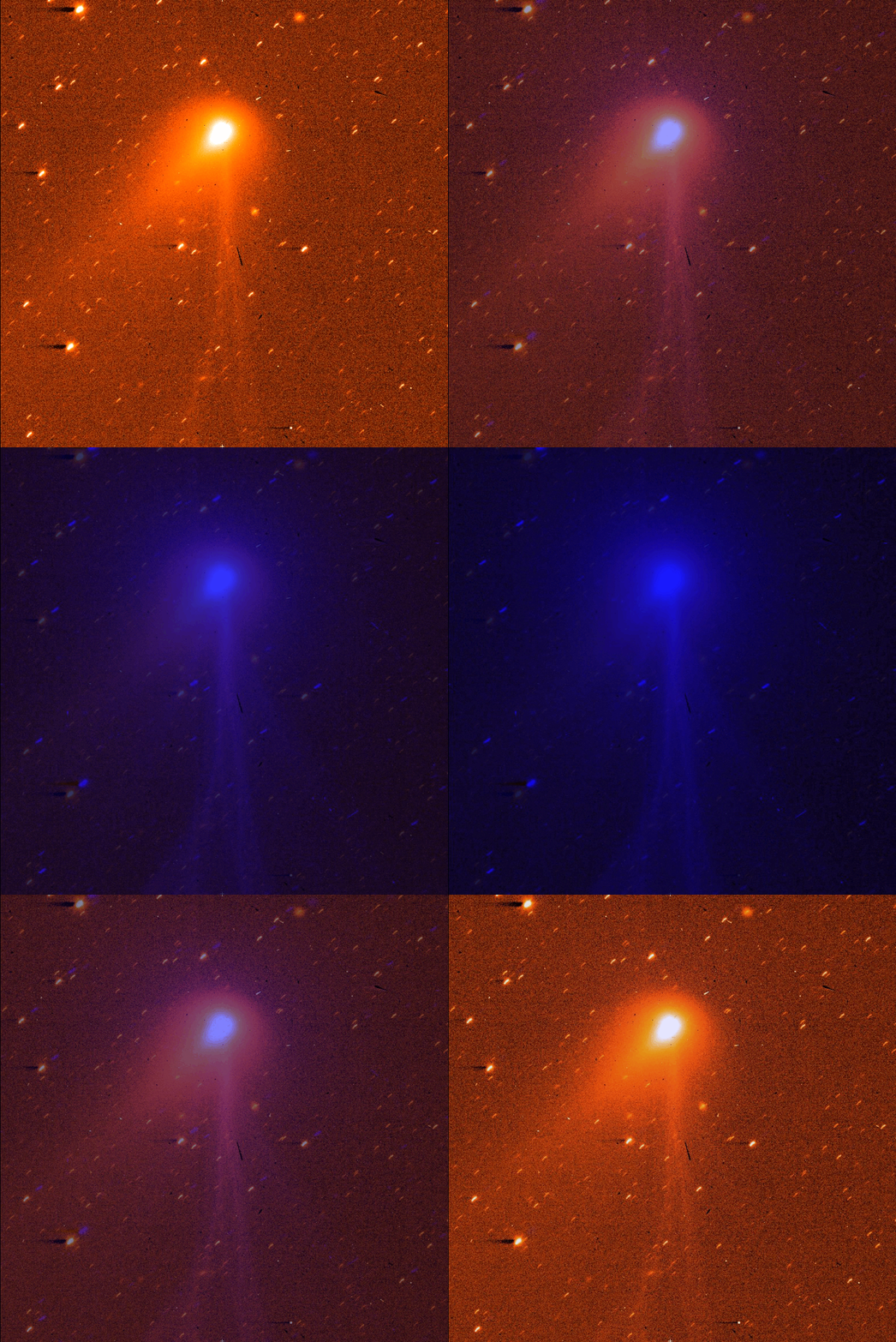
3I/ATLAS as seen by JUICE instrument MAJIS

3I/ATLAS as seen by JUICE instrument MAJIS (Image credit: ESA/Juice/MAJIS)

The JUICE observations of 3I/ATLAS were more extraordinary because they were unplanned, only occurring to the team after the discovery of 3I/ATLAS on July 1, 2025. The observations were challenging due to the short periods of time JUICE had to spot 3I/ATLAS and how faint the interstellar comet’s emissions were.

These observations were followed by a prolonged wait, with the data only reaching Earth in February 2026.

“We waited a long time, but it was truly worth it,” team member Pasquale Palumbo, an INAF researcher and principal investigator of JANUS, said. “The wonderful images collected reveal for the first time the comet’s intense activity right around perihelion. 3I/ATLAS showed an extended coma, a tail, and various morphological structures, such as rays, jets, and filaments. The data collected will allow us to study the morphological structures, light intensity, and evolution of the comet’s coma and tail on short and medium timescales.

“We are very pleased with the performance JANUS has provided us; it is an excellent preview of what it will be able to do when it operates around Jupiter and its icy moons, the final destination of the JUICE mission.”


You may like

Breaking space news, the latest updates on rocket launches, skywatching events and more!

Tags: rocket launch
No Result
View All Result

Recent Posts

  • How to see the Lyrid meteor shower 2026: Where to look in the night sky
  • Artemis 2 and Tiangong space station astronauts set record for farthest distance between humans
  • This Week In Space podcast: Episode 206 — I Want to Believe
  • Don’t miss the moon, Venus and the Pleiades align after sunset on April 19
  • This life-hunting rover may be SpaceX’s 1st-ever Mars launch

Categories

  • Excursions
  • Kepler Mission
  • NASA
  • NASA Breaking News
  • Physical Preparation
  • Preparation
  • Space News
  • Space Station News
  • Spacewalks
  • Tours
  • Uncategorized
  • Weightlessness Training
  • What Not to Pack
  • What to Pack

Meta

  • Log in
  • Entries feed
  • Comments feed
  • WordPress.org
  • Home
  • Start Here
  • Preparing for Your Trip
  • Space Tourism Companies
  • Space Tours
  • Contact

© 2026 JNews - Premium WordPress news & magazine theme by Jegtheme.

No Result
View All Result
  • About
  • Contact
  • Feeds
  • Frequently Asked Questions
  • Preparing for Your Trip
    • Insurance and Legal Waivers
    • Physical and Medical Requirements
    • Training Programs
    • What to Expect
  • Privacy Policy
  • Space Tourism Companies
    • Axiom Space
    • Blue Origin
    • Blue Origin vs Virgin Galactic
    • Comparison Chart: Features, Pricing, Booking
    • SpaceX
    • Virgin Galactic
    • World View (stratospheric balloon flights)
  • Space Tours
    • Custom & Luxury Packages
    • Duration, Training, Costs
    • Experiences
    • Future Moon/Mars Options
    • Orbital Flights
    • Parabolic Flight Experiences
    • Private Missions
    • Stratospheric Balloon Flights
    • Suborbital Flights
    • Zero-Gravity Flights
  • Spaceflight Technologies
    • Space Tourism Balloon
  • Start Here
    • How to Book a Space Tour
    • Intro to Commercial Spaceflight
    • Is Space Tourism Safe?
    • Space Travel FAQs
    • View Earth from the Edge
    • What to Pack
  • Tours in Space is your launchpad to the world of space tourism

© 2026 JNews - Premium WordPress news & magazine theme by Jegtheme.