• Home
  • About
  • FAQ
  • Feeds
  • Glossary
  • Contact
Tours In Space
  • Home
  • Start Here
    • Intro to Commercial Spaceflight
    • How to Book a Space Tour
    • Is Space Tourism Safe?
    • Space Travel FAQs
    • View Earth from the Edge
    • What to Pack
  • Preparing for Your Trip
    • Insurance and Legal Waivers
    • Physical and Medical Requirements
    • Training Programs
    • What to Expect
  • Space Tourism Companies
    • Axiom Space
    • Blue Origin
    • SpaceX
    • Virgin Galactic
    • World View (stratospheric balloon flights)
    • Blue Origin vs Virgin Galactic
    • Comparison Chart: Features, Pricing, Booking
  • Space Tours
    • Custom & Luxury Packages
    • Duration, Training, Costs
    • Experiences
    • Future Moon/Mars Options
    • Orbital Flights
    • Parabolic Flight Experiences
    • Private Missions
    • Stratospheric Balloon Flights
    • Suborbital Flights
    • Zero-Gravity Flights
  • Spaceflight Technologies
    • Space Tourism Balloon
No Result
View All Result
  • Home
  • Start Here
    • Intro to Commercial Spaceflight
    • How to Book a Space Tour
    • Is Space Tourism Safe?
    • Space Travel FAQs
    • View Earth from the Edge
    • What to Pack
  • Preparing for Your Trip
    • Insurance and Legal Waivers
    • Physical and Medical Requirements
    • Training Programs
    • What to Expect
  • Space Tourism Companies
    • Axiom Space
    • Blue Origin
    • SpaceX
    • Virgin Galactic
    • World View (stratospheric balloon flights)
    • Blue Origin vs Virgin Galactic
    • Comparison Chart: Features, Pricing, Booking
  • Space Tours
    • Custom & Luxury Packages
    • Duration, Training, Costs
    • Experiences
    • Future Moon/Mars Options
    • Orbital Flights
    • Parabolic Flight Experiences
    • Private Missions
    • Stratospheric Balloon Flights
    • Suborbital Flights
    • Zero-Gravity Flights
  • Spaceflight Technologies
    • Space Tourism Balloon
No Result
View All Result
Tours In Space
No Result
View All Result
Home Space News

Solar wind travels up to 4 times faster than expected, eclipse spacecraft reveals

Ensign by Ensign
April 15, 2026
in Space News
0
Solar wind travels up to 4 times faster than expected, eclipse spacecraft reveals
189
SHARES
1.5k
VIEWS
Share on FacebookShare on Twitter

Solar wind in the sun’s atmosphere, the corona, flows up to four times faster than scientists had thought, a study based on photographs taken by a solar eclipsing spacecraft revealed.

The type of wind that the researchers studied forms very close to the sun’s surface and had previously been known to blow at speeds of 60 miles per second (100 kilometers per second). That’s considerably slower than the 480 miles per second so-called fast solar wind that blows from coronal holes — dark, cool regions with open magnetic field lines in the sun’s upper atmosphere, the corona. But images taken by the European Space Agency’s (ESA) Proba-3 mission — a duo of satellites flying in a formation to simulate the solar eclipse — revealed that even the slow kind of solar wind can be much faster than expected.
“In the inner corona, a region very difficult to observe, we saw slow solar wind gusts moving three to four times faster than expected,” Andrei Zhukov, a solar physicist at the Royal Observatory of Belgium and the lead author of the study, said in a statement.


You may like

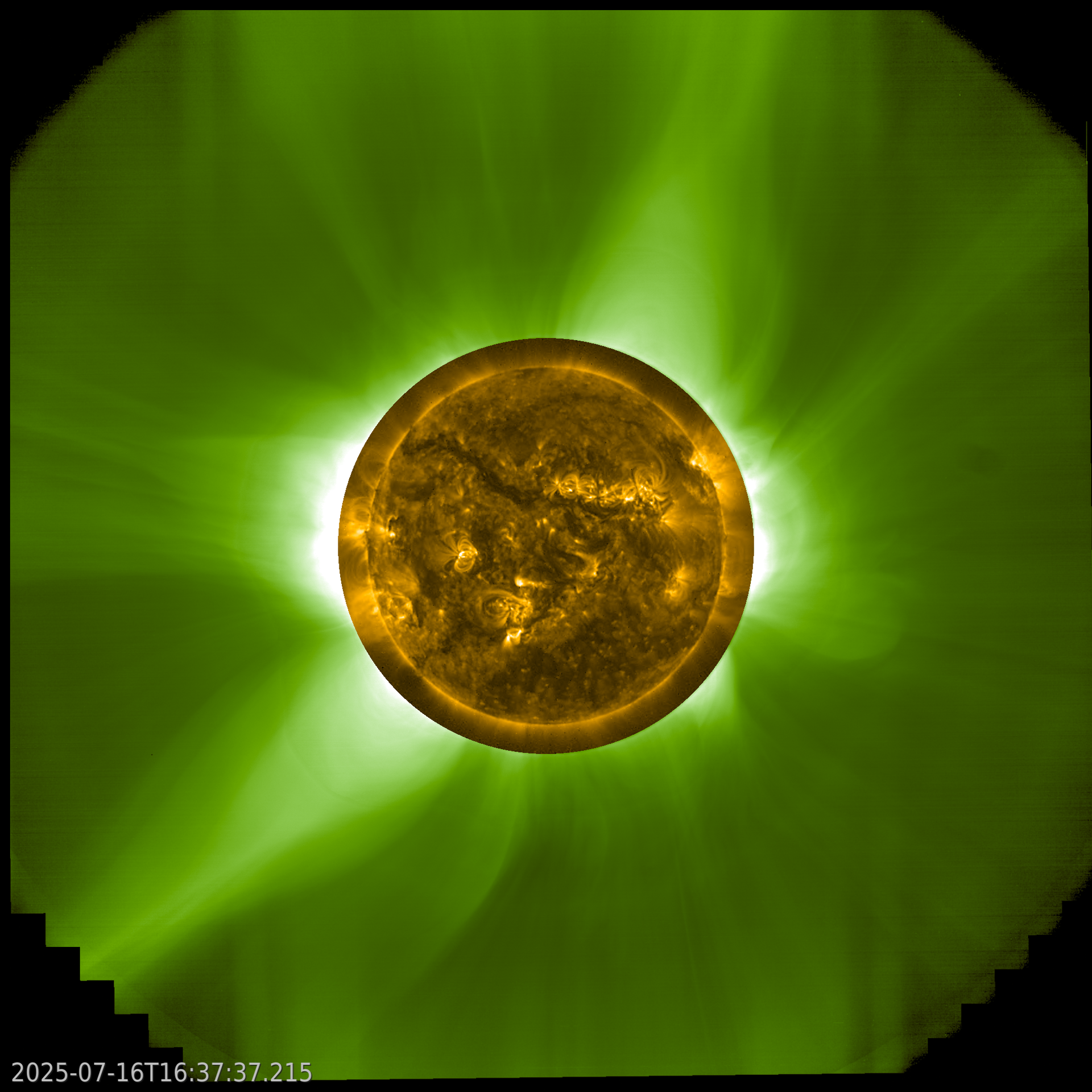
A square image with the Sun in the centre. The Sun looks yellow, with bright and dark regions. Surrounding this central image is a different image in green, showing green glowing arcs and rays extending out from the Sun. Two large rays stand out in the top centre-right and bottom left

Proba-3 image showing streamers to the top center-right and bottom left of the sun. (Image credit: ESA/Proba-3/ASPIICS & ESA/Proba-2/SWAP, A. Zhukov (ROB))

Instead of the expected 60 miles (100km) per second, the wind gusts just above the solar surface were reaching speeds up to 300 miles (480km) per second.

Solar wind is a stream of charged particles that constantly emanates from the sun and spreads across the solar system, causing geomagnetic storms and bringing intense radiation. The slow kind of solar wind, which was the object of this study, is likely generated when the sun’s magnetic field lines break and reconnect, scientists think. But the process is still shrouded in mystery. Unlike the smooth stream of fast coronal wind, the slow solar wind comes out of the sun in gusty blobs, which are visible in coronal images as bright rays.
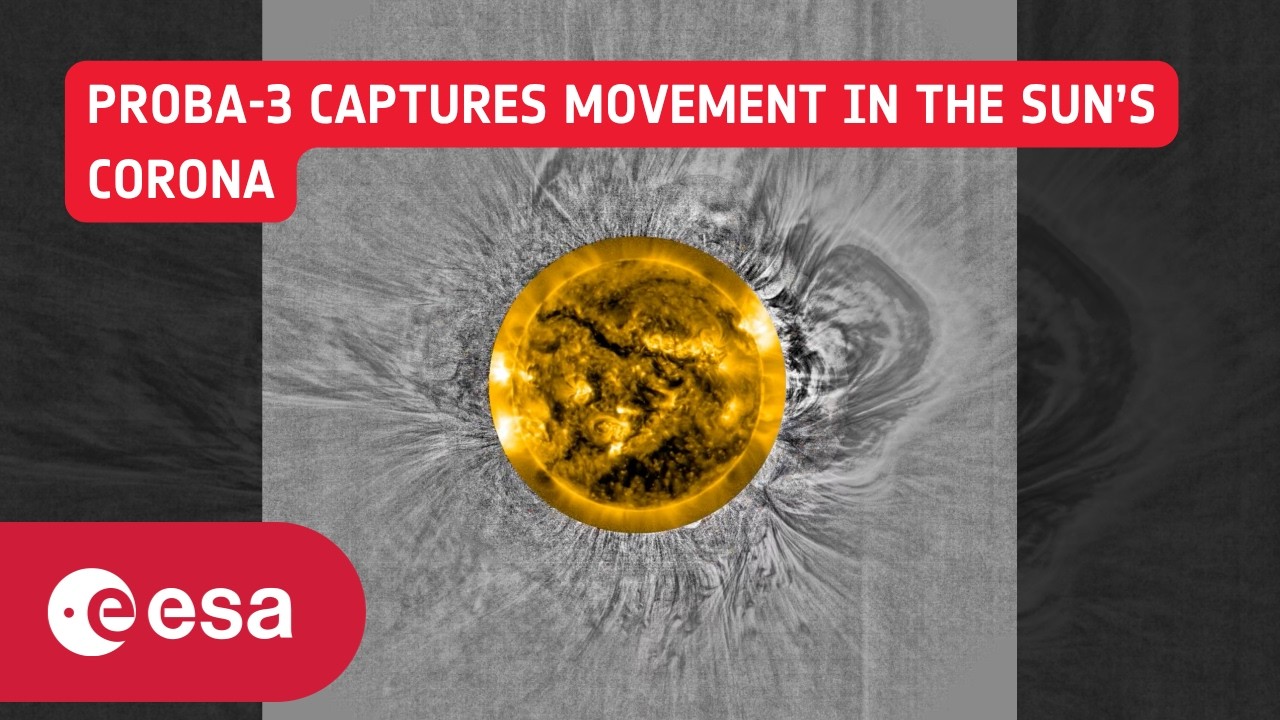
Proba-3 captures movement in the Sun’s corona – YouTube
Proba-3 captures movement in the Sun’s corona - YouTube

Watch On

Until recently, imaging the solar corona was rather difficult. The corona is extremely faint compared to the luminous disk of the sun, which outshines it a million times, unless hidden behind special instruments called occulters. The problem with occulters mounted on Earth-based telescopes is that they must also cover the region of the corona nearest to the sun’s surface to prevent the solar light from spilling over. It’s in this region where the solar wind originates. Until recently, the only option to view this region was during natural total solar eclipses.

The moon, by coincidence, is just the right size and at the right distance from Earth to cover the entire solar disk. The distance between the moon and observers on Earth means that the overspilling of light that plagues telescopes on Earth is negligible. But total solar eclipses are a rare phenomenon. They occur on average less than once a year somewhere on the planet and only last a few fleeting minutes — not enough to allow scientists to crack the sun’s major mysteries.

The ESA Proba-3 mission solves this problem. It consists of two spacecraft flying in a formation 490 feet apart (150 meters), with the spacecraft closer to the sun acting as a giant occulter to the observer satellite farther away. Since its launch in December 2024, the spacecraft has recreated 57 artificial solar eclipses, capturing 250 hours of high-resolution video of the little-understood region where solar wind forms.
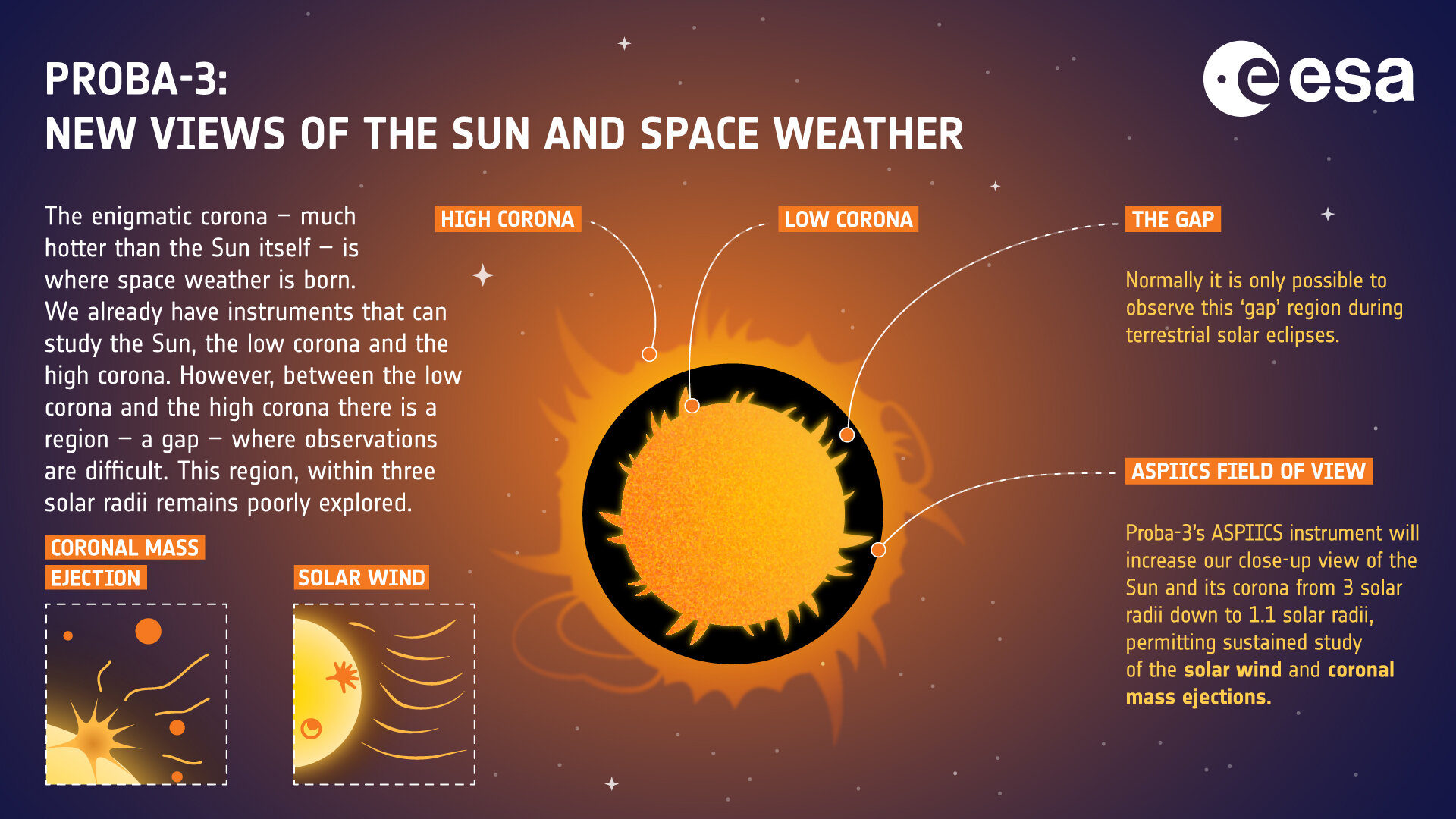
infographic explaining how proba 3 gives new views of the sun and space weather.

Proba-3 gives us new views of the sun and space weather. (Image credit: ESA-F. Zonno)

“We can track how solar wind speeds up close to the Sun, we see it all over Proba-3’s field of view, and we have already seen speeds and accelerations that surprised us,” Joe Zander, the Proba-3 project scientist at ESA, said in the statement.

The measurements reveal that the slow solar wind emerges from the sun’s surface in a nonuniform manner, producing small-scale magnetic-field disturbances.

“This first dataset is just the beginning of the much longer journey to fully understand what’s happening,” Zander said.

The study was published in The Astrophysical Journal Letters in March.

No Result
View All Result

Recent Posts

  • How to see the Lyrid meteor shower 2026: Where to look in the night sky
  • Artemis 2 and Tiangong space station astronauts set record for farthest distance between humans
  • This Week In Space podcast: Episode 206 — I Want to Believe
  • Don’t miss the moon, Venus and the Pleiades align after sunset on April 19
  • This life-hunting rover may be SpaceX’s 1st-ever Mars launch

Categories

  • Excursions
  • Kepler Mission
  • NASA
  • NASA Breaking News
  • Physical Preparation
  • Preparation
  • Space News
  • Space Station News
  • Spacewalks
  • Tours
  • Uncategorized
  • Weightlessness Training
  • What Not to Pack
  • What to Pack

Meta

  • Log in
  • Entries feed
  • Comments feed
  • WordPress.org
  • Home
  • Start Here
  • Preparing for Your Trip
  • Space Tourism Companies
  • Space Tours
  • Contact

© 2026 JNews - Premium WordPress news & magazine theme by Jegtheme.

No Result
View All Result
  • About
  • Contact
  • Feeds
  • Frequently Asked Questions
  • Preparing for Your Trip
    • Insurance and Legal Waivers
    • Physical and Medical Requirements
    • Training Programs
    • What to Expect
  • Privacy Policy
  • Space Tourism Companies
    • Axiom Space
    • Blue Origin
    • Blue Origin vs Virgin Galactic
    • Comparison Chart: Features, Pricing, Booking
    • SpaceX
    • Virgin Galactic
    • World View (stratospheric balloon flights)
  • Space Tours
    • Custom & Luxury Packages
    • Duration, Training, Costs
    • Experiences
    • Future Moon/Mars Options
    • Orbital Flights
    • Parabolic Flight Experiences
    • Private Missions
    • Stratospheric Balloon Flights
    • Suborbital Flights
    • Zero-Gravity Flights
  • Spaceflight Technologies
    • Space Tourism Balloon
  • Start Here
    • How to Book a Space Tour
    • Intro to Commercial Spaceflight
    • Is Space Tourism Safe?
    • Space Travel FAQs
    • View Earth from the Edge
    • What to Pack
  • Tours in Space is your launchpad to the world of space tourism

© 2026 JNews - Premium WordPress news & magazine theme by Jegtheme.