• Home
  • About
  • FAQ
  • Feeds
  • Glossary
  • Contact
Tours In Space
  • Home
  • Start Here
    • Intro to Commercial Spaceflight
    • How to Book a Space Tour
    • Is Space Tourism Safe?
    • Space Travel FAQs
    • View Earth from the Edge
    • What to Pack
  • Preparing for Your Trip
    • Insurance and Legal Waivers
    • Physical and Medical Requirements
    • Training Programs
    • What to Expect
  • Space Tourism Companies
    • Axiom Space
    • Blue Origin
    • SpaceX
    • Virgin Galactic
    • World View (stratospheric balloon flights)
    • Blue Origin vs Virgin Galactic
    • Comparison Chart: Features, Pricing, Booking
  • Space Tours
    • Custom & Luxury Packages
    • Duration, Training, Costs
    • Experiences
    • Future Moon/Mars Options
    • Orbital Flights
    • Parabolic Flight Experiences
    • Private Missions
    • Stratospheric Balloon Flights
    • Suborbital Flights
    • Zero-Gravity Flights
  • Spaceflight Technologies
    • Space Tourism Balloon
No Result
View All Result
  • Home
  • Start Here
    • Intro to Commercial Spaceflight
    • How to Book a Space Tour
    • Is Space Tourism Safe?
    • Space Travel FAQs
    • View Earth from the Edge
    • What to Pack
  • Preparing for Your Trip
    • Insurance and Legal Waivers
    • Physical and Medical Requirements
    • Training Programs
    • What to Expect
  • Space Tourism Companies
    • Axiom Space
    • Blue Origin
    • SpaceX
    • Virgin Galactic
    • World View (stratospheric balloon flights)
    • Blue Origin vs Virgin Galactic
    • Comparison Chart: Features, Pricing, Booking
  • Space Tours
    • Custom & Luxury Packages
    • Duration, Training, Costs
    • Experiences
    • Future Moon/Mars Options
    • Orbital Flights
    • Parabolic Flight Experiences
    • Private Missions
    • Stratospheric Balloon Flights
    • Suborbital Flights
    • Zero-Gravity Flights
  • Spaceflight Technologies
    • Space Tourism Balloon
No Result
View All Result
Tours In Space
No Result
View All Result
Home Space News

The Lyrid meteor shower returns with ideal viewing conditions! Here’s what to look out for this week

Ensign by Ensign
April 19, 2026
in Space News
0
The Lyrid meteor shower returns with ideal viewing conditions! Here’s what to look out for this week
189
SHARES
1.5k
VIEWS
Share on FacebookShare on Twitter

For enthusiastic meteor watchers, it has been a long stretch — nearly 16 weeks to be exact — since there has been a good opportunity to catch sight of a reasonably good meteor shower. There are ten displays during the year that are generally considered reliable and worth looking for. But the last of these peaked in early January — the Quadrantid meteors. Since then, we’ve gone through the rest of winter and into the first month of spring with not much in the way of significant meteor activity.

That drought will come to an end before dawn on Wednesday (April 22) with the appearance of one of the oldest known meteor showers.

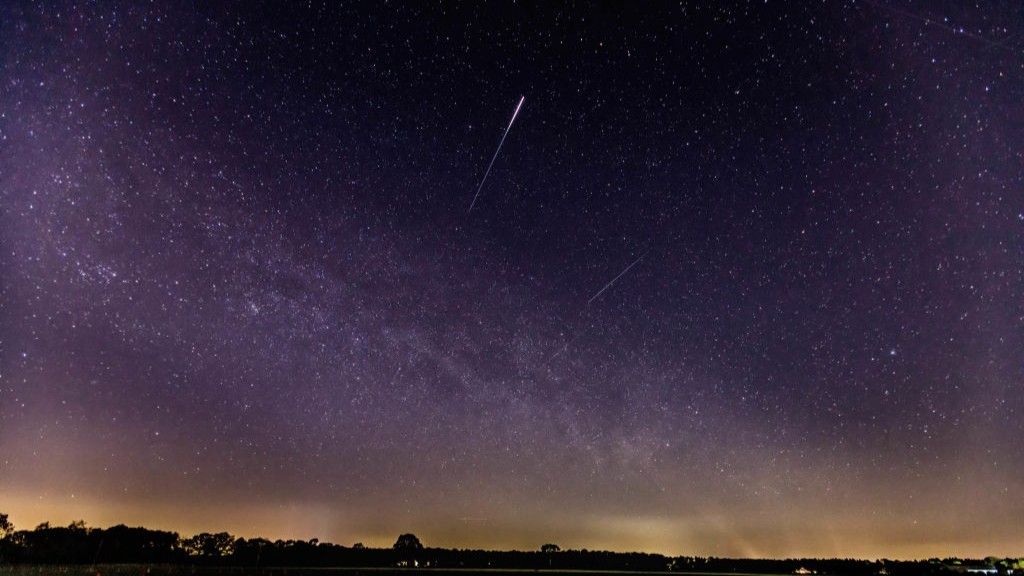
The meteors are called “Lyrids” because their paths, if extended backward, appear to diverge from a spot in the sky about 9 degrees to the lower right of the brilliant bluish-white star Vega, in the constellation of Lyra, the Lyre. To give you a good idea of how far that is, your clenched fist held at arm’s length measures 10 degrees. Within a day on either side of the maximum, about 5 to 10 Lyrids can usually be seen each hour by a single observer under good skies.

Article continues below


You may like

Good viewing circumstances

At the peak, which comes on Wednesday morning, the Lyrid rate is roughly 10 to 20 per hour.

Vega appears to rise from the northeast around 9 p.m. local daylight time, but by 4 a.m., it has climbed to a point in the sky nearly overhead. By that time, you might want to lie down on a long lounge chair where you can get a good view of the sky. Bundle up too, for while it probably won’t be as cold as on a winter’s night, nights (and especially early mornings) in April can still be quite chilly.

Finally, while the moon will arrive at first quarter phase on April 23, it will have set by 1:15 a.m. on Wednesday, leaving the sky dark and moonless for at least 3 and a quarter hours before the first light of dawn, providing a good backdrop for viewing this faithful meteor display.
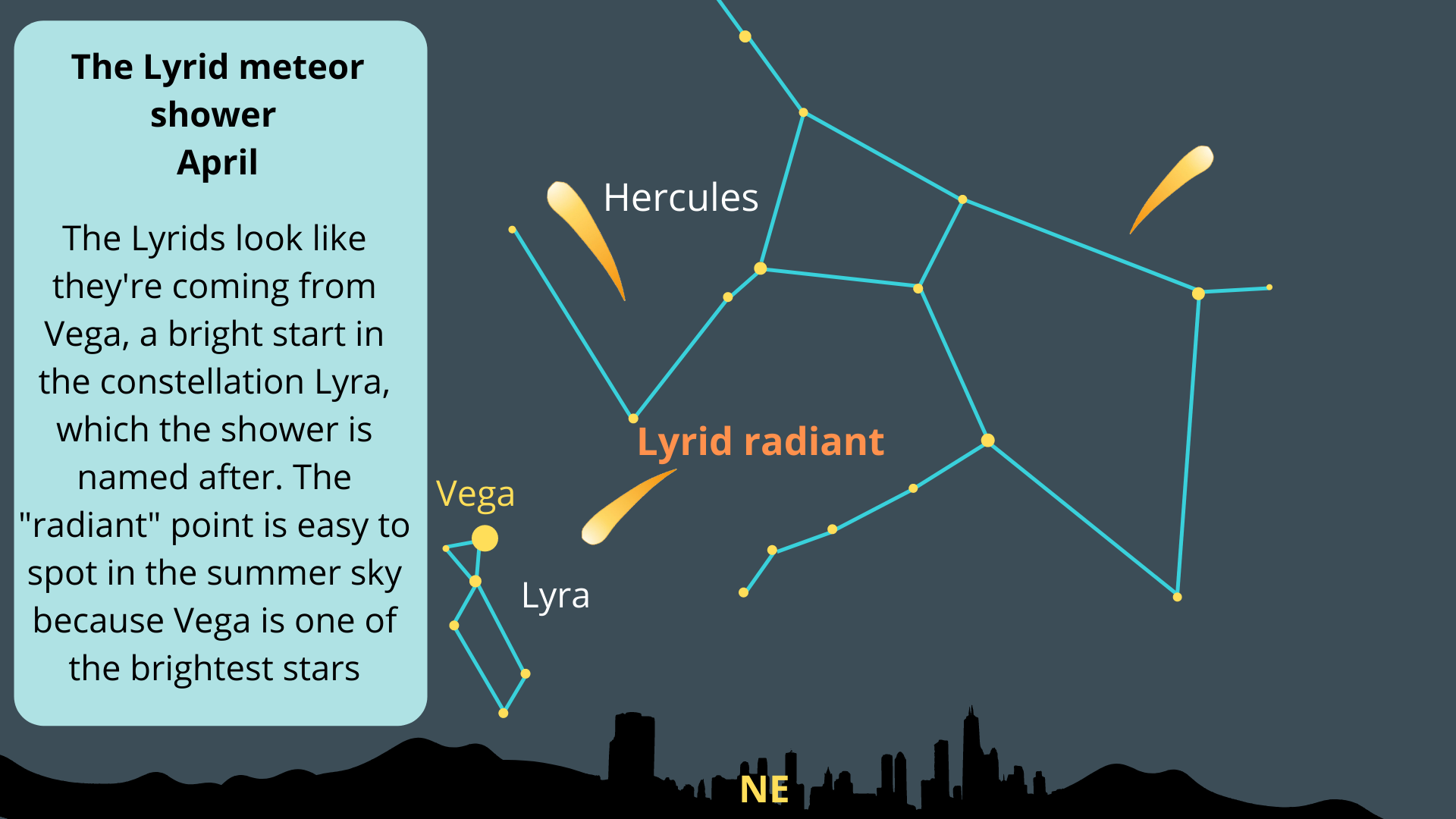
Graphic showing the Lyrid radiant and meteors appearing to originate there.

The radiant of the Lyrid meteor shower is located near the Hercules-Lyra border. (Image credit: Future)

Crumbs from Comet Thatcher

While hardly a rich display like the famous August Perseids or December Geminids, the April Lyrids are brilliant and appear to move fairly fast, appearing to streak through our atmosphere at 30 miles (48 km) per second. About 20-25% leave persistent trains. Their orbit strongly resembles that of C/1861 G1 (Thatcher), a comet which appeared in 1861 and has an orbital period of about 415 years; it’s due to return sometime around the year 2276. The Earth’s orbit nearly coincides with Comet Thatcher around April 22 each year. When we pass that part of our orbit, we ram through the dusty debris left behind by the comet.

Breaking space news, the latest updates on rocket launches, skywatching events and more!

Thus, the Lyrids are this comet’s legacy: they represent the tiny bits and pieces shed by this comet on previous visits to the sun. None of us, of course, has any chance of seeing this comet’s return engagement with the sun, but we will certainly be able to enjoy the sight of tiny bits and pieces that broke off its nucleus hundreds or thousands of years ago, blaze through our atmosphere in a fiery flash to create the effect of a “shooting star.”

An ancient meteor shower
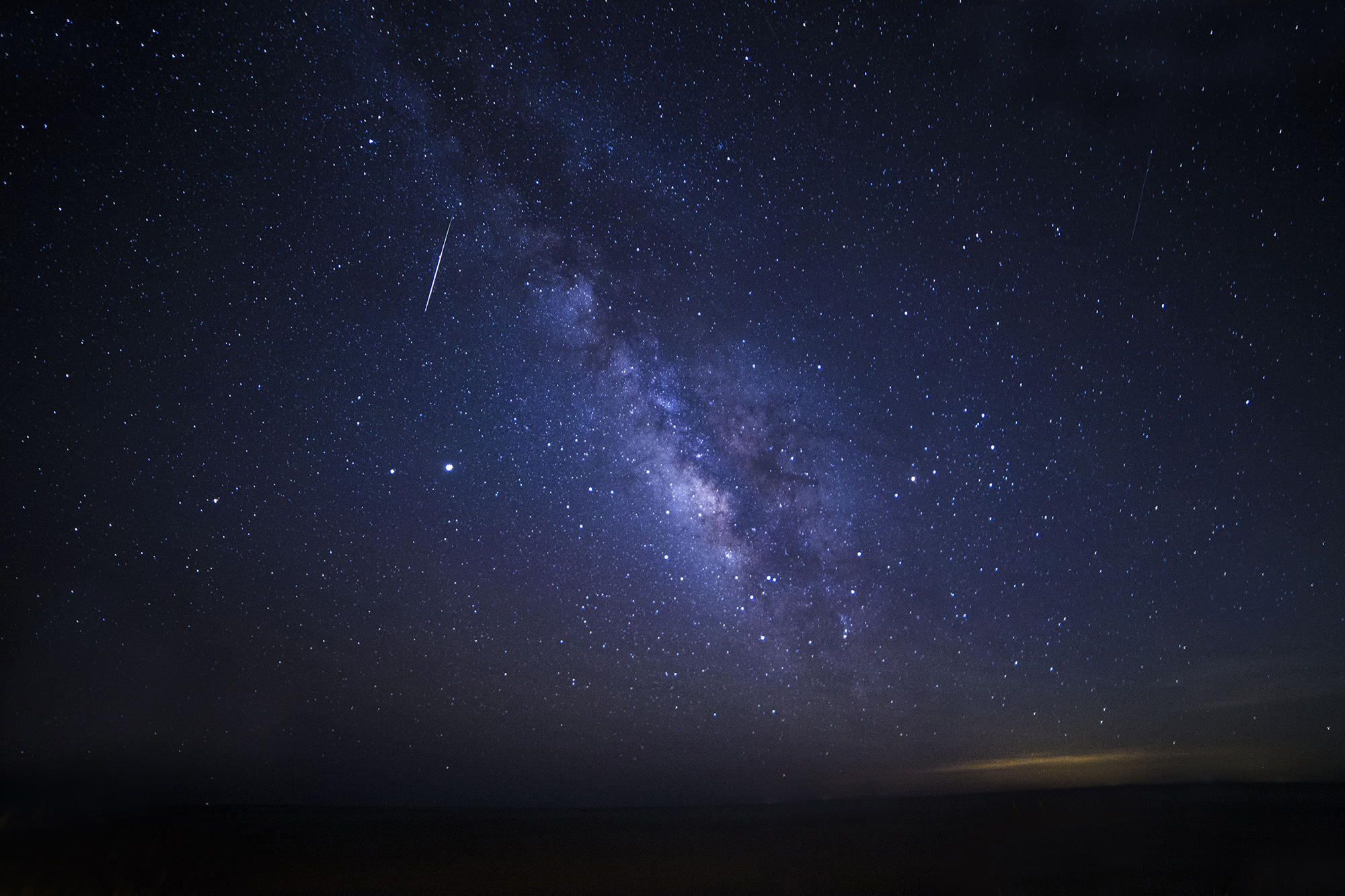
milky way streaks across the center of the image and a meteor in the top left corner leaves a long white trail in the sky.

A Lyrid meteor crosses the Milky Way galaxy in this photo taken by Tina Pappas Lee on Fripp Island, South Carolina. The photo was taken at approximately 4:45 a.m. local time on April 22, 2020. (Image credit: Courtesy of Tina Pappas Lee)

The Lyrid meteor shower has been observed for more than 2,600 years; Chinese records say “stars fell like rain” in the shower of 687 B.C. Quite spectacular displays have also been witnessed at least a dozen times since. On April 20, 1803, residents of Richmond, Virginia, after being roused out of bed by a fire bell, were surprised to see great numbers of meteors in all parts of the sky.

In 1922, an unexpected Lyrid rate of 96 per hour was recorded, and in 1982 rates unexpectedly reached 80 per hour, so although it is usually a weak display, the Lyrids have had a history to surprise observers, so it’s always one to watch.

<em>Joe Rao serves as an instructor and guest lecturer at New York’s Hayden Planetarium. He writes about astronomy for Natural History magazine, Sky and Telescope, The Old Farmer’s Almanac and other publications.

Tags: rocket launch
No Result
View All Result

Recent Posts

  • Watch SpaceX launch advanced GPS satellite for US Space Force early on April 20
  • Blue Origin just launched the giant Bluebird 7 mobile phone satellite into space — but it’s in the wrong orbit
  • ‘Sunshine’ was 2007’s answer to ‘Project Hail Mary’, and it told a much darker tale of solar catastrophe
  • The Lyrid meteor shower returns with ideal viewing conditions! Here’s what to look out for this week
  • Telescope livestream: Watch the moon pass in front of the Pleiades on April 19

Categories

  • Excursions
  • Kepler Mission
  • NASA
  • NASA Breaking News
  • Physical Preparation
  • Preparation
  • Space News
  • Space Station News
  • Spacewalks
  • Tours
  • Uncategorized
  • Weightlessness Training
  • What Not to Pack
  • What to Pack

Meta

  • Log in
  • Entries feed
  • Comments feed
  • WordPress.org
  • Home
  • Start Here
  • Preparing for Your Trip
  • Space Tourism Companies
  • Space Tours
  • Contact

© 2026 JNews - Premium WordPress news & magazine theme by Jegtheme.

No Result
View All Result
  • About
  • Contact
  • Feeds
  • Frequently Asked Questions
  • Preparing for Your Trip
    • Insurance and Legal Waivers
    • Physical and Medical Requirements
    • Training Programs
    • What to Expect
  • Privacy Policy
  • Space Tourism Companies
    • Axiom Space
    • Blue Origin
    • Blue Origin vs Virgin Galactic
    • Comparison Chart: Features, Pricing, Booking
    • SpaceX
    • Virgin Galactic
    • World View (stratospheric balloon flights)
  • Space Tours
    • Custom & Luxury Packages
    • Duration, Training, Costs
    • Experiences
    • Future Moon/Mars Options
    • Orbital Flights
    • Parabolic Flight Experiences
    • Private Missions
    • Stratospheric Balloon Flights
    • Suborbital Flights
    • Zero-Gravity Flights
  • Spaceflight Technologies
    • Space Tourism Balloon
  • Start Here
    • How to Book a Space Tour
    • Intro to Commercial Spaceflight
    • Is Space Tourism Safe?
    • Space Travel FAQs
    • View Earth from the Edge
    • What to Pack
  • Tours in Space is your launchpad to the world of space tourism

© 2026 JNews - Premium WordPress news & magazine theme by Jegtheme.