• Home
  • About
  • FAQ
  • Feeds
  • Glossary
  • Contact
Tours In Space
  • Home
  • Start Here
    • Intro to Commercial Spaceflight
    • How to Book a Space Tour
    • Is Space Tourism Safe?
    • Space Travel FAQs
    • View Earth from the Edge
    • What to Pack
  • Preparing for Your Trip
    • Insurance and Legal Waivers
    • Physical and Medical Requirements
    • Training Programs
    • What to Expect
  • Space Tourism Companies
    • Axiom Space
    • Blue Origin
    • SpaceX
    • Virgin Galactic
    • World View (stratospheric balloon flights)
    • Blue Origin vs Virgin Galactic
    • Comparison Chart: Features, Pricing, Booking
  • Space Tours
    • Custom & Luxury Packages
    • Duration, Training, Costs
    • Experiences
    • Future Moon/Mars Options
    • Orbital Flights
    • Parabolic Flight Experiences
    • Private Missions
    • Stratospheric Balloon Flights
    • Suborbital Flights
    • Zero-Gravity Flights
  • Spaceflight Technologies
    • Space Tourism Balloon
No Result
View All Result
  • Home
  • Start Here
    • Intro to Commercial Spaceflight
    • How to Book a Space Tour
    • Is Space Tourism Safe?
    • Space Travel FAQs
    • View Earth from the Edge
    • What to Pack
  • Preparing for Your Trip
    • Insurance and Legal Waivers
    • Physical and Medical Requirements
    • Training Programs
    • What to Expect
  • Space Tourism Companies
    • Axiom Space
    • Blue Origin
    • SpaceX
    • Virgin Galactic
    • World View (stratospheric balloon flights)
    • Blue Origin vs Virgin Galactic
    • Comparison Chart: Features, Pricing, Booking
  • Space Tours
    • Custom & Luxury Packages
    • Duration, Training, Costs
    • Experiences
    • Future Moon/Mars Options
    • Orbital Flights
    • Parabolic Flight Experiences
    • Private Missions
    • Stratospheric Balloon Flights
    • Suborbital Flights
    • Zero-Gravity Flights
  • Spaceflight Technologies
    • Space Tourism Balloon
No Result
View All Result
Tours In Space
No Result
View All Result
Home Space News

Synthetic universe allows you to ‘see and hear’ galaxies evolving from the dawn of time (video)

Ensign by Ensign
April 19, 2026
in Space News
0
Synthetic universe allows you to ‘see and hear’ galaxies evolving from the dawn of time (video)
189
SHARES
1.5k
VIEWS
Share on FacebookShare on Twitter

Ever dreamt of being present during the birth of the first galaxies? Perhaps being able to fast-forward through billions of years of cosmic evolution to watch those galaxies grow and shape the universe we know today? Of course, that sadly isn’t possible. But thanks to a revolutionary new and unique audiovisual simulation of “virtual universes,” scientists have developed the best picture of cosmic evolution to date, and you too can see and hear it!
The COLIBRE virtual universes use the standard model of cosmology to model the dynamics of cold galactic dust and gas, which form the building blocks of stars, from the first billion years after the Big Bang to the present day. With more computing power than previously available to other cosmic simulations, COLIBRE developed a synthetic universe that closely resembles observations the James Webb Space Telescope (JWST) has been making of the early cosmos. As such, the research offers validation of the standard model of cosmology, also known as the Lambda Cold Dark Matter (LCDM) model.

And fascinatingly, this synthetic universe is so convincing that even some astronomers are doing double-takes.


You may like

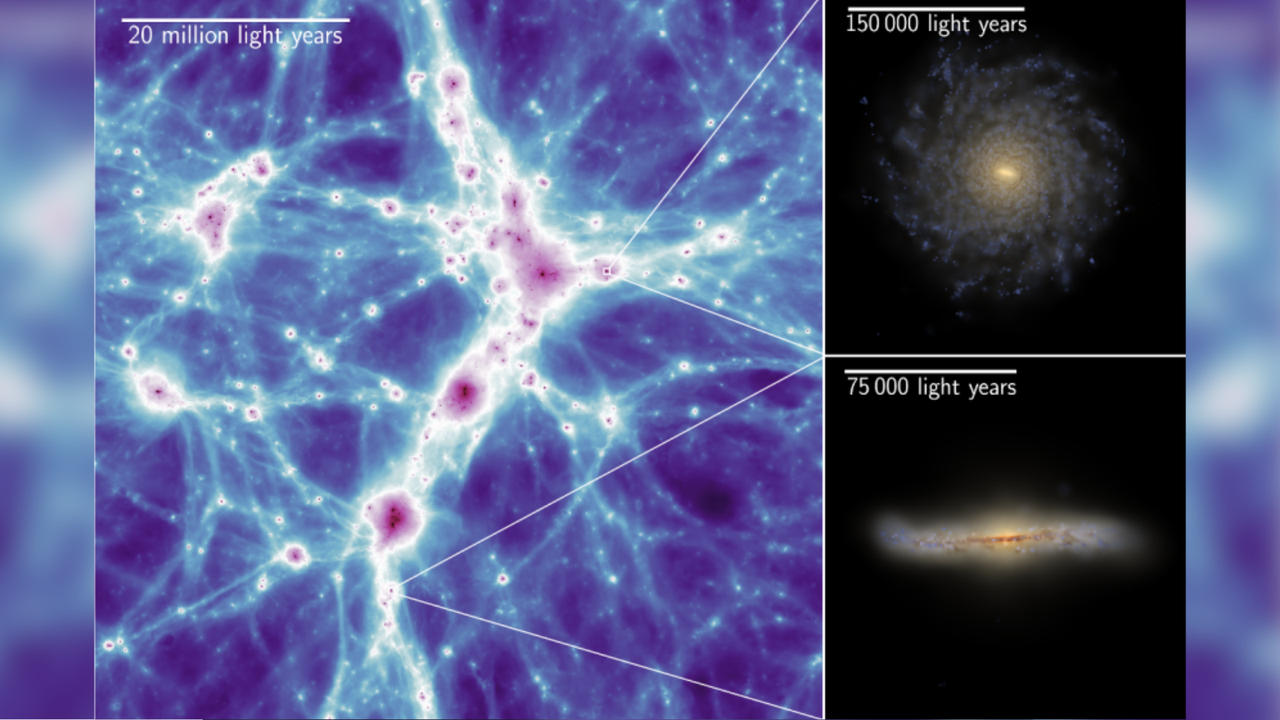
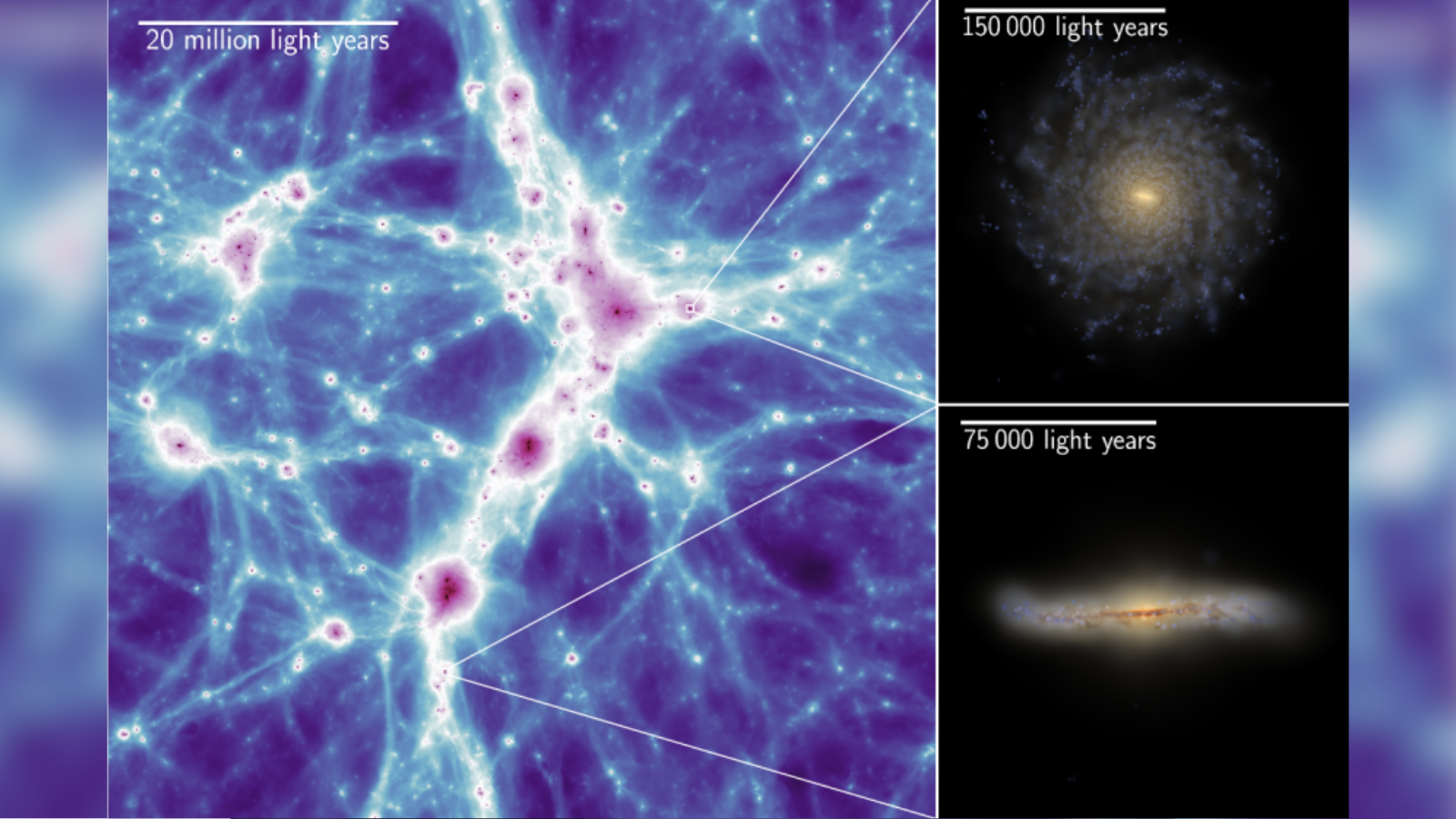
A blue and purple web in the background. Two insets show galaxies. The first one shows a spiral from above and the other one shows a galaxy edge-on. The latter looks more like a line.

(Left) The so-called cosmic web, where the color encodes the projected density of gas and stars. (Right) Two of the many galaxies formed in the simulations seen face-on (top) and edge-on (right). (Image credit: Schaye et al. (2026))

“It is exhilarating to see ‘galaxies’ come out of our computer that look indistinguishable from the real thing and share many of the properties that astronomers measure in real data, such as their number, luminosities, colors and sizes,” COLIBRE team member Carlos Frenk said in a statement. “I like to tease my observer colleagues by asking, ‘Which galaxy catalogue do you think these images came from?’ What is most remarkable is that we are able to produce this synthetic universe purely by solving the relevant equations of physics in the expanding universe.”

The simulation runs on the COSMA8 supercomputer at Durham University, and has overcome a challenge that others have found insurmountable: the modeling of cold gas. But difficulty with such modeling was a problem because stars form when cold gas and dust collapse under their own gravity — to accurately simulate stars, you need to be able to accurately simulate cold gas movements. COLIBRE was also able to simulate small dust grains and their impact in helping form hydrogen molecules and blocking ultraviolet light that would prevent gas from cooling and birthing stars.

“Much of the gas inside real galaxies is cold and dusty, but most previous large simulations had to ignore this,” COLIBRE leader Joop Schaye, of Leiden University in the Netherlands, said in the statement. “With COLIBRE, we finally bring these essential components into the picture.”

Yet, as good as the synthetic universes are, there is still one cosmic puzzle the JWST has unveiled that they can’t answer. Those are the so-called “little red dots” this instrument has been seeing in abundance during one period of cosmic time.

Breaking space news, the latest updates on rocket launches, skywatching events and more!

That could be because these enigmatic objects – which appear in vast numbers 600 million years after the Big Bang but disappear after the universe is around 1.5 billion years old — are heavy black hole seeds.

Though most of the simulations were completed in 2025, some are still running, and the data they have already delivered will take years to analyze.

“We’re excited not just about the science, but also about creating new ways to explore it,” James Trayford, of the University of Portsmouth, U.K., who led the development of COLIBRE’s dust model and the sonification of its visualizations, said in the statement. “These tools could provide new insights, make our field more accessible, and help us build intuition for how galaxies grow and evolve.”

The COLIBRE research was published on Monday (April 13) in the journal Monthly Notices of the Royal Astronomical Society.

No Result
View All Result

Recent Posts

  • Watch SpaceX launch advanced GPS satellite for US Space Force early on April 20
  • Blue Origin just launched the giant Bluebird 7 mobile phone satellite into space — but it’s in the wrong orbit
  • ‘Sunshine’ was 2007’s answer to ‘Project Hail Mary’, and it told a much darker tale of solar catastrophe
  • The Lyrid meteor shower returns with ideal viewing conditions! Here’s what to look out for this week
  • Telescope livestream: Watch the moon pass in front of the Pleiades on April 19

Categories

  • Excursions
  • Kepler Mission
  • NASA
  • NASA Breaking News
  • Physical Preparation
  • Preparation
  • Space News
  • Space Station News
  • Spacewalks
  • Tours
  • Uncategorized
  • Weightlessness Training
  • What Not to Pack
  • What to Pack

Meta

  • Log in
  • Entries feed
  • Comments feed
  • WordPress.org
  • Home
  • Start Here
  • Preparing for Your Trip
  • Space Tourism Companies
  • Space Tours
  • Contact

© 2026 JNews - Premium WordPress news & magazine theme by Jegtheme.

No Result
View All Result
  • About
  • Contact
  • Feeds
  • Frequently Asked Questions
  • Preparing for Your Trip
    • Insurance and Legal Waivers
    • Physical and Medical Requirements
    • Training Programs
    • What to Expect
  • Privacy Policy
  • Space Tourism Companies
    • Axiom Space
    • Blue Origin
    • Blue Origin vs Virgin Galactic
    • Comparison Chart: Features, Pricing, Booking
    • SpaceX
    • Virgin Galactic
    • World View (stratospheric balloon flights)
  • Space Tours
    • Custom & Luxury Packages
    • Duration, Training, Costs
    • Experiences
    • Future Moon/Mars Options
    • Orbital Flights
    • Parabolic Flight Experiences
    • Private Missions
    • Stratospheric Balloon Flights
    • Suborbital Flights
    • Zero-Gravity Flights
  • Spaceflight Technologies
    • Space Tourism Balloon
  • Start Here
    • How to Book a Space Tour
    • Intro to Commercial Spaceflight
    • Is Space Tourism Safe?
    • Space Travel FAQs
    • View Earth from the Edge
    • What to Pack
  • Tours in Space is your launchpad to the world of space tourism

© 2026 JNews - Premium WordPress news & magazine theme by Jegtheme.