• Home
  • About
  • FAQ
  • Feeds
  • Glossary
  • Contact
Tours In Space
  • Home
  • Start Here
    • Intro to Commercial Spaceflight
    • How to Book a Space Tour
    • Is Space Tourism Safe?
    • Space Travel FAQs
    • View Earth from the Edge
    • What to Pack
  • Preparing for Your Trip
    • Insurance and Legal Waivers
    • Physical and Medical Requirements
    • Training Programs
    • What to Expect
  • Space Tourism Companies
    • Axiom Space
    • Blue Origin
    • SpaceX
    • Virgin Galactic
    • World View (stratospheric balloon flights)
    • Blue Origin vs Virgin Galactic
    • Comparison Chart: Features, Pricing, Booking
  • Space Tours
    • Custom & Luxury Packages
    • Duration, Training, Costs
    • Experiences
    • Future Moon/Mars Options
    • Orbital Flights
    • Parabolic Flight Experiences
    • Private Missions
    • Stratospheric Balloon Flights
    • Suborbital Flights
    • Zero-Gravity Flights
  • Spaceflight Technologies
    • Space Tourism Balloon
No Result
View All Result
  • Home
  • Start Here
    • Intro to Commercial Spaceflight
    • How to Book a Space Tour
    • Is Space Tourism Safe?
    • Space Travel FAQs
    • View Earth from the Edge
    • What to Pack
  • Preparing for Your Trip
    • Insurance and Legal Waivers
    • Physical and Medical Requirements
    • Training Programs
    • What to Expect
  • Space Tourism Companies
    • Axiom Space
    • Blue Origin
    • SpaceX
    • Virgin Galactic
    • World View (stratospheric balloon flights)
    • Blue Origin vs Virgin Galactic
    • Comparison Chart: Features, Pricing, Booking
  • Space Tours
    • Custom & Luxury Packages
    • Duration, Training, Costs
    • Experiences
    • Future Moon/Mars Options
    • Orbital Flights
    • Parabolic Flight Experiences
    • Private Missions
    • Stratospheric Balloon Flights
    • Suborbital Flights
    • Zero-Gravity Flights
  • Spaceflight Technologies
    • Space Tourism Balloon
No Result
View All Result
Tours In Space
No Result
View All Result
Home Space News

Hubble Telescope celebrates 36th anniversary with gorgeous new image of famous Trifid Nebula

Ensign by Ensign
April 24, 2026
in Space News
0
Nebula sparkles in new Hubble snapshot | Space photo of the day for April 23, 2026
190
SHARES
1.5k
VIEWS
Share on FacebookShare on Twitter

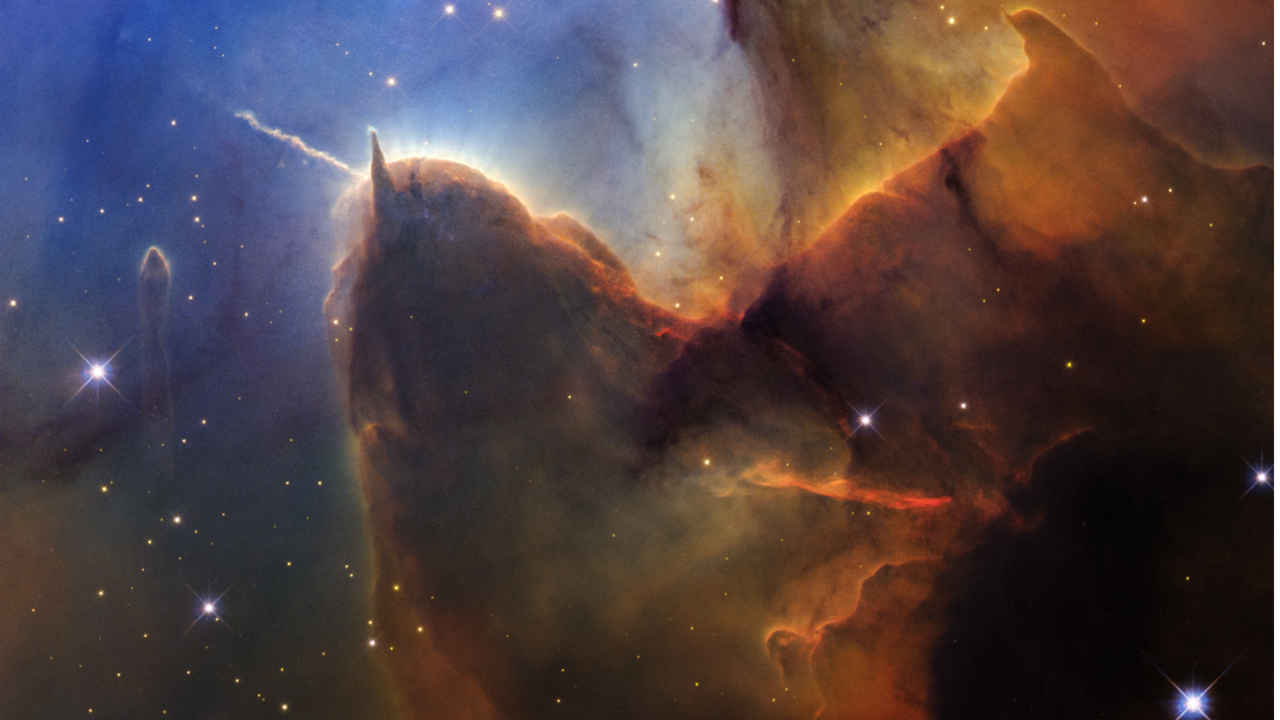
colorful clouds of gas on a starry background

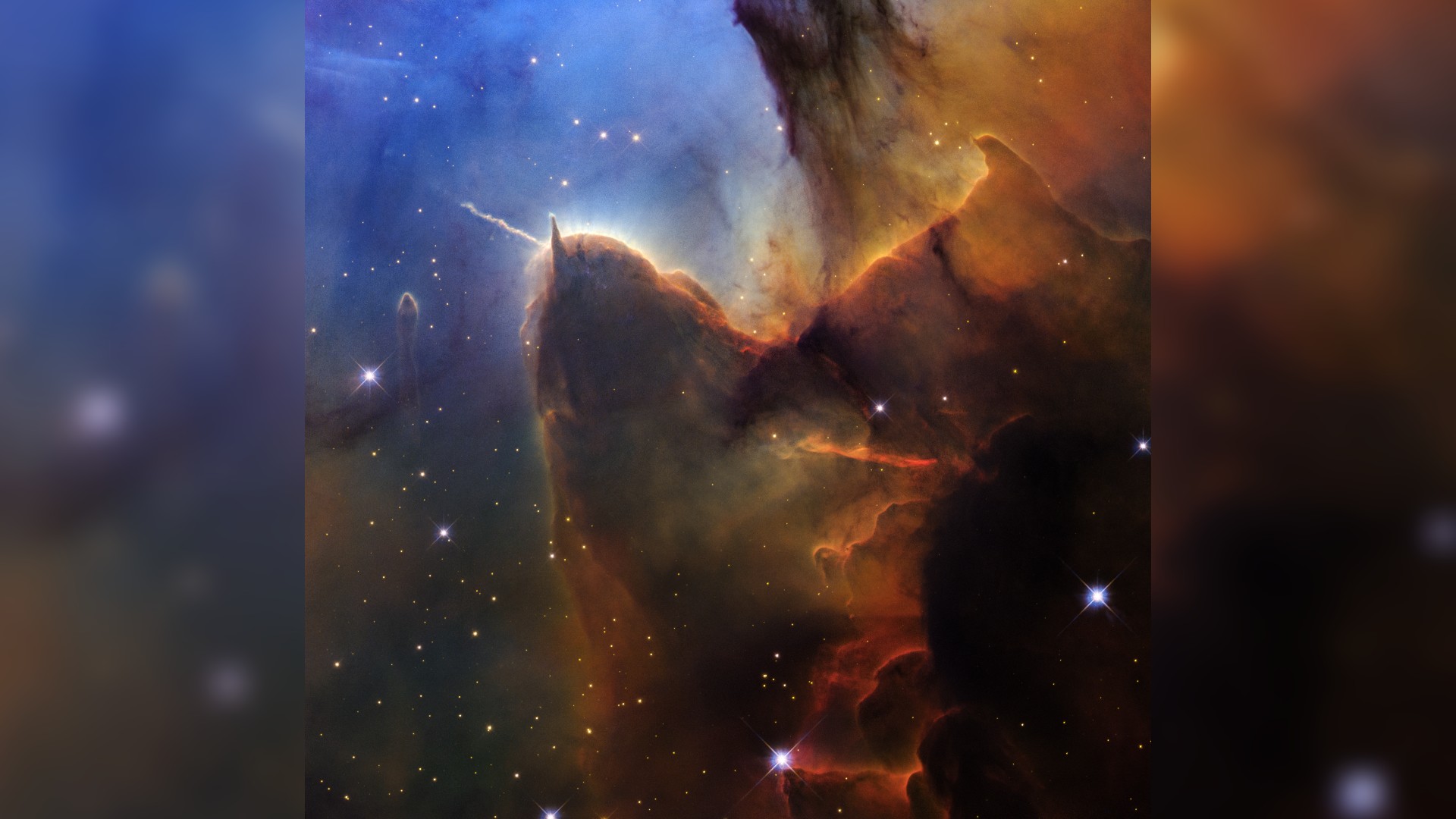
NASA celebrates Hubble’s 36th anniversary with a new image of the Trifid Nebula, a star-forming region it first captured in 1997. (Image credit: NASA, ESA, STScI; Image Processing: Joseph DePasquale (STScI))

The Hubble Space Telescope is celebrating its 36th anniversary in space this week with a glimpse into the heart of a major star-forming region, presented in prismatic color.

The Trifid Nebula (also known as Messier 20) is one of the most famous objects in the night sky, attracting amateur astronomers to its location in the constellation of Sagittarius the Archer, set against myriad stars of the Milky Way. Hubble‘s new view of the Trifid is somewhat different from what skywatchers can see from Earth: the space telescope’s 2.4-meter (8-foot) mirror is able to see much closer and in far more detail than any telescope on the ground is capable of achieving.

Hubble’s anniversary image presents what is just a small section of the Trifid, at the end of one of the four large dust lanes that extend from the central region of the nebula. Towering columns and sweeping walls of gas and dust dominate the scene. The center point is perhaps what looks like a gigantic mountain with two ‘spikes’ protruding from its peak, like the antennae on an insect. Yet despite their appearances, these spikes are two completely different phenomena.


You may like

The spike pointing straight up is a pillar of denser gas and dust that has not yet been eroded by the barrage of ultraviolet light and powerful particle winds from nearby newborn massive stars that are just beyond the edges of this image. At the tip of the pillar, we can see a star that has formed. Although it is still embedded in the nebula and not clearly visible, we can see what looks a little like the tip of a fingernail around it. This, it seems, is a circumstellar disk that one day will form planets.

The other spike pointing towards the left is very different, with a more cloudy and uneven appearance than the thick pillar. This spike is a Herbig–Haro object (HH 399, specifically) — a jet of material launched by a growing protostar accreting too much matter and ejecting the excess along its rotational axis. The jet bursts out through the clouds of the nebula and extends light-years into space.

Between Hubble’s first image of the Trifid taken in 1997 and this new image, astronomers have been able to measure the speed of the jet and see how its size and structure have changed during the intervening 29 years. From this information, they aim to learn in greater detail how young stars interact with their environment, which potentially can impact upon how those young stars mature.
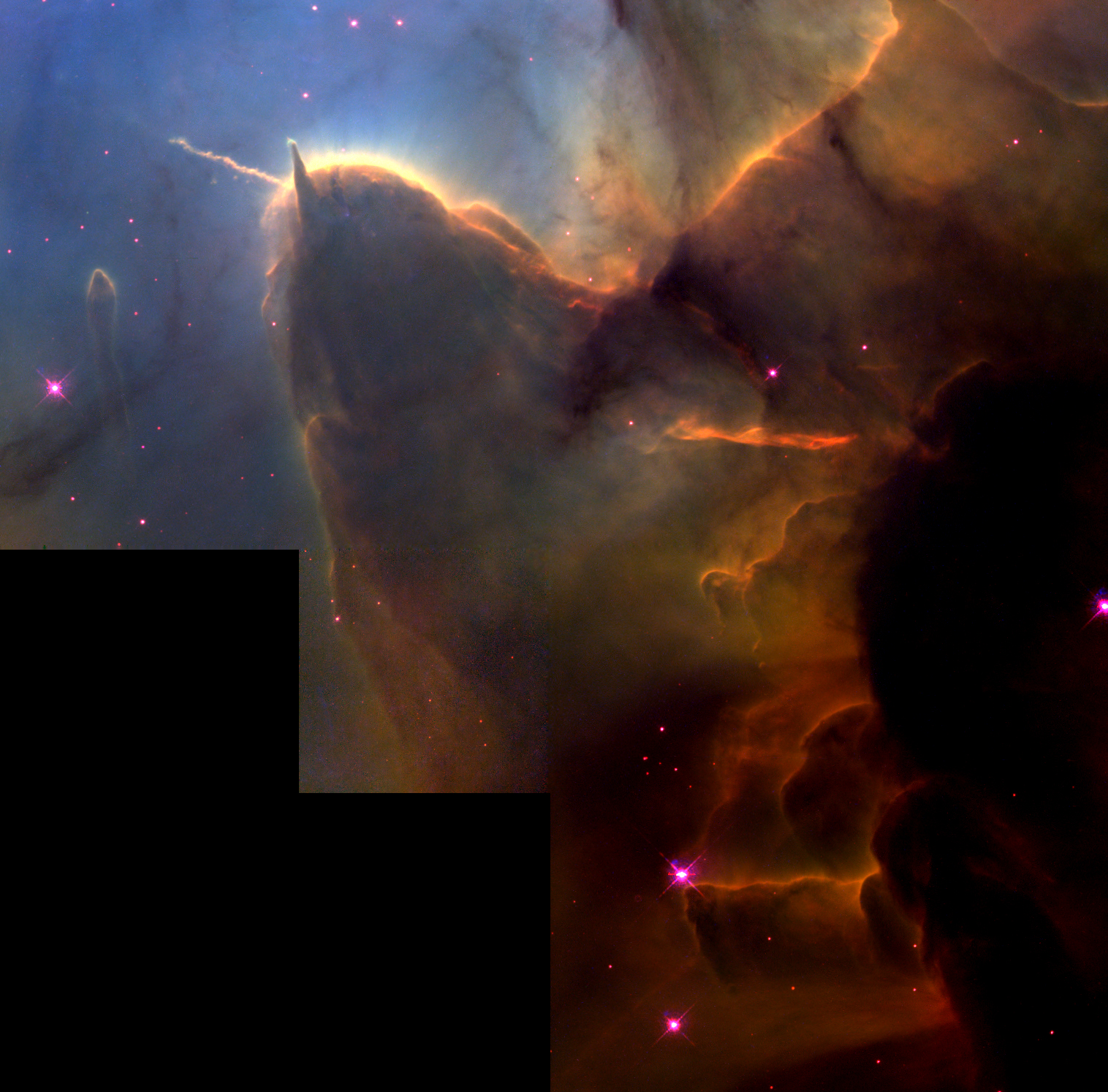
a reddish-orange cloud of dust on a starry black-and-blue background

A Hubble Space Telescope image of the Trifid Nebula taken in 1997. (Image credit: NASA and Jeff Hester (Arizona State University))

To the left of the ‘space slug’ we can see a lone tendril of gas separated from the rest. This tadpole-like object is a clump of denser nebulosity that hasn’t been completely photo-dissociated by the Trifid’s radiation field yet.

Breaking space news, the latest updates on rocket launches, skywatching events and more!

Meanwhile, the top left and bottom right corners of the new Hubble image are in stark contrast to one another. You might at first think that it is the bottom right corner that is the clearest region in the image, because it is black.

However, the black that you see is not space — it has barely any stars. Instead it is a supremely dense patch of dusty gas that may be forming stars from within, but from without still appears impenetrable.

It’s actually the top left corner that is clearest. The pretty blue hue is produced by ionized gas as ultraviolet light begins to clear away the nebula. We can see this process in action  — the yellow glow around the head of the slug looks like the nebula is fraying, and this is where the denser gas is being eroded by the radiation. Indeed, in star-forming regions such as the Trifid, the radiation sculpts the nebulosity in a way that is somewhat analogous to how wind sculpts rocks in the desert.
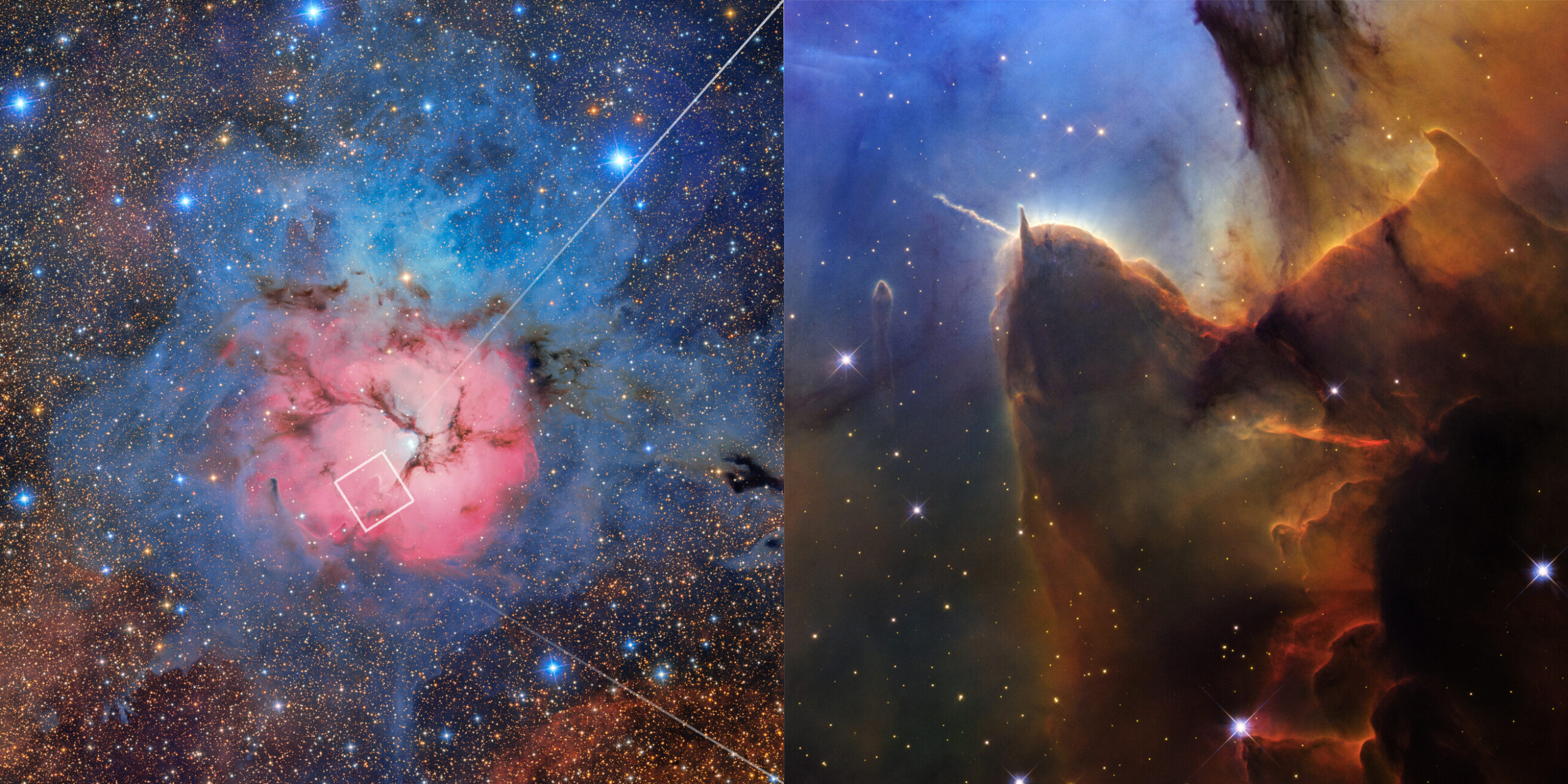
two images of clouds of colorful gases on starry backgrounds

A composite view of the Trifid Nebula captured by the NSF-DOE Vera C. Rubin Observatory in Chile. The white box in the left image, captured by Rubin, shows the area the NASA/ESA Hubble Space Telescope targeted, featured on the right. Rubin’s field of view stretches approximately 56 light-years across, while Hubble’s takes up about four light-years. (Image credit: NASA, ESA, STScI. Image processing: J. DePasquale (STScI))

The name of the Trifid, which is over 4,000 light-years away, refers to an object that has three lobes. The nebula was given this name by the nineteenth century British astronomer John Herschel, who saw three lobes divided by dust lanes through his telescope. In actuality, the nebula has four lobes  — Herschel’s telescope was unable to resolve the fourth dust lane.

This latest image from Hubble forms just one of more than 1.7 million observations that the space telescope has made over the past 36 years since it launched on April 24, 1990. Those observations have spawned about 23,000 research papers written by nearly 29,000 astronomers in total worldwide, and about 1,100 of those papers were written in 2025 alone.

Hubble may be getting old, but it is far too soon to be talking about its legacy  — it is still accomplishing an extraordinary amount of work in the here and now.

Tags: NASArocket launch
No Result
View All Result

Recent Posts

  • Voyager ‘very optimistic’ about Starlab amid potential NASA changes
  • Ukrainian forces test direct-to-device satellite imagery for frontline troops
  • New NGA head makes industry debut at GEOINT Symposium 2026
  • Startup develops software to help military tap commercial imaging satellites
  • Loft Orbital expands into full-service constellation deals

Categories

  • Excursions
  • Kepler Mission
  • NASA
  • NASA Breaking News
  • Physical Preparation
  • Preparation
  • Space News
  • Space Station News
  • Spacewalks
  • Tours
  • Uncategorized
  • Weightlessness Training
  • What Not to Pack
  • What to Pack

Meta

  • Log in
  • Entries feed
  • Comments feed
  • WordPress.org
  • Home
  • Start Here
  • Preparing for Your Trip
  • Space Tourism Companies
  • Space Tours
  • Contact

© 2026 JNews - Premium WordPress news & magazine theme by Jegtheme.

No Result
View All Result
  • About
  • Contact
  • Feeds
  • Frequently Asked Questions
  • Preparing for Your Trip
    • Insurance and Legal Waivers
    • Physical and Medical Requirements
    • Training Programs
    • What to Expect
  • Privacy Policy
  • Space Tourism Companies
    • Axiom Space
    • Blue Origin
    • Blue Origin vs Virgin Galactic
    • Comparison Chart: Features, Pricing, Booking
    • SpaceX
    • Virgin Galactic
    • World View (stratospheric balloon flights)
  • Space Tours
    • Custom & Luxury Packages
    • Duration, Training, Costs
    • Experiences
    • Future Moon/Mars Options
    • Orbital Flights
    • Parabolic Flight Experiences
    • Private Missions
    • Stratospheric Balloon Flights
    • Suborbital Flights
    • Zero-Gravity Flights
  • Spaceflight Technologies
    • Space Tourism Balloon
  • Start Here
    • How to Book a Space Tour
    • Intro to Commercial Spaceflight
    • Is Space Tourism Safe?
    • Space Travel FAQs
    • View Earth from the Edge
    • What to Pack
  • Tours in Space is your launchpad to the world of space tourism

© 2026 JNews - Premium WordPress news & magazine theme by Jegtheme.