• Home
  • About
  • FAQ
  • Feeds
  • Glossary
  • Contact
Tours In Space
  • Home
  • Start Here
    • Intro to Commercial Spaceflight
    • How to Book a Space Tour
    • Is Space Tourism Safe?
    • Space Travel FAQs
    • View Earth from the Edge
    • What to Pack
  • Preparing for Your Trip
    • Insurance and Legal Waivers
    • Physical and Medical Requirements
    • Training Programs
    • What to Expect
  • Space Tourism Companies
    • Axiom Space
    • Blue Origin
    • SpaceX
    • Virgin Galactic
    • World View (stratospheric balloon flights)
    • Blue Origin vs Virgin Galactic
    • Comparison Chart: Features, Pricing, Booking
  • Space Tours
    • Custom & Luxury Packages
    • Duration, Training, Costs
    • Experiences
    • Future Moon/Mars Options
    • Orbital Flights
    • Parabolic Flight Experiences
    • Private Missions
    • Stratospheric Balloon Flights
    • Suborbital Flights
    • Zero-Gravity Flights
  • Spaceflight Technologies
    • Space Tourism Balloon
No Result
View All Result
  • Home
  • Start Here
    • Intro to Commercial Spaceflight
    • How to Book a Space Tour
    • Is Space Tourism Safe?
    • Space Travel FAQs
    • View Earth from the Edge
    • What to Pack
  • Preparing for Your Trip
    • Insurance and Legal Waivers
    • Physical and Medical Requirements
    • Training Programs
    • What to Expect
  • Space Tourism Companies
    • Axiom Space
    • Blue Origin
    • SpaceX
    • Virgin Galactic
    • World View (stratospheric balloon flights)
    • Blue Origin vs Virgin Galactic
    • Comparison Chart: Features, Pricing, Booking
  • Space Tours
    • Custom & Luxury Packages
    • Duration, Training, Costs
    • Experiences
    • Future Moon/Mars Options
    • Orbital Flights
    • Parabolic Flight Experiences
    • Private Missions
    • Stratospheric Balloon Flights
    • Suborbital Flights
    • Zero-Gravity Flights
  • Spaceflight Technologies
    • Space Tourism Balloon
No Result
View All Result
Tours In Space
No Result
View All Result
Home Space News

Famous asteroid Ryugu may have been bombarded by a swarm of tiny space rocks 1,000 years ago

Ensign by Ensign
April 27, 2026
in Space News
0
Famous asteroid Ryugu may have been bombarded by a swarm of tiny space rocks 1,000 years ago
189
SHARES
1.5k
VIEWS
Share on FacebookShare on Twitter

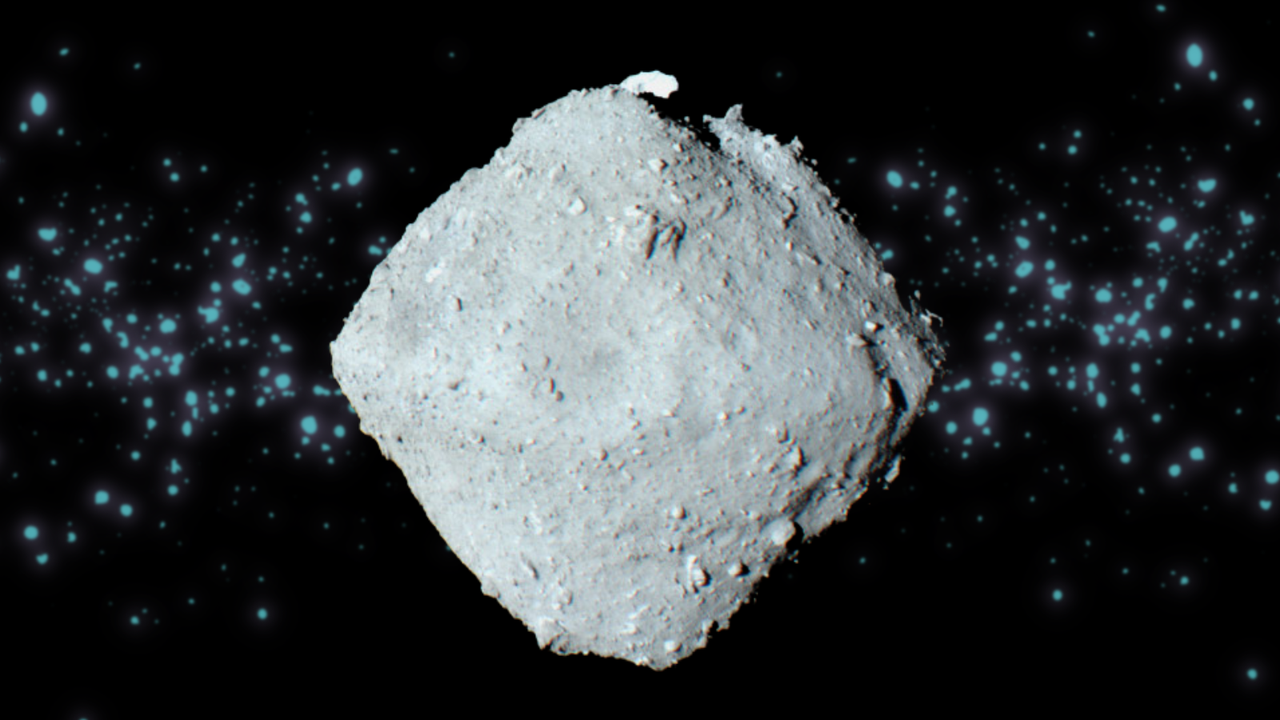
In 2020, Japan’s Hayabusa2 spacecraft brought samples of an asteroid named Ryugu to Earth — and now, scientists examining those samples found that the object bears the scars of a recent encounter with tiny space rocks.

The reason the research team believes Ryugu was bombarded by micrometeorites is due to a fine layer of sodium, just 10 nanometers thick, on the surface of the asteroid‘s fragments. This kind of build-up is unusual because volatile elements like sodium, which can get exposed after an object is blasted with micrometeorites, are usually later depleted by solar winds blowing from the sun and the general influence of space.

Based on the volume of sodium observed by the researchers, they estimate that Ryugu’s passage through a dense cloud of micrometeorites must have occurred around 1,000 years ago. That’s an extremely recent event considering the asteroid formed 4.6 billion years ago, while planets like Earth were still taking shape around our infant sun.


You may like

“Over the past thousand years, the asteroid has passed through a particularly intense swarm that has profoundly altered the chemical properties of its surface. We were able to detect these changes by analyzing two millimeter-thin fragments of Ryugu, using techniques capable of studying the morphology and chemistry of layers just a few billionths of a meter thick,” lead researcher Ernesto Palomba of the Italian National Institute for Astrophysics (INAF) said in a statement translated from Italian. “In this context, finding an accumulation of sodium on particles collected on the surface and exposed to external agents is a puzzle we needed to solve.”

“Experiments show sodium depletion of up to 50% over very rapid timescales, on the order of a few hundred years,” Palomba added. “Based on these data, we considered a maximum time window of a thousand years, beyond which the sodium should have been completely released, making it impossible to observe any accumulation.”
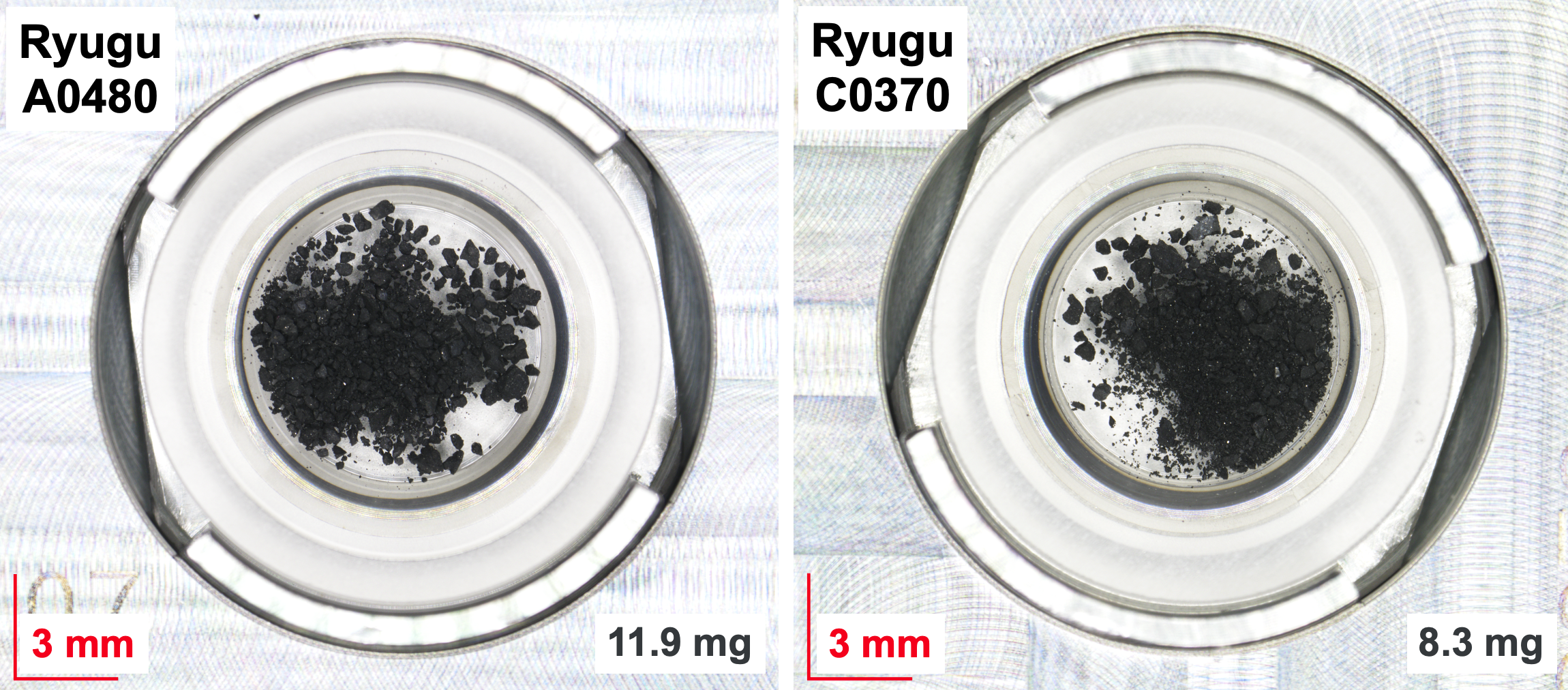
Two views of a container (from above) where it looks like tiny black specks are in a glass bottle.

Samples of asteroid Ryugu brought back to Earth. (Image credit: JAXA/JAMSTEC)

The team also discovered evidence of micrometorite impacts in the form of glassy formations, or tiny impact craters, and lattice-like microstructures created by interactions with the solar wind.

“The iron enrichment found in the particle collected on the surface can be traced back to interaction with the solar wind and continuous microimpacts,” Palomba said. “This trend, already observed in previous studies, confirms once again that the exposed particle has undergone a more marked alteration than the one that remained protected underground.”

Breaking space news, the latest updates on rocket launches, skywatching events and more!

The team’s findings demonstrate how near-Earth asteroids close to our planet encounter swarms of meteoroids that are capable of altering their surface properties.

“This, in a sense, is what happens to our planet: in the case of Earth, the atmosphere protects us and allows encounters with these swarms to become a beautiful spectacle that periodically lights up our sky, as in the case of the Perseids or the Geminids,” Palomba said. “For bodies without an atmosphere like the asteroid Ryugu, however, the outcome is different.”

The INAF researcher said the team’s next goal will be to conduct specific experiments on chemicals present on the asteroid Ryugu, to reproduce observations of the asteroid’s surface chemistry.

The team’s research was published on April 16 in the journal The Astrophysical Journal Letters.

Tags: rocket launch
No Result
View All Result

Recent Posts

  • Voyager ‘very optimistic’ about Starlab amid potential NASA changes
  • Ukrainian forces test direct-to-device satellite imagery for frontline troops
  • New NGA head makes industry debut at GEOINT Symposium 2026
  • Startup develops software to help military tap commercial imaging satellites
  • Loft Orbital expands into full-service constellation deals

Categories

  • Excursions
  • Kepler Mission
  • NASA
  • NASA Breaking News
  • Physical Preparation
  • Preparation
  • Space News
  • Space Station News
  • Spacewalks
  • Tours
  • Uncategorized
  • Weightlessness Training
  • What Not to Pack
  • What to Pack

Meta

  • Log in
  • Entries feed
  • Comments feed
  • WordPress.org
  • Home
  • Start Here
  • Preparing for Your Trip
  • Space Tourism Companies
  • Space Tours
  • Contact

© 2026 JNews - Premium WordPress news & magazine theme by Jegtheme.

No Result
View All Result
  • About
  • Contact
  • Feeds
  • Frequently Asked Questions
  • Preparing for Your Trip
    • Insurance and Legal Waivers
    • Physical and Medical Requirements
    • Training Programs
    • What to Expect
  • Privacy Policy
  • Space Tourism Companies
    • Axiom Space
    • Blue Origin
    • Blue Origin vs Virgin Galactic
    • Comparison Chart: Features, Pricing, Booking
    • SpaceX
    • Virgin Galactic
    • World View (stratospheric balloon flights)
  • Space Tours
    • Custom & Luxury Packages
    • Duration, Training, Costs
    • Experiences
    • Future Moon/Mars Options
    • Orbital Flights
    • Parabolic Flight Experiences
    • Private Missions
    • Stratospheric Balloon Flights
    • Suborbital Flights
    • Zero-Gravity Flights
  • Spaceflight Technologies
    • Space Tourism Balloon
  • Start Here
    • How to Book a Space Tour
    • Intro to Commercial Spaceflight
    • Is Space Tourism Safe?
    • Space Travel FAQs
    • View Earth from the Edge
    • What to Pack
  • Tours in Space is your launchpad to the world of space tourism

© 2026 JNews - Premium WordPress news & magazine theme by Jegtheme.